


Is Pitaya a Super Food? Evidence and Label Decisions
Jul 26, 2019

Pitaya can be a nutritious fruit, but "super food" is not a legal food category or a scientific grade. The expression is a flexible marketing label. It does not prove that pitaya is better than every other fruit, that one serving changes a health outcome, or that every product containing pitaya has the same nutritional value.
A sound evaluation starts with narrower questions. Which pitaya type and product form are being sold? What is in the ingredient list? What does a defined serving provide? Is the evidence a composition analysis, a laboratory experiment, an animal study, or a controlled human trial? Does the final wording meet the destination market's rules? Those questions turn a broad promotional idea into facts that you can verify.
Plain fresh flesh and unsweetened frozen pieces can fit a varied diet as fruit. Pitaya contributes water, carbohydrate, dietary fiber, seeds, micronutrients, and plant pigments, with actual amounts varying by species, cultivar, maturity, processing, and test method. That ordinary food value is useful. It does not support claims that pitaya prevents cancer or stroke, removes heavy metals, whitens skin, protects the liver, treats stomach disease, or prevents anemia.
The short answer: Pitaya is fruit, not a special scientific class. Judge it by the actual serving, nutrition data, ingredient list, evidence quality, and finished-product use. Specific statements such as a permitted fiber claim are more meaningful than a broad halo word.

What Does the "Super Food" Label Actually Mean?
Harvard T.H. Chan School of Public Health describes the expression as a marketing term rather than a scientifically based definition. There is no scoring system under which a fruit passes a universal test and enters a special category. A colorful food, an uncommon origin, a high value for one nutrient, or strong antioxidant activity in a laboratory can all help create the label, yet none supplies a complete judgment about diet or disease.
That distinction matters because broad praise compresses several different propositions. "Contains pitaya" is an ingredient fact. "Provides 15% of the Daily Value for fiber per serving" is a measurable nutrition statement. "Supports normal bowel function" needs careful wording and evidence. "Prevents colorectal cancer" is a disease claim of an entirely different order. Repeating one attractive label can blur all four.
The U.S. food-label framework illustrates why specific language is better. Under 21 CFR 101.54, "good source" generally corresponds to 10–19% of the Reference Daily Intake or Daily Reference Value per reference amount, while "high" generally starts at 20%. These are defined nutrient-content thresholds, not a general excellence award. Other markets use their own rules, serving bases, wording, and conditions, so the claim review must follow the market where the product will be sold.
A regulated threshold still does not prove a clinical outcome. It only tells you that a measured amount meets a defined labeling condition. Pitaya can qualify for a specific statement only when the data for the actual product and declared serving support it. A reputation attached to the fruit name is not a substitute for the calculation.

A Five-Question Test for Any Pitaya Claim
1. What exactly is the food? Record the flesh color or specified type, and separate whole flesh, IQF dice, pulp, puree, juice, concentrate, dried powder, and extract. Pitaya and dragon fruit are common names covering more than one commercial type. The dragon fruit varieties guide explains why red skin alone does not identify flesh color or composition.
2. What is the comparison basis? Per 100 g, per cup, per pouch, and per declared serving are not interchangeable. A dried powder concentrates solids because much of the water has been removed. A smoothie may contain several ingredients, while a retail bag of plain frozen dice may contain only pitaya. Put competing values on the same mass and serving basis before drawing a conclusion.
3. What was actually measured? Use a nutrition declaration, a representative laboratory report, or a documented database entry that matches the product as closely as possible. Published pitaya composition varies across species, geography, maturity, sample preparation, and analytical method. A value from one red-flesh research sample is not automatically the value for every frozen pack.
4. What level of evidence supports the wording? Composition analysis can establish that a compound was detected. A chemical antioxidant assay can describe a reaction under laboratory conditions. Cell and animal work can explore mechanisms. Controlled human trials can test a specific dose, form, duration, and population. These levels answer different questions and should not be blended into one promise.
5. What will the final label or advertisement say? Write the proposed sentence before approving the artwork. Check whether it is an ingredient statement, a nutrient-content claim, a structure/function statement, a health claim, or a disease claim under the relevant rules. FTC guidance also requires objective health-related advertising claims to have appropriate scientific support. A claim can be misleading through implication even when no single word is literally false.

Nutrition Data Are Useful, but They Need a Serving
The strongest everyday case for pitaya is modest. It is a fruit that can add variety, water, carbohydrate, fiber, seeds, and plant compounds to a diet. The evidence-based pitaya benefits guide covers its nutrition and the limits of current human research in detail. Here, the important issue is how those data become-or fail to become-a defensible claim.
Dietary fiber is a useful example because the FDA Daily Value is 28 g and nutrient-content thresholds are explicit. Vitamin C, magnesium, iron, and other nutrients require the same discipline: start with the amount in the actual serving, compare it with the current reference value, and then apply all conditions of use. Saying that a nutrient exists is not the same as saying the food is a good or high source.
Worked example: Suppose a plain frozen pitaya specification reports 3.0 g of dietary fiber per 100 g, and the proposed serving is 140 g. The serving would provide 3.0 × 140 ÷ 100 = 4.2 g fiber. Against the 28 g Daily Value, that is 4.2 ÷ 28 × 100 = 15%. On the numerical threshold alone, 15% falls in the U.S. "good source" range of 10–19%, not the "high" range of 20% or more. This is an illustrative calculation, not a nutrition promise for every XMSD item; the actual product data, reference amount, declared serving, rounding, and all other regulatory conditions still govern the label.
Notice what the result does not say. It does not show that the product causes weight loss, corrects digestive disease, or prevents cancer. It supports only a defined nutrient-content decision within a defined labeling system. A formula using 70 g of the same ingredient would receive 2.1 g fiber from it, while a sweetened blend could change both serving composition and the overall nutrition panel.

Product Form Can Change the Answer
WHO healthy-diet guidance treats unsweetened frozen fruit as a useful option alongside fresh fruit, while advising limits on fruit juice because juice sugars count as free sugars. That does not mean every frozen item is identical to fresh fruit. It means the ingredient list and degree of processing matter more than the temperature label alone.
| Product form | Useful factual description | Marketing trap to avoid |
|---|---|---|
| Fresh flesh or plain frozen pieces | Whole edible pulp and seeds; check serving, flesh type, and actual nutrition data | Assuming all cultivars or packs have one universal composition |
| Pulp or puree | Convenient flow, seed identity, and color distribution; ingredient statement remains decisive | Transferring data from intact fruit without checking processing and recipe |
| Juice or sweetened beverage base | Evaluate juice content, added sugars, dilution, serving size, and the complete nutrition panel | Using fruit imagery to create a whole-fruit health halo |
| Dried powder or extract | Concentrated solids or selected compounds; specify carrier, dose, and test basis | Treating an extract study as proof for ordinary fruit, or vice versa |
Plain IQF dice can be close to prepared fresh flesh in ingredient identity, but thawed texture, drip, separation, and color migration may differ. Puree gives uniform distribution but does not provide a visible piece. Juice changes the food matrix, while sweeteners and other ingredients change the finished formula. Drying raises many nutrients per 100 g simply by removing water; it can also change heat-sensitive compounds and the portion normally consumed.
Read the complete ingredient statement. "Pitaya smoothie" might mean plain blended fruit, a small percentage of puree in apple juice, or a sweetened dairy dessert with pitaya flavor and color. The front-of-pack fruit name cannot answer that question. A full formula has to be assessed as a full formula.
Color and Antioxidant Tests Do Not Prove Clinical Superiority
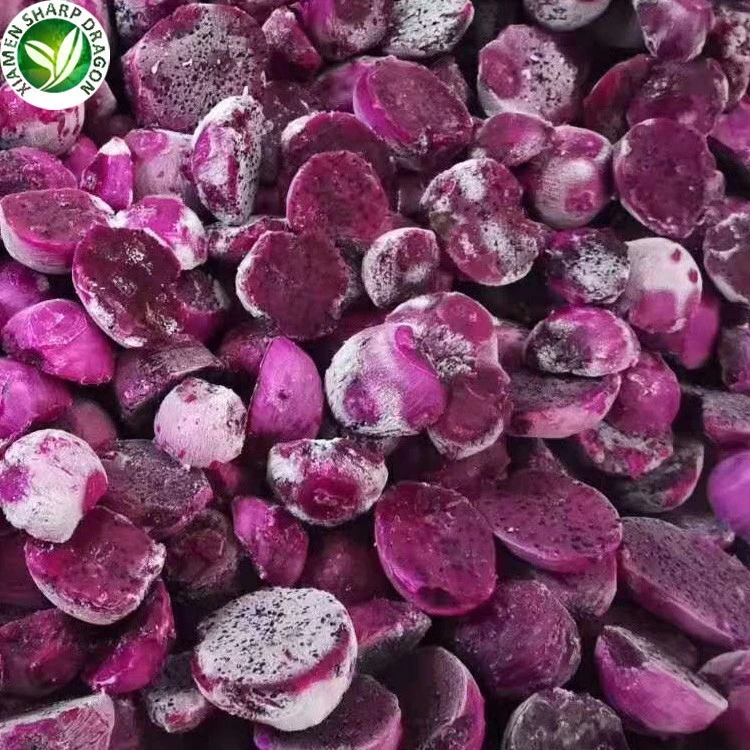
Red and magenta pitaya contain betalain pigments, including betacyanins, while pitaya research also reports phenolic compounds and antioxidant activity. These findings are relevant to food composition and product development. Pigment concentration affects color intensity; pH, heat, oxygen, light, dilution, and storage can affect how the color performs in a beverage, yogurt, sorbet, or bakery filling.
A laboratory antioxidant assay measures a chemical reaction in a defined test. It does not demonstrate that eating the ingredient prevents a heart attack, stroke, cancer, or skin aging. A 2023 review of dragon-fruit research found only five human clinical trials meeting its criteria, all involving red pitaya, while much more of the literature consisted of animal or laboratory studies. A small evidence base may justify more research; it cannot carry sweeping outcome promises.
Human trials also have to match the marketed form. A study of a standardized powder, isolated oligosaccharides, or a prepared beverage does not automatically establish an effect for a handful of fresh cubes. Dose, matrix, duration, comparison group, participant characteristics, and endpoint all matter. If those details are absent from the claim discussion, the evidence has been simplified too far.
Red flesh can still offer a valuable commercial function: vivid natural color. White flesh can offer visible black seeds and a more neutral color in a recipe. Neither color deserves a universal health ranking. Use the dragon fruit color, Brix, and usable-yield guide to connect raw-material measurements with application performance instead of turning pigment into a medical claim.

From a Marketing Story to a Defensible Product Brief
Start with the function that the pitaya must perform. If you need visible pieces in a bowl or yogurt, define flesh color, cut range, piece integrity, seed appearance, and acceptable drip after a controlled thaw. If you need uniform beverage color, define puree or pulp consistency, dosage, target color after processing, and shelf-life checkpoints. The current XMSD frozen dragon fruit range shows several starting forms, but a product photograph does not establish nutrition or finished-formula performance.
Practical example: A yogurt developer wants magenta color throughout the cup plus a visible fruit inclusion. Red pitaya puree may distribute the color more evenly, while frozen dice can provide recognizable pieces. The useful test is a pilot using the planned dose and process: measure color after mixing and storage, record piece breakage, weigh drip after a defined thaw, and run the nutrition calculation on the complete yogurt. Calling red pitaya healthier because it is darker would not answer any of those application questions.
Build the data file around the final claim. For a nutrient statement, keep the applicable specification, sampling basis, test report or defensible data source, calculation, serving basis, rounding method, and destination-market review together. For an ingredient-origin or processing statement, keep traceability and process records. For color or texture language, retain the approved application standard and representative samples. This makes the artwork auditable when the recipe, source, or serving changes.
Packaging also affects whether the approved form arrives usable. Define inner-pack size from your production batch, resealing practice, and thaw plan. Review seal integrity, code legibility, carton strength, pallet stability, and cold-chain exposure. A pack that protects piece separation can be more valuable than a stronger promotional adjective. XMSD's frozen-food packaging overview provides a practical basis for matching the pack to handling conditions.
Separate three approval questions at sample stage. First, confirm identity and food-safety documentation: ingredient statement, lot traceability, required certificates or test records, and the controls relevant to the destination. Second, assess frozen and thawed quality with recorded time, temperature, sample mass, and acceptance limits. Third, test the ingredient in the real process. A pass on one question cannot compensate for a failure on another. Bright color does not establish identity, and an acceptable nutrition panel does not establish piece integrity.
Build change control into the brief as well. A change in flesh type, supplier lot, harvest maturity, puree concentration, carrier, serving size, or recipe percentage can alter the facts behind the artwork. Decide which changes trigger a new application trial, nutrition calculation, laboratory test, or label review. This prevents a valid statement for one formulation from lingering after the product has changed. It also gives procurement, quality, formulation, and regulatory colleagues one traceable evidence set instead of several inconsistent marketing summaries.
Claims to Remove or Rewrite
Remove statements that pitaya prevents cancer or stroke, softens blood vessels, removes heavy metals, protects the liver, cures stomach disorders, whitens skin, removes freckles, or prevents anemia. Finding fiber, vitamin C, iron, pigments, or antioxidant activity does not establish those results. Several claims also turn the normal role of a nutrient into a promised effect from a particular food, without showing the amount delivered or the evidence for the outcome.
Rewrite broad praise as a specific, proportionate fact. "Made with red-flesh pitaya puree" describes identity. "No added sugar" may be considered only when the complete formula and applicable market rules support it. A fiber claim needs the actual serving calculation and regulatory conditions. A statement about natural magenta color should be supported by the product composition and should not imply a disease benefit.
Be equally careful with research language. "Studied for" does not mean "proven to." "Contains antioxidants" does not mean "prevents oxidative disease." "Traditionally used" does not establish effectiveness. If a human trial used a specific extract, dosage, or participant group, do not translate it into a general promise for all pitaya foods.
The better message is often simpler: pitaya is a colorful fruit ingredient available in formats with different sensory and processing functions. Its contribution can be quantified from the complete product and serving. That statement gives you a stable basis for nutrition, formulation, and procurement decisions without asking one fashionable label to carry more meaning than the evidence allows.

XMSD sourcing note: Share the intended product, market, serving, ingredient statement, application, pack, and claim wording. We can review a frozen pitaya form against that brief and identify the specification and sample checks needed for your project.
Final Judgment
Pitaya does not need a special halo to be useful. It can be eaten as fruit, supply dietary fiber and other components in amounts that depend on the product and serving, add distinctive seeds, and provide red color where the flesh type and formulation support it. Those are credible advantages because they can be observed, measured, and tested.
Treat "super food" as a prompt to investigate, not as the conclusion. Identify the form, normalize the data, calculate the real serving, grade the evidence, read the complete formula, and apply the correct claim rules. That method protects consumers from exaggerated promises and gives your product team a clearer basis for ingredient selection, labeling, and quality approval.
References
- Harvard T.H. Chan School of Public Health, guide to high-profile food marketing labels.
- U.S. Electronic Code of Federal Regulations, 21 CFR 101.54: Nutrient content claims for good source, high, and more.
- U.S. Federal Trade Commission, Health Products Compliance Guidance.
- World Health Organization, Healthy diet fact sheet.
- Jalgaonkar K, et al., Postharvest Profile, Processing and Waste Utilization of Dragon Fruit, Foods, 2023.
- Hernández-Alcántara AM, et al., Dragon Fruit: A Review of Health Benefits and Nutrients and Its Sustainable Development under Climate Changes in Vietnam, Czech Journal of Food Sciences, 2023.