


Frozen Fruit Pack-Size Selection: Use Rate and Cost Guide
Aug 22, 2026

Choose a frozen-fruit pack size from the quantity consumed during one controlled handling window, not from the lowest packaging cost per kilogram. A suitable pack can be opened, identified, dosed and finished before repeated access, warm exposure, condensation, odor pickup, clumping, spill or lot-mixing changes product condition. It also fits the freezer, thaw plan, batch size, portion tool, traceability rule and waste target.
A 10 kg liner may be efficient for a processor using 50 kg per shift. The same liner can be expensive for a cafe using 1.2 kg per day if it is repeatedly opened or fully thawed. Ten 1 kg bags may reduce open-pack exposure but add film, handling, labels and unit checks. The right answer balances usable fruit, labor, packaging, freezer space and control risk for the actual operation.
Our frozen-food packaging options provide material and format context. Pack size still needs a buyer-owned operating calculation because a technically sound bag can remain unsuitable for the site's use rate and thaw discipline.

Calculate the Controlled Use Window First
Define what happens after the primary pack is opened. Will fruit stay frozen and be weighed directly, thaw in a closed container for one batch, move into a refrigerated preparation, or be displayed for service? Record the maximum time, temperature, access frequency, handling tools, storage container and discard rule supported by the food-safety plan and quality trial.
Estimate demand during that window from real data. Use median and high-volume periods rather than one annual average. A hotel may serve 0.8 kg on weekdays and 4.5 kg during weekend brunch. A beverage line may consume 200 kg in one run but nothing for six days. Pack size should work through both routine and high-risk low-turnover conditions.
A practical starting calculation is pack size = use rate per hour multiplied by the controlled window, adjusted to the batch or portion multiple. If a kitchen uses 0.7 kg per hour during a four-hour service window, the theoretical use is 2.8 kg. A 2.5 kg bag may finish cleanly with a small second bag opened late; a 10 kg bag creates more residual handling. The formula starts a trial rather than declaring shelf life after opening.
Map Every Handling Step and Exposure
Follow the pack from case opening through return to storage or final use. Count freezer-door openings, trips to preparation, time on a warm bench, scoops, resealing, transfers, thawing and leftover decisions. Measure product and room conditions under the intended method. Repeated short events can create surface frost and clumps even when the fruit core remains frozen.
Condensation forms when cold packaging or fruit meets warmer humid air. Moisture can freeze on return to storage, increasing loose ice and adhesion. Open liners can also permit dehydration or odor pickup. Codex quick-frozen-food guidance expects packaging to protect sensory quality, dehydration and contamination and expects handling to minimize warming. It does not provide one permitted number of bag openings for all fruit.
Keep the original lot identity with any working container. If staff empty several supplier bags into one unmarked bin, they lose code, opening time and remaining quantity. A smaller pack may reduce that temptation, but the operating procedure must still prohibit mixing lots without a controlled record.

Match Pack Size to Fruit Form and Fragility
Whole berries, dense chunks, soft dice and puree blocks do not handle alike. Large packs increase compression depth and make manual separation more forceful. Fragile fruit can generate fines when staff break a frozen mass. A dense puree block may require a long controlled thaw and must match one batch; dividing a partially thawed block can create both accuracy and handling problems.
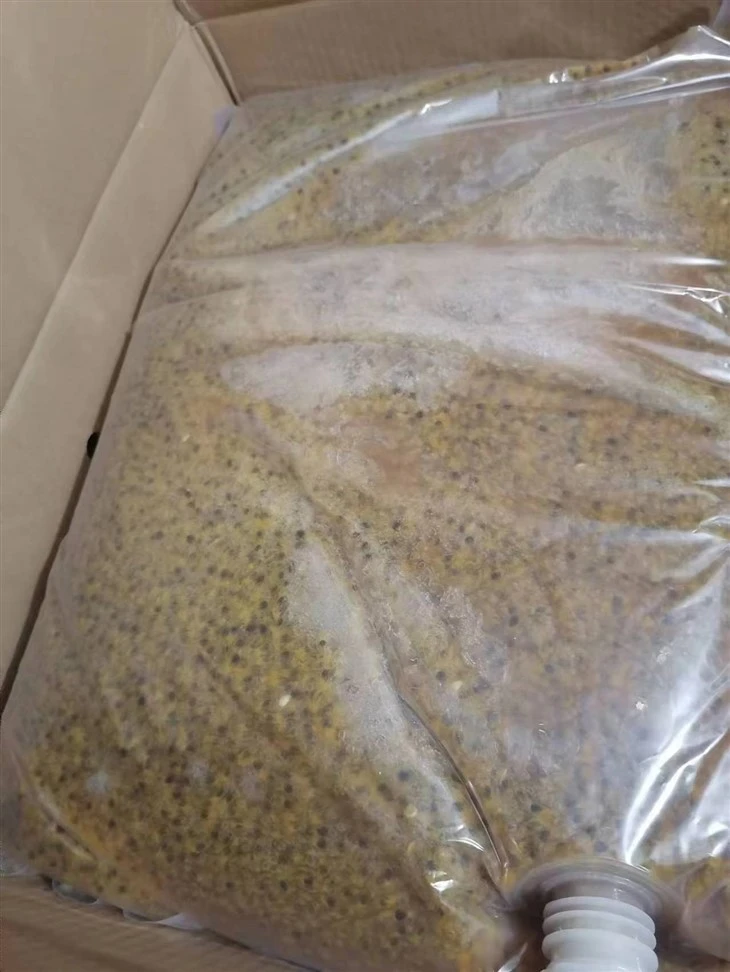
With IQF frozen blueberries, test free flow, skin damage and dosing from the actual bag depth. With frozen strawberry puree, align block or liner weight with tank capacity and formula dose. The product form decides whether partial use is practical.
Review cut geometry and bag opening together. A narrow spout may work for puree but bridge large chunks. A wide liner supports discharge into processing equipment but increases exposure in manual service. Test the real gloves, scoop, scale, funnel, hopper and container rather than approving from a flat film sample.

Align the Pack With Batch and Portion Accuracy
An exact batch multiple reduces partial bags. If a sauce uses 7.5 kg fruit, three 2.5 kg bags support full-pack dosing and independent code checks. A single 10 kg liner leaves 2.5 kg that must be resealed, identified and stored. For a 375 kg industrial batch, a 10 or 25 kg format may be more efficient, provided the lifting and discharge method is safe.
Net-weight tolerance and dosing method affect formula accuracy. Weigh a run of unopened packs and compare actual addition if production empties whole bags without scale verification. Smaller units can reduce the impact of one over- or underweight pack but multiply the number of units. Larger units reduce openings yet can magnify a dosing error when the full bag is assumed to equal its label.
Foodservice portions need a tool that can reach and release the fruit without crushing it. Run ten consecutive portions at opening, halfway through the pack and near the end. Record mass, piece count where meaningful, liquid pickup and service time. A large bag that doses well when full may become slow or inconsistent after clumps form at the bottom.
Compare Cost per Usable Kilogram, Not Pack Price
Build a cost model with delivered ingredient cost, packaging, receiving units, freezer space, internal handling, opening and weighing labor, usable yield, spills, thaw loss, discarded remainder and waste disposal. Add downtime or recipe correction when pack size affects dosing. Use measured site data for the largest cost drivers.
Usable cost = total landed and handling cost divided by kilograms that enter conforming product or service. A 10 kg bag delivered at $20 that loses 1.4 kg through leftover discard and damaged fruit costs $2.33 per usable kilogram before labor. Two 5 kg bags delivered at $21 total with 0.3 kg loss cost $2.16 per usable kilogram. The smaller format wins in that operation despite a higher invoiced kilogram price. A trial with frozen pineapple pieces can track retained pieces, liquid and discarded remainder separately.
Do not generalize those figures. A fast industrial line may use every gram from the 10 kg bag and incur more labor with smaller units. Run low, normal and peak-volume scenarios. Include the case count and pallet utilization because a small inner pack can still ship efficiently when the master carton and pallet are designed well.

Select the Primary Pack and Master Carton Together
Specify inner net weight, bags per carton, carton gross weight, liner, closure, dimensions, code location and pallet pattern as one system. A useful inner pack can fail commercially if the carton is too heavy, leaves poor pallet utilization, crushes lower layers or does not fit receiving racks and freezers.
Review manual-handling limits and equipment. A large industrial liner may need a hoist, tipper or controlled cutting station. A foodservice bag needs grip, opening and closure that work with cold hands and limited counter space. Retail pouches add artwork, seal presentation and shelf-display considerations that a plain bulk liner does not need.
Verify carton compression and pallet stability through the route, not only at packing. Frozen cartons face stacking, vibration, humidity and handling. A different count per carton changes void space and load distribution. Record trial configuration, pallet height, stretch wrap, corner protection where used, container loading and arrival condition.
Check Freezer Capacity, Order Quantity and Stock Rotation
Smaller inner packs can increase the number of facings, picks and labels even when total kilograms stay constant. Measure carton dimensions against freezer shelves, racks and door clearance. Count how many cartons fit without blocking air circulation or placing stock outside the approved load line. A compact inner bag offers no operational gain if its master carton wastes cube or cannot be rotated safely.
Connect pack size with minimum production quantity and order cadence. A custom 1 kg bag may require a larger film run or packing setup than the site can consume within its stock policy. Compare annual demand, order frequency, lead time, safety stock, crop season and remaining shelf-life requirement. The best operating pack can still be commercially impractical if inventory ages before use.
Plan FIFO or FEFO at the unit the warehouse can see. If date code appears only on the master carton, individual bags removed from it may lose usable rotation information. Put the necessary product, lot and date identity on the inner unit or maintain a controlled secondary label. Repacking loose bags without code linkage turns a packaging decision into a traceability failure.
Model one disrupted period. A delayed menu launch, equipment outage or low-season week can leave more opened or aging stock than forecast. Decide whether smaller inners, a mixed order cadence or a different master-carton count reduces that risk. The result belongs in purchasing parameters, not only in kitchen instructions.
Recheck the model when menu, batch size, labor, freezer layout or delivery frequency changes. Pack approval describes a working system; it should not survive unchanged after the operating assumptions that justified it disappear.
Validate Resealing and Working-Container Controls
A zipper or reclosable feature can support handling, but it does not reset the product history or guarantee a hermetic seal. Test whether frost, fruit fragments and gloves interfere with closure. Observe the seal after repeated cycles under the actual frozen condition. If the operating plan requires a separate lidded bin, qualify that container, label and cleaning procedure.
Mark the product, supplier lot, internal code, opening date and time, use-by or discard instruction under the validated plan, and operator or area. Keep the original bag or label until the working quantity is used. Do not top up an old bin with a new lot. Empty, clean and release the container between codes according to the site's hygiene program.
Store opened packs where they remain protected and cannot spill into allergens or raw materials. Return frozen product promptly when the procedure allows it. Do not treat a clump broken by hand as proof that quality remains unchanged; compare free flow, ice, texture, drip and application behavior during validation.

Run a Side-by-Side Pack-Size Trial
Compare at least two candidate sizes through receipt, freezer placement, opening, dosing, return or thaw, final use and disposal. Use the same fruit lot where practical so product variation does not hide the pack effect. Record opening time, exposures, labor, portion variation, clumps, spills, drip, accepted yield, residual mass and staff deviations from the planned method.
Test a normal and low-volume day. Low turnover often exposes problems that a busy launch misses. For seasonal foodservice, include the quiet period. For production, include a planned line stop and partial batch. The chosen pack must remain manageable when demand is below forecast, not only when every case empties quickly.
Ask operators what caused workarounds, then verify the observations. A bag may be described as difficult because the opening is too small, the fruit is clumped, the freezer shelf is high or the scale platform is undersized. Those causes lead to different actions: pack redesign, product control, storage layout or equipment change.
Worked Pack-Size Decisions
Worked example: smoothie kiosk
A kiosk uses 3.6 kg frozen mango during a normal day and 7.8 kg on Saturday. A 10 kg bag stays open across three normal days and shows more surface ice near the end. Two 2 kg bags cover normal demand with one controlled remainder; four bags cover Saturday. The trial records 4% lower ingredient discard and faster portioning despite higher film use, so the kiosk selects 2 kg inners inside a master carton.
Worked example: industrial filling line
A bakery batch requires 240 kg fruit. Twenty-four 10 kg liners add 18 minutes of opening and checking, while twelve 20 kg liners add 10 minutes and empty fully through a qualified tipper. Yield and dose accuracy are equivalent. The line approves 20 kg because the handling equipment controls lifting and no partial pack remains; a manual site without the tipper would reach a different decision.
Worked example: hotel dessert station
A hotel thaws 5 kg strawberry packs for a breakfast topping and discards an average 1.1 kg after the controlled service window. A 2.5 kg format increases bag openings from one to two but reduces average remainder to 0.2 kg. At 180 service days, the measured fruit saving outweighs added packaging and 45 seconds of extra opening labor. The hotel approves 2.5 kg and keeps full traceability on each bag.
Write Pack Size Into the Purchase and Operating Specifications
The purchase specification should identify product form, inner net weight and tolerance, units per carton, material structure, dimensions, closure, seal, print or label, code, carton, pallet, storage and route. Link it to tests for seal, drop or handling, net weight, product condition and arrival. Packaging statements must match the actual food-contact and destination requirements.
The site procedure should identify receiving status, freezer location, opening method, working container, dose, thaw or frozen handling, maximum window, return-to-storage rule, discard trigger, label, sanitation, lot segregation and record. The supplier cannot write the site's safe use window without its process data; the buyer cannot evaluate pack efficiency without knowing the supplied format.
Place pack-size changes under review. A move from 2.5 kg to 10 kg changes exposure, lifting, thaw time, dosing and residual control even when film and fruit are unchanged. Repeat targeted trials before routine purchase and identify the first changed lot.

Questions to Resolve Before Choosing the Pack
Is the lowest-priced pack per kilogram the best choice?
Only if usable yield, labor, exposure, freezer use and waste support it. Calculate cost per usable kilogram across normal and low-volume periods.
Does a zipper make repeated opening safe?
It can improve closure convenience, but safety and quality still depend on time, temperature, hygiene, lot control and product condition. Validate the full handling plan.
Can a large frozen bag be divided after thawing?
Follow the site's validated thaw and use procedure. Partial thaw can create uneven temperature and damage. Selecting a smaller pack or portioned block before purchase is usually more controllable than improvising division later.
How many candidate sizes need a trial?
Compare enough realistic formats to reveal the trade-off, usually a smaller and larger option around the calculated controlled-use quantity. Include the actual master carton and pallet.
What evidence supports the final decision?
Retain use-rate data, exposure map, handling trial, yield and cost calculation, portion results, operator observations, packaging tests, approved specification and first-lot verification.
Choose a Pack the Operation Can Control Every Day
The strongest choice turns supplier packaging into an operating control. It matches the fruit, use rate, handling window, batch, portion, freezer, tools and traceability system. It reduces workarounds and protects usable yield without creating unnecessary material or labor.
Review the wider frozen-fruit supply range, then lock pack size only after the site trial. We can coordinate available forms and packaging discussions around the buyer's measurable operating brief.
Review a Frozen-Fruit Pack Format
Send the fruit, form, use rate, batch or portion, handling window, destination and candidate net weights. We will review the practical pack, sample and trial points.
References
Research reviewed on 21 August 2026 included Codex quick-frozen-food packaging and handling guidance, USDA frozen-fruit commodity specifications with several primary-pack examples, and current foodservice packaging search results. The examples demonstrate method; legal, safety and use-window decisions remain product- and operation-specific.