


What Are the Different Varieties of Dragon Fruit?
Dec 05, 2019

Dragon fruit is commonly sold in three visible commercial groups: red or pink skin with white flesh, red or pink skin with red-to-purple flesh, and yellow skin with white flesh. Those groups are useful for buying and product development, but they are not complete cultivar names. Several species, hybrids and local cultivars can share a similar appearance, and older references often use Hylocereus names that current botanical sources place under Selenicereus.
For frozen dragon fruit, flesh color usually matters more than peel color because the peel has been removed. White flesh gives a neutral pale base with black seeds. Red or purple flesh delivers strong natural color but can bleed into other ingredients and change during processing. Yellow-skinned fruit is a recognized fresh-market group, yet a supplier still needs to identify the actual offered fruit and show that its frozen form is commercially available. Do not order "red dragon fruit" without stating whether "red" describes the skin or the flesh.
Direct answer: the main market groups are red-skin/white-flesh, red-skin/red-or-purple-flesh, and yellow-skin/white-flesh dragon fruit. Within them are different species and cultivars. For a frozen order, write the required flesh color, cut, maturity, flavor, Brix or agreed soluble-solids method, seed appearance, piece integrity and application test into the specification.

Use Color Groups Without Pretending They Are Cultivar Names
Color groups solve a practical communication problem. A developer choosing a pale smoothie base does not need the same fruit as a producer seeking an intense magenta dessert. Fresh-fruit standards from Codex and Thailand recognize yellow and red/white market presentations, while the Thai standard illustrates red skin with white, red or pink flesh and yellow or gold skin with white flesh. These standards address fresh fruit, not a finished frozen-cube specification, but they confirm that several visible commercial types exist.
The common scientific names require care. Many trade and research documents call the white-fleshed red-skin type Hylocereus undatus. Kew treats that name as a synonym of the accepted Selenicereus undatus. Likewise, older literature uses Hylocereus costaricensis for a red-fleshed type that Kew accepts as Selenicereus costaricensis. Yellow pitahaya is often associated with Selenicereus megalanthus, although a yellow exterior alone does not prove that species.
Taxonomy changes as evidence and classifications change, while commercial names often remain. That is not a reason to avoid identity; it is a reason to record both the supplier's commercial description and the scientific or cultivar name it can support. If the buyer's label, ingredient declaration or destination documentation requires a species, verify it through traceable records instead of copying the first Latin name found online.
A phrase such as "purple dragon fruit" normally describes a dark red-to-purple flesh result. It may not identify one globally standardized cultivar. The same caution applies to "pink," "red" and "yellow." Treat color as a measurable product attribute and identity as a traceability claim. One can be checked against a reference sample; the other needs records supporting the offered raw material.
Red Skin With White Flesh
The familiar red- or pink-skinned fruit with white flesh and small black seeds is widely associated with Selenicereus undatus. It normally gives a pale frozen piece and a milder visual effect in smoothies, fruit preparations and desserts. That color neutrality can be an advantage when another ingredient must control the finished shade.
White flesh is not proof of weak sweetness, just as red flesh is not proof of high sweetness. Cultivar, maturity, crop conditions and handling change soluble solids, acidity, aroma and firmness. UC Davis postharvest guidance notes that dragon fruit is harvested near full ripeness because it does not continue normal ripening after harvest; soluble solids rise while acidity and firmness decline during maturation. A colorful peel cannot compensate for fruit harvested outside the desired flavor window.
In a frozen white-flesh item, inspect browning, grey tones, pink or red contamination from mixed fruit, seed distribution, peel residue, bruised translucent tissue, ice and clusters. If the product will be blended with dairy or a pale fruit base, run a thawed color check because even a small amount of red-flesh material can create visible streaks. The frozen dragon fruit range shows why the requested flesh color and format need to appear in the order description.
Red or Pink Skin With Red-to-Purple Flesh
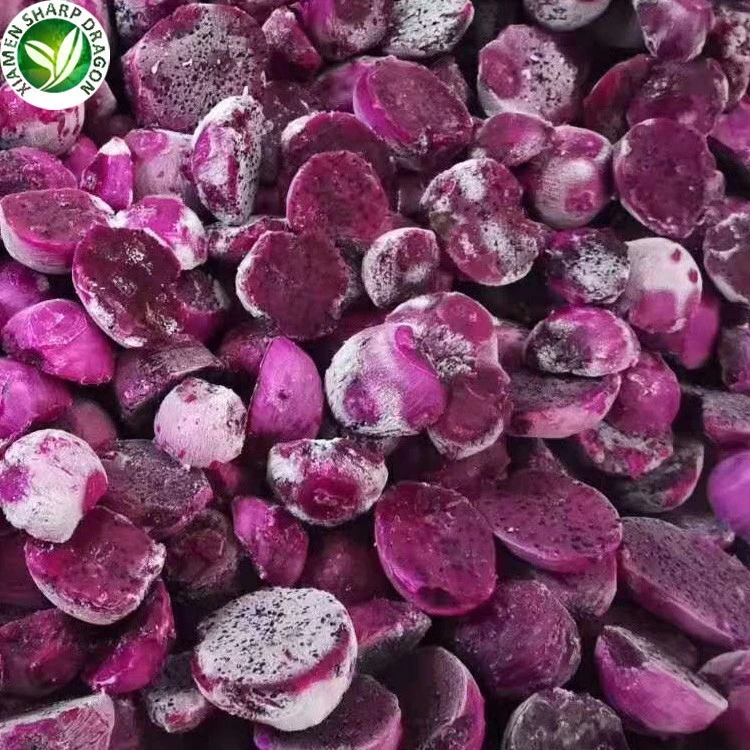
Red-fleshed dragon fruit contains betalain pigments, including betacyanins that create its magenta-to-purple appearance. That strong color can be the main reason to choose it for smoothies, bowls, sorbet, beverage bases, fruit preparations and bakery fillings. It also makes color control a procurement requirement rather than a decorative preference.
Pigment does not behave like permanent paint. Peer-reviewed work with red-fleshed juice and concentrate shows that betacyanin stability responds to heat, pH, light, oxygen and other processing conditions. A frozen sample that looks vivid by itself can move toward a different shade after acid, dairy, heat or storage is introduced. Test the fruit in the actual formula, container and process instead of approving color from a frozen photograph.
Red pigment also travels with liquid released during thawing. Color bleed may be welcome in a smoothie but undesirable in a mixed-fruit bag where white mango, pineapple or coconut pieces are expected to remain visually separate. Record the thaw condition and contact time, then inspect both the dragon fruit and neighboring components. A brief rinse may remove valuable color and soluble solids; it is not a substitute for selecting the right item.
The IQF red dragon fruit format should be qualified by cut, color reference, ingredient statement, defect limits and downstream performance. "Natural red" still allows crop variation. If your retail or foodservice presentation requires a narrow shade, use approved reference images or an instrumental color range and state when the measurement is taken.

Yellow Skin With White Flesh
Yellow or gold-skinned, white-fleshed pitahaya is a recognized commercial group. Codex separates yellow and red/white pitahayas in its fresh-fruit sizing provisions, and the Thai standard illustrates more than one yellow or gold presentation. Those classifications show that "yellow dragon fruit" is not merely an unripe red fruit. They do not prove that every yellow lot belongs to one species or performs the same way.
Online descriptions often claim that yellow pitahaya is always sweeter or more premium. That shortcut is not suitable for a specification. Measure the actual crop, maturity, flavor and usable yield. Some yellow fruit may be smaller, and surface structures or spines can differ, so peeling labor and flesh yield may not match a red-skinned item. If the peel is removed before freezing, the final white pieces can also become difficult to distinguish without traceability.
Before promoting a yellow variety, verify current supply, species or cultivar evidence, crop window, peeled yield, frozen cut, flavor and documentation. XMSD's public frozen range does not by itself promise every fresh-market color group in every season. Treat yellow-flesh or yellow-skin availability as an order-specific sourcing question and approve a representative sample before committing the label.
Maturity Can Matter More Than the Variety Name
Dragon fruit is non-climacteric for practical postharvest handling: it should be harvested close to the desired ripeness because it will not develop the way a climacteric fruit such as banana does after harvest. UC Davis lists days after flowering and skin-color development as maturity indices and explains that total soluble solids increase while titratable acidity and firmness fall as fruit matures. The exact timing varies by cultivar and production area.
Do not transfer a fresh-fruit maturity ratio into a universal frozen specification. A ratio can inform sweetness-acid balance, but freezing, peeling, cutting, thawing and formula ingredients change the sensory result. Record the soluble-solids method, sample temperature, acidity method if used, sensory scale and crop lot. Taste the product after the intended thaw or processing step.
Immature fruit may give weak aroma, low sweetness and a firmer but less satisfying bite. Overmature fruit may peel well yet collapse during cutting or release more juice after thawing. The best maturity is the one that meets flavor, color and usable-piece requirements together. A higher Brix is not automatically better if the fruit loses the structure required by a visible frozen pack.

Frozen Cut and Thaw Performance Change the Decision
Dragon fruit flesh contains substantial water and becomes softer after freezing and thawing. Whole peeled portions, halves, slices, dice, chunks and puree therefore serve different jobs. A smoothie plant may accept irregular pieces and some released juice. A retail fruit bag needs controlled dimensions, clean cut faces and free-flowing pieces. A dessert topping may require the highest intact yield after a defined thaw.
Specify nominal dimensions and tolerance, not only "cube." Define fragments, crushed fruit, peel, severe deformation, discoloration, free ice and clusters. Black seeds are a normal part of the flesh, but an unusual seed distribution or pale undeveloped area can signal raw-material variation. Approve the frozen dragon fruit pieces under the final handling method.
Use a repeatable thaw trial. Weigh a defined frozen sample, spread or contain it as the application will, thaw for a stated time and temperature, drain through a defined screen if relevant, then record drained weight, intact pieces, color, drip, aroma and flavor. Two laboratories can produce different yields from the same bag if one drains for two minutes and the other for twenty.
For a mixed-fruit pack, add a contact test. Place the approved dragon fruit beside the lightest neighboring ingredient at the intended ratio, hold it under the expected frozen and thawed conditions, then score staining at fixed times. Photograph the untouched control and the tested mix under the same lighting. If red transfer makes the pale fruit unacceptable, reduce contact time, change the mix design, use white-flesh dragon fruit or move the red fruit into a blended application where released pigment contributes value.
Application example: a smoothie developer orders "red dragon fruit" expecting a magenta base. The delivered fruit has red skin in the raw-material photographs but white flesh after peeling. Identity may be traceable and the fruit may be sound, yet it cannot provide the required color.
The developer rejects the lot for this formula, rewrites the specification as "red- or purple-fleshed dragon fruit, peeled IQF dice," adds an approved thawed color reference and tests the next sample in the complete smoothie. The problem was an ambiguous color word, not proof that all white-flesh fruit was low quality.

Compare Cost on Approved Usable Output
Variety and color premiums are meaningful only when the product earns them in the finished application. Compare the same cut, preparation and acceptance method. Include intact pieces, thaw drip, off-color material, peel residue and formula performance. A lower price per frozen kilogram can cost more per usable kilogram if the rejected or drained share is larger.
Worked example: a dessert producer compares two illustrative red-flesh IQF dice offers for a 6,000 kg usable-fruit requirement. Lot A costs $2.34/kg and gives 92% application-usable dice after the approved thaw and drain. Lot B costs $2.22/kg and gives 84% because it contains more fragments and drip.
A usable cost = $2.34 ÷ 0.92 = about $2.54/kg. B usable cost = $2.22 ÷ 0.84 = about $2.64/kg. A purchase required = 6,000 ÷ 0.92 = about 6,522 kg. B purchase required = 6,000 ÷ 0.84 = about 7,143 kg.
The producer selects A after color, flavor, safety and documents also pass. B could still fit puree, where fragments carry value. The figures are a decision method, not an XMSD quotation, supply promise or guaranteed yield.

Write a Variety and Product Specification That Can Be Checked
Begin with product identity: commercial name, required skin and flesh color of the raw fruit, supported species or cultivar when necessary, origin, crop window and ingredient statement. If the peel is absent from the finished item, state flesh color in the product name. If mixed color is intentional, define the ratio and tolerance; if it is not, treat cross-color pieces as a defect.
Add measurable finished-product controls: cut, size tolerance, color reference, Brix or soluble-solids method where useful, acidity or ratio when decision-relevant, flavor, seed appearance, peel residue, foreign material, fragments, deformation, free ice, clumps and net weight. State whether inspection occurs frozen, partly thawed, fully thawed or drained. The condition changes what the inspector can see.
Define process and food-safety status. Confirm washing, peeling, cutting, freezing, metal or foreign-material controls, microbiological criteria, storage, shelf life and preparation direction. Frozen fruit is not automatically sterile or ready to eat. If the finished food has no later control step, confirm that the item's intended-use status and facility program support that route.
Match evidence to the offered product and facility. Review traceability, certificate holder and scope, pesticide-residue requirements, contaminants, lot coding and export documents. The food-processing facility route provides context, but order approval depends on evidence for the actual dragon fruit item and production site.

Approve the Variety in the Final Formula
A successful solo taste test is only the first gate. Red flesh can dominate a mixed-fruit color, while white flesh can disappear visually even when its texture and flavor are acceptable. Acid can shift pigment behavior. Heat can reduce color stability. Dairy, starch, air incorporation and storage light can change the final appearance. Test the intended concentration, process and shelf-life conditions.
Keep one approved sample or a controlled image and written result. Record fruit lot, preparation, recipe percentages, time, temperature, equipment, container and observation points. When a later shipment differs, this record separates raw-material variation from a recipe or process change. It also makes a color complaint more useful than "too pale" or "not purple enough."
For a frozen dragon fruit review, tell us the required flesh color, cut, application, ingredient statement, product status, pack, volume, destination and documents. Use the XMSD inquiry form to request a specification-led discussion. We will check the current item and supply route rather than assume that every color group or cultivar is interchangeable.
Frequently Asked Questions
1. What are the three main dragon fruit color groups?
They are red or pink skin with white flesh, red or pink skin with red-to-purple flesh, and yellow skin with white flesh. Each group can contain different species, cultivars or hybrids, so the color description is not a complete botanical identity.
2. Does red dragon fruit mean red skin or red flesh?
It can mean either in informal trade language. Remove the ambiguity by writing "red-skin/white-flesh" or "red-skin/red-flesh" and attaching an approved color reference for a frozen order.
3. Is purple dragon fruit a separate species?
Not necessarily. "Purple" commonly describes dark red-to-purple flesh in commerce. Ask for the supported species or cultivar separately when identity is important to labeling, traceability or product performance.
4. Is yellow dragon fruit always sweeter?
No universal sweetness promise follows from yellow skin. Cultivar, maturity and crop affect flavor. Measure and taste the actual lot, and compare peeled or frozen usable yield before accepting a premium.
5. Will red dragon fruit keep the same color after processing?
Not always. Betacyanin color can respond to heat, pH, light, oxygen and storage. Test the fruit in the final formula and package under the intended process rather than approve color from a frozen piece alone.
6. What should appear in an IQF dragon fruit specification?
State supported identity, flesh color, origin, cut, size tolerance, color, soluble solids or flavor targets where relevant, seed and peel limits, fragments, ice, clumps, ingredient statement, product status, pack, storage, safety criteria, traceability and application test.
References
- Codex Standard for Pitahayas, CXS 237-2003
- UC Davis Postharvest Research and Extension Center: Dragon Fruit
- Kew Plants of the World Online: Selenicereus undatus
- Kew Plants of the World Online: Selenicereus costaricensis
- Woo et al.: Effects of Heat, pH, Antioxidant, Agitation and Light on Betacyanin Stability
- Ghent University: Characterization of Dragon Fruit Components and Processing Behavior