


The Function of Frozen Spring Onion | XMSD
Feb 15, 2019

Frozen spring onion mainly functions as a convenient flavoring vegetable. It adds a mild onion aroma, green color, and small pieces of vegetable to soups, sauces, noodles, fillings, ready meals, and savory bakery products. It also contributes nutrients, but it should be treated as one ingredient in a balanced diet rather than as a treatment for a health condition.
The short answer: The most defensible functions of frozen spring onion are culinary flavor, visual appeal, portioning convenience, and a modest contribution of fiber and micronutrients. Evidence does not support claims that eating it prevents cancer, kills viruses, lowers blood pressure, or controls blood sugar.

What does frozen spring onion do in food?
Its first function is sensory. The green and white parts bring a fresh onion note that is usually milder than mature bulb onion. The pieces also provide visible color contrast. That makes the ingredient useful when a formulation needs recognizable onion pieces without the preparation work and short usable life associated with fresh bunches.
Its second function is operational. Individually quick-frozen pieces can remain separate enough for controlled portioning when the product has been properly processed, packed, stored, and handled. The result can reduce washing, trimming, and cutting at the point of use. Actual free-flowing performance still depends on the product specification and cold-chain history.

Nutritional functions without exaggerated promises
USDA FoodData Central lists raw spring onions or scallions, including the tops and bulb, as a low-energy vegetable that contains carbohydrate, fiber, a small amount of protein, vitamin K, vitamin C, folate, and several minerals. These composition data describe the raw food entry. They should not be treated as a guaranteed label value for every frozen commercial product.
| Component | Realistic dietary role | Important limit |
|---|---|---|
| Vitamin K | Contributes to normal blood-clotting and bone-related protein functions | A garnish-sized portion may contribute less than a full vegetable serving |
| Fiber | Adds to total daily fiber intake | It is not a treatment for digestive symptoms |
| Vitamin C and folate | Contribute to the micronutrient mix of the overall meal | Levels vary with raw material, processing, storage, and cooking |
The protein and carbohydrate in spring onion are real, but ordinary portions do not make it a protein-focused or energy-dense food. Its nutritional value is better understood as a small contribution within a varied meal. The rest of the recipe-such as oil, pastry, cream, salt, meat, legumes, or grains-usually has a much larger effect on the final nutrition profile.

Does freezing change its function?
Freezing changes convenience and texture more clearly than it changes the basic identity of the ingredient. Frozen spring onion can still provide onion flavor, color, and nutrients, but thawed pieces may be softer and release more water than freshly cut spring onion. This matters more in a cold garnish than in a soup, sauce, filling, or cooked ready meal.
Nutrient retention is not an all-or-nothing question. Research comparing selected fresh and frozen fruits and vegetables has found that results vary by food and vitamin. Spring onion was not one of the commodities in that study, so it cannot prove a specific retention percentage for this product. Raw-material quality, preparation, any heat treatment, freezing rate, frozen-storage time, packaging, and final cooking can all influence the result.
Fresh and frozen serve different priorities: fresh spring onion may be preferred for crisp raw garnish, while IQF pieces can be more practical for repeatable portioning, year-round production, and cooked applications. Neither format is automatically better for every use.
How to use frozen spring onion effectively
For soups, sauces, and noodles
Add the onion at a stage that matches the desired flavor. Earlier addition produces a softer texture and more integrated onion note. Later addition keeps more visible green color and a fresher aroma. Follow the pack directions and validate the sequence in the actual recipe rather than relying on a universal cooking time.
For dumpling, pancake, and savory bakery fillings
Water release matters. A small trial can show whether the frozen pieces should be incorporated directly, partially tempered under controlled conditions, or balanced with other ingredients. The correct approach depends on the filling, dough, mixing time, and final heat process.
For ready meals and foodservice
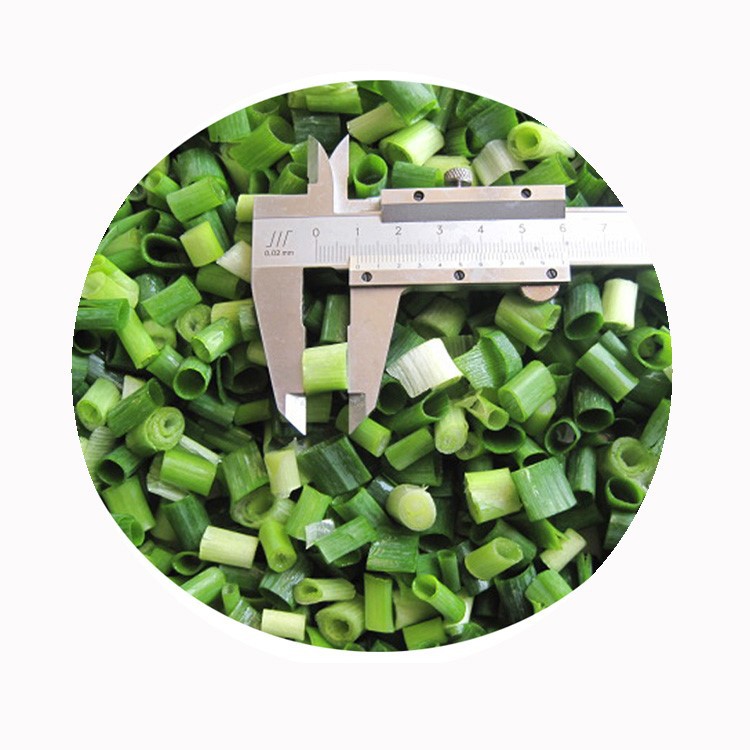
Uniform cut size helps distribute flavor and color from portion to portion. Buyers should check the acceptable range rather than looking only at an average cut. Too many fine particles can disappear into a sauce, while pieces that are too long may distribute unevenly or complicate filling and dosing.

Claims that need correction
Spring onion belongs to the Allium group, and onions contain sulfur compounds and flavonoids that have been studied in laboratory, animal, and observational research. These research categories can help scientists investigate mechanisms, but they do not establish that a normal serving of frozen spring onion treats disease.
It is therefore not appropriate to promise that frozen spring onion induces useful sweating, reduces body heat, stimulates digestive secretions, kills bacteria or viruses in the body, prevents cancer, lowers blood fat, lowers blood pressure, or lowers blood sugar. Broad reviews of Allium vegetables report potential associations for some outcomes, but the strength and quality of evidence vary, and findings for extracts or different onion species cannot be transferred directly to a portion of frozen scallion.
A more useful statement is that spring onion adds flavor and color to meals and contributes nutrients. Its strong aroma may make a dish more appealing to some people, but that culinary effect is not the same as a clinically proven appetite treatment.
Safety note: People taking warfarin should keep vitamin K intake reasonably consistent and follow their clinician's advice. NIH guidance focuses on avoiding sudden changes in vitamin K intake; it does not advise everyone to avoid green vegetables.

What food buyers should specify
For a commercial buyer, the functional question becomes practical: will the ingredient deliver the required appearance, flavor, dosing behavior, and finished-product performance? The product name alone is not enough because "spring onion," "green onion," and "scallion" can overlap in trade use.
Confirm the cut style and length range, green-to-white ratio, free-flowing condition, particle distribution, defect tolerance, aroma, water release, and intended cooking step. Packaging, label requirements, destination documents, and cold-chain handling should also be agreed before an order. If a nutrition declaration is required, use product-specific calculation or testing that follows the destination market's rules.
At XMSD, we supply IQF frozen green onion and spring onion for food manufacturing, foodservice, and retail programs. Buyers can review our processing and quality-control equipment and discuss a suitable frozen-food packing format. Final details remain subject to the agreed product specification.

XMSD sourcing note: Share the target cut, green-to-white ratio, application, packing format, destination, and label requirements. We can then discuss a suitable specification and sample evaluation without relying on unsupported health promises.
Frequently Asked Questions
1. What is the main function of frozen spring onion?
Its main functions are to add a mild onion flavor, green color, and visible vegetable pieces while providing convenient portioning for cooked dishes and food production.
2. Is frozen spring onion nutritious?
It can contribute fiber, vitamin K, vitamin C, folate, and other nutrients. The exact amount depends on the raw material, processing, storage, serving size, and final cooking method.
3. Is frozen spring onion high in protein?
No. Spring onion contains some protein, but normal portions are small and it should not be used as a substitute for protein-focused foods.
4. Does frozen spring onion improve digestion?
Its fiber contributes to total fiber intake, but it is not a digestive treatment. Some people tolerate onion-family foods well, while others may experience gas or discomfort, especially with larger portions.
5. Is frozen spring onion antibacterial or antiviral?
Some onion compounds have shown activity in laboratory research. That does not prove that eating frozen spring onion prevents or treats bacterial or viral infections in people.
6. Can frozen spring onion prevent cancer?
No food should be presented as a cancer preventive or treatment on the basis of laboratory findings or observational associations. Frozen spring onion can be part of a varied diet, but it does not provide a guaranteed protective effect.
7. Does it lower blood pressure or blood sugar?
There is no basis for promising that a serving of frozen spring onion will lower either measure. People managing hypertension or diabetes should follow individualized guidance from qualified health professionals.
8. Does spring onion increase sweating or reduce body heat?
These are not established nutritional functions. A warming sensation from a pungent meal should not be described as proof of fever treatment, detoxification, or body-temperature control.
9. Is frozen spring onion as nutritious as fresh?
There is no universal percentage. Nutrient retention varies with the product, preparation, freezing, storage, and cooking. Product-specific data are needed for an exact comparison.
10. Should frozen spring onion be thawed before use?
Not always. It can often be added directly to a hot application, but the correct method depends on the product instructions and recipe. Controlled trials are useful when water release or texture is critical.
11. When should it be added during cooking?
Add it earlier for a softer texture and integrated onion flavor, or later for brighter color and a fresher aroma. Validate the timing in the actual dish.
12. Are spring onion, green onion, and scallion the same?
The terms overlap in everyday and trade use, but regional naming and bulb maturity can differ. Buyers should confirm the actual material, cut, and green-to-white ratio.
13. Can people taking warfarin eat spring onion?
They should follow their clinician's advice and avoid sudden changes in vitamin K intake. The general goal is consistency, not an automatic ban on every green vegetable.
14. What should a buyer check before ordering IQF spring onion?
Confirm the product identity, cut range, green-to-white ratio, defect limits, free-flowing condition, water release, packing, labeling, destination documents, cold-chain requirements, and application test.
Final Thoughts from XMSD
The clearest function of frozen spring onion is practical: it adds onion flavor, green color, and portionable vegetable pieces to many cooked foods. It also contributes nutrients, but those benefits should remain proportionate to the serving and the complete dish. For commercial use, cut, green-to-white ratio, water release, packing, and application performance deserve the same attention as nutrition.
References
- USDA FoodData Central: Onions, spring or scallions, raw
- NIH Office of Dietary Supplements: Vitamin K Fact Sheet for Consumers
- Vitamin Retention in Eight Fruits and Vegetables: A Comparison of Refrigerated and Frozen Storage
- Allium Vegetable Consumption and Health: An Umbrella Review of Meta-Analyses
- USDA Food Safety and Inspection Service: Freezing and Food Safety
- XMSD: IQF Frozen Green Onion