


Lotus Root Functional Properties: Crispness, Starch, Cut and Frozen Performance
Dec 11, 2019

Lotus root functions as a structured vegetable, a texture carrier and a starch-bearing ingredient. Its perforated cross-section gives slices a recognizable shape; the flesh can remain crisp in a quick stir-fry, become tender during braising, or turn softer and more powdery in varieties selected for longer cooking. Grated rhizome and separated lotus-root starch can add body, but they do not behave like intact slices.
The useful question is therefore not whether lotus root has one universal "function." Define the desired bite, cut thickness, cooking method, hold time and serving format. Variety, maturity, starch structure, blanching, freezing and thawing all influence the result. A specification written only as "lotus root slices" leaves the decisive performance variables open.
Direct answer: Use crisp, uniform slices for visible stir-fries, hot pots and pickled formats; select softer or starchier material for soups, braises, mash and fillings; use grated material or isolated starch only when binding or thickening is the intended role. Approve every route under the actual heat and hold conditions.

The Edible Part Is a Rhizome with Built-In Structure
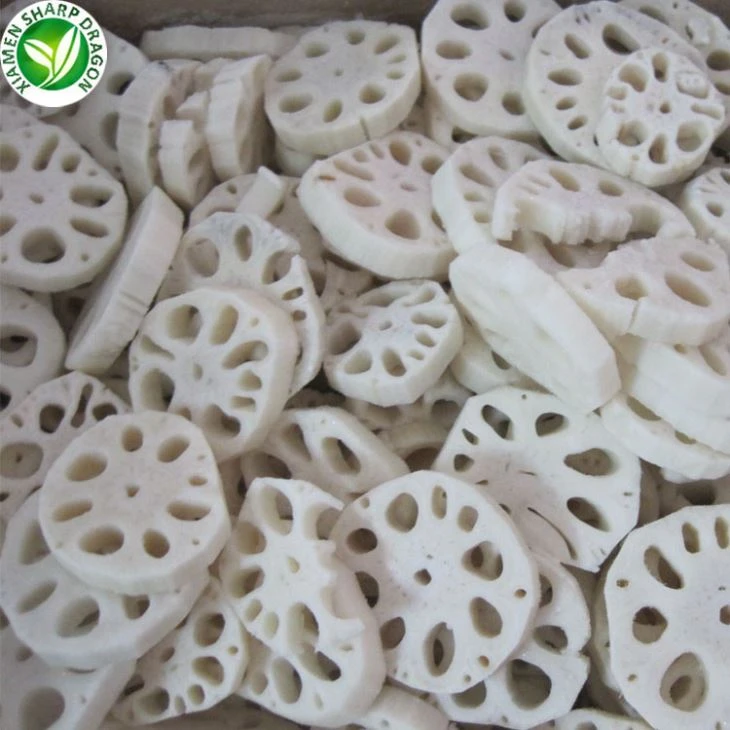
The familiar "root" is botanically an enlarged underground stem, or rhizome. Air channels running through it produce the round or elongated holes visible in every cross-section. Those channels are not decoration alone. They shape the slice, reduce solid mass across its diameter and affect how liquid, sauce and heat contact the piece. Hole pattern, outer diameter and trimming therefore influence visual identity and portion count.
A whole segment can be peeled, cut across into rounds, divided into half-moons, diced, cut into strips, grated or milled. Each transformation changes the eating and processing role. Thin rounds expose more surface and cook rapidly. Thick rounds protect bite during longer heating. Dice distribute through fillings or mixed vegetables. Grated flesh releases more starch and loses the clean geometry expected from a visible slice.
For identification and broad culinary context, the XMSD guide to lotus root food uses covers the ingredient at a general level. Functional approval goes further: it connects a defined piece to a defined process and an observable result.
Crisp and Powdery Types Serve Different Texture Targets
Researchers and cooks commonly distinguish crisp lotus rhizomes from powdery or mealy types. Crisp material is favored when a clean snap or firm bite must survive brief cooking. Powdery material is more suitable when a soft, floury mouthfeel is wanted after steaming, simmering or braising. Published work links these differences to cell-wall behavior, starch traits and other compositional factors rather than to one simple moisture reading.
Variety names alone may not travel reliably between origins and markets. A practical brief describes the result: "discernible crisp bite after 90 seconds in the defined stir-fry process" or "tender, slightly mealy center after the stated steam cycle." The approval sample then anchors the words. Instrumental firmness can support the comparison, but sensory assessment under the serving method remains important.
In our product evaluations, raw hardness is never treated as the final answer. We cook the candidate through the customer's representative time, temperature, sauce and hold, then compare fracture, fibrousness, mealiness and center texture. A lot that feels firm while frozen may soften rapidly after blanching and service; another may preserve a cleaner bite. The decision belongs to the cooked result.
Thickness Controls Heat Path, Bite and Piece Survival
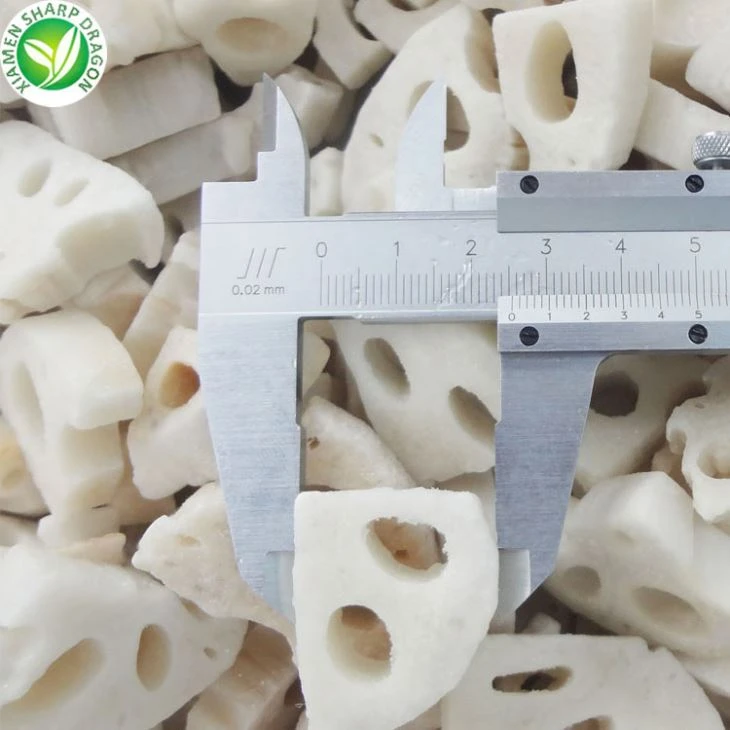
Nominal diameter tells how wide a round appears, while thickness sets the shortest heat path through the flesh. A 3 mm round and an 8 mm round from the same rhizome can behave like different ingredients. The thin piece heats and seasons quickly but is more exposed to breakage and over-softening. The thick piece retains volume and bite, yet needs more heat to reach the desired center texture.
Thickness also changes pieces per kilogram. That affects bowl coverage, visual distribution and serving cost. A count-based specification may be useful for plated products, while a weight-based recipe alone may be enough for soup. Record tolerance and measurement method: random caliper readings across a defined sample are more reproducible than judging the bag by eye.
Service example: A hot-pot operator compares 3 mm and 7 mm rounds in the same broth. The 3 mm pieces reach an acceptable bite after 45 seconds but become fragile during a three-minute table hold. The 7 mm pieces need 100 seconds and remain intact during the hold. That result chooses the 7 mm route for open-table service, while the faster 3 mm route remains useful for a controlled kitchen stir-fry. One trial answers cooking speed; the other answers hold resilience.
Cooking Converts Structure Along a Time-and-Temperature Curve
Heating softens plant tissue as cell walls and middle lamellae change, while starch granules absorb water and gelatinize. The two processes overlap. Brief heating may reduce raw hardness while preserving a crisp fracture. Longer wet cooking can produce tenderness and a powdery sensation. Published texture studies show that cooking method and duration alter hardness, springiness and flavor profile, so one universal minute value is not defensible.
Stir-frying supplies intense surface heat with limited water. Boiling and simmering provide sustained wet heat. Steaming limits direct leaching into cooking water. Braising adds sauce chemistry and a longer residence time. Frying can dry and brown the surface while the interior cooks. Acid, salt, sugar and calcium in the surrounding formula may also shift softening or perceived firmness.
A useful cooking test records starting state, piece dimensions, product-to-liquid ratio, heating equipment, time measured from a defined point and post-cook hold. "Boil until done" cannot be reproduced across a laboratory beaker, restaurant pot and factory kettle. The purpose of a method is not to imitate every kitchen; it is to expose the ingredient to the process that governs acceptance.

Starch Gives Body, but Whole Slices Are Not a Pure Thickener
Lotus rhizome contains starch stored inside its tissues. Heating in water swells and gelatinizes accessible starch, contributing to a softer or mealier bite. Grating, crushing or milling disrupts more cells and makes the starch-bearing material more available. Separated lotus-root starch is a concentrated ingredient with pasting and gel properties; intact frozen rounds retain most starch within their cellular structure.
That distinction prevents a common formulation error. Adding 8% sliced lotus root to a soup does not have the same thickening effect as adding 8% purified starch. The slices contribute solids, texture and some release during cooking, while the isolated starch disperses through the liquid phase. If viscosity is critical, measure the complete formula rather than assigning a theoretical thickening value to the visible vegetable.
Starch behavior also varies with botanical source, amylose-to-amylopectin balance, granule damage, temperature, shear and other ingredients. A paste may thicken during heating and then change during cooling, freezing or reheating. Product developers using lotus-root starch need a pasting trial. Operators using lotus-root slices need a piece-texture and broth-clarity trial. Those are related but separate approval paths.
Blanching and Freezing Reset the Starting Point
Commercial frozen lotus root is commonly peeled, cut, treated as needed, blanched, cooled and frozen. Blanching reduces enzyme activity and begins the heat transformation; freezing then creates ice within and around the tissue. The thawed or cooked bite will not exactly reproduce a raw market rhizome. That is not a defect by definition-it is a different starting condition.
The XMSD frozen lotus root range provides the relevant form for industrial and foodservice trials. Evaluate pieces from frozen when the recipe permits direct cooking. Thawing first may increase handling damage and liquid release. When a thaw step is unavoidable, define its temperature, time and drainage procedure.
During our arrival checks, we separate three observations. Free flow and excessive clumping describe frozen handling. Cut thickness, diameter, hole pattern and broken pieces describe physical conformity. Bite, color and fibrousness after the agreed cooking cycle describe application performance. Combining them into one vague score hides the corrective action: cold-chain review, cutting adjustment or raw-material selection.

Color and Browning Need a Defined Observation Point
Cut lotus tissue can darken through enzymatic and non-enzymatic reactions. Raw exposure time, treatment, blanching, oxygen, metal contact, storage and cooking formula may influence the appearance. A color limit without an observation point is incomplete. Specify whether color is judged frozen, immediately after cooking, after sauce addition or after a service hold.
Sauce can mask moderate variation, whereas a clear hot-pot broth exposes every dark edge. Pickled or seasoned formats may intentionally shift tone. Use representative lighting and the intended background for visual approval. Instrumental color measurements can support repeatability, but a laboratory value does not replace the appearance of the finished dish.
Dark discoloration must also be separated from normal tan variation, surface dehydration and foreign material. Photograph the unopened pack, frozen pieces and cooked result with the lot code. This sequence preserves evidence for a meaningful disposition instead of relying on a single close-up image with no process context.

Two Approval Scenarios Produce Different Decisions
Worked manufacturing example: A 1,000 kg ready-meal batch is formulated with 18% frozen lotus root, equal to 180 kg before cooking. A pilot run measures 166.5 kg of acceptable cooked pieces after removing fragments and excess liquid. The usable yield is 92.5%. If the commercial target is 180 kg of acceptable cooked pieces, the starting quantity becomes about 194.6 kg, calculated as 180 divided by 0.925. The decision is a yield and costing correction, not a change to the sensory specification.
The hot-pot comparison earlier answered which thickness survives service. The ready-meal calculation answers how much frozen input delivers a planned cooked amount. Keeping those cases separate matters: texture acceptance does not reveal production yield, and yield arithmetic does not prove that the bite is right.
Run both trials when the application needs both outcomes. Record whole-piece recovery, fragment percentage, drained weight and sensory result. A supplier sample may pass diameter and thickness yet fail after extended sauce hold. Another may have excellent bite but an uneconomic broken-piece loss. The purchase decision has to reflect the constraint that controls the finished product.
Build the Specification Around Measurable Function
Begin with product identity and origin, then state cut shape, diameter band, thickness band, blanch condition, frozen state, ingredient declaration and pack format. Add limits or sampling methods for broken pieces, major defects, discoloration, foreign material and clumping. Where food-safety or destination-market requirements apply, list microbiological, pesticide-residue, traceability and document expectations separately from sensory performance.
Next attach an application method. Name the equipment, frozen or thawed start, batch ratio, heating endpoint, hold time and acceptance language. The shelf-life question belongs to the supplied state and pack: the XMSD note on lotus root storage life distinguishes storage assumptions, while the guide to freezing lotus root explains why preparation and frozen handling change quality.
Pack size must match the usage pattern. A kitchen consuming one inner bag per service can limit open exposure; a manufacturing line may prioritize rapid liner discharge. Review seal integrity, carton strength, labeling and pallet conditions through the XMSD frozen packaging framework. Packaging protects the approved function only when storage and handling maintain the frozen condition.

Sample Enough Pieces to See the Lot, Not Just the Best Round
A single attractive round can confirm identity, but it cannot describe distribution. Take pieces from more than one inner pack and from different positions where practical. Measure the same defined attributes on every selected piece: thickness, diameter, major discoloration, edge loss and whole-piece status. Report the count inspected as well as the count outside tolerance. Ten failures among 200 pieces communicate more than the phrase "some slices were irregular."
Cooking samples need comparable loading. If one saucepan contains twice as much product or starts from a different frozen temperature, its heating curve will differ. Weigh the sample, use the same liquid ratio and equipment, and identify when timing begins. If your line cooks continuously, reproduce the relevant belt, steam or kettle conditions as closely as a pilot permits. Record any gap between the small test and production equipment.
Score only terms that have anchors. "Firm" can mean a clean first fracture, resistance at the center or persistent fiber after chewing. Define the intended meaning and retain a reference sample or photograph where useful. A simple three-point scale-too soft, acceptable, too hard-can outperform an elaborate scorecard when each point has a precise cooked example. More numbers do not rescue an undefined sensory word.
Lot release and recipe approval are also different events. Incoming inspection verifies the shipment against the purchase specification. Application testing verifies that the accepted material still delivers the prepared food. When an incoming lot passes dimensions but the finished dish fails, preserve both records. The evidence can reveal a process change, an ingredient interaction or a texture limit that the purchase specification did not yet capture.
Map Each Failure to the Next Useful Check
Excessive breakage points first to slice thickness, raw-material brittleness, mechanical handling, bag fill, pallet pressure and thaw abuse. A soft cooked center points toward cultivar or maturity, blanch severity and the final heat cycle. Dark surfaces point toward raw exposure, treatment, storage and recipe chemistry. Heavy clumping points toward freezing, temperature fluctuation or moisture conditions. These are investigation routes, not automatic conclusions.
Keep food-safety evidence on its own track. Off-odor, damaged packaging, lost traceability or temperature deviation cannot be accepted because texture looks good. Conversely, a texture miss does not by itself prove a safety failure. Quarantine rules, sampling, laboratory methods and disposition authority belong in the food-safety plan; culinary adjustments belong in the application file.
Your corrective request becomes stronger when it names the failed condition and supplies comparable evidence. Include item, lot, pack, frozen arrival state, measured distribution, preparation method and finished result. Ask for the variable most likely to move the result: a narrower thickness band, another raw-material profile, a blanching review or stronger physical protection. That is more actionable than asking only for "better lotus root."
A Practical Decision Sequence
First name the finished-food function: visible shape, crisp bite, tender body, starch release, sauce pickup or portion coverage. Second choose the physical form most likely to deliver it. Third test the chosen form through the actual process. Fourth quantify yield and defects. Fifth lock the sample, method and tolerance together. That sequence turns a broad ingredient description into repeatable acceptance.
For crisp applications, watch thickness, heating time and hold. For tender applications, watch center texture and fiber. For visible rounds, watch diameter, hole pattern, edge breakage and color. For thickening, decide whether the formula calls for disrupted whole tissue or isolated starch. For frozen supply, add blanch history, free flow, pack integrity and direct-from-frozen handling.
A concise request can include dish, target bite, cut dimensions, annual or shipment quantity, pack, destination, cooking method and acceptance sample. Retain the approved cooking record beside the physical standard. If a later shipment produces another bite, the comparison then has a shared method, not two unrelated impressions.
Do not force every attribute into the narrowest possible tolerance. A very tight diameter band may raise sorting loss without changing a diced filling, while it can matter greatly for a retail tray built around uniform rounds. Rank each limit by finished-food consequence. Tighten the variables the customer sees, tastes or cannot control later; leave harmless natural variation inside a clear acceptable range. That balance protects function without paying for precision that the application does not use.
Share the final dish, slice dimensions, cook-and-hold cycle, acceptable texture, pack and destination through the XMSD product inquiry route. XMSD can align the sample review with those measurable conditions.
References
- Zhang, Y. et al. Changes in texture and flavor of lotus rhizome after different cooking processes. Foods, 2023.
- Liu, J. et al. Comparative characteristics associated with powdery and crispy lotus rhizome types. 2024.
- Zhu, F. Structures, properties and applications of lotus starches. Food Hydrocolloids, 2017.