


Sea Buckthorn Formats: Berries, Puree, Juice, Powder and Oil
Jan 17, 2019

Sea buckthorn is not one interchangeable ingredient. Whole frozen berries carry skin, pulp, juice and seed. Puree retains a different share of fruit solids. Clarified juice emphasizes the aqueous fraction. Concentrate changes water and flavor intensity. Powder depends on drying and carrier. Seed oil and pulp oil come from different parts and have different fatty-acid profiles. Choose the format from the finished product and processing line, not from the strongest generic nutrition claim.
Before requesting a quotation, define what you need the ingredient to do: provide visible fruit, deliver color and acidity, mix quickly, survive heat, support a measured nutrient target, contribute an oil fraction, reduce cold storage, or simplify dosing. Then compare composition, solids, seed content, viscosity, microbiology, packaging, shelf life, preparation loss and usable cost on the same basis.
The short answer: Use whole frozen berries when fruit identity matters and your process can crush, screen or handle seeds. Use puree when you need more suspended solids and body. Use juice for a more fluid beverage base, concentrate when freight and dilution justify it, powder when dry blending and ambient handling matter, and seed or pulp oil only when the lipid fraction is the intended ingredient. Test the actual lot and finished formula because these formats do not carry the same composition.

Start with the Product Architecture
The same berry can be separated into aqueous, solid and oily fractions. Pressed juice may contain suspended pulp and oil droplets, or it may be clarified. The remaining press cake contains peel, pulp residue and seeds that can be dried, milled or used for further extraction. Oil from soft fruit parts is not compositionally identical to seed oil. A product called simply "sea buckthorn extract" therefore tells you very little.
Ask for a process map and mass balance. Identify the starting fruit, thaw condition, crushing, pulping, screening, pressing, clarification, concentration, heat treatment, drying, extraction, carrier addition and packing stages. The map reveals which components are retained, separated, diluted, concentrated or exposed to heat and oxygen. It also shows where the supplier should take samples for identity, quality and nutrition testing.
Do not rank formats as universally "most nutritious." Juice can preserve a useful aqueous fraction while removing much of the seed and coarse solids. Oil concentrates lipids but does not represent the berry's water-soluble profile. Powder can concentrate dry matter while also containing a carrier. Whole berries preserve the starting structure but may create seed, crushing and yield costs. The correct format is the one that delivers your target with controlled loss and practical line performance.
| Format | Useful when | Main trade-off | Critical checks |
|---|---|---|---|
| Whole frozen berry | Visible fruit or flexible further processing | Seeds, variable yield, crushing and cold storage | Maturity, defects, size, free flow, recovery |
| Puree | Body, color, pulp and direct formulation | Viscosity, seed fragments and separation | Brix, pH, acidity, mesh, pulp, heat process |
| Juice or base | Fluid beverages and easier metering | Less coarse solids; oil and sediment may vary | Clarification, solids, acidity, turbidity, stability |
| Concentrate or powder | Freight reduction or dry formulation | Reconstitution, carrier and process effects | Concentration ratio, moisture, carrier, solubility |
| Seed or pulp oil | A defined lipid ingredient is required | Oxidation, strong color and different profiles | Source fraction, fatty acids, peroxide, identity |
Whole Frozen Berries: Maximum Flexibility, More Preparation
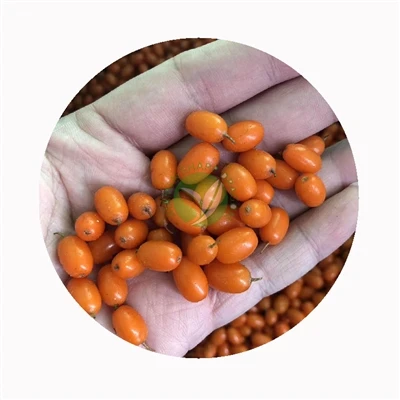
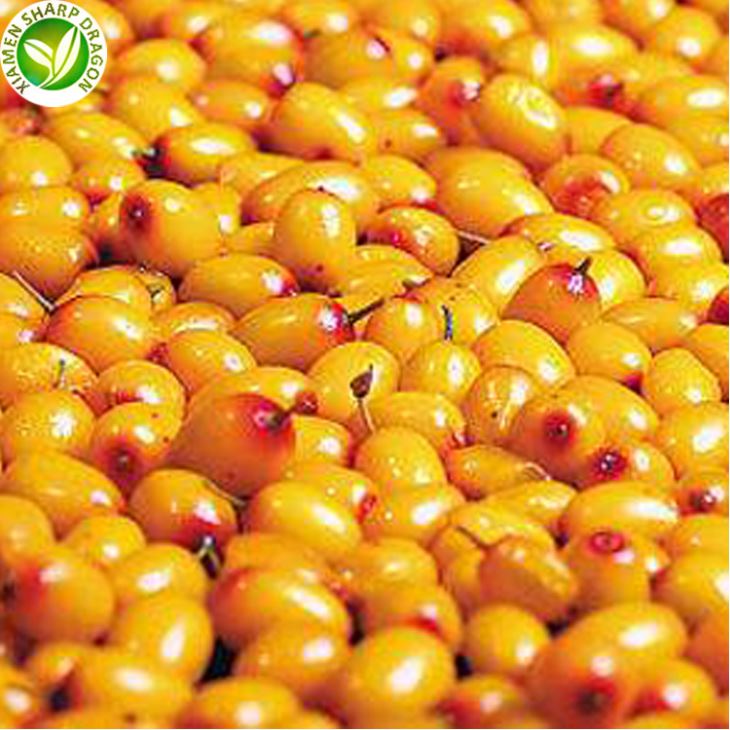
Whole frozen berries give you control over pressing, pulping, screening and blending. They work for visible-fruit concepts, fermented products, preserves, sauces, or factories that already own suitable fruit preparation equipment. You can inspect the original berry's color, maturity, size, defects and seed condition rather than receiving an already homogenized mass.
That flexibility carries cost. Sea buckthorn has thin skin, soft pulp and a seed. Thawing releases juice and may make handling messy. Crushing and screening create equipment load, labor, cleaning, residue and yield loss. A whole-berry price cannot be compared directly with a ready-to-use puree price until you calculate recovered usable mass.
Specify botanical identity, origin, crop and harvest window, maturity, color, berry size, stems, leaves, foreign material, damaged or discolored fruit, free flow, ice, clumps, package, net weight and storage. Add the processing outcome: juice or puree recovery, screen loss, seed and skin fraction, Brix, pH, titratable acidity, color and sensory result after the agreed method.
If you are new to the ingredient, compare whole berries with a screened puree from the same or similar lot. Whole fruit may give a stronger authenticity story, while puree may reduce work and variation. Our frozen sea buckthorn use overview gives general application ideas; commercial approval still needs the exact process, yield and specification.

Puree and Juice: Define Solids, Screening and Separation
Puree usually retains more suspended fruit material than clarified juice, but the words are not universal standards. One supplier may call a screened pulpy liquid puree; another may call it cloudy juice. Ask for the processing method, mesh or screen, insoluble-solids definition, centrifugation or clarification step, pulp percentage, sediment rule and photograph after standardized standing.
Sea buckthorn juice can separate because suspended solids and oil droplets do not behave like one simple clear liquid. A research sample separated into cream, middle juice and sediment phases after refrigerated standing. That does not mean every commercial product must separate the same way. It shows why homogenization, enzyme treatment, centrifugation, heat processing, stabilizers and storage conditions can change viscosity, turbidity and phase behavior.
For a beverage, measure Brix, pH, titratable acidity with acid basis, color, turbidity, viscosity, sediment, oil ring, aroma, bitterness, astringency and dilution behavior. For dairy or plant-based drinks, test protein stability and heat sequence. For sauce, jam or filling, test body, cooking loss and gel interaction. For every format, define added water, sugar, carrier, antioxidant or preservative instead of assuming a single-ingredient product.
When nutrition is a selling point, keep the format and reporting basis explicit. Review our sea buckthorn nutrition and testing guide before using a published berry or juice value in a label calculation. Whole fruit, juice, puree and oil results cannot be substituted without evidence.
Concentrate and Powder: Compare Reconstituted Performance
Concentrating juice removes water and can reduce refrigerated or frozen freight per unit of soluble solids. It also increases viscosity and flavor intensity and can change volatile aroma, color and heat exposure. Specify the concentration method, original and final Brix, concentration ratio, acid profile, reconstitution water, microbiological process, package, storage and allowable sediment.
Judge concentrate after reconstitution to the agreed basis. A 60° Brix concentrate diluted to 10° Brix uses one mass part concentrate and five mass parts water if simple soluble-solids balance applies. Actual formulation may need correction for density, added ingredients and the target measured with a calibrated refractometer. Compare the reconstituted product with the approved reference for aroma, acidity, color, turbidity and finish.
Powder is even less self-defining. Freeze-dried whole-fruit powder, spray-dried juice powder, milled pomace, seed powder and encapsulated oil powder have different ingredients and behavior. Spray-dried juice often needs a carrier such as maltodextrin or inulin. That carrier affects fruit percentage, bulk density, hygroscopicity, solubility, flavor intensity, nutrition per kilogram and label declaration.
Request moisture, water activity, fruit-solids basis, carrier type and percentage, particle-size distribution, bulk and tapped density, solubility or dispersibility, caking, color, oxidation protection, microbiology and packaging barrier. Test the powder in the actual dry blend and reconstituted product. A free-flowing sample in a small foil pouch may cake after repeated humid-air exposure on a production line.

Seed Oil and Pulp Oil Are Different Ingredients
Sea buckthorn seed oil and oil from pulp or peel differ in fatty-acid pattern and color. Published composition reviews describe seed oil as richer in C18 unsaturated fatty acids such as linoleic and alpha-linolenic acids, while pulp oil commonly has more palmitic and palmitoleic acids. Exact proportions vary with subspecies, cultivar, origin, extraction and analysis.
Require the source fraction in the product name and specification. "Sea buckthorn oil" is incomplete if your formulation depends on a fatty-acid target. Also define extraction method, refined or unrefined status, carrier or blend, fatty-acid profile, peroxide value, free fatty acids, moisture, insoluble impurities, carotenoids or tocopherols where material, heavy metals, pesticide residues, contaminants and oxidation-control package.
Protect oil from oxygen, light, heat and repeated opening. Evaluate odor and color in the finished formula because a strongly colored pulp oil may tint a beverage, capsule, emulsion or food. Seed oil may behave differently in flavor and color. Run emulsion, dispersion and shelf-life tests instead of assuming a published fatty-acid table predicts physical performance.
Do not treat an oil specification as proof of a medical or cosmetic outcome. Composition, laboratory oxidation measures and clinical effects are separate evidence categories. The sea buckthorn skin-positioning article explains how to discuss food applications without converting ingredient composition into a treatment promise.
Calculate Usable Cost, Not Only Delivered Price
Worked example: whole berries versus ready puree
Assume whole frozen berries cost $1.40 per kilogram delivered. A production trial processes 100 kilograms and recovers 68 kilograms of screened puree that meets the formula; 32 kilograms becomes seeds, skin, line hold-up and discarded residue. Raw-fruit cost is $140, so ingredient cost before labor, energy, cleaning and waste is $140 ÷ 68, or about $2.06 per usable kilogram of puree.
A ready puree costs $2.18 per kilogram delivered and has 98% usable yield after package and transfer loss. Its usable ingredient cost is $2.18 ÷ 0.98, or about $2.22 per kilogram. Whole berries appear lower by $0.16 per usable kilogram before conversion cost. If berry processing costs more than $10.88 for the 68 kilograms recovered, the ready puree becomes lower cost on this simplified basis.
The figures are hypothetical. The correct comparison also includes Brix, acidity, fruit-solids basis, nutrition target, waste value, equipment capacity, cleaning time, microbiological risk, frozen storage, minimum order, pack loss and consistency. If the whole berry creates a more valuable visible-fruit product, cost per puree kilogram may not be the deciding metric.
Practical example: choose a format for a beverage line
A beverage developer compares cloudy juice, screened puree and spray-dried juice powder. Juice pumps easily but forms an oil ring after storage. Puree gives the preferred body and orange color but increases sediment and requires stronger mixing. Powder is easy to dose and store, yet the carrier reduces fruit intensity and produces a cooked note after pasteurization.
The team should not select the lowest delivered price from the first bench sample. It prepares all three to the same target fruit-solids contribution, applies the real mixing and heat process, fills the intended package, and measures phase separation, color, acidity, flavor, vitamin target and sediment through shelf life. If a small stabilizer adjustment makes cloudy juice pass while preserving the target flavor, it may beat puree on pumping and powder on ingredient declaration.
Record the rejected alternatives and why. A future pack, process, market or claim can change the decision. The approved format should be tied to a controlled supplier specification and pilot result, not to the generic phrase "sea buckthorn ingredient."

Write the Order Specification
State product identity, botanical name where needed, source fraction, origin, crop, ingredients, concentration or dilution state, added carrier, process, heat treatment, frozen or ambient condition, Brix, pH, titratable acidity and basis, color, viscosity, mesh, pulp, sediment, oil, seed residue, sensory limits, microbiology, residues, contaminants, pack, storage, shelf life, traceability and destination documents.
Attach a method to each critical number. Define sample selection, preparation temperature, mixing, instrument, calibration, test method, result basis, rounding, retest and disposition. For visual or sensory attributes, use controlled photographs, an approved retained sample, defined lighting, preparation and panel method. A sample name without version, lot and storage history is not a stable standard.
Confirm change notification for fruit origin, cultivar, crop, maturity, puree screen, clarification, concentration, carrier, extraction, heat treatment, package or plant. A technically similar substitute can change color, acidity, phase stability, nutrition result and labeling. Decide which changes require documents only, a laboratory test, a bench sample or a full line trial.
Use a staged approval. First compare documents and a representative sample. Second run a bench formulation with an approved control. Third test the selected option on production equipment at enough scale to expose pumping, mixing, screen, heat-transfer, filling and cleaning behavior. Finally check the packed product through the planned shelf life. A sample that passes taste on day one may still fail through oil separation, sediment, caking, color loss or package interaction.
Set receiving checks for the purchased format. Frozen berries need representative product temperatures, clumps, ice and carton condition. Puree and juice need seal, temperature, thaw state, separation and odor checks. Concentrate needs identity, Brix and dilution verification. Powder needs intact moisture barrier, lot matching, caking and flow review. Oil needs seal, fill, oxidation evidence, color and odor. Hold deviations until the approved method shows their scope and application consequence.
Keep packaging linked to format. Whole berries need cold-chain and crush protection. Puree and juice need seal integrity, headspace and thaw handling. Concentrate needs transfer and dilution controls. Powder needs moisture and oxygen barriers. Oil needs oxygen, light and temperature protection. One generic carton or drum requirement cannot manage every sea buckthorn form.

Frequently Asked Questions
Is sea buckthorn puree the same as juice?
Not necessarily. Puree usually retains more suspended solids, while juice may be pressed, screened or clarified. Ask for process, mesh, insoluble solids, pulp, sediment and oil-phase definitions rather than relying on the product name.
Which format is best for beverages?
Juice suits fluid metering, puree adds body and pulp, concentrate reduces water freight, and powder suits dry dosing. Test them at the same fruit-solids contribution through mixing, heat treatment, filling and shelf life. The best format is the one that meets flavor, color, stability, claim and line targets.
Does sea buckthorn powder contain only fruit?
It depends on the process. Freeze-dried whole-fruit powder may differ from spray-dried juice powder, which often uses a carrier. Request the complete ingredient declaration, fruit-solids percentage, moisture, carrier, drying method and reconstitution performance.
What is the difference between seed oil and pulp oil?
They come from different berry fractions and typically have different fatty-acid and pigment profiles. Specify the source fraction, extraction, refining, fatty-acid limits, oxidation measures, color and contaminants. Do not purchase on the name "sea buckthorn oil" alone.
What should I send for a format recommendation?
Send the finished application, recipe role, process, target Brix and acidity, pulp or clarity preference, nutrition or claim target, package, shelf life, annual and order volume, destination, required documents, storage and equipment limits. Include an approved benchmark and pilot method where possible.
XMSD sourcing note: Tell us your sea buckthorn application, preferred fruit format, process, target solids and acidity, pack, storage, volume, destination and test requirements. We can review whole frozen berries and other practical supply options against your project specification.
Final Selection
Choose a sea buckthorn format by function. Whole berries maximize processing flexibility; puree retains body; juice improves fluid handling; concentrate reduces water; powder supports dry formulation; seed and pulp oils provide distinct lipid ingredients. Each choice changes composition, preparation, yield, packaging, testing and cost.
Compare samples on the same solids and application basis, calculate usable cost, run the full process and shelf-life trial, and lock the result into an inspectable specification with change control. That turns a broad botanical name into a repeatable commercial ingredient.
References
- Journal of Agricultural and Food Chemistry: Sea Buckthorn Products, Manufacture and Composition
- Journal of Agricultural and Food Chemistry: Processing Effects on Sea Buckthorn Juice
- Foods: Sea Buckthorn Pretreatment, Drying and High-Quality Processing
- International Journal of Environmental Research and Public Health: Analytical Review of Sea Buckthorn Composition
- Foods: Carrier, Drying and Storage Effects on Sea Buckthorn Juice Powders
- Agricultural Sciences: Chemical Composition of Sea Buckthorn Processing Products