


Sea Buckthorn Nutrition: Nutrients, Variation and Buyer Testing
Jan 17, 2019

Sea buckthorn is a tart orange berry with an unusual mix of water-soluble nutrients, colorful plant compounds and lipids. Its best-known nutrient is vitamin C, but a dependable nutrition profile must describe the species, fruit fraction, processing method and test basis.
The short answer: Sea buckthorn berries can provide vitamin C, carotenoids, vitamin E compounds, polyphenols, organic acids, natural sugars and small but nutritionally interesting oil fractions. The amount of each component varies widely, so a single universal value should not be applied to every berry, juice, powder or frozen lot.

What Nutrients Does Sea Buckthorn Contain?
The fruit contains several nutrient groups rather than one isolated "active" ingredient. A comprehensive review of sea buckthorn composition identifies vitamin C, carotenoids, polyphenols, fatty acids, phytosterols, organic acids, amino acids and minerals among the components reported in the fruit.
| Component group | Where it matters | How to interpret it |
|---|---|---|
| Vitamin C | Berry flesh and juice | Often prominent, but sensitive to origin, harvest, processing and storage |
| Carotenoids and tocopherols | Pulp and oil fractions | Contribute color and antioxidant activity; levels differ among subspecies |
| Polyphenols and flavonoids | Whole fruit and extracts | Laboratory antioxidant findings do not by themselves prove a clinical benefit |
| Organic acids and sugars | Juice and puree | Shape the berry's sharp taste and formulation needs |
| Fatty acids and phytosterols | Seed and pulp oils | More concentrated in oil than in juice; seed oil and pulp oil are not identical |

Vitamin C is the headline nutrient
A study of sea buckthorn berries and juice reported about 400 mg of vitamin C per 100 g in the berries it tested. That is a useful example, not a label value for every product. Separate research found that genetic origin and harvest date were major determinants of vitamin C concentration.
Vitamin C has established roles in collagen synthesis, antioxidant function, immune function and the absorption of nonheme iron. Those are functions of the nutrient described by the NIH Office of Dietary Supplements; they are not evidence that sea buckthorn prevents or treats a disease.
The orange color points to carotenoids, not a fixed dose
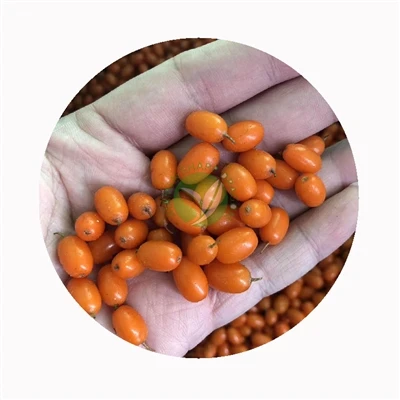
Sea buckthorn also contains carotenoids, tocopherols and phenolic compounds. A comparative study of two sea buckthorn species found meaningful differences in vitamin C, vitamin E compounds, carotenoids, sugars, acids and phenolics. The visible color is useful for product description, but it cannot replace laboratory analysis.
Why Sea Buckthorn Nutrition Numbers Vary
Sea buckthorn is not chemically uniform. Subspecies, cultivar, climate, soil, harvest date, ripeness and year can change the starting fruit. Storage time, temperature, oxygen exposure and the analytical method can change the measured result or the way it is reported.
Reading a number correctly: "mg per 100 g of whole berry," "mg per 100 mL of juice" and "mg per g of dry powder" are different bases. A value without the food form, unit basis and test method is not procurement-ready nutrition information.
This variability explains why published values can look inconsistent without either source being fabricated. It also explains why buyers should avoid building a nutrition panel or marketing claim from a generic article range.

Whole Berries, Juice, Oil and Sweetened Products Differ
Product form changes the nutrition story. Whole berries retain the fruit structure and seeds. Juice emphasizes water-soluble components but may contain less fiber. Puree can retain more fruit solids. Seed oil and pulp oil concentrate lipids and fat-soluble compounds, while contributing little of the whole berry's water-soluble vitamin profile.
- Unsweetened berry or puree: the closest match to the original fruit.
- Juice or concentrate: check concentration, serving basis and whether sugar was added.
- Seed or pulp oil: evaluate its fatty-acid and tocopherol specification separately.
- Jam, syrup or dessert: assess the complete recipe, not sea buckthorn alone.
- Powder or extract: identify the carrier, extraction method and dry-weight basis.
The berry's acidity often leads formulators to balance it with sugar or sweeter fruit. That can make a product easier to use, but it also changes energy, sugar concentration and serving size.
What Freezing Changes-and What It Does Not
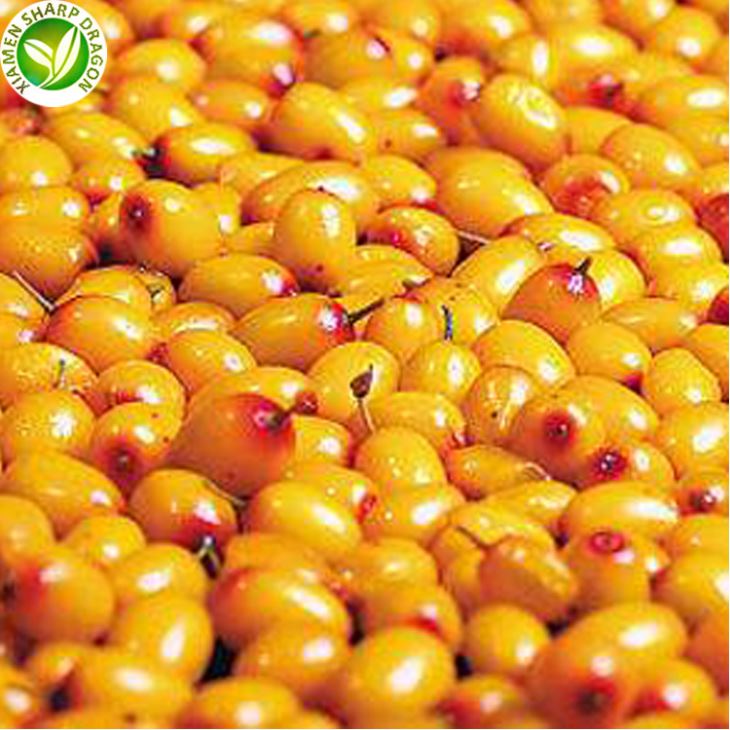
Freezing is a preservation method, not a guarantee that every nutrient remains unchanged. In one study of a single sea buckthorn cultivar, freezing temperature and storage duration affected ascorbic acid, total flavonoids, total phenolics and several physical quality measurements. Longer storage was generally associated with lower measured values.
That study helps explain the direction of change, but its exact results should not be transferred to every cultivar or commercial cold chain. Raw-material quality, freezing rate, package barrier, storage stability and thawing history all matter. Frozen fruit can remain a useful ingredient, yet a nutrition guarantee still requires a defined specification and a suitable test.
How to Read Sea Buckthorn Claims Responsibly
Composition evidence is stronger than many disease-focused claims. Researchers have identified vitamins, pigments, phenolics and lipids in sea buckthorn, but laboratory antioxidant activity does not prove that eating the berry will prevent cancer, cure inflammation or produce a guaranteed skin or heart result.
Sea buckthorn should not be presented as a natural vitamin B12 source. NIH guidance states that plant foods do not naturally contain vitamin B12; a fortified finished product would be a separate case. The unsupported B12 values sometimes repeated online should not be used on a specification or nutrition panel.
For everyday food use, evaluate the ingredient within the full diet and recipe. People following a medically prescribed diet or using concentrated supplements should seek individual guidance from a qualified health professional.
Practical Ways to Use the Berry
Sea buckthorn's tart, aromatic profile can work in blended juices, smoothies, dairy products, sorbets, sauces, preserves and bakery fillings. The best amount depends on acidity, sweetness, color target and the other ingredients in the formulation; there is no universal serving that fits every product.
For a less sweet application, the berry can be paired with yogurt, oats or a sweeter fruit rather than relying only on added sugar. For commercial development, bench testing is more informative than copying a consumer recipe because heat treatment, dilution and storage can change flavor and nutrient retention.

What B2B Buyers Should Verify
When nutrition is part of the purchase decision, the commercial specification should identify more than the product name. We recommend defining the botanical identity, whole-berry or processed format, origin, crop or lot basis, test method, reporting units and any nutrient that must meet a label or formulation target.
Start with the claim you intend to make and work backward to the evidence. If your finished label depends on vitamin C, you need a realistic ingredient contribution after storage and processing, not the highest value found in a paper. If your product is sold through a nutrition or beauty concept, read our sea buckthorn food and skin-positioning guide before turning composition research into a consumer promise.
- Confirm whether the result applies to whole fruit, juice, puree, oil or dry powder.
- Request a batch-specific certificate or laboratory report when a nutrient claim is material.
- Review soluble-solids and acidity targets for beverage, dairy or sauce applications.
- Agree on defect tolerance, foreign-material control and sensory expectations.
- Match the frozen packaging format and labeling to the destination market and cold chain.
- Validate the finished product after heat treatment, dilution and storage rather than assuming the raw-fruit value will remain unchanged.
Build a Testable Nutrition Specification
A usable specification identifies exactly what is being tested. Write the botanical species or accepted commercial identity, fruit part, format, added ingredients, concentration state, crop or production lot, and sampling point. Whole frozen berries, seedless puree, clarified juice, concentrate, pomace powder, seed oil and pulp oil are not interchangeable samples. A result from dry powder cannot be copied into a whole-berry data sheet without a valid conversion.
Next define the reporting basis. State whether the value is per 100 grams, per 100 milliliters, per serving, on an as-sold basis, or on a dry-matter basis. Record the analytical method, laboratory, limit of quantification, number of composite increments, result rounding, and whether uncertainty is reported. Without that information, two correct laboratory reports can appear to conflict simply because they use different units or moisture bases.
Set commercial limits only after representative data. One attractive pre-shipment sample may not represent cultivar, field, maturity, processing date, storage age or the full lot. For a new program, test several production lots and seasons where possible. Use a minimum only when the supplier can control and verify it; otherwise use a typical information range and do not build a regulated label claim that depends on an unguaranteed number.
Separate identity and quality tests from nutrition tests. Brix, titratable acidity, pH, color, seed content, defects, free flow, odor, microbiology and pesticide-residue controls help you approve the ingredient, but they do not replace vitamin or carotenoid analysis. In the same way, an orange color does not quantify carotenoids and a sharp taste does not quantify vitamin C.
Confirm change control. A different origin, cultivar, crop year, maturity window, juice yield, concentration step, carrier, heat treatment, freeze-drying condition, pack barrier or storage duration may change the declared profile. State which changes require notice, new samples, new nutrition testing, a formulation trial, or revised artwork. Review current frozen berry forms through the XMSD sea buckthorn range, then confirm the actual format, origin, crop, process, pack and test plan for your order.
Worked example: convert a vitamin C result to the serving
Assume a laboratory reports 240 milligrams of vitamin C per 100 grams of an unsweetened sea buckthorn puree. A beverage formula uses 12 grams of that puree in one 250-milliliter serving. The ingredient contribution before processing is 240 ÷ 100 × 12, or 28.8 milligrams of vitamin C per serving.
Now assume a validated pilot finds 75% retention after mixing, heat treatment and the intended storage period. The estimated end-of-shelf-life contribution is 28.8 × 0.75, or 21.6 milligrams per serving. The formulation team must still test the finished beverage using the destination market's accepted method and claim rules. The calculation is a development tool, not a substitute for finished-product verification.
The values are hypothetical. Your actual result can change with the berry lot, puree concentration, oxygen, pH, heat load, package, storage temperature and shelf life. If the label claim fails when retention is lower than expected, the right action may be a larger ingredient dose, a process or package change, permitted fortification, a different claim, or no claim at all.
Practical example: compare two puree offers on usable solids
A beverage buyer compares puree A at $1.60 per kilogram and 10° Brix with puree B at $1.84 per kilogram and 13° Brix. Using Brix only as a formulation screening value, one kilogram of A contains about 0.10 kilogram soluble solids, so its price is $16.00 per kilogram of soluble solids. B contains about 0.13 kilogram, giving $1.84 ÷ 0.13, or about $14.15 per kilogram of soluble solids.
Puree B looks more economical on this one basis, but that does not make it nutritionally superior. The buyer still compares acidity, pulp, color, seed residue, flavor, vitamin target, microbiology, process yield and the amount needed in the final recipe. Brix is not a direct measure of vitamin C or every fruit solid. Use the calculation to expose formulation cost, then let the complete specification and pilot decide the purchase.
Keep the approved evidence together: supplier specification, laboratory reports, sample identity, raw data, formulation calculation, pilot process, finished-product result, packaging, shelf-life checkpoints, label review and sign-off. That file lets procurement, R&D, QA and regulatory teams trace the number without relying on a copied web claim.

XMSD sourcing note: We supply frozen sea buckthorn berries for B2B programs. Tell us the intended application, berry format, packing format and any test requirement so we can discuss the relevant product specification instead of relying on a generic nutrition number.
Frequently Asked Questions
1. What are the main nutrients in sea buckthorn?
The berry is known for vitamin C and also contains carotenoids, tocopherols, polyphenols, organic acids, natural sugars, minerals and lipid fractions. The exact profile depends on the berry and product form.
2. Is sea buckthorn high in vitamin C?
Many tested sea buckthorn berries are rich in vitamin C, but the concentration varies widely by genetic origin, harvest date, processing and storage. A product-specific result is more reliable than a universal internet range.
3. How much vitamin C is in 100 g of sea buckthorn?
One published study reported approximately 400 mg per 100 g in the berries it tested, but other studies show substantial variation. Use that number as research context, not as the guaranteed value of an untested lot.
4. Does sea buckthorn naturally contain vitamin B12?
Sea buckthorn should not be treated as a natural vitamin B12 source. Plant foods do not naturally contain vitamin B12 according to NIH guidance. A fortified drink or food could contain added B12, which should be shown on its label.
5. Are sea buckthorn oil and whole berries nutritionally the same?
No. Oil concentrates fatty acids and fat-soluble compounds, while whole berries and juice contain more water-soluble components. Seed oil and pulp oil also have different profiles.
6. Does freezing destroy sea buckthorn vitamin C?
Freezing does not instantly remove vitamin C, but retention is not absolute. Research on frozen sea buckthorn shows that temperature and storage duration can affect ascorbic acid and other measured quality components.
7. Is frozen sea buckthorn less nutritious than fresh?
A simple yes or no is misleading. Fresh-fruit quality changes after harvest, while frozen-fruit quality depends on the starting material, freezing process, packaging and storage history. Compare tested products on the same basis.
8. Is sea buckthorn juice the same as eating whole berries?
Not exactly. Juice can provide vitamin C and other soluble compounds, but it may contain less fiber and may be concentrated or sweetened. Check the ingredient list and serving basis.
9. Why is sugar often added to sea buckthorn products?
The fruit is naturally tart and acidic, so sugar may be used to balance flavor. Added sugar changes the nutrition of the finished product and should be evaluated separately from the berry.
10. Can sea buckthorn be eaten every day?
It can be included as one fruit ingredient in a varied diet, but there is no evidence-based universal daily amount for every person or product. Portion, concentration, added sugar and individual tolerance matter.
11. Does sea buckthorn cure or prevent disease?
Its nutrient and phytochemical composition is well documented, but that does not establish it as a treatment. Laboratory, animal and limited human findings should not be turned into promises of prevention or cure.
12. What gives sea buckthorn its orange color?
Carotenoid pigments contribute to the orange or golden color. Their amount and pattern vary by species, cultivar and fruit maturity, so color alone is not a quantitative nutrient test.
13. Which form works best for food manufacturing?
Whole frozen berries suit products that can handle seeds and visible fruit. Puree or juice may suit beverages and sauces, while oil is a different ingredient class. The answer depends on texture, acidity, color and process conditions.
14. What nutrition evidence should a B2B buyer request?
Request the product specification and, when a nutrition claim matters, a batch-specific report that identifies the sample, analytical method, units and laboratory. Also confirm whether the result applies to the raw ingredient or the finished formulation.
Final Thoughts from XMSD
Sea buckthorn is nutritionally distinctive because vitamin C, carotenoids, phenolics and berry oils occur in the same fruit. The responsible way to describe it is to separate proven composition from proposed health effects and to use product-specific testing whenever a number becomes a commercial claim.
References
- Phytochemistry, health benefits, and food applications of sea buckthorn: a comprehensive review
- Vitamin C content in sea buckthorn berries and related products: storage stability and processing effects
- Effects of origin and harvesting time on vitamin C, tocopherols, and tocotrienols in sea buckthorn berries
- Comparative assessment of functional components in two sea buckthorn species
- Quality attributes of sea buckthorn berries under differing freezing regimes
- Chemical composition analysis of sea buckthorn from three growing regions
- NIH Office of Dietary Supplements: Vitamin C Fact Sheet for Health Professionals
- NIH Office of Dietary Supplements: Vitamin B12 Fact Sheet for Health Professionals
- XMSD operational experience in frozen-food sourcing, processing coordination, packaging and cold-chain handling.