


What is the right time to eat mango?
Nov 07, 2019

There is no universal hour when mango becomes healthier or easier to absorb. For most people, the right time to eat mango is when the fruit is properly ripe, the portion fits the meal, and eating it then does not aggravate reflux or another known digestive problem. Breakfast, lunch, an afternoon snack, or dessert can all work. The useful decision is not "morning versus evening" by itself; it is whether mango is replacing another food or simply adding more energy to an already complete meal.
Start with a portion you can see and repeat. Whole fresh pieces or plain frozen mango make that easier than a large sweetened drink. Pairing mango with yogurt, oats, nuts, or a normal meal can also make the eating occasion more complete. If you have troublesome nighttime reflux, the National Institute of Diabetes and Digestive and Kidney Diseases advises leaving at least three hours between a meal and lying down. That is a reason to move the eating occasion earlier, not evidence that mango itself has a forbidden time.
The short answer: Eat mango when it is ripe and when the portion fits your meal. Change the timing only for a practical reason, such as exercise, appetite, meal planning, reflux near bedtime, or the service window of thawed frozen fruit.

First Decide Whether "Right Time" Means Ripeness or Clock Time
The question has two different meanings. One person wants to know whether mango belongs at breakfast or after dinner. Another person is looking at a firm fruit and wants to know whether it is ready to cut. Mixing those questions creates poor advice. Clock time mainly changes meal context, appetite, and symptoms. Ripeness changes sweetness, aroma, firmness, cut yield, and the pleasure of eating the fruit.
For a fresh mango, color alone is an unreliable readiness test because varieties remain green, turn yellow, or develop red skin differently. A better household check combines a slight give under gentle pressure, a fruity aroma near the stem, and flesh that cuts cleanly without being hard or watery. The USDA SNAP-Ed produce guide notes that mango continues to ripen after harvest. If the fruit is still hard and lacks aroma, waiting at room temperature is normally more useful than debating breakfast versus lunch.
Frozen mango removes much of the ripeness decision from the kitchen, but it introduces a service decision. IQF pieces may be used from frozen in smoothies, partially thawed for bowls, or fully thawed for sauces and fillings. The correct moment is the point at which the texture matches the application. A cube that is pleasant in a blended drink may still be too firm for a yogurt topping, while a fully thawed slice may release more liquid than a pastry needs.
From our frozen-fruit perspective, this distinction matters because "ready" is observable. We look at piece separation, surface ice, firmness after a defined thaw, and liquid released into the container. Those signals tell you more about serving performance than a claim that mango must be eaten at a particular hour.

Choose the Eating Occasion by What Mango Is Doing in the Meal
Mango can be part of several sensible eating occasions. At breakfast it can add fruit to plain yogurt or oats. At lunch it can sit in a grain bowl or salsa. In the afternoon it can replace a confectionery snack. After dinner it can provide a measured dessert. None of those occasions is automatically superior. The difference is the rest of the meal and the amount served.
Breakfast works when mango completes the plate
A bowl made only from fruit may not keep everyone satisfied for long. If breakfast is the chosen time, combine mango with a source of protein, fat, or whole grain that fits your normal diet. Plain yogurt, milk, soy yogurt, oats, nuts, or seeds are common options. The mango supplies fruit, sweetness, and texture; the rest of the bowl determines whether the meal is substantial enough for the morning.
A snack works when mango replaces rather than piles on
An afternoon portion is useful when it takes the place of another snack. If mango is added on top of chips, a sweet drink, and a full meal, timing does not cancel the extra intake. This replacement test is especially important when the reason for asking about timing is body weight. No clock hour turns mango into a fat-burning food, and no clock hour makes a reasonable portion inherently fattening.
Dessert works when the portion remains visible
Mango after a meal can be a practical dessert. Serve pieces in a bowl rather than drinking a large blended portion whose fruit quantity is difficult to see. The finished recipe matters. Plain fruit, mango in syrup, ice cream, sweetened yogurt, and a large smoothie are different foods even when each contains mango. Judge the complete dish instead of assigning the effect to the fruit name.
Practical example: Suppose a person normally buys a 60 g pastry for a 3 p.m. snack. They replace it with 140 g of thawed mango pieces and 120 g of plain yogurt. The decision is not that 3 p.m. is a special mango hour. The useful change is a visible fruit portion replacing the pastry while yogurt makes the snack more complete. If hunger returns too quickly, the next adjustment is the meal composition, not moving mango to 10 a.m.

Portion and Product Form Matter More Than Morning or Night
Timing questions often hide a portion question. "A mango" is not a consistent unit because fruit size and edible yield vary. A cup, a weighed gram amount, or a defined number of frozen pieces is more repeatable. You do not need to weigh fruit forever, but measuring a few servings teaches your eye what a normal bowl looks like.
The product form changes how easy that measurement is. Whole fruit includes peel and stone, so purchase weight is not edible weight. Frozen dice are already prepared and can be portioned directly from the bag. Mango puree and juice are easy to pour, but their fruit quantity and any added ingredients should be read from the label. Dried mango concentrates the fruit into a smaller volume, and sweetened dried mango adds another variable.
| Mango form | Main timing question | Useful control |
|---|---|---|
| Fresh whole mango | Is it ripe enough to cut? | Check aroma, gentle give, and flesh quality |
| IQF pieces | How far should the pieces thaw? | Define time, temperature, texture, and drip |
| Puree or smoothie | How much fruit and added ingredient is in the drink? | Measure the recipe and read the label |
For a repeatable kitchen test, choose one basis and keep it constant. A breakfast bowl might use 120 g of mango pieces; a beverage trial might use 80 g per 400 ml finished drink; a dessert garnish might use 45 g per plate. These are illustrative test quantities, not universal dietary targets or XMSD product specifications. Their value is that they make comparisons honest.
If one mango occasion feels too sweet or too large, reduce the portion or move some fruit into another meal. Splitting a large amount is a practical response. Declaring all mango unsafe after a particular hour is not.

When Evening Timing Deserves a Different Decision
Most people do not need a mango curfew. Evening becomes relevant when it changes comfort, sleep, or the size of the eating occasion. Someone who lies down soon after a large meal may experience reflux regardless of whether the last food was mango, bread, or another dessert. NIDDK guidance for people with nighttime GERD symptoms is to finish meals at least three hours before lying down or going to bed.
Use symptoms rather than internet rules. If a small mango portion after dinner causes no problem, there is no evidence-based reason to move it to morning solely because of the clock. If late eating repeatedly brings burning, regurgitation, bloating, or disturbed sleep, try an earlier occasion and a smaller complete meal. Persistent or severe symptoms deserve professional assessment rather than a long list of banned fruits.
Safety note: Mango can cause allergic reactions in susceptible people, and contact with peel or sap can be relevant for some individuals. Difficulty breathing, facial swelling, or another severe reaction requires urgent medical care. Timing is not a solution to a true allergy.
People managing diabetes or another condition that changes carbohydrate planning should fit mango into the plan agreed with their clinician or dietitian. The useful details are portion, product label, accompanying foods, and individual response. "Never after 6 p.m." is too blunt to replace those details.
For Frozen Mango, Build a Thaw-and-Service Window
A consumer timing question becomes an operational timing question in foodservice and manufacturing. Frozen mango does not have one correct thaw time for every cut and recipe. Dice, chunks, and slices have different surface-area-to-volume ratios. A smoothie can accept hard frozen pieces, a parfait may need pieces that are cold but biteable, and a bakery filling may need controlled thawing and drainage so free liquid does not weaken the dough.
For us, the first useful test is not a clock printed without conditions. It is a small trial with a defined product form, thaw environment, portion depth, and target texture. Record the starting weight, time, temperature, firmness, separated liquid, and finished-recipe result. Repeat the same method before changing two variables at once.
Worked example: A café wants 30 breakfast bowls, each with 90 g of mango dice. It needs 2,700 g of usable fruit. In a representative trial, the team thaws 1,000 g under its controlled refrigerated procedure and measures 940 g of drained pieces that meet the texture target. The illustrative usable-yield factor is 0.94. Dividing 2,700 g by 0.94 gives about 2,872 g, so the café rounds its trial pull to 2.9 kg. If the next batch or cut produces a different yield, the pull quantity changes. The calculation makes the service time repeatable without pretending that 94% is a universal specification.
The failure signals are easy to see: clumped pieces that portion unevenly, soft edges with a frozen center, excessive liquid in the bottom of the pan, browning, or a hold time that extends beyond the kitchen's food-safety procedure. Correct the thaw depth, container loading, cut choice, or pull schedule. Moving service from 8 a.m. to 9 a.m. without changing those variables will not solve the underlying problem.

Match the Mango Cut to the Eating Occasion
Cut shape changes the eating experience and the service window. Dice distribute evenly through yogurt and oats. Larger chunks keep a more obvious fruit bite in smoothies and bowls. Slices suit plated desserts but can be less convenient for measured spoon portions. Puree gives consistent flavor distribution but removes the visual piece identity that some menus need.
The frozen mango category shows why product form should be named rather than hidden behind the word "mango." If your application needs individual pieces, compare cut consistency and separation. If it needs a smooth base, a different form may be appropriate. The choice should follow the finished food, not a fashionable time-of-day rule.
For a plate where presentation matters, frozen mango slices provide a different visual and thaw behavior from cubes. For blended or mixed applications, the IQF frozen mango format gives another useful reference point. Review the actual cut, piece condition, and application trial before treating those pages as interchangeable.
Packaging also affects timing after a bag is opened. A foodservice kitchen that needs one small portion per shift should avoid repeatedly exposing a large open pack if a smaller inner-pack plan is available. Review the relevant frozen packaging considerations together with pull quantity, storage, and the operation's handling procedure.
A separate XMSD guide on the best time to eat mango in meal context focuses on portion placement. The next decision is readiness: identify the product form first, then choose the meal or service window that preserves the intended texture and keeps the portion visible.

A Four-Question Timing Test
1. Is the mango ready? For fresh fruit, check ripeness and sound condition. For frozen fruit, decide whether the recipe needs frozen, partially thawed, or fully thawed pieces. Do not let the clock override a visibly unsuitable product state.
2. What is mango replacing or completing? Name the eating occasion. If it replaces another snack, record that. If it is added to a full dessert, count the finished dish. For a commercial recipe, name the function: fruit identity, sweetness, color, texture, yield, or garnish.
3. Can you see the portion? Pieces in a bowl are easier to judge than a freely poured drink. Use grams, cups, pieces, or recipe percentages during a trial. Once the team can recognize the target portion, routine service becomes faster.
4. Does the timing create a real problem? Look for repeated reflux near bedtime, poor appetite before a main meal, unwanted liquid after thawing, inconsistent bowl weight, or fruit held too long. Move the timing only when doing so addresses an observed issue. Otherwise keep the occasion that is practical and enjoyable.
Common Questions About Mango Timing
Is morning the healthiest time to eat mango?
Morning can be convenient, but it does not make mango uniquely nutritious. Judge the entire breakfast, the portion, and your tolerance. A balanced bowl at breakfast and a measured dessert after lunch can both be reasonable.
Should mango be eaten before or after a meal?
Either can work. Before a meal, a large fruit portion may reduce appetite for the meal; after a meal, it adds to the total. Choose the placement that fits your purpose and keeps the amount sensible. There is no need to separate mango from other foods for normal digestion.
Can frozen mango be eaten without thawing?
Frozen pieces are commonly used directly in blended applications. For spoon eating, very hard pieces may be uncomfortable and unsuitable for young children or anyone with chewing difficulty. Follow the package directions and thaw to the texture the application needs while maintaining sound food handling.
How should a foodservice buyer define the right time?
Define it as a service specification: product form, pull quantity, thaw environment, target piece temperature or texture, maximum hold within the operation's procedure, drained yield, and finished-dish acceptance. That converts "right time" into a repeatable process.
Keep the first trial small enough to observe. Photograph the pieces at removal from the freezer, at the planned service point, and after the intended hold. Record whether the surface is dry or wet, whether pieces separate without force, and whether the cut remains recognizable in the finished bowl. A clock entry without those observations cannot explain why one trial succeeds and another fails.
The same record helps purchasing and kitchen staff discuss the product without vague language. "Thaw for one hour" may describe only one container depth and room condition. "Serve when the 90 g portion is spoonable, the center is no longer hard, and free liquid stays within the agreed trial limit" describes an outcome. Temperature control and maximum holding remain governed by the operation's food-safety system, while the texture and yield record sets the quality decision.
XMSD sourcing note: For a frozen mango trial, send the application, preferred cut, portion basis, thaw method, packing format, destination, and the texture or drip result that will count as acceptable.
References
- National Institute of Diabetes and Digestive and Kidney Diseases - Eating, Diet, & Nutrition for GER & GERD
- USDA SNAP-Ed - Mangos Seasonal Produce Guide
- National Mango Board - Ripe and Ready-to-Eat Mango Quality Guidance
- XMSD operational perspective on IQF mango cut, thaw behavior, portion control, packaging, and food-application trials.
There is no universal hour when mango becomes healthier or easier to absorb. For most people, the right time to eat mango is when the fruit is properly ripe, the portion fits the meal, and eating it then does not aggravate reflux or another known digestive problem. Breakfast, lunch, an afternoon snack, or dessert can all work. The useful decision is not "morning versus evening" by itself; it is whether mango is replacing another food or simply adding more energy to an already complete meal.
Start with a portion you can see and repeat. Whole fresh pieces or plain frozen mango make that easier than a large sweetened drink. Pairing mango with yogurt, oats, nuts, or a normal meal can also make the eating occasion more complete. If you have troublesome nighttime reflux, the National Institute of Diabetes and Digestive and Kidney Diseases advises leaving at least three hours between a meal and lying down. That is a reason to move the eating occasion earlier, not evidence that mango itself has a forbidden time.
The short answer: Eat mango when it is ripe and when the portion fits your meal. Change the timing only for a practical reason, such as exercise, appetite, meal planning, reflux near bedtime, or the service window of thawed frozen fruit.
First Decide Whether "Right Time" Means Ripeness or Clock Time
The question has two different meanings. One person wants to know whether mango belongs at breakfast or after dinner. Another person is looking at a firm fruit and wants to know whether it is ready to cut. Mixing those questions creates poor advice. Clock time mainly changes meal context, appetite, and symptoms. Ripeness changes sweetness, aroma, firmness, cut yield, and the pleasure of eating the fruit.
For a fresh mango, color alone is an unreliable readiness test because varieties remain green, turn yellow, or develop red skin differently. A better household check combines a slight give under gentle pressure, a fruity aroma near the stem, and flesh that cuts cleanly without being hard or watery. The USDA SNAP-Ed produce guide notes that mango continues to ripen after harvest. If the fruit is still hard and lacks aroma, waiting at room temperature is normally more useful than debating breakfast versus lunch.
Frozen mango removes much of the ripeness decision from the kitchen, but it introduces a service decision. IQF pieces may be used from frozen in smoothies, partially thawed for bowls, or fully thawed for sauces and fillings. The correct moment is the point at which the texture matches the application. A cube that is pleasant in a blended drink may still be too firm for a yogurt topping, while a fully thawed slice may release more liquid than a pastry needs.
From our frozen-fruit perspective, this distinction matters because "ready" is observable. We look at piece separation, surface ice, firmness after a defined thaw, and liquid released into the container. Those signals tell you more about serving performance than a claim that mango must be eaten at a particular hour.
Choose the Eating Occasion by What Mango Is Doing in the Meal
Mango can be part of several sensible eating occasions. At breakfast it can add fruit to plain yogurt or oats. At lunch it can sit in a grain bowl or salsa. In the afternoon it can replace a confectionery snack. After dinner it can provide a measured dessert. None of those occasions is automatically superior. The difference is the rest of the meal and the amount served.
Breakfast works when mango completes the plate
A bowl made only from fruit may not keep everyone satisfied for long. If breakfast is the chosen time, combine mango with a source of protein, fat, or whole grain that fits your normal diet. Plain yogurt, milk, soy yogurt, oats, nuts, or seeds are common options. The mango supplies fruit, sweetness, and texture; the rest of the bowl determines whether the meal is substantial enough for the morning.
A snack works when mango replaces rather than piles on
An afternoon portion is useful when it takes the place of another snack. If mango is added on top of chips, a sweet drink, and a full meal, timing does not cancel the extra intake. This replacement test is especially important when the reason for asking about timing is body weight. No clock hour turns mango into a fat-burning food, and no clock hour makes a reasonable portion inherently fattening.
Dessert works when the portion remains visible
Mango after a meal can be a practical dessert. Serve pieces in a bowl rather than drinking a large blended portion whose fruit quantity is difficult to see. The finished recipe matters. Plain fruit, mango in syrup, ice cream, sweetened yogurt, and a large smoothie are different foods even when each contains mango. Judge the complete dish instead of assigning the effect to the fruit name.
Practical example: Suppose a person normally buys a 60 g pastry for a 3 p.m. snack. They replace it with 140 g of thawed mango pieces and 120 g of plain yogurt. The decision is not that 3 p.m. is a special mango hour. The useful change is a visible fruit portion replacing the pastry while yogurt makes the snack more complete. If hunger returns too quickly, the next adjustment is the meal composition, not moving mango to 10 a.m.
Portion and Product Form Matter More Than Morning or Night
Timing questions often hide a portion question. "A mango" is not a consistent unit because fruit size and edible yield vary. A cup, a weighed gram amount, or a defined number of frozen pieces is more repeatable. You do not need to weigh fruit forever, but measuring a few servings teaches your eye what a normal bowl looks like.
The product form changes how easy that measurement is. Whole fruit includes peel and stone, so purchase weight is not edible weight. Frozen dice are already prepared and can be portioned directly from the bag. Mango puree and juice are easy to pour, but their fruit quantity and any added ingredients should be read from the label. Dried mango concentrates the fruit into a smaller volume, and sweetened dried mango adds another variable.
| Mango form | Main timing question | Useful control |
|---|---|---|
| Fresh whole mango | Is it ripe enough to cut? | Check aroma, gentle give, and flesh quality |
| IQF pieces | How far should the pieces thaw? | Define time, temperature, texture, and drip |
| Puree or smoothie | How much fruit and added ingredient is in the drink? | Measure the recipe and read the label |
For a repeatable kitchen test, choose one basis and keep it constant. A breakfast bowl might use 120 g of mango pieces; a beverage trial might use 80 g per 400 ml finished drink; a dessert garnish might use 45 g per plate. These are illustrative test quantities, not universal dietary targets or XMSD product specifications. Their value is that they make comparisons honest.
If one mango occasion feels too sweet or too large, reduce the portion or move some fruit into another meal. Splitting a large amount is a practical response. Declaring all mango unsafe after a particular hour is not.
When Evening Timing Deserves a Different Decision
Most people do not need a mango curfew. Evening becomes relevant when it changes comfort, sleep, or the size of the eating occasion. Someone who lies down soon after a large meal may experience reflux regardless of whether the last food was mango, bread, or another dessert. NIDDK guidance for people with nighttime GERD symptoms is to finish meals at least three hours before lying down or going to bed.
Use symptoms rather than internet rules. If a small mango portion after dinner causes no problem, there is no evidence-based reason to move it to morning solely because of the clock. If late eating repeatedly brings burning, regurgitation, bloating, or disturbed sleep, try an earlier occasion and a smaller complete meal. Persistent or severe symptoms deserve professional assessment rather than a long list of banned fruits.
Safety note: Mango can cause allergic reactions in susceptible people, and contact with peel or sap can be relevant for some individuals. Difficulty breathing, facial swelling, or another severe reaction requires urgent medical care. Timing is not a solution to a true allergy.
People managing diabetes or another condition that changes carbohydrate planning should fit mango into the plan agreed with their clinician or dietitian. The useful details are portion, product label, accompanying foods, and individual response. "Never after 6 p.m." is too blunt to replace those details.
For Frozen Mango, Build a Thaw-and-Service Window
A consumer timing question becomes an operational timing question in foodservice and manufacturing. Frozen mango does not have one correct thaw time for every cut and recipe. Dice, chunks, and slices have different surface-area-to-volume ratios. A smoothie can accept hard frozen pieces, a parfait may need pieces that are cold but biteable, and a bakery filling may need controlled thawing and drainage so free liquid does not weaken the dough.
For us, the first useful test is not a clock printed without conditions. It is a small trial with a defined product form, thaw environment, portion depth, and target texture. Record the starting weight, time, temperature, firmness, separated liquid, and finished-recipe result. Repeat the same method before changing two variables at once.
Worked example: A café wants 30 breakfast bowls, each with 90 g of mango dice. It needs 2,700 g of usable fruit. In a representative trial, the team thaws 1,000 g under its controlled refrigerated procedure and measures 940 g of drained pieces that meet the texture target. The illustrative usable-yield factor is 0.94. Dividing 2,700 g by 0.94 gives about 2,872 g, so the café rounds its trial pull to 2.9 kg. If the next batch or cut produces a different yield, the pull quantity changes. The calculation makes the service time repeatable without pretending that 94% is a universal specification.
The failure signals are easy to see: clumped pieces that portion unevenly, soft edges with a frozen center, excessive liquid in the bottom of the pan, browning, or a hold time that extends beyond the kitchen's food-safety procedure. Correct the thaw depth, container loading, cut choice, or pull schedule. Moving service from 8 a.m. to 9 a.m. without changing those variables will not solve the underlying problem.
Match the Mango Cut to the Eating Occasion
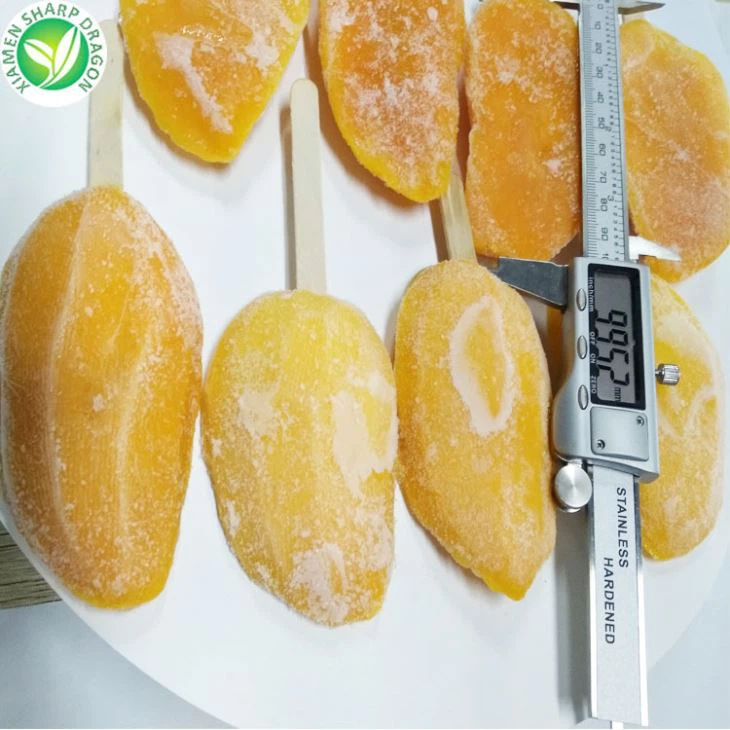
Cut shape changes the eating experience and the service window. Dice distribute evenly through yogurt and oats. Larger chunks keep a more obvious fruit bite in smoothies and bowls. Slices suit plated desserts but can be less convenient for measured spoon portions. Puree gives consistent flavor distribution but removes the visual piece identity that some menus need.
The frozen mango category shows why product form should be named rather than hidden behind the word "mango." If your application needs individual pieces, compare cut consistency and separation. If it needs a smooth base, a different form may be appropriate. The choice should follow the finished food, not a fashionable time-of-day rule.
For a plate where presentation matters, frozen mango slices provide a different visual and thaw behavior from cubes. For blended or mixed applications, the IQF frozen mango format gives another useful reference point. Review the actual cut, piece condition, and application trial before treating those pages as interchangeable.
Packaging also affects timing after a bag is opened. A foodservice kitchen that needs one small portion per shift should avoid repeatedly exposing a large open pack if a smaller inner-pack plan is available. Review the relevant frozen packaging considerations together with pull quantity, storage, and the operation's handling procedure.
A separate XMSD guide on the best time to eat mango in meal context focuses on portion placement. This page serves a different decision: first identify readiness and product form, then choose the meal or service window that preserves the intended texture and keeps the portion visible.
A Four-Question Timing Test
1. Is the mango ready? For fresh fruit, check ripeness and sound condition. For frozen fruit, decide whether the recipe needs frozen, partially thawed, or fully thawed pieces. Do not let the clock override a visibly unsuitable product state.
2. What is mango replacing or completing? Name the eating occasion. If it replaces another snack, record that. If it is added to a full dessert, count the finished dish. For a commercial recipe, name the function: fruit identity, sweetness, color, texture, yield, or garnish.
3. Can you see the portion? Pieces in a bowl are easier to judge than a freely poured drink. Use grams, cups, pieces, or recipe percentages during a trial. Once the team can recognize the target portion, routine service becomes faster.
4. Does the timing create a real problem? Look for repeated reflux near bedtime, poor appetite before a main meal, unwanted liquid after thawing, inconsistent bowl weight, or fruit held too long. Move the timing only when doing so addresses an observed issue. Otherwise keep the occasion that is practical and enjoyable.
Common Questions About Mango Timing
Is morning the healthiest time to eat mango?
Morning can be convenient, but it does not make mango uniquely nutritious. Judge the entire breakfast, the portion, and your tolerance. A balanced bowl at breakfast and a measured dessert after lunch can both be reasonable.
Should mango be eaten before or after a meal?
Either can work. Before a meal, a large fruit portion may reduce appetite for the meal; after a meal, it adds to the total. Choose the placement that fits your purpose and keeps the amount sensible. There is no need to separate mango from other foods for normal digestion.
Can frozen mango be eaten without thawing?
Frozen pieces are commonly used directly in blended applications. For spoon eating, very hard pieces may be uncomfortable and unsuitable for young children or anyone with chewing difficulty. Follow the package directions and thaw to the texture the application needs while maintaining sound food handling.
How should a foodservice buyer define the right time?
Define it as a service specification: product form, pull quantity, thaw environment, target piece temperature or texture, maximum hold within the operation's procedure, drained yield, and finished-dish acceptance. That converts "right time" into a repeatable process.
Keep the first trial small enough to observe. Photograph the pieces at removal from the freezer, at the planned service point, and after the intended hold. Record whether the surface is dry or wet, whether pieces separate without force, and whether the cut remains recognizable in the finished bowl. A clock entry without those observations cannot explain why one trial succeeds and another fails.
The same record helps purchasing and kitchen staff discuss the product without vague language. "Thaw for one hour" may describe only one container depth and room condition. "Serve when the 90 g portion is spoonable, the center is no longer hard, and free liquid stays within the agreed trial limit" describes an outcome. Temperature control and maximum holding remain governed by the operation's food-safety system, while the texture and yield record sets the quality decision.
XMSD sourcing note: For a frozen mango trial, send the application, preferred cut, portion basis, thaw method, packing format, destination, and the texture or drip result that will count as acceptable.
References
- National Institute of Diabetes and Digestive and Kidney Diseases - Eating, Diet, & Nutrition for GER & GERD
- USDA SNAP-Ed - Mangos Seasonal Produce Guide
- National Mango Board - Ripe and Ready-to-Eat Mango Quality Guidance
- XMSD operational perspective on IQF mango cut, thaw behavior, portion control, packaging, and food-application trials.
Eating mango before breakfast is the right time, because eating mango at this time can make the stomach more easily absorb the nutrition of mango, and during this time, people need to supplement nutrients most, but the digestive function of the stomach has not been fully activated.At this time, eat mangoes that are easily digested.Not only can add vitamins, but it also plays an appetizing role.
