


What Is Pumpkin Rich In? Nutrition, Forms and Labels
Jul 31, 2019

Pumpkin flesh is most notable for provitamin A carotenoids, which are reflected in its vitamin A value. It also supplies carbohydrate, some fiber, vitamin C, potassium and smaller amounts of several other micronutrients. It is not rich in protein or fat. USDA FoodData Central lists plain cooked pumpkin, boiled and drained without salt, at 288 mcg retinol activity equivalents (RAE) of vitamin A per 100 g, compared with 4.9 g carbohydrate, 1.1 g fiber, 0.72 g protein and 0.07 g fat on the same basis.
That answer applies to a named form and basis, not every product with pumpkin in its name. Raw cubes, boiled flesh, concentrated purée, frozen pieces, seed kernels, pie filling and soup can have very different water content, ingredients, serving weights and nutrient values. Color alone cannot verify a vitamin A amount, and a generic food-database entry is not a finished-product certificate.
The words "rich in" need equal care. In everyday conversation they may simply mean "contains a noteworthy amount." On a U.S. food label, however, "high," "rich in" and "excellent source of" are defined nutrient content claims. The product must meet the applicable threshold on the required reference basis. Start with the food identity, measured serving and destination rule before deciding which nutrient deserves that wording.
The short answer: Plain pumpkin flesh stands out for provitamin A carotenoids and vitamin A activity. It contributes carbohydrate, fiber, vitamin C and potassium, but very little protein and fat. Use "rich in" only after the exact product, serving or reference amount, nutrient result and market rule support the claim.

Which Nutrients Actually Stand Out in Pumpkin Flesh?
The defensible starting point is a complete food description. USDA entry 168448 describes raw pumpkin from Cucurbita species. Per 100 g edible portion, it lists 26 kcal, 91.6 g water, 6.5 g carbohydrate, 0.5 g fiber, 1.0 g protein and 0.1 g fat. The same entry lists 426 mcg RAE vitamin A, 3,100 mcg beta-carotene, 9 mg vitamin C and 340 mg potassium.[1] Those numbers show why "rich in protein and fat" is the wrong summary.
USDA entry 168449 describes pumpkin that is cooked, boiled, drained and unsalted. Per 100 g, it lists 20 kcal, 93.7 g water, 4.9 g carbohydrate, 1.1 g fiber, 0.72 g protein and 0.07 g fat. It also lists 288 mcg RAE vitamin A, 2,100 mcg beta-carotene, 4.7 mg vitamin C and 230 mg potassium.[2] The lower or higher-looking values do not mean cooking is uniformly good or bad. Water uptake, draining, heat sensitivity, concentration and the database method differ by nutrient.
| Nutrient per 100 g | Raw pumpkin | Cooked, boiled, drained, no salt |
|---|---|---|
| Energy | 26 kcal | 20 kcal |
| Carbohydrate | 6.5 g | 4.9 g |
| Fiber | 0.5 g | 1.1 g |
| Protein / fat | 1.0 g / 0.1 g | 0.72 g / 0.07 g |
| Vitamin A | 426 mcg RAE | 288 mcg RAE |
| Vitamin C / potassium | 9 mg / 340 mg | 4.7 mg / 230 mg |
Vitamin A activity is the clearest standout in this comparison. Carbohydrate is the largest macronutrient after water, but that classification is a different question from whether a nutrient qualifies for a "rich in" label claim. For meal-planning context, the detailed comparison of pumpkin as carbohydrate versus protein explains why flesh is classified by its macronutrient balance. Keep that classification separate from the nutrient amount and legal claim language used on a package.
A database average is a reference, not a lot guarantee. Species, cultivar, growing conditions, maturity, flesh color, edible trimming, cooking, water loss or gain and analytical method can move a result. If the business decision is a package claim, recipe declaration or customer specification, use representative data for the actual product rather than treating the table as a certificate for every orange cube.

What Those Nutrients Do-and What They Do Not Prove
The orange color is linked to carotenoids, but the physiological statement should remain specific. NIH explains that beta-carotene, alpha-carotene and beta-cryptoxanthin are provitamin A carotenoids. The body can convert them into vitamin A, with conversion varying among people. Vitamin A supports vision, immune function, cellular communication, growth and normal cell differentiation.[6] This supports a nutrient-role explanation; it does not prove that one pumpkin serving prevents eye disease or infection.
Vitamin C has established roles in collagen synthesis, antioxidant function, immune function and nonheme-iron absorption.[7] Plain cooked pumpkin contributes vitamin C, but the 4.7 mg per 100 g reference is much lower than its vitamin A contribution when each is compared with the corresponding Daily Value. A claim that pumpkin is uniformly "rich in vitamin C" therefore needs product-specific support rather than a borrowed vegetable reputation.
Potassium is required for normal cell function and helps maintain fluid and electrochemical gradients used in nerve transmission, muscle contraction and kidney function.[8] That normal role does not mean a serving of pumpkin lowers blood pressure in every person. The cooked 100 g reference provides 230 mg potassium, while the FDA Daily Value is 4,700 mg. Put the amount and serving context before any broader health interpretation.
Fiber deserves the same discipline. It is present in pumpkin flesh, and a larger or more concentrated serving may provide more grams. Yet a food-composition number cannot promise improved digestion, disease prevention or universal tolerance. The complete diet, recipe, portion and individual circumstances matter. For normal use, pumpkin can contribute variety as a red-and-orange vegetable; it does not need a medical promise to be useful.
Evidence example: A presentation calls orange frozen pumpkin "an immunity food" because it contains beta-carotene. The composition and nutrient mechanism support a narrower statement: the defined pumpkin serving supplies vitamin A activity from provitamin A carotenoids. Remove the guaranteed immune outcome, state the product form and amount, and use an authorized nutrient claim only if the actual SKU qualifies.
The Pumpkin Part and Product Form Change the Answer
"Pumpkin" can name a whole botanical product, orange flesh, peel, seed kernels, purée, powder or a formulated food. These are not interchangeable nutrition materials. USDA lists roasted pumpkin and squash seed kernels without salt at 574 kcal, 29.8 g protein, 49 g fat and 550 mg magnesium per 100 g.[3] Those values explain why seed-based foods may be discussed differently, but they must never be assigned to pumpkin flesh.
The detailed comparison of pumpkin flesh versus seeds as protein sources shows how sharply the two materials differ. The practical rule is to attach the part name to every number. "Pumpkin seed kernel, roasted" and "pumpkin flesh, cooked and drained" should appear as separate material identities in a specification, formulation database and label file.
| Product form | What changes | Best evidence basis |
|---|---|---|
| Raw flesh or cubes | High water content; values depend on edible trimming and cultivar | Matched raw entry or representative analysis |
| Cooked or frozen flesh | Blanching, cooking, draining and moisture change the basis | As-sold and/or as-prepared values with stated method |
| Unsweetened purée | Dense cup measure and possible concentration | Exact purée label, recipe or tested product |
| Pie filling, soup or dessert | Sugar, fat, sodium, dairy, starch and dilution may dominate | Finished-recipe calculation plus required verification |
| Seed kernels or seed flour | Much less water and much more protein and fat | Exact seed product data; never flesh data |
Concentration can make a cup comparison misleading even when both products are plain. Illinois Extension notes that one-half cup of puréed pumpkin has around 40 calories, 10 g carbohydrate and 3 g fiber, and it explicitly warns that pumpkin purée is not the same as pumpkin pie mix or filling.[10] Compare grams and ingredients before comparing cup values.
For eating context, compare plain, puréed and prepared pumpkin carbohydrate forms by ingredients, portion and complete meal. For a nutrition or label file, use the narrower test: decide which nutrient statement belongs to the named product identity and evidence basis.

Per 100 Grams and Per Serving Answer Different Questions
Per 100 g is useful for comparing nutrient density because the mass is standardized. Per serving is useful for understanding what the label or meal actually delivers. A cup is less stable as a comparison because loose cubes, packed cubes and purée fill the same volume differently. For product development, keep the gram weight beside every household measure.
The cooked USDA entry includes a 245 g cup measure. Multiplying the 100 g values by 2.45 gives about 49 kcal, 12.0 g carbohydrate, 2.7 g fiber, 1.76 g protein, 0.17 g fat, 706 mcg RAE vitamin A, 11.5 mg vitamin C and 564 mg potassium. The cup makes vitamin A look more prominent because it is a large 245 g serving; the nutrient density itself has not changed.
FDA explains that a Nutrition Facts serving size reflects the amount people typically consume and is not a recommendation of how much to eat. Nutrition information is usually given per serving, while one package may contain more than one serving.[4] A front-of-pack claim, nutrition table and recipe brief therefore need to use a consistent serving basis.
Worked example: screening a 150 g serving. Suppose an early concept uses the USDA cooked-pumpkin values as a provisional reference. Multiplying each 100 g amount by 1.5 gives 30 kcal, 7.35 g carbohydrate, 1.65 g fiber, 432 mcg RAE vitamin A, 7.05 mg vitamin C and 345 mg potassium. Against current FDA Daily Values of 900 mcg RAE vitamin A, 90 mg vitamin C, 28 g fiber and 4,700 mg potassium, that is about 48%, 7.8%, 5.9% and 7.3% respectively.[4]
The screening calculation points to vitamin A as the only one of those nutrients above the FDA's general 20% high-level guide. It is not permission to print a claim. The database food may differ from the commercial pumpkin, and a regulated claim can depend on the reference amount customarily consumed, preparation directions, analytical support, rounding rules and the exact destination regulation. Use the arithmetic to choose what to test, then substantiate the actual SKU.

"Rich In" Is a Label Claim, Not a Color Judgment
For U.S. conventional food labeling, FDA materials state that "high," "rich in" and "excellent source of" generally mean 20% or more of the Daily Value per reference amount customarily consumed. "Good source," "contains" or "provides" describes 10% to 19% of the Daily Value under the relevant rule. FDA also notes that the "rich in" wording may describe protein, vitamins, minerals, dietary fiber or potassium but may not be used for total carbohydrate.[5]
This is why "pumpkin is rich in carbs" is poor label language even though carbohydrate is its largest macronutrient after water. The precise factual statement is that a defined serving contains a stated number of grams of total carbohydrate. Whether plain pumpkin is a sensible carbohydrate choice belongs to meal context; whether a package may use "rich in" belongs to the applicable nutrient-content-claim rule.
The threshold must be applied to the product that carries the label. If the package contains skin-on cubes, a peeled-flesh value may not represent the edible product. If directions require cooking and draining, the as-prepared serving may differ from the as-sold frozen weight. If vitamin A is not otherwise mandatory on the market's nutrition panel, making a vitamin A amount claim may trigger additional declaration requirements. Artwork approval needs the regulatory file, not only a marketing sentence.
Practical example: A 300 g soup contains 20% pumpkin purée, so each serving has 60 g pumpkin before any processing adjustment. Multiplying a generic cooked-pumpkin vitamin A value by 0.6 estimates 173 mcg RAE from the pumpkin portion, about 19% of the U.S. Daily Value. The soup therefore cannot inherit a "rich in vitamin A" claim from a full serving of plain pumpkin. Calculate the complete recipe, account for processing and use the applicable reference basis before approving copy.
Other markets use different nutrient reference values, claim categories, rounding and evidence rules. Do not copy a U.S. claim onto an EU, UK, Canadian, Japanese or other destination pack without a fresh review. The commercial decision is made for the destination and exact label, even when the underlying pumpkin ingredient is the same.

Frozen Pumpkin Needs Its Own Product Basis
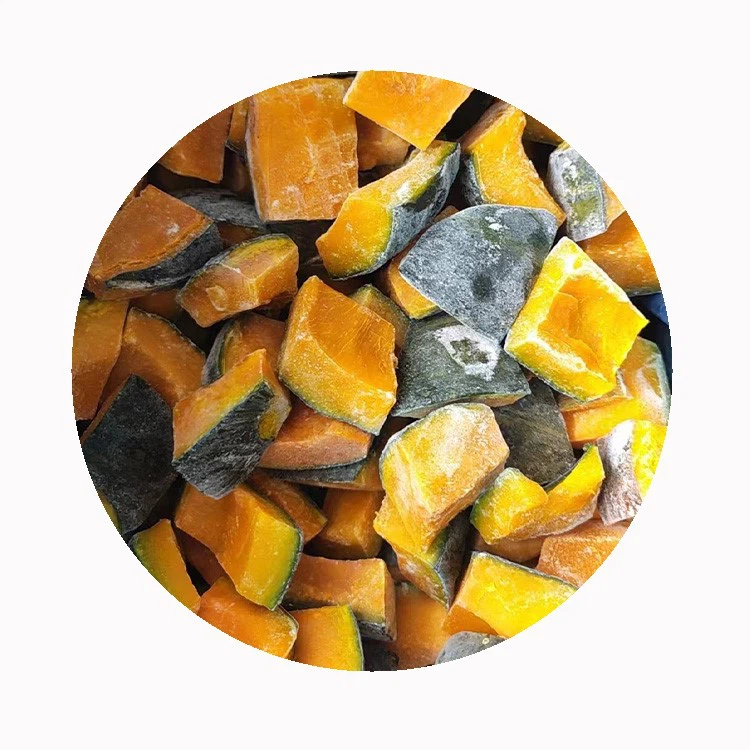
Freezing does not create one universal pumpkin nutrient profile. Frozen pumpkin may be raw or blanched, peeled or skin-on, cut into small dice or large chunks, and sold plain or within a seasoned blend. Cultivar, maturity and original dry matter influence the starting material. Washing, trimming, blanching, freezing, frozen storage, thawing and final cooking can affect moisture and sensitive nutrients in different ways.
The broader XMSD review of what frozen-vegetable nutrition evidence shows explains why freezing does not destroy all nutrients and does not preserve every value unchanged. For pumpkin, use that process principle without inventing a retention percentage. A value for vitamin C may respond differently from fiber, minerals or carotenoids.
A frozen pack also raises two valid measurement questions: "as sold" and "as prepared." The as-sold value belongs to the frozen product and declared serving. The as-prepared value depends on the stated cooking method, added water or oil, draining and yield. When directions offer several cooking methods, one calculated result may not represent every outcome. Define which panel and claim basis the market requires before commissioning analysis.
Ingredients often matter more than the freezing method. Plain IQF pumpkin is not equivalent to a butter sauce, sweet glaze, breaded bite, pie filling or dairy soup. Added sugar, sodium, saturated fat and serving energy can shift the finished-product judgment. USDA's canned-pumpkin fact sheet likewise notes that sauces and seasonings can add fat and calories, while fresh, frozen and canned vegetables all remain recognizable vegetable forms.[9]
For a plain frozen SKU, start with a matched reference only as a development screen. Then decide whether recipe calculation, supplier data, representative laboratory analysis or a combination is required for the destination. Preserve the sample identity, lot, method, test date and preparation state in the evidence file so a later number can be traced to the material actually sold.

Build a B2B Nutrition File That Matches the SKU
We begin with identity because an accurate calculation cannot repair an ambiguous sample. Record the pumpkin species or commercial type when available, edible part, peel status, cut, blanching status, ingredients, frozen or prepared state and intended serving. If one program buys both skin-on chunks and peeled dice, keep separate item codes and nutrition evidence rather than averaging them into one convenient number.
Next, align the commercial and analytical bases. The specification controls what arrives; the formulation controls how much enters the recipe; the cooking or drain study controls finished yield; the nutrition file controls the declared serving values; and the artwork file controls the wording seen on pack. A change in cultivar, peel, cut, supplier lot profile, blanching, recipe or preparation instructions can require a review because it may change the evidence chain.
Appearance is useful for product acceptance but cannot replace nutrient data. Orange color can flag maturity or variety differences worth investigating, yet it does not quantify beta-carotene or vitamin A RAE. Surface frost can reveal handling or free-flow concerns but says nothing exact about fiber. Cut uniformity helps portioning and thermal consistency, but it does not prove a front-of-pack nutrient claim.
Worked procurement example: A hypothetical retail program needs 4,000 bags at 300 g net weight, or 1,200 kg finished packed pumpkin. If validated sorting and packing trials show 94% packable yield from issued frozen material, the issue quantity is 1,200 ÷ 0.94 = 1,276.6 kg. That yield calculation plans purchasing; it does not change the nutrition amount per 150 g labeled serving. Keep procurement yield and nutrition serving math in separate controlled fields.
For claim review, keep the exact regulation or market guidance, reference amount, serving size, nutrient value, calculation, rounding method, evidence source, sample description and approval date together. If the data came from a generic database, mark it as preliminary. If the claim depends on an actual analysis, define how representative samples are selected and how a process or supplier change triggers reassessment.
Acceptance should connect back to use. Small dice may suit a measured soup inclusion and distribute more evenly; large chunks may suit a retail side dish but create more variable piece counts per serving; purée may simplify a bakery formula while changing water and solids. Choose the form by application performance, then calculate and substantiate nutrition for that form. Do not choose a cut because a generic nutrition table looks attractive.
XMSD sourcing note: Review the current frozen pumpkin forms, then send us your cut, peel status, application, packing and destination label basis. We can align the product discussion with the evidence your nutrition file needs.
Final Answer
Pumpkin flesh is most notable for provitamin A carotenoids and the vitamin A activity they provide. It also contributes carbohydrate, fiber, vitamin C and potassium, while plain flesh contains only small amounts of protein and fat. The nutrient ranking changes with the part, cultivar, maturity, moisture, processing, serving and complete recipe.
Use per-100 g data to compare density and per-serving data to understand the package or meal. Keep raw, cooked, frozen, puréed, seed and formulated products separate. For a commercial "rich in" statement, apply the destination rule to the exact SKU and reference basis, then support the artwork with representative data and a controlled calculation. The best short answer is therefore specific: pumpkin flesh can be a strong vitamin A contributor, but no broad list of nutrients should be called "rich" without the product and serving evidence.
References
- USDA FoodData Central: Pumpkin, Raw (FDC 168448)
- USDA FoodData Central: Pumpkin, Cooked, Boiled, Drained, Without Salt (FDC 168449)
- USDA FoodData Central: Pumpkin and Squash Seed Kernels, Roasted, Without Salt (FDC 170557)
- FDA: Daily Value on the Nutrition and Supplement Facts Labels
- FDA: Nutrient Content Claims-High, Rich In, Excellent Source, and Related Terms
- NIH Office of Dietary Supplements: Vitamin A and Carotenoids
- NIH Office of Dietary Supplements: Vitamin C
- NIH Office of Dietary Supplements: Potassium
- USDA Foods: Pumpkin, No Salt Added, Canned Household Fact Sheet
- University of Illinois Extension: Pumpkin Purée and Pie-Filling Guidance