


Carrot Nutrients: Values, Forms, and Uses
Jan 18, 2019

Carrots provide carbohydrate, fiber, potassium, vitamin K, vitamin C, and several B vitamins, but their most distinctive nutritional feature is their carotenoid content. Orange carrots are especially known for beta-carotene, which the body can convert to vitamin A.
The short answer: A 100 g portion of raw carrots contains about 41 kcal, 9.6 g carbohydrate, 2.8 g fiber, 0.9 g protein, and 0.2 g fat in the USDA FoodData Central SR Legacy entry. It also supplies about 835 micrograms of vitamin A RAE, largely because it contains provitamin A carotenoids. These figures describe one defined raw food entry, not every variety, cooked dish, juice, or frozen product.

Carrot Nutrition Facts per 100 Grams
The table below uses the USDA FoodData Central entry for raw carrots and rounds the values for readability. The food form matters: data for boiled, drained, frozen, canned, or juiced carrots should not be substituted without checking the matching entry.
| Nutrient | Approximate amount per 100 g raw | How to read it |
|---|---|---|
| Energy | 41 kcal | Plain raw carrots are relatively low in energy by weight. |
| Carbohydrate | 9.58 g | This total includes sugars, starch, and fiber. |
| Total sugars | 4.74 g | These are naturally present in the plain vegetable, not added sugar. |
| Dietary fiber | 2.8 g | Whole pieces retain the plant structure that juice may partly remove. |
| Protein | 0.93 g | Carrots are not a concentrated protein food. |
| Total fat | 0.24 g | Oil, butter, dressing, or sauce changes the finished dish. |
| Potassium | 320 mg | A useful contribution, but not a reason to treat carrots as therapy. |
| Vitamin C | 5.9 mg | The amount can vary with storage and preparation. |
| Vitamin K | 13.2 micrograms | One of several micronutrients present in raw carrots. |
| Folate | 19 micrograms | A modest contribution within the whole diet. |
| Vitamin A | 835 micrograms RAE | Expressed as retinol activity equivalents, not milligrams of preformed vitamin A. |
| Beta-carotene | 8,285 micrograms | A plant pigment and provitamin A carotenoid. |
The original value should always travel with its unit. For example, 835 micrograms RAE is 0.835 mg RAE; it is not 835 mg of vitamin A. Mixing micrograms, milligrams, international units, carotene mass, and RAE is a common source of misleading carrot nutrition tables.
Worked Example 1: Convert the 100 g Table to a Real Portion
Worked example: suppose your formulation uses 125 g of raw carrot. Divide 125 g by the table basis of 100 g to get a factor of 1.25. Multiplying each table value by 1.25 gives approximately 51 kcal, 12.0 g carbohydrate, 3.5 g fiber, 1.2 g protein, 400 mg potassium, and 1,044 micrograms RAE of vitamin A activity. This is a transparent conversion of one reference entry, not a finished nutrition label.
For your actual product, first choose the entry that matches the food form: raw, boiled and drained, frozen and unprepared, or the complete prepared recipe. Then account for ingredient weight, cooking yield, added ingredients, serving size, and the rounding rules of the destination market. If a supplier laboratory report or an accredited test is required, use the tested result for the agreed product rather than treating this generic table as a certificate of analysis.
Keep four bases separate in technical communication: per 100 g, per serving, as sold, and as prepared. A 70 g frozen ingredient portion may become part of a 350 g soup serving, while a dry label calculation may use a different yield convention. Stating the basis beside every value prevents a small arithmetic exercise from becoming a large specification dispute.
Our decision rule: use a reference database when you need an early formulation estimate, but move to supplier-specific or laboratory evidence when the value changes a claim, contract, or regulatory decision. Record the database name, food identifier, release or access date, preparation state, unit, and calculation basis in the working file. If your recipe team later changes the carrot cut, blanching condition, ingredient proportion, or cooking yield, reopen the calculation instead of carrying the old number forward. This traceable method matters more than displaying extra decimal places.
A useful review question is: what evidence would make this number wrong for the product in front of us? The answer may be added sauce, drained weight, a different carrot form, seasonal raw-material variation, a changed serving size, or a destination-market rule. Name that variable and assign the next check. For example, the product developer verifies the recipe and yield, the supplier confirms the ingredient basis, and the label reviewer applies the market rule. This keeps the nutrition statement tied to a controlled product rather than to a generic vegetable description.

Why Beta-Carotene Gets So Much Attention
Carotenoids are pigments that give many yellow, orange, and red foods their color. The NIH Office of Dietary Supplements explains that the body can convert some carotenoids, including beta-carotene, into vitamin A. Vitamin A is required for normal vision, immune function, reproduction, growth, and development.
That evidence supports a measured statement: carrots can contribute to vitamin A intake. It does not show that carrots sharpen normal eyesight, prevent infection, reverse skin problems, or treat a vitamin A deficiency in every person. Deficiency, absorption problems, and medical symptoms need individual assessment.
Orange color is also not a laboratory result. Variety, maturity, growing conditions, and storage can change carotenoid content. A darker orange root may suggest more carotenoid pigment, but use an agreed specification or test result for your label when a numerical nutrient claim matters.

Raw, Cooked, Frozen, and Juiced Carrots Are Not Identical
A per-100 g comparison can change simply because cooking adds or removes water. Boiling may soften carrot tissue and alter water-soluble nutrients, while roasting can concentrate solids as water evaporates. A prepared carrot dish may also contain oil, salt, sugar, dairy, or sauce, so the finished nutrition profile belongs to the complete recipe.
Composition is not the same as absorption: a small human study involving eight ileostomy volunteers found greater beta-carotene absorption from a cooked carrot puree meal than from a raw chopped carrot meal under the study conditions. The result shows that processing can affect bioavailability, but it does not establish one universally best way to eat carrots.
Plain frozen carrots remain a vegetable choice, and the USDA MyPlate Vegetable Group includes fresh, frozen, canned, dried, raw, and cooked forms. Freezing should not be described as retaining every nutrient perfectly. Raw material, blanching, freezing, storage time, temperature, packaging, thawing, and final cooking all influence the product that reaches the plate.
Carrot juice is another distinct form. It can contain carotenoids, but the amount of fiber depends on how it is processed, and a drink can be consumed faster than whole pieces. Sweetened juice blends and plain whole carrots should never share one nutrition claim without qualification.
What Processing Changes-and What It Does Not
Processing changes the food matrix as well as the water balance. Cutting increases exposed surface area. Heating softens cell structures. Pureeing reduces particle size. Adding a small amount of fat to a meal can also affect how carotenoids are released and absorbed. That is why a human study can find higher beta-carotene bioavailability from a processed carrot meal even though its result does not prove that every cooked carrot contains more beta-carotene than every raw carrot.
For frozen vegetables, the process normally includes receiving, washing, sorting, trimming, cutting, blanching, cooling, freezing, packing, and cold storage. Freezing is only one step. Blanching can reduce some heat-sensitive or water-soluble components, while low-temperature storage helps slow later quality loss. Time, temperature, oxygen exposure, pack integrity, thawing, and the final cooking method all affect the product your customer uses. A statement such as "frozen retains nutrients" therefore needs a defined nutrient, product, process, and comparison.
USDA grade standards for frozen peas and carrots illustrate a different part of the specification. They address observable quality factors such as color, defects, character, flavor, and preparation. These criteria help describe commercial quality, but a good physical grade is not a nutrient assay. Use a physical specification for cut and defect control, a process record for production controls, and a suitable analytical method when your contract requires a numerical nutrient value.
Practical example: a soup plant plans 12,500 finished portions and uses 80 g of retained frozen carrot in each 350 g portion. The retained requirement is 12,500 × 80 g = 1,000 kg. If the validated handling loss is 2%, the starting quantity is 1,000 ÷ 0.98, or about 1,020.4 kg. This calculation supports purchasing and yield planning; it does not by itself calculate the finished soup's nutrition. For that, you still need the approved ingredient data, recipe, processing yield, and serving basis.

What Carrot Nutrients Can and Cannot Tell Us
A composition table tells us what was measured in a defined food sample. It does not prove that eating a set number of carrots will lower cholesterol, prevent heart disease, stop cancer, improve sexual function, clear skin conditions, or "detoxify" the body. Those are clinical claims, not nutrient facts.
The NIH distinguishes beta-carotene from foods from high-dose beta-carotene supplements. It notes that high-dose supplements increased lung-cancer risk in some studies of smokers, former smokers, and people exposed to asbestos. That supplement evidence should not be transferred to ordinary carrot portions, but neither should it be used to promote carrots as cancer prevention.
Very high beta-carotene intake can turn the skin yellow-orange. NIH describes this as harmless and reversible when intake falls. It is different from toxicity caused by excessive preformed vitamin A. Anyone with a new unexplained skin-color change or a medically prescribed diet should seek individualized professional advice rather than self-diagnosing from a food article.
Choosing a Carrot Form for the Application
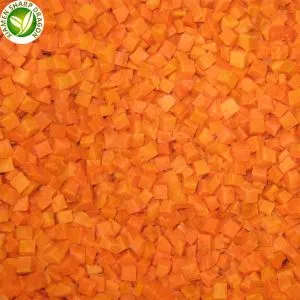
For households and foodservice kitchens, the most useful form is the one that fits the dish. Raw sticks and grated carrots keep a firmer bite. Dice distribute through soups, fried rice, sauces, and fillings. Slices create a more visible vegetable piece, while strips suit stir-fries and mixed-vegetable products.
Cooking method matters to both texture and the final nutrition calculation. A plain steamed carrot and a glazed carrot may begin with the same ingredient, but their added sugar, fat, and sodium can be very different. For a label or technical sheet, calculate the actual recipe and yield rather than copying the raw-carrot row.
The same discipline applies to frozen products. Confirm whether your specification describes unprepared frozen pieces, a blanched ingredient, or a seasoned ready-to-cook item. Nutrition declarations must follow the product as sold and the destination-market rules.

Verification for a Frozen-Carrot Specification
For B2B sourcing, nutrient language must match the purchased product, while the physical specification must match the application. At XMSD, we recommend confirming the cut shape and dimensions, blanching level, color range, texture after cooking, defect tolerance, free-flowing condition, packing format, and destination-market documentation before approval.
Our current IQF frozen carrot page lists dice, slices, strips, and customized cuts. It also identifies 8 × 8 × 8 mm and 10 × 10 × 10 mm dice as available examples. These formats suit different visual, portioning, and cooking requirements, so a buyer sample should be tested in the actual soup, ready meal, vegetable mix, stir-fry, or other finished product.
If the project needs retail, foodservice, or industrial packs, discuss the bag and carton format together with the ingredient specification. Our frozen packaging overview and frozen food solutions provide the context for that conversation.
Documentation is part of the product decision, not a final administrative detail. Review the facility and product scope, traceability route, lot coding, microbiological criteria, pesticide-residue plan, certificate validity, and destination requirements before shipment. Our certification overview explains the document-checking context, while the importer and global buyer page outlines the commercial information to align for an export project.

XMSD sourcing note: Share the target cut, end use, packing format, and destination market. We can then discuss a suitable frozen-carrot specification, sample review, and quotation without relying on generic nutrition promises.
Frequently Asked Questions
1. What are the main nutrients in carrots?
Carrots contain carbohydrate, fiber, potassium, vitamin K, vitamin C, folate, and other micronutrients. Their best-known feature is provitamin A carotenoids, especially beta-carotene in orange varieties.
2. How many calories are in 100 grams of raw carrots?
The USDA FoodData Central SR Legacy entry lists about 41 kcal per 100 g of raw carrots. A cooked recipe, juice, canned product, or seasoned frozen item may have a different value.
3. How much protein do carrots contain?
Raw carrots provide about 0.93 g protein per 100 g in the cited USDA entry. They contribute a small amount but should not be described as a high-protein food.
4. Are carrots high in sugar?
The cited raw-carrot entry contains about 4.74 g naturally occurring sugars per 100 g. "High" depends on the comparison, portion, and complete meal. Plain carrots are different from sweetened juice or glazed carrots.
5. How much fiber is in carrots?
Raw carrots contain about 2.8 g dietary fiber per 100 g in the USDA entry. The amount in juice depends on processing because some pulp and fiber may be removed.
6. Do carrots contain vitamin A or beta-carotene?
They contain beta-carotene and other provitamin A carotenoids that the body can convert to vitamin A. FoodData Central expresses the combined vitamin A activity as RAE, which should not be confused with the carotene weight itself.
7. Do carrots improve eyesight?
Vitamin A is required for normal vision, and carrots can contribute to vitamin A intake. Eating extra carrots does not necessarily sharpen already-normal eyesight or correct eye problems caused by another condition.
8. Are cooked carrots more nutritious than raw carrots?
Neither form is universally more nutritious. Cooking changes water content, texture, and some nutrient levels, while processing can improve carotenoid absorption under certain conditions. Compare the defined food form and the complete meal.
9. Do frozen carrots still contain nutrients?
Yes, plain frozen carrots still contain carbohydrate, fiber, carotenoids, and micronutrients. Exact amounts vary with the raw material, blanching, freezing, storage, and final cooking, so avoid claims that every nutrient is fully retained.
10. Do purple, yellow, and orange carrots have the same nutrients?
They share the same general food category, but pigment profiles and measured nutrient levels can differ by color, variety, maturity, and growing conditions. A value for one orange variety should not be treated as a laboratory result for every carrot.
11. Can carrots be eaten every day?
Most people can include carrots regularly as part of a varied diet. Variety still matters because no single vegetable supplies every nutrient in ideal amounts for every person.
12. Can eating many carrots turn the skin orange?
Very high beta-carotene intake can cause a yellow-orange skin color. NIH describes this as harmless and reversible when intake is reduced, but an unexplained color change should not be self-diagnosed.
13. Which frozen carrot cut should a food manufacturer choose?
Choose by application: dice distribute evenly, slices remain visible, strips fit stir-fries and blends, and crinkle cuts add surface texture. Confirm dimensions and blanching level, then test a sample in the actual process before ordering.
Final Thoughts from XMSD
Carrots are most notable for beta-carotene and vitamin A activity, while also contributing fiber, potassium, and several other nutrients. Accurate communication requires the right food form, serving basis, unit, and evidence limit. For frozen-carrot sourcing, the cut, processing specification, packing, and end-use test matter as much as the general nutrition story.
References
- USDA FoodData Central: Carrots, Raw, SR Legacy, FDC ID 170393
- USDA FoodData Central: Downloadable Data and SR Legacy Documentation
- NIH Office of Dietary Supplements: Vitamin A and Carotenoids
- Livny et al.: Beta-Carotene Bioavailability from Differently Processed Carrot Meals
- USDA MyPlate: Vegetable Group
- XMSD: IQF Frozen Carrot Product Forms and Specifications