


Production Process of Frozen Ginger Pieces
May 12, 2023

The commercial production process for frozen ginger pieces normally follows a controlled sequence: receive and inspect fresh ginger, establish lot traceability, remove soil, wash, sort, peel or trim as specified, cut to the agreed size, remove surface water, quick-freeze, inspect, detect foreign material, pack, and hold the product in an uninterrupted frozen chain. The most important distinction is that no single flow fits every specification. A visible ginger cube for a meal kit, a fine dice for a sauce, and a piece intended for grinding require different cut control, fiber tolerance, and application testing.
Blanching is also a specification choice, not an automatic step. Some processes include a validated heat treatment; others freeze cleaned, prepared ginger without blanching to protect a fresher aroma and firmer bite. In either case, freezing itself is not sterilization. Hygiene, wash-water control, equipment sanitation, raw-material rejection, and a hazard-based food-safety plan must do the safety work before and during freezing.
For acceptance, we recommend following evidence rather than a generic flow chart: the raw-material record, approved sample, cut-size results, process-monitoring record, product thermal-center result, foreign-body control check, pack integrity, lot code, and cold-chain record. Together, these show whether the process produced the ginger pieces you actually ordered.
The short answer: Good frozen ginger pieces come from a controlled sequence, but process quality is judged by measurable outputs: clean raw material, the right cut distribution, suitable pretreatment, rapid freezing to a thermal center of -18°C or colder, free-flowing pieces, intact packaging, traceability, and stable frozen handling.

The Production Flow at a Glance
The order matters because every stage changes what the next stage can control. Washing does not rescue decayed raw ginger. Freezing does not correct a poor cut. Metal detection does not replace visual sorting. Packaging cannot restore product that warmed or clumped before filling. We therefore treat the process as a chain of release decisions rather than a row of machines.
- Receive the ginger and identify the growing, supplier, and receiving lot.
- Inspect maturity, soundness, decay, soil load, odor, pests, and physical damage against the raw-material specification.
- Pre-clean and wash with controlled water to remove soil and reduce cross-contamination risk.
- Sort again, then peel or trim according to the finished-product definition.
- Cut, slice, dice, mince, or form pieces to the agreed measurement method.
- Apply a validated blanching or other pretreatment only when the specification and application require it.
- Drain or dewater so excess surface water does not become ice and promote clumping.
- Quick-freeze with a controlled bed depth, feed rate, air condition, and residence time.
- Verify the thermal-center result, separate clusters, and inspect frozen appearance and cut distribution.
- Run the defined foreign-material controls, weigh, seal, code, and case-pack the product.
- Move the cartons promptly to frozen storage and maintain the cold chain through loading, transport, and delivery.
That is the normal architecture, not a contractual recipe. Sanitizer type and concentration, blanching conditions, freezer air temperature, residence time, pack size, test limits, and shelf life must come from the validated process and agreed destination-market specification. A web article cannot responsibly turn those site-specific controls into universal numbers.
1. Raw Ginger Receiving, Sorting, and Traceability
The best time to prevent a frozen defect is before the ginger enters the line. At receiving, we want sound rhizomes with the maturity, color, aroma, and fiber character needed for the final application. Decay, mold, fermentation odor, pest damage, excessive sprouting, serious mechanical injury, and embedded foreign material are not problems to hide with peeling. They are reasons to segregate or reject material under the receiving plan.
Maturity deserves more attention than it usually receives. Tender ginger can be easier to cut and less fibrous, while mature ginger may deliver a stronger, more fibrous character. Neither is automatically superior. If your sauce is finely milled, fiber load and flavor strength may matter more than the appearance of each piece. If your meal kit displays a visible cube, sound edges, even color, and piece integrity become more important. We set the incoming definition from the intended use, not from a generic grade label.
Traceability should begin at this point. The receiving lot must connect the raw-material source and date to the processing batch, finished-product code, packing record, and shipment. The useful test is simple: if one finished carton is selected, can the supplier reconstruct which receiving lot fed it and which control records apply? A batch number printed on a carton is not enough when it cannot lead back to evidence.

2. Washing, Peeling, Trimming, and Cutting
Washing must remove soil without spreading contamination
Ginger arrives from soil, so the first cleaning stages usually carry a heavy dirt load. A practical line separates rough soil removal from later clean-product handling. Water that is suitable at the beginning of a wash system can become a contamination vehicle as soil and organic load accumulate. The FDA's fresh-cut produce guidance therefore emphasizes water quality, disinfectant level where used, pH, temperature, monitoring, and corrective action rather than treating washing as a simple rinse.
You should review the wash system as a control loop: water source, flow direction, replacement or treatment, monitored parameters, alarm or hold action, and record. We do not judge it only by how clean the ginger looks. The process must also prevent dirty water, tools, drains, or incoming containers from contaminating the cleaner side of the line.
Peeling and trimming define more than appearance
Peel removal can improve visual uniformity and reduce tough surface material, but aggressive peeling also reduces yield and may change the sensory balance. The specification should state whether the product is fully peeled, partially peeled, or trimmed, and how residual peel is evaluated. A vague phrase such as "clean peeled ginger" gives neither side a usable release rule.
Cutting then creates the product your line must dose. The current XMSD frozen ginger range lists diced, cube, puree, and whole-root formats and identifies a 5 mm diced option. That verified page value is a product option, not a universal standard. Other applications may need a different nominal size, shape, or particle distribution.
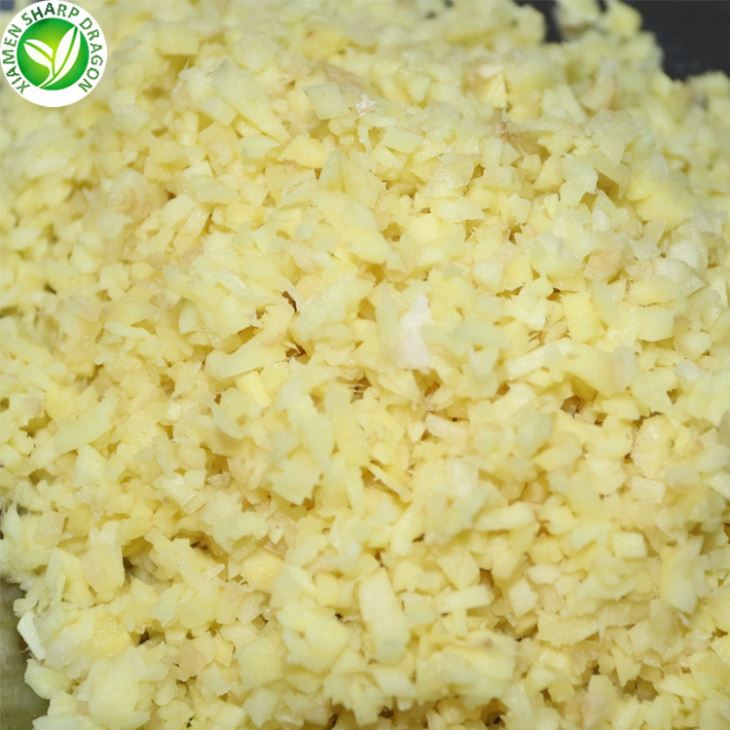
Practical example: Suppose your hypothetical specification calls for 5-10 mm pieces and requires at least 95 of every 100 sampled pieces to fall within that range. A frozen sample contains 91 in range, seven undersize pieces, and two oversize pieces. The product does not pass merely because the average looks close. You would record the distribution, investigate blade condition and feed orientation, and repeat the defined sampling after corrective action. This approach makes cut acceptance reproducible instead of visual and subjective.
3. Is Blanching Required for Frozen Ginger Pieces?
No universal rule requires every frozen ginger piece to be blanched. The correct choice comes from the product definition, intended use, hazard analysis, sensory target, and validated plant process. Current market pages themselves show the distinction: some describe ginger as blanched or sterilized, while the published XMSD product flow moves from peeling or cutting and dewatering to IQF freezing without listing blanching as an automatic stage.
A heat treatment can support a defined process purpose, but it also changes the ingredient. Research on ginger shows that scalding or blanching and freezing velocity affect texture; other ginger studies show that longer thermal exposure can soften tissue. Those findings support a cautious conclusion: validate the exact treatment against the required bite, aroma, color, enzyme activity, microbial objective, and final cooking process. They do not support copying one published temperature and time into every frozen-ginger specification.
For a soup base that will receive a full validated cook, you may prioritize aroma and fast flavor release. For a chilled sauce assembled without a later lethal step, the food-safety plan may require a different control strategy. The responsibility belongs in the hazard analysis and product specification. The phrase "blanched for safety" is too vague unless it identifies the target hazard, process limit, monitoring method, validation, and corrective action.
Decision rule: Specify blanching only when it solves a defined quality or safety objective and the resulting ginger still performs in your application. Otherwise, do not add heat merely because a generic vegetable flow chart contains it.
4. Dewatering and IQF Freezing
Surface water should be removed before freezing because free water becomes ice on and between pieces. Too much surface moisture can create clusters, add uncontrolled glaze-like weight, reduce free flow, and make a sample look whiter or frostier than the ginger itself. Dewatering must be strong enough to prepare the surface without crushing tender pieces or allowing the product to warm and wait.
In IQF operation, the important controls include piece thickness, incoming product temperature, freezer loading, bed depth, airflow, residence time, and equipment condition. Small pieces may freeze faster than thick slices, but a faster conveyor is not automatically better. If the feed is too dense, pieces shield each other and leave the freezer with an uneven temperature profile. If it is too light or residence time is excessive, the line may waste capacity and increase dehydration.
Codex CXC 8 makes the acceptance point clear: quick freezing is not complete until the product reaches -18°C or colder at its thermal center after temperature stabilization. That product result is not the same as the freezer air setting. A study may report an air temperature below -40°C for its own ginger experiment, while another plant uses different equipment and loading. The useful record is the validated relationship between equipment settings, actual product load, residence time, and the measured thermal center.

After the freezer, we examine separation, frost, clumps, color, odor, and physical damage. Free-flowing product is not a cosmetic luxury: it supports accurate dosing and lets you remove part of a bag without thawing the rest. If pieces are fused, investigate surface water, loading pattern, belt agitation, freezer performance, delays before packing, and later temperature fluctuation. Breaking clusters by force may make the bag look loose while increasing fines, so it is not a substitute for correcting the cause.
5. Frozen Inspection, Foreign-Material Control, and Packing
Inspection after freezing should reconnect the finished product to the agreed sample and specification. We look for cut distribution, residual peel, fibers, discoloration, damaged pieces, frost, clusters, extraneous vegetable matter, and abnormal odor. The acceptable amount of each item is not supplied by the article; it belongs in a measurable defect table. Without a counting or weight basis, terms such as "uniform," "low fiber," and "practically free" are difficult to audit.
Foreign-material controls should match the hazard analysis. The FDA fresh-cut produce guide recommends operating metal detectors according to the manufacturer's instructions and checking proper function at least daily. The plant control plan should state the test pieces, frequency, product effect, reject verification, line stop, product hold, and investigation procedure for the equipment and risk. A photograph of a detector proves that equipment exists; the monitored record shows whether the control worked for the batch.

Packing must protect the product from dehydration, contamination, odor transfer, and mechanical damage. Codex identifies those functions directly for quick-frozen food packaging. Ginger adds a specific consideration: its aroma can transfer, so seal integrity and warehouse segregation matter. The inner bag, case weight, number of inner units, carton strength, liner, seal method, lot code, label, and pallet plan should fit your opening pattern and distribution route.
A 10 kg foodservice bag and ten 1 kg inner bags may contain the same net quantity but behave differently after opening. If you use only 2 kg per shift, smaller inner packs can reduce repeated exposure to humid air and handling. If your automated line empties a full 10 kg bag at once, the larger format may reduce film and opening labor. Review the available frozen-food packaging options as a design input, then test the chosen materials and seals under the real cold-chain route.

6. Frozen Storage, Loading, and Arrival Inspection
Once packed, the cartons should move to frozen storage without an avoidable warm wait. Codex recommends maintaining quick-frozen product at -18°C or colder with minimal fluctuation, starting transport at -18°C or colder, pre-cooling the vehicle or container, and minimizing temperature rise during transfer. These are product-temperature principles. An air probe by the door or a reefer set point alone does not describe the temperature of every carton.
Loading must preserve airflow and protect cartons from crushing, moisture, and movement. A pallet pattern that looks dense may reduce airflow or overhang cases. An excessively loose pattern may shift in transport. Evaluate carton dimensions, gross weight, pallet type, stretch wrap, corner protection, container airflow paths, and unloading method together. The final answer should be a loading drawing or approved pattern, not the phrase "export packing."

Practical example: A container arrives with the reefer display at -18°C, but several outer cartons are wet and the first bag sampled contains large fused clusters. Do not accept the display as proof that the cargo stayed stable. Photograph the pallet positions, inspect seals and carton condition, measure representative product temperatures with a defined method, download the logger where available, and compare inner and door-side locations. The evidence may distinguish a packing leak, transfer delay, local airflow problem, or wider temperature excursion.
What Each Process Stage Should Prove
A process description becomes useful when each stage has an output and release record. The table below is not a complete HACCP plan; it shows how to translate a flow into evidence you can review before approval.
| Stage | Main failure signal | Useful release evidence |
|---|---|---|
| Receiving | Decay, off-odor, soil, wrong maturity, weak traceability | Receiving inspection, lot identity, source record, sampling result |
| Washing and preparation | Dirty water, cross-contamination, excessive peel, damaged tissue | Water-control log, sanitation record, peel and trim inspection |
| Cutting | Oversize, undersize, fines, ragged edges, high fiber exposure | Defined measurement method and cut-distribution result |
| Pretreatment | Soft texture, weak aroma, unmet control objective | Validated parameters, monitoring record, sensory or process check |
| IQF freezing | Warm center, clumps, heavy frost, dehydration, uneven pieces | Equipment record, load and time record, thermal-center verification |
| Packing and inspection | Foreign material, weak seal, wrong weight, unreadable lot code | Detector challenge, weight check, seal check, label reconciliation |
| Storage and transport | Temperature fluctuation, crushed cartons, fused pieces | Cold-store record, loading check, logger data, arrival inspection |
The release evidence changes with the product and process. A puree will not use the same cut-distribution check as a 5 mm dice. A non-blanched line will not produce a blanching log, but it still needs validated hygiene and hazard controls appropriate to the intended use. Likewise, a metal detector record addresses detectable metal under its verified conditions; it does not demonstrate control of every possible foreign material.
When reviewing a supplier, select one recent lot and follow it across the table. Check that receiving identity carries through the cut record, freezer result, packing code, inspection, storage, and shipment documents. Missing continuity is a risk signal because isolated records can look complete while referring to different lots. Your acceptance rule should require a connected batch history and a finished sample that meets the same written specification.
How to Specify Frozen Ginger Pieces for Your Application
Start with what the ginger must do after it leaves the bag. Fine dice or mince distributes quickly in sauces, fillings, and seasoning blends. Larger pieces remain visible in meal kits, soups, and prepared dishes. Slices favor infusion, while puree favors even mixing and pumping. Our guide to using frozen ginger by product form explains why these formats are not interchangeable.
Then define the measurable attributes: ingredient statement, nominal cut, permitted size distribution, peel tolerance, fiber expectation, color, aroma, pungency or sensory reference, free-flow requirement, defect categories, foreign-material controls, packing, storage instruction, lot coding, and required documents. Include the test method or sample basis when a number matters. "5 mm" may describe a cutter setting, a target dimension, or an acceptance range; only the written measurement rule resolves that ambiguity.
You should also define how the sample is prepared for evaluation. Frozen appearance, thawed texture, and cooked performance answer different questions. A product can look firm while frozen and soften after thawing because ice formation changes plant tissue. If texture in the final dish matters, test it in that dish or in a controlled model process. The comparison in frozen ginger versus fresh ginger is useful when the application still depends on raw crispness or last-minute aroma.
Worked example: Consider a hypothetical 1,000 kg receiving lot. If 3% is rejected at sorting, 970 kg remains. If peeling and trimming remove 10% of that remainder, 873 kg remains. If cutting, final trimming, and line inspection remove another 4%, the ready-to-freeze quantity is 838.08 kg: 1,000 × 0.97 × 0.90 × 0.96. The preliminary process yield is therefore 83.8%. These are illustrative inputs, not an XMSD yield promise. Use the same formula with actual weighed stage data to compare suppliers and identify whether loss comes from poor raw material, aggressive peeling, or cutting fines.
Three Buyer Decisions Generic Flow Charts Miss
1. Formulation: size alone does not control flavor release
Two 5 mm samples can behave differently because maturity, fiber, pungency, exposed cut surface, pretreatment, and storage history differ. For a sauce, weigh the ginger into a fixed batch, use the same heating and mixing sequence, and compare aroma, perceived heat, fiber, and distribution. If one sample needs a higher inclusion rate to reach the reference flavor, its lower price per kilogram may not produce a lower cost per finished batch.
2. Quality assurance: the process name is not the control
Words such as "sterilized," "blanched," "IQF," and "metal detected" describe activities. They do not state the hazard, limit, method, frequency, validation, or action when a check fails. Ask for the process flow and the evidence relevant to your risk. The current XMSD page on processing and testing equipment shows cleaning, preparation, freezing, packing, inspection, and testing capability. For lot approval, connect that capability to the batch record and agreed specification.
3. Logistics: free flow is partly a transport result
Good IQF separation can be lost after production if bags warm, cartons absorb moisture, pallets block airflow, or cases sit at ambient temperature during transfer. Define the storage and transport requirement, logger arrangement, arrival sampling, temperature method, and response to clumping before shipment. This gives you a consistent decision when the outer carton looks normal but the inner product does not.
A Practical Approval Sequence
We recommend approving the product and process in the same order that risk becomes visible. First, write the intended application and measurable finished-product specification. Second, review the proposed flow, especially blanching status, dewatering, freezing verification, foreign-material controls, and packing. Third, evaluate a representative frozen sample for cut, defects, aroma, fiber, separation, and pack condition. Fourth, run the sample through your actual recipe or production line. Fifth, agree the retained sample, inspection method, documents, batch-release evidence, cold-chain record, and arrival response.
This sequence prevents a common mistake: approving an attractive sample while leaving the recurring order undefined. A sample is evidence of one lot. The specification and control plan explain how future lots will be judged. If the product is used in several applications, identify the most sensitive one. A fine sauce may expose fiber and water release; a visible meal component may expose shape and color; an automated filler may expose clumping and pack-opening behavior.
XMSD sourcing note: If you are evaluating frozen ginger pieces, send us the target cut, application, blanching preference, defect expectations, packing format, destination, and required documents. We can use those inputs to discuss the appropriate product specification and sample.
Final Judgment
The production process of frozen ginger pieces is straightforward to draw but demanding to control. Receiving protects the line from raw-material defects. Washing and sanitation manage soil and cross-contamination. Peeling, trimming, and cutting create the form your application needs. Pretreatment must have a defined purpose. Dewatering and IQF freezing protect separation and texture. Inspection, foreign-material control, packing, frozen storage, and transport preserve the result.
When you compare suppliers, do not ask only whether they follow these steps. Ask what each step must achieve, how it is measured, which record releases the lot, and what happens when the result fails. That turns a generic process flow into a product you can approve, repeat, and inspect at arrival.
References
- Codex CXC 8-1976: Code of Practice for the Processing and Handling of Quick Frozen Foods
- U.S. FDA: Guide to Minimize Microbial Food Safety Hazards of Fresh-cut Fruits and Vegetables
- Codex CXC 1-1969: General Principles of Food Hygiene
- Deng et al.: Study on Freezing Property and Characteristic Quality Changes of Ginger under Different Freezing Temperatures
- XMSD operational experience in frozen-food sourcing, IQF processing, quality control, packaging, and B2B export coordination.