


Is Peach Good for Health? How to Judge the Evidence
Aug 08, 2019

Yes, plain peach can fit a health-supporting diet, but that answer is much narrower than saying peach produces a particular medical, cosmetic or "detox" result. A defined serving supplies measurable nutrients, so it can support ordinary dietary guidance. That composition fact alone cannot prove that peach lightens skin spots, clears toxins, treats constipation, relieves a cough or fever, or cures a hangover.
To test a statement, match it to the evidence that actually exists. Name the exact edible material, serving, population, outcome and time period. Then identify whether the support is a food-composition database, a recognized nutrient function, an observational study, a controlled human intervention or an authorized claim for the destination market. If one of those elements changes, the conclusion may no longer travel with it.
The distinction stays the same when you choose fruit, develop a formula or approve a purchase. Whole peach flesh is not interchangeable with peach-flower tea, kernel extract or a concentrated laboratory fraction. A plain frozen peach is not automatically equivalent to a sweetened peach preparation. A study of a broad fruit-and-vegetable pattern cannot isolate a peach-specific clinical effect. Responsible health wording begins with those limits, not with a longer list of promised benefits.
The short answer: Eat peach as one possible fruit in a varied diet if it suits your needs and tolerance. Treat nutrient amounts as composition evidence, not proof of a treatment outcome. For a product claim, use evidence and label data for the exact finished SKU, serving and sales market.

"Good for Health" Is Not One Testable Outcome
The phrase sounds simple because it compresses several different questions. "Can peach be part of a varied diet?" is a food-choice question. "Does one peach change a laboratory marker?" is an intervention question. "Does regular peach intake reduce the risk of a named disease?" is a long-term health-outcome question. "May this package carry a particular statement?" is also a regulatory and substantiation question. One answer cannot be copied across all four.
Before assessing a claim, restate it so you can check it. "Peach is healthy" does not identify a dose or outcome. "A 150 g raw peach contains a stated amount of vitamin C" can be checked against a composition source. "Eating 150 g of this peach product daily for eight weeks improves a defined skin-color measurement in adults" would require direct human evidence for that product, amount, population, duration and outcome. The second statement cannot be used as proof of the third.
The same rule prevents vague language from hiding a medical promise. "Supports wellness," "cleans the body" and "boosts health" can imply different effects to different readers. Ask what change is meant, how it was measured, compared with what, and in whom. If the answer remains undefined, the statement is not strong evidence; it is only broad promotional language.
For food labeling in the United States, FDA distinguishes nutrient-content claims, structure/function claims and health claims. A health claim links a substance with reduced risk of a disease or health-related condition. FDA also states that health claims concern risk reduction, not diagnosis, cure, mitigation or treatment. Other markets use their own claim lists, wording and notification or approval systems, so a U.S. example is a method illustration rather than global clearance.
Start With Composition, Then Stop at Its Evidence Boundary
Composition data are the correct first layer because they describe the food rather than a hoped-for result. USDA SNAP-Ed lists one medium raw peach as 150 g, with 58 calories, 14 g carbohydrate, 2 g dietary fiber, 13 g total sugars, 0 g added sugars and 11 mg vitamin C. Those numbers provide a useful reference serving for raw peach. They can vary with cultivar, maturity, sample and analytical source, and they should not be pasted onto a different finished product without a valid basis.
A nutrient's established function is the next layer, but it is still not a peach clinical trial. The NIH Office of Dietary Supplements explains that vitamin C is required for collagen biosynthesis, acts as a physiological antioxidant, supports immune function and improves absorption of nonheme iron. That tells us why adequate vitamin C matters. It does not demonstrate that eating a peach lightens spots, visibly brightens skin or produces a measured cosmetic change.
Practical example: separate a true premise from an unsupported finish. A supplier can verify that an approved peach lot or finished SKU contains vitamin C through an appropriate composition source or analysis. The sentence "vitamin C contributes to normal collagen synthesis," where allowed and correctly qualified, concerns a recognized nutrient role. The sentence "this peach makes skin brighter and removes dark spots" names a direct appearance outcome. It needs evidence on the exact food, dose, relevant population and measured endpoint; the presence of vitamin C alone does not supply that proof.
Nutrients remain important within this boundary. A food can make a modest, useful contribution without acting like a medicine or cosmetic treatment. The related peach nutrition and benefits guide covers the nutrient contribution in more detail. Here, the important question is how far the evidence permits a claim to travel.
Use an Evidence Ladder Before Accepting a Benefit
Evidence becomes more decision-useful when it matches the claim closely. A laboratory experiment can explain a possible mechanism. An animal study can identify questions worth testing. Neither one establishes what happens when people eat a normal peach serving. Observational studies can detect associations in real populations, but diet, lifestyle and other differences may remain. Controlled human studies can test an intervention more directly, although design, duration, sample size, comparator and relevance still matter.
| Evidence layer | What it can support | What it cannot establish alone |
|---|---|---|
| Food composition | Amount of a nutrient in a defined food and serving | A disease, cosmetic or symptom outcome |
| Mechanistic, cell or animal research | Biological plausibility and research questions | Effectiveness from an ordinary human serving |
| Observational human research | An association under stated conditions | Causation or an isolated peach effect when diet is broader |
| Controlled human intervention | Effect on defined outcomes for the tested form, dose and population | Automatic transfer to another form, dose, group or commercial SKU |
| Authorized or accepted claim basis | Specified wording when the product and market conditions are met | Permission in every market or for broader wording |
A 2017 systematic review and meta-analysis of 95 prospective studies found that higher fruit-and-vegetable intake was associated with lower risks of several outcomes. The authors reported the results for broad food groups and described associations, with a conditional estimate of preventable deaths if those associations were causal. That is valuable public-health evidence. It is not a controlled trial of peach, and it does not establish that one peach produces the reported risk difference.
Look at the unit being studied. If the exposure is "fruit and vegetables," the conclusion belongs to that pattern. If the material is peach-flower extract, the result belongs to that extract at the tested dose. If the endpoint is movement of cells in a dish, it is not a clinical endpoint. If participants know what they are eating and the comparator differs in more than peach, interpretation becomes harder. Strong-sounding headlines do not repair a mismatch between study and claim.
Also check whether the evidence shows a meaningful effect, not just a statistically detectable difference. Ask for absolute values where possible, the confidence interval, dropouts, adverse events and the duration of follow-up. A single small study may be useful, but you should not describe it as settled evidence. The total body of relevant research and its consistency matter.

Audit the Common Peach Claims One by One
Skin brightening or spot reduction: vitamin C's role in collagen synthesis is a nutrient-function fact. A visible skin-tone claim is a different endpoint. Confirm whether a controlled human study tested normal peach flesh, the proposed serving, the intended population and an objective measurement. Do not substitute a study of topical vitamin C, a supplement, purified compound or unrelated fruit.
"Detox" or intestinal cleansing: the word toxin must identify a substance and a validated measurement. NCCIH reports that only a small number of human studies have examined detox programs, many were low quality, and a 2015 review found no compelling research supporting detox diets for eliminating toxins. Ordinary digestive waste is not evidence that a food removes unspecified toxins. Peach can be eaten as fruit; it does not need a cleansing story.
Constipation treatment: a medium peach has a modest amount of fiber, but a composition entry does not demonstrate that one or two peaches will treat constipation in every person. Bowel response depends on the person, the rest of the diet, fluid intake, medical factors and the peach form and portion. Keep general food guidance separate from treatment language and from evidence on peach flowers or extracts.
Cough or fever treatment: water and food may be comfortable when someone can eat normally, but comfort is not clinical treatment evidence. FDA's U.S. health-claim framework does not allow food health claims to promise diagnosis, cure, mitigation or treatment of disease. A peach product should not be positioned as an adjunctive treatment for cough, fever or another illness on the strength of vitamins and water.
Hangover relief: neither niacin in a food nor a general statement about circulation proves a hangover remedy. NIAAA states that no remedies promoted online or through social media have been scientifically proven effective and that time is the only cure. Peach may be eaten if it is tolerated, but it should not be sold or recommended as a way to speed recovery from alcohol.
Keep the conclusion proportionate instead of replacing one absolute with another. "Contains peach," "contains 10 mg vitamin C per serving," "can contribute fruit to the menu," and "cures a hangover" are four different statements. Each needs its own product facts, evidence and legal review.

Match the Evidence to the Exact Peach Form
"Peach" can mean fresh flesh with skin, peeled flesh, unsweetened frozen pieces, canned fruit in water or syrup, puree, juice, pomace, flower, leaf, kernel or a standardized extract. These materials differ in edible serving, concentration, processing and safety. A paper's botanical name is only the beginning; read the plant part, extraction solvent, concentration, dose and analytical profile.
Practical example: follow the study material. A cell experiment reports an effect from a concentrated peach-kernel extract. A consumer article then says eating peaches creates the same effect. That is an invalid transfer. The study did not test normal peach flesh, digestion of a household serving, a human population or a clinical outcome. The kernel also has a different safety boundary from edible flesh. The defensible conclusion is that the extract result may justify further research, not a benefit promise for frozen peach slices.
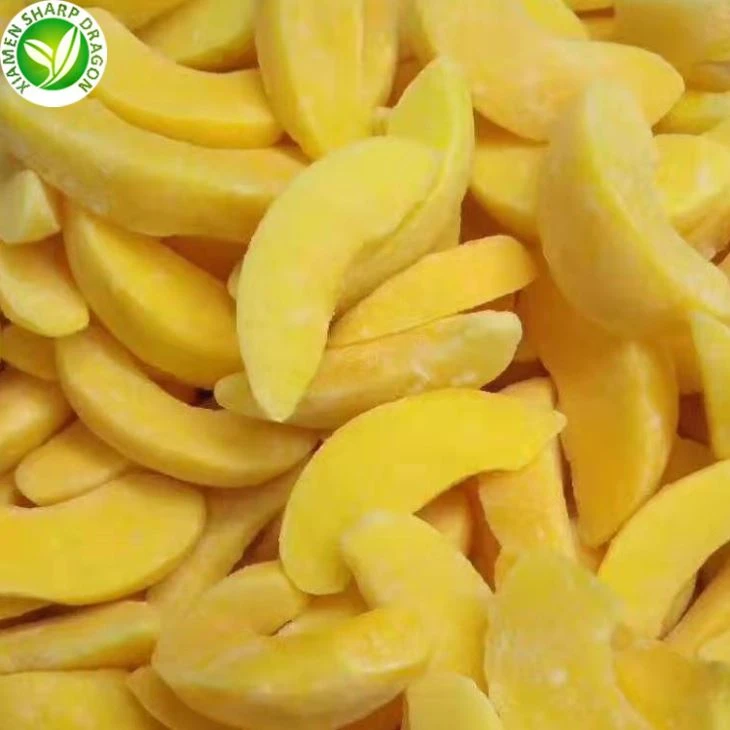
Processing changes must also be named without assuming that every change is harmful or beneficial. Freezing preserves the product for distribution and changes texture after thawing; IQF means pieces are frozen separately. It does not certify a health outcome. The IQF freezing definition explains the process boundary. Ingredient additions, nutrition, serving and claims still require separate review.
For a plain frozen item, identify cultivar direction, cut, peel status, maturity, additives and analytical basis. For puree or preparation, request peach percentage, all other ingredients, concentration basis and the finished serving. For canned fruit, define the packing medium and whether comparison uses net or drained weight. These facts stop a true statement about raw peach from being pasted onto a materially different SKU.
If your decision is about a pack in front of you, use the separate peach form and label guide. If you are defining a frozen ingredient, review the available frozen yellow peach forms. Neither selection replaces a substantiation review for the exact wording intended on a finished product.

A Finished Product Needs Its Own Claim Basis
A finished SKU is the real object of a label claim. Product name, formula, serving size, nutrition method, claims and artwork must refer to the same item. A raw-peach database entry can be a development reference, but it is not automatically the Nutrition Facts panel for a peach yogurt, beverage, filling or fruit cup. Water, other ingredients, concentration, heat, drainage and serving size can all change the declared values.
Worked example: quantify how much peach is actually in the serving. Suppose a 200 g snack cup contains 15% peach puree by finished-product weight. Peach puree per cup is 200 g × 0.15 = 30 g. Compared only as an ingredient-mass check with the 150 g medium raw-peach reference, the cup contains 30 g ÷ 150 g × 100 = 20% of that reference mass. It would be wrong to copy the medium peach's entire nutrition panel or imply that the cup delivers the same exposure. Use the approved formula and a valid nutrition calculation or analysis for the 200 g finished serving.
Now suppose finished-product analysis, purely for illustration, reports 5 mg vitamin C per 100 g. A 200 g serving contains 10 mg. Against the current U.S. Daily Value of 90 mg, the unrounded arithmetic is 10 ÷ 90 × 100 = 11.1%. You must still apply the relevant analytical, variability, rounding, claim-threshold and market rules. The calculation makes the basis visible; it does not authorize wording by itself.
Regulatory category matters. In FDA's U.S. framework, a quantitative statement such as an accurate amount of sodium does not necessarily characterize the nutrient level, while terms such as "low," "high" or "reduced" are nutrient-content claims with defined conditions. A health claim links a food substance to disease-risk reduction and requires an allowed basis and wording. Structure/function and general dietary-guidance language have different boundaries. Start by classifying the proposed sentence; do not try to qualify a treatment promise into acceptability with an asterisk.
Put the destination country at the top of your review. Definitions, daily values, required declarations, permitted claims and language versions can differ. If one pack serves several markets, the strictest-looking wording is not automatically compliant everywhere. Obtain local regulatory confirmation before artwork approval and again when formula, serving or claim text changes.
XMSD specification note: We connect peach percentage, cut, additives, pack weight, serving basis and approved artwork through the frozen packaging workflow. A product change should reopen any nutrition or claim review affected by that change.

Build a Claim File That Survives Formula and Supplier Changes
Start the development file with your exact formula and processing route. Record the peach material, supplier specification, percentage, solids or concentration basis, other ingredients, heat step, expected storage and declared serving. If supporting research used a materially different food or dose, document the gap instead of hiding it under the common name "peach."
Keep your proposed claim text beside its category, evidence, target population, endpoint and destination rule. Store the nutrition calculation or laboratory report, sampling date, method, unit, rounding basis and version. Separate background literature from direct substantiation. A systematic review about fruit-and-vegetable patterns can support dietary context; it does not become SKU-specific clinical proof merely because peach is a fruit.
Create purchasing triggers that reopen the review. A new cultivar, origin, supplier, puree concentration, additive, thermal process, fruit percentage or serving can alter the basis. Even when the sensory result seems unchanged, a label number or claim threshold may move. Know which specification fields are claim-critical before you approve an alternate lot or cost-saving formula.
Practical example: control a substitution. A peach beverage originally uses 30 kg of single-strength puree in a 200 kg batch. R&D proposes 20 kg of a more concentrated puree plus water to preserve flavor and solids. Do not approve the old nutrition and claim file only because both ingredients are called peach puree. Recalculate the finished formula, confirm the concentration and nutrient inputs, review processing losses, verify the serving basis and route the affected artwork through approval.
A concise dossier can be more useful than a thick folder. It should answer: What exactly is the product? What exactly is the claim? Which evidence directly supports it? Which evidence is only background? What market rule permits the wording? Which product attributes must remain unchanged? Who approved the final text, and when must it be reviewed? If those answers cannot be produced, delay the claim rather than filling the gap with a broad wellness phrase.

A Responsible Answer to the Original Question
Peach can be a useful fruit choice. A medium raw peach provides a defined serving with fiber and vitamin C, and plain frozen peach can provide a convenient fruit form. That is enough for a reasonable dietary answer. It is not evidence that peach treats symptoms, removes toxins, repairs the effects of alcohol, changes skin tone or prevents a named disease.
When you encounter a larger claim, slow it down. Identify the exact peach material and serving. Name the outcome. Check whether the research is in cells, animals, observational populations or a controlled human intervention. Confirm that the tested dose and population resemble the proposed use. If the wording is headed for packaging, classify it under the destination market and substantiate it with the finished SKU's formula and data.
That method leaves room for an honest positive conclusion without inventing certainty. Peach can belong in a varied diet without being a cure, and its commercial value can come from reliable form, specification and application fit rather than a vague health halo. Truthful nutrition information is stronger than a benefit the evidence cannot carry.
For an IQF peach brief, send the required cut, peel status, ingredients, pack size, serving basis, destination market and intended wording through the XMSD inquiry form. We can review the product specification and identify which nutrition or claim evidence must come from the finished formula.
References
- USDA SNAP-Ed. Peaches: nutrition information for a 150 g medium peach. Accessed August 27, 2026.
- NIH Office of Dietary Supplements. Vitamin C Fact Sheet for Health Professionals. Accessed August 27, 2026.
- Aune D, et al. Fruit and vegetable intake and the risk of cardiovascular disease, total cancer and all-cause mortality: a systematic review and dose-response meta-analysis of prospective studies. International Journal of Epidemiology. 2017;46(3):1029–1056.
- U.S. Food and Drug Administration. Label Claims for Conventional Foods and Dietary Supplements. Accessed August 27, 2026.
- U.S. Food and Drug Administration. Questions and Answers on Health Claims in Food Labeling. Accessed August 27, 2026.
- National Center for Complementary and Integrative Health. "Detoxes" and "Cleanses": What You Need To Know. Updated March 2025. Accessed August 27, 2026.
- National Institute on Alcohol Abuse and Alcoholism. Hangovers. Accessed August 27, 2026.