


Is It Better to Drink Carrot Juice or Eat Carrots?
Jul 09, 2019

For most people, eating whole carrots is the better everyday default. Whole carrots retain substantially more fiber per equal weight, require chewing, and are easier to place visibly in a meal. Carrot juice is not nutritionally empty or automatically high in added sugar. It supplies carotenoids, and a small human study found higher beta-carotene absorption from fresh carrot juice than from raw carrots under tightly controlled test conditions. The better choice therefore depends on what you need the product to do.
The comparison must also use fair units. In USDA legacy data, 100 g of raw carrot provides about 41 kcal, 2.8 g fiber and 4.74 g total sugars; 100 g of canned carrot juice provides about 40 kcal, 0.8 g fiber and 3.91 g total sugars. The calorie and natural-sugar difference is small at equal weight, while the raw carrot has 3.5 times as much fiber. A typical cup tells a different story because a cup of juice contains much more carrot material by weight than a cup of sliced raw carrot.
The short answer: Choose whole carrots for routine meals, snacks, fiber and portion visibility. Choose a modest amount of 100% carrot juice when a drinkable format, smooth texture or concentrated carotenoid delivery serves a real purpose. Compare equal weights first, then check the actual serving, ingredient list, Total Sugars, Added Sugars, sodium, pulp and pasteurization.

Whole Carrots Are the Better Default, Not the Only Valid Form
Current dietary guidance gives whole vegetables the first position. The Dietary Guidelines for Americans, 2025–2030 advises eating vegetables and fruits in their original form and says 100% fruit or vegetable juice should be consumed in limited portions or diluted with water. The NHS uses a similar practical boundary: 80 g of fresh, frozen or canned fruit or vegetables counts as one adult portion, while a combined 150 ml of juice and smoothies counts only once toward 5 A Day. These are food-pattern rules, not proof that every sip of juice is harmful.
Whole carrots have several everyday advantages at once. The fiber remains in the food matrix. You see and handle the amount before eating it. Chewing generally slows the eating event compared with drinking. A plate containing 80 g of carrot sticks or cooked carrot pieces is also easier to combine deliberately with other vegetables, protein foods and the rest of the meal. Those features support portion awareness even though individual fullness responses are not identical.
Juice earns a place when its form solves a problem. If you have difficulty chewing, a treated, smooth beverage may be easier to consume, although a clinician or speech-language professional should guide texture choices when swallowing is impaired. In product development, you may need carrot flavor and color in a beverage with no solid pieces. A small serving can be convenient where a full vegetable side is unavailable. None of those uses makes juice a complete replacement for the fiber and eating experience of whole vegetables.
Form also includes more than "fresh carrot" and "bottled juice." Raw sticks, cooked slices, plain IQF dice, purée, pulpy blended drinks, clarified juice, juice from concentrate and vegetable juice blends behave differently. A blender that retains all edible pulp is not doing exactly what a juicer that separates pulp does. Read the process and product description before assigning a nutrition profile based only on the word "carrot."

Compare Equal Weight Before You Compare Cups
Many online comparisons put one cup of juice beside one cup of sliced carrots and then conclude that juicing doubles calories or sugar. The arithmetic may be correct for those cups, but the explanation is incomplete. Liquid fills space efficiently. USDA's household measures place one cup of canned carrot juice at about 236 g and one cup of sliced raw carrots at about 122 g. The juice cup contains about 1.93 times the food mass: 236 ÷ 122 = 1.93. It is not an equal-weight test.
| USDA legacy reference | Raw carrots | Canned carrot juice | Decision meaning |
|---|---|---|---|
| Energy per 100 g | 41 kcal | 40 kcal | Almost identical at equal weight |
| Dietary fiber per 100 g | 2.8 g | 0.8 g | Raw carrots provide 3.5 times the fiber |
| Total sugars per 100 g | 4.74 g | 3.91 g | The database does not show more sugar in juice at equal weight |
| Potassium per 100 g | 320 mg | 292 mg | Close, with normal product variation expected |
| Beta-carotene per 100 g | 8,285 micrograms | 9,303 micrograms | Both are concentrated sources; cultivar and processing matter |
| Published one-cup weight | 122 g, sliced | 236 g | A juice cup holds about 1.93 times the mass |
Worked example: For an equal-weight comparison, put 100 g of raw carrots beside 100 g of canned carrot juice. The energy difference is 41 − 40 = 1 kcal, and raw carrots contain 4.74 − 3.91 = 0.83 g more total sugars in these entries. The decisive gap is fiber: 2.8 ÷ 0.8 = 3.5. Your accurate conclusion is not "juice is much more caloric per gram"; it is "the whole form retains far more fiber per gram."
Worked example: For common cup measures, a 122 g cup of sliced raw carrots scales to about 50 kcal, 3.4 g fiber and 5.8 g total sugars. A 236 g cup of juice scales to about 94 kcal, 1.9 g fiber and 9.2 g total sugars. The juice cup has 94 ÷ 50 = 1.88 times the calories, yet that is mainly because the cup holds nearly twice the mass. State both the serving volume and gram weight whenever you compare product forms.
These database numbers are references, not specifications for every carrot or every beverage. Raw-material variety, maturity, storage, extraction yield, filtration, concentration, water addition and blending can change the finished values. Use the actual Nutrition Facts panel for a packaged retail drink and laboratory or approved database calculations for a commercial formula. If your question is how much carrot fits a day rather than which form is preferable, use our separate carrot portion guide.

Fiber and Consumption Speed Change the Practical Choice
Juicing usually separates much of the insoluble pulp from the liquid. The USDA entries quantify the result: 2.8 g fiber per 100 g for raw carrot versus 0.8 g for canned carrot juice. A pulpy product may retain more than a clarified juice, so "juice" is not one fixed number. Even so, a screened beverage cannot be assumed to preserve the fiber profile of the intact raw material. Ask for or read the finished-product value.
Chewing and pace matter because a beverage can be consumed quickly. It is easy to drink 236 g of juice in a few minutes, while 236 g of raw carrot is almost two USDA cups of slices and demands much more chewing. This does not prove that every person will consume more calories after juice, nor does it mean liquid calories are uniquely harmful. It explains why equal cups can quietly become unequal food amounts.
Use that insight as a behavior check. Pour juice into a measured glass instead of drinking from a large bottle. Keep it with a meal rather than treating refills as hydration. Let water remain the main thirst drink. If you want a snack that occupies time and adds fiber, whole carrot pieces are the clearer choice. If you need a smooth beverage for a defined use, set the serving before you start drinking.
A smoothie sits between the categories only when it retains all edible carrot pulp; added ingredients may then dominate the comparison. Fruit, yogurt, sweeteners, protein powders or fats alter the energy, total sugars, added sugars and texture. "Carrot smoothie" is therefore a recipe name, not a standard nutrition profile. The same caution applies to soups and purées: processing changes particle size, but the fiber remains only if the solids remain in the food.
Carrot Juice Can Deliver Beta-Carotene Efficiently
The strongest case for carrot juice is not a vague "detox" promise. It is bioavailability: breaking plant tissue can make some carotenoids more accessible for absorption. The American Heart Association notes that processing, including juicing, can break cell membranes and make carotenoids more available. It also points out that a little dietary fat can help the body use these fat-soluble compounds. Cooking can create a related accessibility advantage, which is why the relevant adjacent comparison is covered separately in our raw-versus-cooked carrot guide.
A 2025 randomized crossover trial provides direct but narrow human evidence. Sixteen healthy adults aged 20 to 30 consumed either 320 g of raw carrots or 530 g of fresh carrot juice, with both test meals standardized to 25 mg beta-carotene and 50 ml canola oil. The juice condition produced a 2.33-times higher peak plasma beta-carotene concentration and a 2.09-times larger absorption area under the curve. That is a meaningful form effect under the study conditions.
It is not evidence that juice is healthier overall. The trial was small, used a single test dose, included young healthy adults and supplied an unusually large 50 ml oil dose with each treatment. It compared beta-carotene absorption over 24 hours, not long-term body weight, diabetes, eye disease, cardiovascular outcomes or overall diet quality. The researchers found no significant between-form differences in measured antioxidant capacity or other fat-soluble vitamin levels. A precise conclusion is that fresh juice improved beta-carotene absorption in that protocol-not that it erased the fiber difference or should replace whole vegetables.
Vitamin A context also needs restraint. Beta-carotene is a provitamin A carotenoid that the body can convert to vitamin A. NIH explains that vitamin A supports normal vision, immune function, growth, reproduction and organ function. More carrot juice does not sharpen normal vision on demand, cure eye disease or guarantee stronger immunity. If you follow a medical nutrition plan or manage altered glucose control, kidney disease or swallowing concerns, use advice tailored to your condition instead of copying a generalized online serving.
Total Sugars and Added Sugars Are Not the Same
Carrots naturally contain sugars, so a 100% carrot juice can show Total Sugars while showing zero Added Sugars. FDA defines Total Sugars as naturally occurring sugars plus any sugars added during processing. Added Sugars is a subset that includes added sucrose, dextrose, syrups, honey and certain concentrated fruit or vegetable juice ingredients used beyond what would be expected in the same volume of 100% juice. Do not interpret every gram on the Total Sugars line as table sugar poured into the product.
Read three places together. First, the product name tells you whether it claims to be 100% juice, a juice blend or a juice drink. Second, the ingredient list shows carrot juice, water, other juices, sweeteners, salt, acids and other recipe components in descending weight order under applicable rules. Third, the Nutrition Facts panel states the serving basis, calories, Total Sugars, Added Sugars, fiber and sodium. A front label with a large carrot image cannot replace those details.
Practical label example: Imagine a bottle declares a 250 ml serving with 10 g Total Sugars, including 4 g Added Sugars. If you pour 150 ml, the scale factor is 150 ÷ 250 = 0.60. That pour contains an estimated 10 × 0.60 = 6 g Total Sugars and 4 × 0.60 = 2.4 g Added Sugars. The remaining 3.6 g of Total Sugars is not automatically all "carrot sugar" because a blend can contain other ingredients. Use the ingredient list before assigning the source.
Serving size has another trap. FDA explains that a label serving is based on the amount people typically consume; it is not a recommendation of how much they should consume. If a bottle lists nutrition per 240 ml but your dietary framework uses a 150 ml juice portion, calculate both. If the bottle contains two servings and you drink it all, multiply every per-serving value by two. The container shape does not define a health target.
Pasteurization and Handling Belong in the Decision
Nutrition is not the only comparison. FDA warns that fresh produce can carry bacteria into juice when it is squeezed or used raw. Pasteurization or another validated treatment reduces this hazard. Most juice sold in the United States is treated, but some refrigerated products sold at juice bars, markets or retail stores may be untreated. Products sold by the glass may not carry the same packaged warning label, so ask when the treatment status is unclear.
Children, older adults, pregnant people and people with weakened immune systems have a greater risk of serious illness from untreated juice. For those groups, an unpasteurized "fresh" claim is not a nutrition advantage. Choose pasteurized or otherwise treated products and follow refrigeration and use-after-opening directions. At home, wash whole carrots under running water before cutting or juicing, remove damaged areas, keep equipment clean and avoid treating raw juice as shelf-stable.
Whole carrots have their own handling questions. Raw hard pieces can be unsuitable for young children or people with chewing and swallowing problems; texture may need to be softened and cut appropriately. Frozen carrot pieces normally require frozen storage and preparation according to the pack directions. Safety is form-specific: do not turn "whole is better" into "every whole-carrot presentation is appropriate for every eater."

Choose the Form by the Job It Must Do
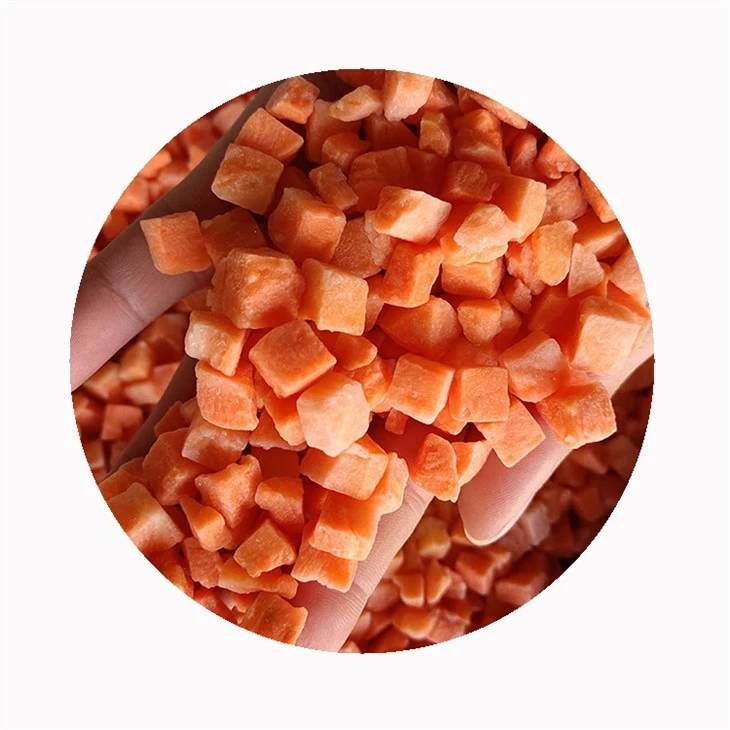
For a snack or visible vegetable side, choose whole pieces. Raw sticks provide crunch; cooked rounds, dice or strips integrate into a meal while keeping the carrot solids. You can weigh the edible portion, see its relationship to the other foods and retain the fiber represented by the finished form. Plain frozen carrots can support the same use when storage life, year-round availability and preparation consistency matter. XMSD's IQF frozen carrot range shows common solid formats rather than a juice proposition.
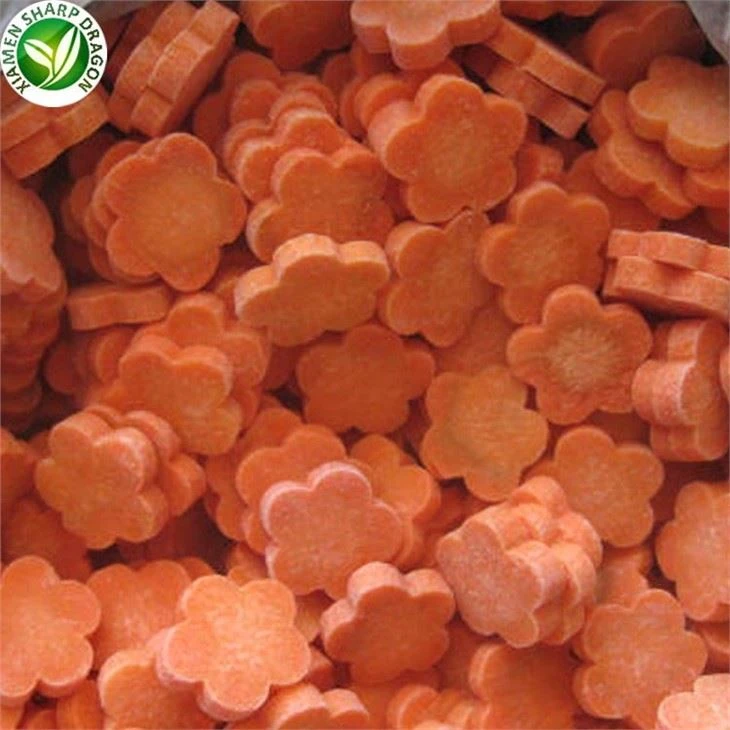
For soup, rice, filling or a ready meal, choose the cut that distributes correctly. Dice spread through a formulation more evenly than large rounds, while strips give visible length and flower cuts provide a decorative identity. Cut geometry affects piece count, scoop density, cooking behavior and the consumer's impression of abundance. It does not make the carrot nutritionally superior. Our frozen diced carrot reference is useful when distribution and measurable cut size matter.
For a beverage, define what the drink must deliver. Is the goal 100% vegetable juice, a carrot-forward blend, a diluted drink, a smoothie retaining pulp or a culinary base? Decide the serving volume, carrot-juice percentage, other juice components, water, sweeteners, salt, acid, pulp level and heat treatment before comparing nutrition panels. "Contains carrot" is too broad for procurement, label review or a meaningful nutrition comparison.
If you dislike carrot texture, consider more than extraction. Roasting, steaming, grating, puréeing into soup or using a fine dice can improve acceptance while retaining more of the solids than screened juice. If beta-carotene accessibility is the goal, cooking with a modest amount of fat may be another route. If convenience is the goal, a measured treated juice may still be the most realistic choice. The best form is one that meets the real constraint without pretending all forms are nutritionally identical.
For Commercial Products, Compare Specifications Rather Than Names
When you compare carrot solids with carrot juice, build two different specification sets. For frozen pieces, define variety or sensory target where relevant, cut shape and dimensions, defect tolerance, color, texture after the intended cook, foreign-material controls, pack size, storage temperature and destination requirements. For juice, define whether it is direct juice or from concentrate, single vegetable or blend, juice percentage, soluble-solids measurement basis, pulp level, acidity, heat treatment, microbiological criteria, pack system and label jurisdiction. One supplier adjective cannot replace those measurable points.
Nutrition claims must come from the finished product and the applicable market rules. A raw-carrot database value cannot simply be copied onto a filtered, concentrated, diluted or blended beverage. Likewise, a generic juice value cannot represent an IQF diced-carrot pack. Confirm the formulation and legal serving basis, use an approved calculation or finished-product testing as required, and maintain revision control when ingredients or processing conditions change.
Worked example: For a commercial beverage, you plan 10,000 bottles of a 250 ml vegetable drink and specify 80% carrot juice by volume. Finished beverage volume is 10,000 × 0.250 L = 2,500 L. Nominal carrot-juice input is 2,500 L × 0.80 = 2,000 L, leaving 500 L for all other formula components before process losses. That calculation does not determine the purchase quantity by itself. Add the verified process-loss allowance, minimum batch size, density basis where mass purchasing is used, production overage and line trial results before issuing the order.
For a frozen meal, the arithmetic starts from solid carrot weight instead. If 20,000 portions each require 35 g carrot dice, net recipe demand is 20,000 × 35 g = 700,000 g, or 700 kg. Then adjust for the validated handling or cooking yield and the pack configuration. These two calculations show why beverage and solid-carrot projects should not share a vague "carrot content" specification.
Packaging decisions follow the product, route and use rate. A reclosable retail frozen bag, a foodservice inner pack and an aseptic juice carton solve different problems. Confirm barrier needs, seal integrity, unit size, coding, secondary case, pallet pattern and cold-chain or ambient route as applicable. Our frozen-food packaging overview provides format context for frozen carrot programs; juice systems require a beverage-specific supplier and validated process.

A Repeatable Choice for Home or Product Development
Start by naming the job: routine vegetable, snack, side dish, texture-managed food, beverage, prepared-meal ingredient or commercial formula. Compare nutrition at the same weight before looking at convenient cup measures. Then bring the real serving back into view. For juice, inspect the full label and treatment status. For whole, cooked or frozen carrots, define the edible weight, cut, sauce or added fat and the role of the carrots within a varied meal.
If no special constraint exists, whole carrots win the everyday decision because they retain more fiber and make the amount easier to see and eat deliberately. Juice can still be a rational measured choice, particularly when the beverage format is useful and the product is 100%, treated and clearly labeled. Its potential beta-carotene bioavailability advantage should be acknowledged without stretching a small absorption study into a broad health claim.
For procurement, send the actual application rather than asking only for "good carrots." Tell us the cut, target piece dimensions, cooking process, pack size, destination and expected annual or shipment volume. We can review suitable frozen carrot formats and the information needed for a sample or quotation. Send your frozen carrot inquiry to XMSD when solid IQF carrot is the correct format for your project.
Final Thoughts from XMSD
Eating carrots is usually the stronger daily choice; drinking carrot juice is a different tool, not a failed version of the vegetable. Equal-weight USDA data show the forms are close in calories and naturally occurring sugars, while whole raw carrot provides 3.5 times the fiber. Typical juice cups look more concentrated partly because they hold far more mass. Juice may improve beta-carotene absorption under specific conditions, but that benefit does not replace fiber, portion control, label review or dietary variety. Choose the form that performs the intended job, and keep the comparison honest about units, formulation and evidence limits.
References
- U.S. Department of Agriculture, Agricultural Research Service. FoodData Central Download Data. SR Legacy entries for carrots, raw (FDC 170393) and carrot juice, canned (FDC 170491). Accessed August 25, 2026.
- U.S. Department of Health and Human Services and U.S. Department of Agriculture. Dietary Guidelines for Americans, 2025–2030. Accessed August 25, 2026.
- National Health Service. 5 A Day: What Counts? Accessed August 25, 2026.
- Choi M, Baek J, Park E. Comparative Bioavailability of Beta-Carotene from Raw Carrots and Fresh Carrot Juice in Humans: A Crossover Study. Nutrition Research and Practice. 2025;19(2):215–224. doi:10.4162/nrp.2025.19.2.215.
- American Heart Association. What's Up with Carrots? Let's Root Out the Truth. Accessed August 25, 2026.
- National Institutes of Health, Office of Dietary Supplements. Vitamin A and Carotenoids: Fact Sheet for Health Professionals. Accessed August 25, 2026.
- U.S. Food and Drug Administration. Added Sugars on the Nutrition Facts Label. Accessed August 25, 2026.
- U.S. Food and Drug Administration. Serving Size on the Nutrition Facts Label. Accessed August 25, 2026.
- U.S. Food and Drug Administration. What You Need to Know About Juice Safety. Accessed August 25, 2026.