


How to make strawberry jam with frozen strawberries
Aug 21, 2026

You can make consistent strawberry jam from frozen strawberries, but you should not treat the frozen fruit as a direct one-for-one copy of a fresh-fruit recipe. Freezing ruptures fruit cells, and thawing releases juice. That juice carries strawberry soluble solids, acids, pigments and aroma compounds. Drain it away and the formula changes; ignore it and the kettle receives more mobile water than your team expected.
For a commercial or foodservice batch, control six linked variables: the identity and packing medium of the frozen fruit, thawed fruit plus released juice, initial soluble solids, pH, the selected pectin system and the final concentration endpoint. Then evaluate yield, gel strength, spread, syneresis, color and flavor after a defined cooling and set period. A fixed boiling time cannot replace those measurements because fruit lots, kettle loads and evaporation rates vary.
The short answer: thaw frozen strawberries in a closed, controlled lot; retain and weigh the released juice; measure the combined fruit for soluble solids and pH; choose a pectin designed for the intended sugar system; concentrate to the validated endpoint; and release the jam against measurable gel, yield, flavor, color, fill and safety criteria. Never cut sugar or swap pectin types without reformulating and validating the product.

Decide What Product You Are Making Before You Set a Formula
"Strawberry jam" is not only a flavor description. It can be a standardized legal name with composition requirements. Codex CXS 296-2009 provides alternative general fruit-content frameworks for jams and describes finished soluble solids in the 60 to 65 percent range or greater, subject to the law of the retail country. It also expects appropriate gelled consistency, normal fruit color and flavor, and freedom from relevant defects. In the United States, 21 CFR 150.160 includes frozen fruit as a permitted fruit ingredient, places strawberries in Group I, specifies a fruit-to-saccharine-ingredient relationship and requires at least 65 percent soluble solids for a standardized jam or preserve.
Those references do not give one universal export formula. A lower-sugar product may need a name such as "fruit spread" in one market, while another market has its own jam categories, fruit minimums, additive permissions and label statements. Before the pilot, record the destination, product name, fruit-content declaration, target nutrition panel, permitted pectin and acid system, preservative policy, pack size, storage condition and intended shelf life. Your regulatory reviewer should approve that framework before production purchases a pectin or prints labels.
Separate shelf-stable jam from refrigerated or frozen fruit spread. A suitable pH and a sealed lid do not by themselves establish commercial sterility, shelf life or a validated thermal process. Home-preservation directions from the National Center for Home Food Preservation are valuable evidence for ingredient order and gel principles, but a processor must use its own approved formulation, scheduled or validated process, hygienic controls, closure system and destination-market requirements.
Decision example: a retailer wants "40% less sugar" on a product that is currently sold as standard strawberry jam. The correct response is not to remove 40 percent of the sucrose from the existing kettle sheet. The team first checks whether the new composition can still use the same legal name, selects a low-sugar pectin system, reviews water activity and thermal-process consequences, recalculates nutrition and yield, and runs shelf-life and sensory validation. The claim, name and process change together.
Keep the Thaw Juice in the Fruit Balance
National Center for Home Food Preservation guidance recognizes thawed fruit and purées as suitable inputs for jam and notes that frozen fruit often releases more juice. For jam production, that released liquid is normally part of the fruit lot unless the approved formula explicitly separates and accounts for it. Collect the berries and their juice in a food-grade covered vessel, then weigh the combined material after the controlled thaw. Do not discard the juice merely to make the fruit look more like fresh strawberries.
The ingredient statement of the frozen material matters. Unsweetened IQF strawberries give you a clean fruit basis. Sugar-packed fruit or strawberries in syrup already contribute sweetener and soluble solids; that amount must be deducted from added sugar and included in label calculations. A supplier description that says only "frozen strawberries" is incomplete for formulation work. Obtain the ingredient list, packing medium, Brix or soluble-solids range, pH data where available, cut form, variety direction, maturity, foreign-material and defect limits, pack weight and storage conditions.
Thaw in a way that keeps each trial traceable. Record lot code, frozen mass, thaw time, thaw temperature, combined mass after thaw, free liquid share, odor, color and any abnormal fermentation or package damage. If your process allows direct addition of partially thawed fruit to the kettle, validate that route separately. Large frozen blocks can lengthen heat-up time and create local scorching or uneven pectin hydration; free-flowing pieces are easier to dose and mix.
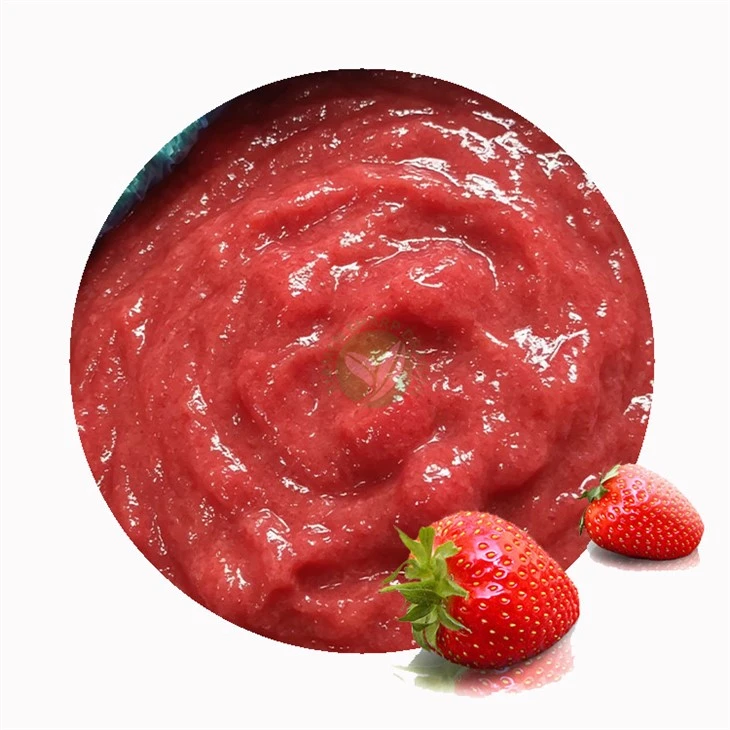
The XMSD frozen strawberry range shows whole, sliced, diced and purée directions. Product form should follow the jam texture brief. Whole or halved IQF fruit supports visible pieces after controlled crushing; dices reduce preparation time; purée supports a smoother spread but changes the way you specify seed, particle and viscosity attributes.

Measure after thawing and mixing
A refractometer reading from the surface liquid alone may not represent a non-uniform thawed lot. Mix or crush according to the defined sampling method, then take a representative sample. Record temperature and apply the method's correction requirements. Treat °Brix as a practical soluble-solids indicator, not a direct proof of sucrose content: strawberry acids, natural sugars and other dissolved solids also affect the reading.
Balance Pectin, Acid, Sugar and Fruit Solids as One System
Strawberries are relatively low in natural pectin. University of Minnesota Extension therefore lists them among fruits that may need commercial pectin and explains the three-way relationship: pectin builds the gel network, acid helps pectin molecules associate, and sugar ties up water while supporting gel formation in traditional systems. Its research-based fruit-spread guidance places the ideal pH range for gel formation at 3.0 to 3.5 and warns that too little acid can prevent a gel while too much can produce a tight gel that weeps.
That 3.0 to 3.5 range is a useful formulation reference, not permission to choose one fixed pH for every product. The required pH depends on the pectin grade, soluble solids, calcium system where relevant, fruit buffer capacity, thermal process and legal or customer specification. Measure with a calibrated pH meter using the agreed sample temperature and preparation. Indicator strips are too coarse for a narrow commercial control window.
Traditional high-methoxyl pectin typically works with higher soluble solids and sufficient acid. Low-methoxyl or amidated low-methoxyl systems can gel at lower sugar levels through calcium-mediated mechanisms. These pectins are not automatic substitutes. Their dose, order of addition, calcium availability, shear tolerance and target texture differ. Follow the selected pectin supplier's application instructions, then verify the result in your own strawberry matrix.
Disperse powdered pectin correctly. Premixing it with part of the sugar can reduce lumping, but the correct ratio and addition point depend on the pectin. Hydration failures appear later as weak gel, grainy particles or inconsistent jars. Excessive high-shear treatment after the fruit structure has been set can also erase the piece profile that the customer approved. Your batch sheet should state mixer speed, addition order, kettle load, heat-up profile and the point at which fruit particles must be protected.
| Control | What it changes | Release evidence |
|---|---|---|
| Fruit Brix and juice release | Added sugar need, evaporation load, flavor concentration | Representative thawed composite |
| Pectin type and dose | Gel mechanism, firmness, spread, sugar tolerance | Approved grade, batch weight and supplier instructions |
| pH and acid addition | Gel formation, flavor, process boundary | Calibrated pH result and addition record |
| Final soluble solids | Concentration, texture, yield and legal name | Agreed refractometer method and endpoint |
| Cook and shear history | Color, cooked flavor, particle integrity and gel damage | Time-temperature and mixer records |

Build the Batch from Measurements, Not a Fixed Boiling Time
A reliable process starts with the approved formula and a pre-batch calculation, then uses measured endpoints. Kettle geometry, steam pressure, surface area, batch size and starting fruit temperature change evaporation. "Boil for 20 minutes" may produce a loose jam on one line and a dark, overcooked jam on another. Time remains a process record, but soluble solids, pH, temperature profile and final mass show what happened.
- Identify and weigh the frozen fruit lot, including its declared sugar or syrup status.
- Thaw under the approved condition; retain all released juice; mix or crush to the specified particle profile.
- Measure combined fruit mass, soluble solids and pH; compare color, odor and defects with the approved reference.
- Calculate sugar, pectin, acid and any permitted minor ingredients for that measured fruit basis.
- Add ingredients in the validated order and control agitation so pectin disperses without destroying the target fruit texture.
- Concentrate to the defined endpoint and verify soluble solids and pH by the agreed methods.
- Fill, close, cool and hold according to the validated product and pack process; retain lot and traceability records.
- Evaluate the gel after the defined set period at a defined test temperature before releasing the lot.
University of Minnesota's home-preservation reference explains that jelly reaches its gel point around 220°F at sea level and that elevation changes the relationship to the boiling point of water. A commercial strawberry jam line should not turn that figure into its only endpoint. Added pectin systems, vacuum cooking, product solids, kettle pressure and local method requirements can alter the useful control plan. Use the approved process, and verify the finished batch analytically.
Worked example: for a mass-balance screen, a trial starts with 100 kg of unsweetened thawed strawberries at 8° Brix and adds 65 kg of sucrose. Ignoring the small soluble-solids contribution from pectin and acid, fruit supplies 8 kg of soluble solids and sugar supplies 65 kg, for 73 kg total. At a measured 65% final soluble-solids endpoint, theoretical finished mass is 73 ÷ 0.65 = 112.3 kg.
The pre-concentration mass is 165 kg, so the simple model predicts about 52.7 kg of water removal. Actual filled yield will differ because pectin and acid add mass, steam or vacuum conditions change losses, and the line retains product in the kettle, pipes, filter, filler, foam and samples. This is a planning model, not a commercial recipe; the finished endpoint and legal composition still require measurement and validation.

Choose Whole Fruit, Pieces or Purée by the Finished Texture
Whole berries are not automatically the premium input for every jam. They require thawing and controlled crushing, and their size distribution affects particle consistency. Halves or dices can shorten preparation and give a more predictable piece profile. Purée reduces crushing work and supports a smooth product, but it should be specified for seed content, screen size, soluble solids, pH, color, heat treatment and packing. Compare usable performance, not the romance of the raw-material name.
For a visible-piece preserve, approve a target particle distribution after the full cook, not only before it. A berry that looks intact while frozen may collapse during thaw and agitation. For a smooth industrial filling, excessive particles can block dosing equipment or create uneven bakery deposits. The frozen strawberry purée reference is useful when the application values rapid mixing and a homogeneous fruit phase. The bulk frozen strawberry reference is the better starting point when the project needs whole, sliced or diced fruit identity.
Practical example: a yogurt-fruit-preparation customer wants soft but recognizable strawberry pieces. The development team screens a 10 mm dice and a whole-berry lot using the same thaw, Brix, pH, pectin, cook and shear conditions. Whole berries create attractive large pieces but produce wider jar-to-jar variation. The dice gives more uniform distribution and faster pumping. The team selects the dice and writes a cooked particle-profile limit instead of paying for whole fruit that the process destroys.

Approve the Frozen Strawberry Lot for Jam Performance
A jam processor can accept shape defects that a retail whole-fruit pack would reject, but it cannot ignore identity, food safety, flavor, fermentation, foreign material or formulation variability. Define two layers: non-negotiable safety and legality, followed by application-specific quality. Raw material affected by mold, abnormal fermentation, chemical odor, undeclared ingredients, temperature abuse or traceability failure is not rescued by boiling it into jam.
For application quality, specify the combined thawed fruit. Useful variables include fruit identity and variety direction, unsweetened or sugar-packed status, Brix range, pH information, red-color reference, ripe and underripe share, green or white shoulder, caps and stems, foreign material, damaged fruit, free liquid, package ice, clumping, odor and flavor. State the sampling method, sample mass, defect definitions and whether limits are calculated by count or weight.
Keep food-safety and compliance criteria on the same signed specification but outside the sensory score. Define the destination and customer limits for microbiology, pesticide residues, contaminants and foreign material; name the analytical methods or accepted laboratory basis; and state which results are required per lot. Link the certificate of analysis to the production and packing code so a satisfactory pilot cannot be paired with an unrelated shipment record.
Run a lab or pilot cook on the incoming lot before a large campaign when color, gel or yield is critical. Use the same fruit mass, formula, kettle, endpoint and test method as the approved reference. Record final mass, fill loss, soluble solids, pH, gel or viscosity, spread, syneresis, fruit-piece distribution, color, flavor and any scorched or cooked note. This separates a visually acceptable lot from a functionally acceptable lot.
Codex CXS 296-2009 treats a container that fails the relevant quality requirements as defective and provides lot-acceptance sampling at AQL 6.5 for its defined criteria. Do not copy that number onto every customer specification. Decide whether Codex, destination law, customer contract or a tighter internal plan governs each attribute. AQL describes a sampling decision; it does not make unsafe product acceptable or replace process control.
| Stage | Minimum review | Failure signal |
|---|---|---|
| Frozen receipt | Lot code, temperature, pack, ingredient statement, frozen condition | Untraceable lot, damaged pack, abnormal clumping or thaw history |
| Thawed composite | Mass, juice, Brix, pH, color, odor, defects | Fermentation, mold, undeclared syrup, out-of-range solids |
| Pilot jam | Yield, gel, spread, syneresis, color, flavor, particle profile | Weak set, weeping, burnt note, dark color or poor usable yield |
| Finished lot | Process records, fill, closure, label, analytical and sensory release | Endpoint drift, closure fault, label mismatch or failed hold sample |
Test Gel, Yield and Syneresis Under a Repeatable Method
A warm jam can appear loose even when it will set correctly, while an over-concentrated jam can appear acceptable in the kettle and become rubbery after cooling. Define the test temperature and the time after filling. Depending on the customer and equipment, the release method may use a consistometer, rotational viscometer, texture analyzer, spread test or an approved sensory reference. The instrument name alone is not enough; record spindle or geometry, speed, temperature, sample preparation and reading time.
Syneresis is liquid separation from the gel. It can result from an unbalanced pectin-acid-sugar system, excessive acid, poor pectin hydration, overcooking, incompatible calcium conditions or storage effects. Evaluate the container after the agreed hold and temperature cycle. A jar that looks glossy immediately after filling may show a liquid ring later. Capture both the percentage or measured separation and the visual acceptance reference.
Yield should be reconciled from weighed inputs to saleable filled product. Record thaw loss only when material is intentionally and validly removed, kettle evaporation, foam or skim, transfer residue, filter loss, filler hold-up, quality samples and underweight or rejected containers. Theoretical mass balance helps production plan; actual reconciled yield helps purchasing compare suppliers. A lower-priced strawberry lot can cost more per saleable jar if it arrives with undeclared syrup, wide Brix variation, excessive unusable defects or weak color that requires a different formula. Compare landed fruit cost together with usable fruit, sugar, pectin, acid, energy, line loss, rework and saleable filled yield.
Use the same application distinction for internal navigation. Frozen strawberries for a cake batter, filling or topping face moisture-management and structure questions that are different from jam gelation. A frozen strawberry smoothie values cold blending and drinkable texture, not a shelf-stable pectin network. Keeping these owners separate gives production teams the correct decision method for each use.

Frequently Asked Questions
Should frozen strawberries be drained before making jam?
Normally, keep the released juice with the fruit and include it in the combined thawed mass. The juice carries strawberry solids, acid, color and aroma. If an approved formula intentionally removes liquid, weigh and document it, then recalculate fruit content, sugar, yield and label values rather than discarding it informally.
Can I reduce sugar but use the same pectin?
Not without evidence from that pectin system and a validated reformulation. Traditional and low-sugar pectins use different gel mechanisms and ingredient balances. Changing sugar also affects soluble solids, water activity, yield, flavor, label values and possibly the legal product name.
What is the right pH for strawberry jam?
Research-based fruit-spread guidance gives 3.0 to 3.5 as an ideal gel-formation range. Your exact target must match the selected pectin, soluble solids, process, flavor, shelf-life design and destination rules. Measure it with a calibrated meter and a defined sample method.
Are broken or soft frozen strawberries acceptable for jam?
Shape defects may be acceptable when the lot meets the agreed identity, safety, flavor, color, defect and formulation requirements. Mold, fermentation, foreign material, undeclared ingredients, temperature abuse and traceability failure are not cosmetic. Approve the lot through a thawed composite and pilot jam, not appearance alone.
XMSD sourcing note: Send us your jam texture, whole/diced/purée preference, required Brix and pH evidence, unsweetened status, defect limits, annual volume, pack and destination. We will review a suitable frozen strawberry direction and the sample evidence needed for your pilot.
Final Thoughts from XMSD
Frozen strawberries are a practical, year-round jam input because thaw softness is not a disadvantage in a crushed or puréed application. The risk comes from uncontrolled assumptions: draining released juice, ignoring added syrup, swapping pectin types, choosing an endpoint by time alone, or approving a lot from frozen appearance without a pilot cook. Treat fruit solids, sugar, acid, pectin, evaporation and process history as one measured system.
Start with the destination product definition, then lock the raw-material specification, thaw method, formulation, analytical endpoints, set test, safety process and reconciled yield. Procurement can then compare whole fruit, dices and purée on saleable performance rather than carton price, and quality receives criteria it can actually inspect.
References
- National Center for Home Food Preservation: Strawberry Jam with Powdered Pectin
- National Center for Home Food Preservation: Thawing and Preparing Frozen Fruit
- University of Minnesota Extension: Preserving Fruit Spreads
- University of Minnesota Extension: Freezing and Thawing Produce
- Codex CXS 296-2009: Standard for Jams, Jellies and Marmalades
- 21 CFR 150.160: Fruit Preserves and Jams
- XMSD operational experience in frozen-fruit sourcing, IQF processing, quality control, packaging and B2B export coordination.