


How to Cook Frozen Broccoli: Methods, Timing and Texture
Aug 26, 2024

Cook plain frozen broccoli directly from frozen when the pack gives that method. Use steaming or a microwave for a moist, tender side; choose a hot oven or air fryer when you want browned edges. Keep the load manageable, cook it thoroughly, and drain released water before adding a sauce. Thawing on the counter is unnecessary for products designed to cook from frozen.
A useful timing reference comes from McCain Classics Broccoli Florets: its product sheet gives approximately 4 minutes boiling, or 5–6 minutes steaming, directly from frozen. These are instructions for that named product, not a universal schedule for every cut or an XMSD cooking specification. Your own product directions take priority. A dense stem, a crowded tray or a larger load can finish differently from a small, loose floret.
Start with the result you need. Broccoli for soup can be softer than broccoli served beside a grilled main course. For a pasta sauce, excess water is often a bigger problem than lack of browning. Getting that choice right is more useful than trying to make every cooking method produce the same texture.

Before extending the next batch's cooking time, compare the pattern across the pieces. Small crowns collapsing while larger stems remain too firm point toward size distribution or an uneven load. If the prepared pieces have an acceptable bite but water pools around them, examine drainage, tray crowding and the sauce rather than adding heat by default. If one side browns while pieces underneath stay wet, compare spacing and turning with the instructed method. Use these observations to adjust preferred texture after completing the product's cooking directions; appearance and tenderness do not independently establish food safety. Change one variable in a small repeat trial and record the result before applying it to the full service load.
Choose the method for the dish
Steam when you want clean broccoli flavor and a moist surface that will take butter, oil or seasoning after draining. The broccoli sits above the water rather than being submerged. Keep enough space for steam to circulate and use a lid that fits. If you stack a deep mound into a small basket, the pieces are no longer receiving the same treatment as a shallow layer.
Boiling is straightforward when a saucepan is already part of the meal preparation. Use the amount of water and cooking sequence specified for the product, then drain promptly. Leaving the florets in hot water while you finish another dish keeps softening them. A colander ready beside the stove is a small preparation step that prevents an otherwise successful batch becoming overcooked.
The microwave suits a small portion or a product supplied in a microwave cooking bag. Use only packaging specifically labeled for that use.
A normal freezer liner or outer bag is not automatically a cooking container. Follow the stated portion, power, water, covering, stirring and standing instructions together; copying only the number of minutes leaves out much of the method.
Roasting and air frying are the better choices for a drier surface and browned tips. The florets still contain moisture, so the early part of cooking involves heating them and releasing water before browning develops. A wide, shallow load gives that moisture a route out. A thick heap makes the lower pieces behave more like steamed vegetables while exposed crowns darken.
For a skillet dish, consider cooking the broccoli by its instructed method first, draining it, and then tossing it briefly with the finished sauce. This separates thorough cooking from the final flavor coating. It is particularly helpful when garlic, spices or a thick glaze would burn before the frozen centers are ready. Add the broccoli gently so tender crowns remain intact.
Roasting and air frying without a watery tray
Birds Eye's frozen-broccoli cooking guide gives an oven example of 450°F, about 232°C, for 20–25 minutes. Its air-fryer example uses 390°F, about 199°C, for 10–20 minutes in a single layer, turning or shaking at 5-minute intervals and watching closely after 10 minutes. These published examples describe the manufacturer's preparation approach; match the actual product and appliance instructions before using them.
Preheat the appliance before adding the broccoli. Spread the pieces so the crowns are exposed rather than buried, and use an appliance-safe tray or basket. A light, even coating of oil helps distribute seasoning without leaving a pool underneath. Pouring oil onto one corner of a frozen heap produces an uneven result: some pieces become heavily coated while others remain dry.
Do not keep adding minutes solely because a few pieces have not browned. Look at the load first.
If water is pooling and the florets overlap heavily, redistribute the next batch over more space or cook smaller batches. Extending the same crowded batch can leave the stalks very soft before the surface ever becomes as dry as you hoped.
The small branches at the edge of a crown darken sooner than its thick stem. Turn pieces as the method requires and compare several positions in the tray. When the crown looks ready but a thick section remains insufficiently cooked, the next adjustment is a narrower size range or a different method, rather than accepting the surface appearance as the only test.
Keep wet finishing ingredients for the right stage. Lemon juice, a thin dressing or a loose sauce added after cooking can give flavor without filling the roasting tray with more liquid. If the broccoli will immediately enter a soup or sauce, there may be little benefit in chasing a deeply browned finish first. Choose that extra step only when its flavor survives in the final dish.

Steaming, boiling and microwave cooking
With steaming, the water should generate steam without reaching the broccoli. Add the frozen portion carefully, cover, and use the product's stated sequence. Lift the lid away from your face when checking. Inspect a thick stem as well as a small crown: the easiest piece to pierce is rarely the most demanding one in the basket. Finish cooking before making a taste assessment.
For boiling, keep the batch within the saucepan's working capacity. A large frozen addition cools the water, so note whether the label starts its timing when the broccoli goes in or when the water returns to the required condition. Those two starting points are not interchangeable. Use the same basis whenever you compare batches, otherwise a timing log can look consistent while the actual treatment varies.
Drain cooked broccoli without pressing or squeezing the crowns. Their shape matters when you want recognizable florets on the plate.
If the dish needs finely chopped broccoli, reduce the size after the required cooking and drainage, using clean utensils. This gives better control than trying to break a frozen cluster with a knife, which can slip and also produce an uneven mixture of crumbs and thick stems.
Microwave instructions are especially sensitive to the named product and portion. McCain's sheet describes a 250 g portion in a suitable covered, vented container on high for approximately 4 minutes, but does not identify a wattage. That omission means it is not a transferable power-and-time instruction for another microwave. Use a label or tested recipe that matches your appliance rather than treating "high" as a universal setting.
If your product requires stirring or standing, include those steps. Stir carefully to redistribute pieces without mashing them. Standing time is part of an instructed process, not spare waiting time that can automatically be removed. Once cooking is complete, drain away surplus water before seasoning, then serve promptly if you want the best definition between the crown and stem.
The factory preparation also changes what arrives in the bag. Blanching and freezing are distinct from the final cooking directions. Our explanation of how frozen broccoli is processed covers that distinction. For kitchen use, the important handover is the product's intended use and cooking instructions, not an assumption that a green, blanched floret is ready to eat.
Why one bag turns soft while another stays uneven
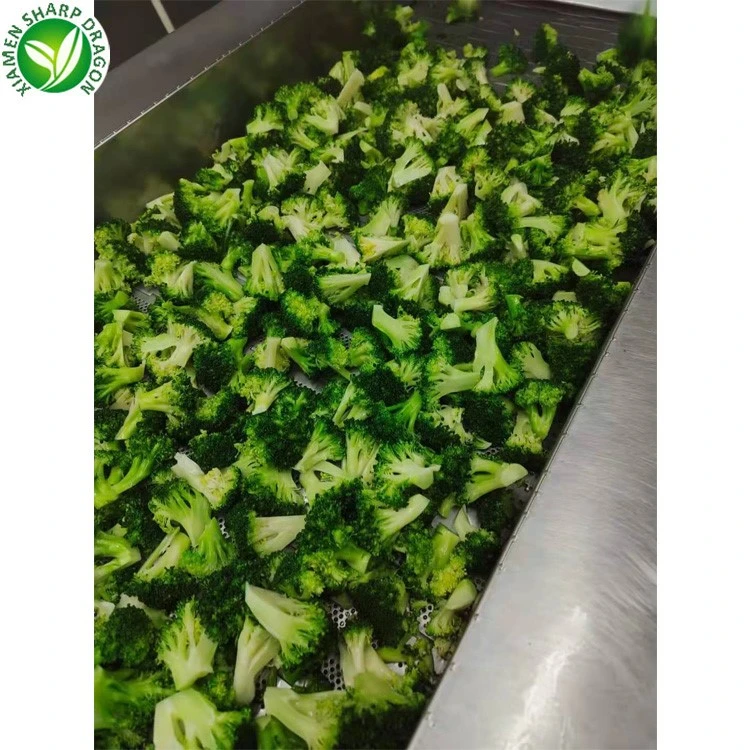
Size distribution is often the first variable to examine. A floret combines a fine crown with a denser stem, and two pieces with similar overall length can have different stem thickness. A bag containing many tiny fragments plus a few large stalk sections is harder to cook evenly than a reasonably consistent cut. A size description becomes useful only when you know what dimension it measures.
For us, the practical sample question is whether the required cooking method gives acceptable crowns and stems at the same point. We would compare the whole sample after cooking, including the smaller pieces at the bottom of the bag.
Selecting only the largest attractive florets for a photograph hides the material that will still enter the kitchen's portions.
The IQF broccoli product range is a starting point for choosing the form. A plated side may need well-defined crowns; soup can use a different balance of stems and pieces. Once the application is clear, describe the cut, the acceptable small pieces and the intended preparation together. Paying for a presentation grade offers little advantage if the broccoli is destined to be blended.
Free-flowing pieces are convenient for portioning, but a bag's appearance alone cannot establish its temperature history. Check storage records and pack condition when a delivery raises concerns. Separate a quality problem, such as broken crowns or an unsuitable size mix, from a food-safety concern. Adding more heat is not a sound way to investigate an unknown handling history.
Use a consistent tasting method for texture comparisons. Cook each sample according to an appropriate agreed procedure, drain it the same way, and assess it after the same service interval. Record firm stems, collapsing crowns, loose fragments and water left on the plate. This produces a useful reason for accepting or rejecting a cut, rather than a general comment that one bag seemed better.

Control water before adding broccoli to a recipe
Water released during cooking belongs in the recipe calculation. In a clear soup it may be easy to accommodate; in an egg filling, pastry or thick cheese sauce it can change the finished texture. Cook and drain the broccoli as required, then measure the usable ingredient on the basis the recipe actually uses. Frozen bag weight and cooked, drained weight answer different questions.
A short drainage step should be repeatable. Use the same sieve, load depth and interval when comparing batches, and avoid changing one sample by pressing it dry while leaving another untouched. If the dish needs a very dry ingredient, develop that preparation deliberately and check the result in the complete recipe. An improvised squeeze can damage florets and make a good ingredient appear inconsistent.
We would separate a sauce problem from a broccoli problem before changing suppliers. Compare the sauce before adding broccoli, immediately after mixing, and at the planned service time. If the sauce is already too thin, selecting larger florets will not fix it.
If the mixture thins only after the vegetable is added, the cooking, draining or ingredient-to-sauce ratio deserves a controlled comparison.
Practical example: Suppose a small café wants recognizable florets in a thick pasta sauce and starts with a 500 g frozen portion. Cook that portion by its directions, drain it using a repeatable method, and weigh what will enter the sauce. Fold the broccoli into the already prepared sauce near service. Compare it with a separate trial in which cooking water enters the sauce; assess coating and liquid at the bottom of the plate. The useful result is a chosen preparation method, not an assumed universal drainage percentage.
For pies, egg dishes or other filled foods, the broccoli's preparation is only one part of cooking the finished dish safely. The complete recipe still needs its own instructions. Our broccoli ideas for savory bakes and fillings explore those application choices. Keep the broad cooking method separate from the specific formulation so a successful side-dish trial is not mistaken for a finished ready-meal process.

Scale the load and the portion separately
Cooking a larger quantity needs more than multiplying a small recipe's minutes. Tray area, basket depth, oven recovery and the amount of water around the broccoli all change. Establish how much the equipment can cook well in one batch, then plan the number of batches around service. Portion demand tells you how much broccoli to buy; equipment performance tells you how to prepare it.
Worked example: Take a catering service planning 40 portions of 80 g cooked, drained broccoli. It needs 40 × 80 g = 3,200 g, or 3.2 kg, ready to portion. If an illustrative trial gives a usable yield of 90%, frozen input would be 3.2 kg ÷ 0.90 = 3.56 kg. At an illustrative 85% yield, it would be 3.2 kg ÷ 0.85 = 3.76 kg. These are hypothetical planning values, not measured XMSD yields or a serving recommendation.
That difference of roughly 0.2 kg matters for purchasing, but it does not tell you the cooking time. Divide the chosen input across the batch loads your equipment has demonstrated, and weigh the drained output. Keep added oil or sauce outside the broccoli yield calculation unless the recipe explicitly measures a finished dressed portion. Otherwise a heavier coating can make the reported vegetable yield misleading.
In a foodservice and catering operation, assess the broccoli at the point customers receive it. A sample tasted immediately after draining can differ from a batch held for the normal service interval. Use the business's required safe holding procedure during the trial and compare texture at the actual handover. Frequent, appropriately sized batches may preserve a more consistent result than one large early batch.
Write down the appliance, product, frozen input, loading pattern and completed method when you approve the routine. Include a photograph of the acceptable cooked result if it helps different cooks recognize it.
The photograph is a quality reference alongside the instructions; it cannot show whether the coldest part received the required cooking treatment. Keep both kinds of evidence in the handover.

Keep cooking directions with the pack
Pack size should support the kitchen's working batch. A large inner bag can be practical when it is used promptly; smaller inner packs may suit a kitchen preparing several separate services. Compare the handling steps as well as the purchase price. Repeated opening, portioning and returning product to storage adds work and makes it easier to lose the original cooking information.
The useful details on frozen-food packaging include a readable product identity, lot reference, storage instructions and preparation directions that reach the person cooking. If broccoli is transferred into an approved storage container, retain that information with it. Keep more than the ingredient name.
A handwritten label saying only "broccoli" does not tell the next cook whether the contents are plain florets, a seasoned blend or a product with a different intended use.
Food safety and preferred texture need separate checks. UK Food Standards Agency guidance says frozen vegetables requiring cooking should be thoroughly cooked, including before cold use. For a cold broccoli salad, finish the instructed cooking first, then use a suitable cooling procedure. A brief dip chosen only to keep the florets green is not a substitute for that required treatment.
For household leftovers, the same UK guidance advises cooling and refrigerating within two hours, eating within 48 hours or freezing, and reheating only once. Its chilling guidance recommends a fridge at 0–5°C. Commercial kitchens should use their own applicable food-safety procedures for cooling, holding and service. Plan those steps before making a large batch rather than leaving cooked broccoli in a deep warm container while deciding what to do with it.
A sound cooking routine is easy to describe: the right product form, an instructed method, a manageable load and a clear finishing step. Change one variable at a time when the result disappoints. If the florets are tender but watery, examine drainage and loading; if stems and crowns finish unevenly, examine the cut. Those observations turn the next trial into a useful adjustment.

For an XMSD broccoli sample discussion, send the dish, preferred floret form, cooking equipment, target cooked portion and inner-pack requirement. Include the texture or water-release problem you want the sample comparison to resolve.
Discuss a broccoli cooking sample