


Fresh Ginger Nutrition Facts: Portions and Product Forms
Sep 28, 2023

Fresh ginger nutrition facts make most sense when you read the amount actually used in cooking. USDA FoodData Central lists raw ginger root at 80 kcal, 17.8 g carbohydrate, 1.82 g protein and 0.75 g fat per 100 g of edible food. A 5 g portion therefore supplies about 4 kcal and 0.89 g carbohydrate. That small portion is a calculation example, not a recommended daily dose.
Ginger is primarily a seasoning in many meals. It contributes some fiber, minerals and vitamins, but a few grams will not provide the amounts suggested by a large 100 g table. The raw ingredient also differs from sweetened ginger, salted paste, dried powder and drinks that contain only a little ginger. For those foods, the recipe or package label matters more than a generic fresh-root entry.
Start with three details: which form you have, how much edible ginger goes into the recipe, and how much of that recipe you eat. These details turn a nutrition list into a useful food calculation. They also help explain why two ginger products can have similar names but different energy, sodium or sugar values.

Fresh ginger nutrition per 100 g and per 5 g
The table below uses the USDA entry "Ginger root, raw," FoodData Central ID 169231. The two numeric columns show a common comparison basis and a calculated small cooking portion. Weights refer to the edible ingredient, not a bag of whole rhizomes with material that will be discarded. Values are rounded, so adding rounded nutrient figures will not necessarily reproduce the energy figure exactly.
| Nutrient | Per 100 g raw ginger | Calculated per 5 g |
|---|---|---|
| Energy | 80 kcal | 4 kcal |
| Carbohydrate | 17.8 g | 0.89 g |
| Protein | 1.82 g | 0.091 g |
| Total fat | 0.75 g | 0.038 g |
| Fiber | 2.0 g | 0.10 g |
| Total sugars | 1.7 g | 0.085 g |
| Potassium | 415 mg | 20.75 mg |
| Magnesium | 43 mg | 2.15 mg |
| Vitamin C | 5 mg | 0.25 mg |
| Sodium | 13 mg | 0.65 mg |
Do not read the 100 g column as a serving recommendation. One hundred grams may supply a whole recipe or several batches of a strongly flavored preparation. Weighing a portion is more reliable than calling it a "piece," because a thin slice, a knobby section and a spoonful of grated ginger can differ substantially in weight. Even a tablespoon changes with the cut and how tightly it is filled.
The database is a reference for a defined raw food. It is not a laboratory report for every variety, harvest or commercial pack. Different databases can also use different samples, analytical methods and rounding conventions. If you compare nutrition figures from two sources, compare the food descriptions and measurement basis before deciding that one ginger product contains more nutrients than another.
For a packaged ingredient, use the matching product information when available. A paste with oil or salt needs its own composition, while a drink containing ginger and other ingredients needs the finished drink calculation. Keep the source record with your recipe notes so that anyone checking the result can reproduce it. This is especially helpful when a purchasing change introduces a new ingredient form but the menu name stays the same.
Check the energy unit before copying an older table. The USDA raw-ginger entry lists 333 kilojoules and 80 kilocalories per 100 g. A 5 g edible portion gives about 17 kilojoules, or 4 kilocalories. If a supplier gives a 20 g serving, use the supplier's declared product and the stated energy unit. The nutrient values of a ginger preparation depend on what is in the pack and how the serving was measured.
What the nutrients contribute in a real meal
Raw ginger contains carbohydrate, small amounts of protein and fat, and measurable quantities of potassium, magnesium and vitamin C. Their presence is real; the contribution from a seasoning portion is modest. In the 5 g calculation, magnesium is about 2.15 mg and vitamin C is about 0.25 mg. That is a better starting point for understanding a meal than describing ginger as a concentrated source of everything listed in a database.
Magnesium helps the body perform normal functions, including muscle and nerve activity and protein production. NIH lists adult recommended amounts of 310–320 mg daily for women and 400–420 mg for men. Against those amounts, the magnesium in 5 g of raw ginger is less than 1%.
Legumes, nuts, seeds, whole grains and leafy vegetables can contribute much larger amounts through the portions normally eaten. Ginger can accompany those foods without needing to carry the meal's mineral content itself.
Fiber follows the same portion logic. The reference contains 2 g per 100 g, but only 0.10 g in 5 g. Vegetables, beans and grains provide most of the bulk in a dish seasoned with ginger. Likewise, a small seasoning portion contributes little protein. If you are building a meal, choose its main ingredients for the nutrition you need and use ginger for the flavor and texture you want.
There is no need to eat a large amount to justify using it. A useful culinary role can be enough. Ginger may make a bean soup, vegetable filling or simple sauce more appealing to you; the nutrition of that dish still comes from the complete combination. When comparing two recipes, inspect the amounts of oil, sugar, salt and other major ingredients before attributing the difference to the ginger.
Calculate the portion before judging the dish
For any nutrient in the raw reference, multiply the amount per 100 g by the edible ginger weight in grams, then divide by 100. This gives the contribution from the ginger, not the total for the recipe. Divide that contribution by the number of equal servings only if the ingredient is distributed evenly and the whole amount remains in the food that will be eaten.
Worked example: Suppose a kitchen adds 20 g of finely grated raw ginger to a four-portion vegetable sauce. The ginger contributes 80 × 20 ÷ 100 = 16 kcal to the batch, or 4 kcal per equal portion. Its carbohydrate contribution is 17.8 × 20 ÷ 100 = 3.56 g for the batch, or 0.89 g per portion. These are illustrative calculations using the USDA reference. The sauce's vegetables, oil and other ingredients must be counted separately.
Now change the preparation: simmer the same 20 g as large slices, then remove the slices before serving. The starting ginger weight is no longer the amount eaten. Some material transfers into the liquid, while the removed slices retain other components. Assigning all of the raw ginger's fiber and nutrients to the strained sauce would overstate what is known. Use a composition appropriate to the finished preparation if a defensible label value is needed.
A similar problem occurs with ginger tea. The weight of root placed in the pot is an ingredient input, not a direct measurement of nutrients in the cup. Water volume, steeping, filtration and any sweetener change the finished product. A drink made by blending and retaining the ginger solids is a different recipe again. Record the method as well as the weight, especially when two operators prepare the same item in different ways.
The most useful kitchen record is brief: edible input, preparation method, finished batch weight and portion weight. Record any material removed. That provides enough information to explain the calculation and repeat the recipe without pretending that a generic ingredient entry measures everything that happens during cooking.

Fresh, frozen, dried and prepared ginger are different entries
Plain frozen ginger can be a convenient way to keep a measured ingredient available. Its nutrition should still be tied to the actual product composition and processing, rather than copied automatically from a raw reference. Added water, other ingredients or losses during preparation can change the basis. Freezing also does not turn a raw ingredient into a ready-to-eat one; the intended use and cooking instructions remain relevant.
Dried ginger has much less water than fresh root. Comparing equal weights therefore compares a concentrated dried ingredient with a water-rich fresh ingredient. A teaspoon comparison adds another variable because powder and grated root pack differently. Choose the nutrition record that names the form you actually weigh. When adapting a recipe, settle the flavor and texture first, then calculate with the ingredient amounts used in that version.
Prepared ginger brings the ingredient list into the decision. Crystallized ginger contains added sugar; pickled ginger may include salt, sweeteners and liquid; a cooking paste may include oil or garlic. Read the formulation and the label, including whether the declared amount refers to the food as sold or a drained serving. Match the stated basis to the amount you will actually use in the dish.
From a food-application perspective, we would choose a form by what the finished dish needs. A smooth sauce usually calls for a different particle profile from a filling where visible pieces are welcome. frozen ginger cube product overview illustrates one format; the useful comparison is its ingredient composition and behavior in your recipe, not just the shape of the frozen portion.
Keep the distinction between a puree portion and a diced piece clear in purchasing notes. A cube-shaped item can be formed puree rather than a cube cut from the rhizome. Once heated, those two ingredients may distribute very differently.
Ask for the actual product description and inspect a prepared sample. This avoids changing the texture of a familiar recipe merely because two products look similarly shaped while frozen.

Match the cut to the sauce, soup or filling
The way ginger is cut changes how it appears in a bite. Fine pieces distribute through a sauce, while larger pieces create more noticeable texture and occasional stronger bites. Long fibers can also matter in a smooth preparation. A nutrition table says little about those effects, even though they can determine whether a product works in the intended dish. Test the ingredient at the stage and temperature at which the customer will eat it.
For a filling, compare distribution after mixing and after cooking. For a soup, decide whether pieces will remain in the bowl or be removed. For a smooth sauce, inspect the texture after the actual blending and straining process. These are different acceptance decisions. Inspect the frozen sample for identity and cut, then finish the assessment with a trial in the food you intend to serve.
Practical example: Take a foodservice kitchen developing a 10 kg sauce with an illustrative 1% ginger input. That is 100 g of edible ginger. One trial uses finely cut plain ginger; another uses a plain ginger puree with the same stated ginger content. Keep the other ingredients and processing method constant, then compare texture, aroma, visible fibers and distribution. If the puree produces the intended smoothness, repeat that version and record the finished batch weight. The result is a reproducible recipe choice, not a claim that every puree is nutritionally identical to raw ginger.
At the reference value of 80 kcal per 100 g, that ginger input contributes 80 kcal across the entire illustrative batch before accounting for any losses or formulation differences. The much larger practical question is whether the selected form delivers the required flavor and texture at that input. Increasing the ginger simply to improve a nutrient number can make the sauce unsuitable for its intended use.
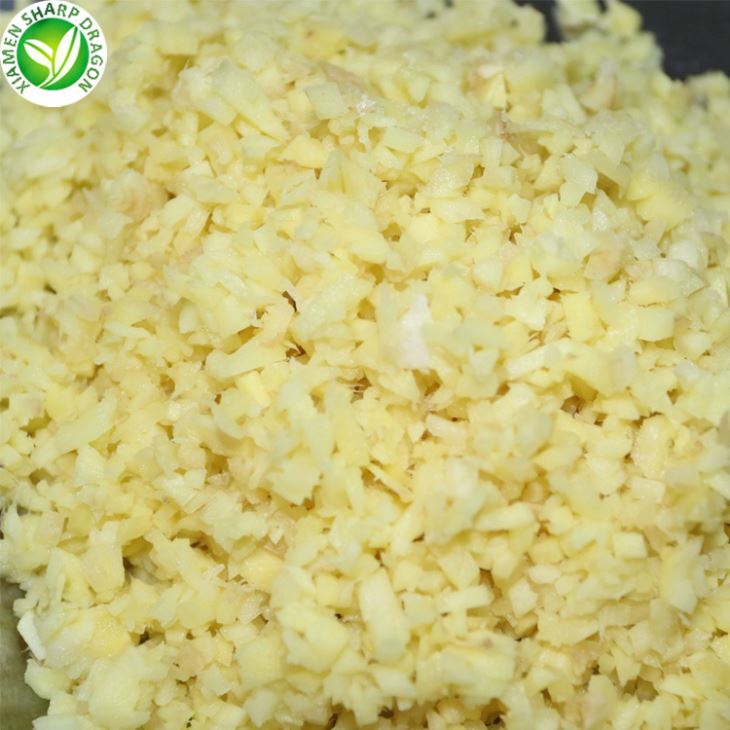
We would compare frozen diced ginger against the approved cut sample, then judge it in the actual recipe. The failure to watch for is an acceptable average cut hiding an objectionable fraction of coarse or fibrous pieces. A retained reference sample and a written preparation method make that assessment more consistent than a photograph alone. For repeated menu preparation, the same approach connects naturally with foodservice ingredient planning.
Keep health claims separate from food composition
The nutrition table describes a food; it does not show whether a serving treats a symptom. NCCIH reports that much of the human research on ginger has used supplements rather than foods. Some evidence supports a possible role in pregnancy-related nausea, while findings differ for other causes of nausea. Those distinctions do not establish a treatment dose for fresh root, a frozen portion or a cup of ginger tea.
Ginger taken by mouth can cause heartburn, abdominal discomfort, diarrhea, or irritation of the mouth and throat. If a preparation bothers you, reduce or stop that preparation rather than increasing it because of a health claim. Consult a healthcare professional about ginger supplements during pregnancy, or when taking medicines. Persistent symptoms deserve appropriate care instead of repeated recipe changes.
For food selection, keep the question practical: do you enjoy the flavor, does the preparation suit you, and does the complete dish fit your needs? A sweetened drink and a small amount in a savory meal can have very different nutritional profiles. Compare the full ingredient list and serving amount when choosing between them.
Commercial descriptions benefit from the same discipline. Describe the product form, ingredients and intended culinary use clearly. For someone deciding between fresh rhizomes and frozen puree, preparation and composition are the useful starting points. When a label or sales brief contains a specific nutrition or health claim, have it reviewed against the actual product and destination requirements before using it commercially.
Handling ginger without confusing quality and safety
Wash fresh produce under running water before preparing it, including when the outer surface will be removed. FDA advises against using soap or detergent on produce. Use clean equipment and keep produce separate from raw meat, poultry and seafood. These practices matter for ginger's uneven surface and for anything that will contact it during peeling, cutting or grating. Washing reduces contamination but does not make every raw food sterile.
For ingredients that require refrigeration, FDA recommends a refrigerator at 40°F (4°C) or below and a freezer at 0°F (−18°C). Follow the product's storage and cooking instructions.
Keep commercially frozen ginger frozen until the planned use or controlled preparation step. Use the shelf life and open-pack instructions that apply to that formulation, with the opening date recorded where your handling procedure requires it.
Freezer burn concerns quality, while an uncertain temperature history raises a separate safety question. FDA notes that freezing stops bacterial growth but does not kill most bacteria. A normal appearance is therefore insufficient evidence that mishandled food is safe. Conversely, a change in texture after freezing is not by itself proof of unsafe food. Record what happened before deciding what the observation means.
For receiving or sample review, we separate three observations: package integrity, frozen condition and performance in the recipe. An intact pack with a documented temperature history is different from a torn pack or an unrecorded thawing event. If there is a discrepancy, hold the affected stock for the agreed quality review and retain the lot details. Tasting is not the method for resolving a safety concern.
For the lined pack shown below, the relevant physical checks include the liner, exposed surfaces and condition of the pieces. Record those observations alongside the lot and handling records. If a liner is damaged, photograph the affected area and record where it occurred in the carton. This gives the quality review a specific issue to resolve instead of a general impression of the delivery.

If you receive a legacy nutrition panel, ask for the ingredient identity, preparation, serving weight, nutrient units and calculation or analysis behind it. For a product containing water, salt or another ingredient, use the record for that formula. Compare two documents only after the units and food basis match. Keep a copy of the approved version with the lot and recipe so an unlabeled table is less likely to return during the next artwork update.
Use the right information for a commercial nutrition statement
A reference database is useful during recipe development. A commercial declaration needs a basis appropriate to the actual product, destination and preparation. Start by matching the ingredient description to the specification: plain ginger or a mixture, peeled or otherwise prepared, and supplied as pieces, mince or puree. If the formulation includes something besides ginger, its contribution belongs in the calculation too.
Next, make sure the portion basis is consistent. A value per 100 g of an ingredient is not a value per 100 g of finished sauce. The finished yield matters because evaporation, added liquid and removed solids can alter the amount represented by a serving. Keep the recipe version and the composition source together so a change to the ingredient or process triggers a review of the calculation.
A supplier document should identify the product it covers and allow you to connect that product with the stock received. Check the product name, ingredient statement, revision and applicable lot or specification reference.
When two documents disagree, resolve the identity or calculation basis before averaging their numbers. Averaging can hide the reason for the difference and leave neither figure representative of the food sold.
For us, nutritional composition and physical inspection answer different questions. A cut-size check tells you about the distribution of pieces. A foreign-material control addresses a different risk. Neither one supplies the protein or energy value for a label. The equipment overview provides context for processing and inspection discussions; ask for the records relevant to the product and process under review when evaluating a particular supply proposal.

Plan the pack around the amount you use
Small recipe inputs can make open-pack handling more important than the size of a master carton. If only a little ginger is needed for each batch, compare the inner-pack quantity with the actual production schedule. A format that permits the required amount to be weighed and the remainder handled as directed may be more practical than repeatedly opening a much larger unit. The decision should follow the workflow and the product's instructions.
Usable yield is another separate calculation. Suppose an illustrative 1 kg whole-root purchase produces 900 g of prepared ginger after trimming. The preparation yield is 90%, and the ingredient cost per usable kilogram is the purchase price divided by 0.90. That example is not a normal yield claim for ginger. Measure your own trimming and preparation losses, then compare with the usable quantity of the alternative form under the same recipe conditions.
Keep packaging evidence proportionate to the decision. Review seal condition, product identification and the relationship between inner packs and outer cartons. The frozen-food packaging overview is useful when discussing those formats. The cartons pictured below show a packing arrangement, not the content or temperature of a specific ginger order.
The final choice should leave you with three things that agree: the ingredient used in the recipe, the composition basis used in the nutrition calculation, and the product description used for purchasing. When they agree, the 100 g table becomes a helpful reference rather than a misleading promise about every spoonful of ginger.

For a ginger ingredient review, share your application, preferred form, recipe input and packing needs. We can review the product information needed for your comparison.
References
- USDA Standard Reference, ginger root, raw, NDB 11216
- USDA Standard Reference, spices, ginger, ground, NDB 02021
- NIH Office of Dietary Supplements: Magnesium
- NCCIH: Ginger
- FDA: Selecting and Serving Produce Safely
- FDA: Are You Storing Food Safely?
- XMSD operational perspective on ginger product forms, recipe trials, packaging and specification review.