


Frozen Water Chestnut: IQF Process, Nutrition, and Buyer Guide
May 08, 2023

Frozen Chinese water chestnut is the peeled edible corm sold whole, sliced or diced. Choose the cut by the bite and appearance you need after cooking. A thin slice can work in a stir-fry, while measured dice spread through a filling. Check whether the actual pack requires cooking, and run the sample through the same cook, hold or reheat that your customers will use.
USDA's reference for raw Chinese water chestnut gives 97 kcal and about 24 g carbohydrate per 100 g of edible material. A frozen, canned or prepared product can have a different composition and weighing basis. Use the exact pack or finished recipe data when you need a nutrition declaration.
For a purchase, ask for the cut and size range, the preparation status, the pack instructions and a sample you can test. A good frozen sample should portion as planned and give the bite you agreed to at service. Measure drained yield separately if your recipe uses only the pieces.

What Frozen Water Chestnut Actually Is
Chinese water chestnut is the edible corm of Eleocharis dulcis, a sedge grown in wet conditions. The pale flesh is exposed by peeling the dark skin. Check the botanical identity if a listing only says water chestnut. Tree chestnuts and the horned fruit of a Trapa water caltrop are different ingredients and have different preparation requirements.
In a study of fresh Chinese water chestnut cut into small cylinders, steaming reduced measured or perceived hardness and crispness, while the samples still retained some bite. That trial did not test your frozen cut, sauce or holding period. Set the texture check at the end of your actual process, especially if the ingredient will be heated twice.
That distinction changes how you evaluate a sample. A visually white, clean piece may still become too soft after your full retort, steam-table, microwave, or reheating cycle. Conversely, a product that seems very firm directly from the freezer may reach the desired bite after cooking. We therefore judge texture at the point at which the finished dish is eaten, not only on a thawed raw sample.

How the IQF Production Process Works
A typical frozen route starts with raw corm inspection, then washing, peeling, trimming, sizing, any agreed pretreatment, quick freezing and packing. For individual quick freezing, look at how well the units separate while frozen. Ask for the actual process sequence and sample condition. The term does not identify the freezer design or tell you how the finished ingredient must be prepared.
- Receive and grade the raw corms. Soundness, maturity, decay, mechanical damage, soil load, size, and processing suitability affect peeling loss, color, texture, and usable yield. Freezing preserves weaknesses as well as desirable quality, so poor incoming material cannot be repaired by a fast freezer.
- Wash, peel, and trim. Cleaning removes soil and field material. Peeling and trimming remove the dark skin, damaged tissue, and unsuitable portions. The acceptance method should distinguish harmless natural surface variation from peel residue, decay, or foreign material.
- Prepare the specified form. Whole corms are graded by diameter or piece range; slices need a diameter and thickness definition; dice need nominal dimensions and an agreed method for measuring oversize, undersize, fines, and broken pieces.
- Apply the agreed pretreatment. Some commercial routes include blanching and cooling to control enzyme activity, color, and product stability. Other SKU descriptions may not list blanching. The useful evidence is the supplier's signed process flow, ingredient statement, sample behavior, and any agreed validation record-not an assumption based on the word "IQF."
- Drain and quick-freeze. Surface water, loading depth, piece geometry, freezer setting, belt speed, and equipment capacity influence separation and ice formation. The operating limits are process-specific, so define the finished condition in your specification rather than copying an unsupported freezer time.
- Inspect, detect, pack, and hold frozen. Visual sorting, foreign-material control, metal detection, weight control, seal checks, coding, carton checks, frozen storage, and shipment records complete the commercial route. The cold chain must protect the quality created upstream.
Keep cooling, freezing and packaging on separate lines in the specification. A vacuum cooler removes heat. A vacuum pack describes how the product is enclosed. Neither tells you that the product was quick-frozen or that it meets the required frozen storage condition. Verify those steps from the supplier's process and product records.

What the Nutrition Data Can and Cannot Tell You
USDA Standard Reference entry 11588 describes raw Chinese water chestnuts. Per 100 g edible portion it gives 97 kcal, 23.94 g carbohydrate, 4.8 g total sugars, 3.0 g fiber, 1.4 g protein, 0.1 g fat and 584 mg potassium. Use that reference only when the product description and measurement basis match.
Start with the form named in the data. Raw edible weight, a drained canned portion and a frozen product as sold can contain different amounts of water and other ingredients. Compare like with like and read the actual pack. If a canned option lists salt or a packing liquid, check the ingredient statement and the basis of any nutrient value you compare.
The product form changes the numbers you may legally or commercially use. Peeling, trimming, blanching, soaking, draining, added ingredients, glaze, and analytical moisture can shift values per 100 g. A plain one-ingredient IQF product is also different from water chestnuts packed in brine, sauce, syrup, a sweet beverage, a fried snack, or a prepared filling. If you prepare a nutrition declaration, base it on the finished SKU and the destination market's rules; do not copy a raw database entry onto a frozen pack without a documented calculation or test basis.
For a meal label, record how much of the purchased product enters the finished serving and include the other ingredients. A diced inclusion in a filling may use much less than 100 g per serving. A side served with sauce needs data for the sauce as well. Keep the product analysis, ingredient calculation and serving weight with the label version.
Use the raw database entry to understand the ingredient. For an order-specific declaration, obtain the applicable product information or a documented finished-recipe calculation on the basis required for the destination.
For scale, 30 g on that same raw edible basis gives about 29 kcal, 7.2 g carbohydrate and 0.9 g fiber. This is the USDA reference multiplied by 0.30. A 30 g cooked or drained serving uses its own composition and weight basis. Use the serving you actually sell when comparing the whole dish.
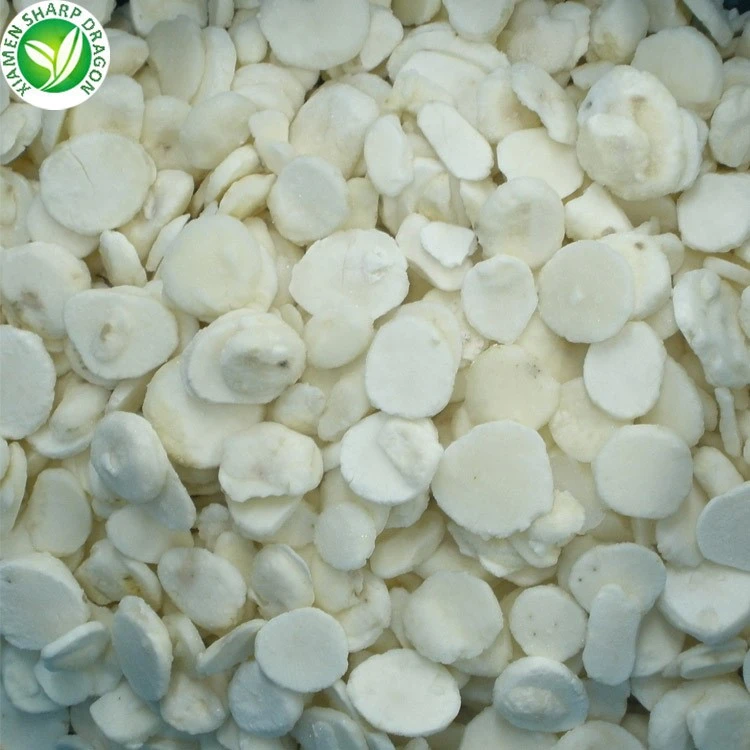
Whole, Sliced, or Diced: Match the Cut to the Application
The cut is not a cosmetic option. It controls visibility, bite, heating rate, distribution through a formulation, dosing accuracy, and the way breakage appears. We start with the final eating experience, then work backward to nominal dimensions and tolerances. A cut that performs well in a short wok cook may not survive a frozen ready-meal reheating cycle, while a fine dice that meters accurately into a filling may disappear in a plated vegetable side.
| Form | Strong starting applications | Decisive acceptance evidence |
|---|---|---|
| Whole | Visible portions, catering dishes, hot pot, and products that need a pronounced bite | Diameter or piece range, peeling residue, broken pieces, core defects, and full-cycle texture |
| Sliced | Stir-fries, soups, noodle bowls, vegetable mixes, and recognizable ready-meal components | Thickness, diameter distribution, intact-slice ratio, surface ice, and sauce-hold performance |
| Diced | Dumpling and roll fillings, portioned blends, sauces, rice products, and automated dosing | Nominal cut, oversize and undersize method, fines, clumping, dosing variation, and usable yield |
Do not accept a size description that contains only "whole," "slice," or "dice." For slices, state the target thickness and how diameter is handled. For dice, state the nominal dimensions and the sieve, caliper, or visual method used to classify deviations. For whole pieces, define the size basis and whether a broken piece still counts as whole. The final tolerance is commercial rather than universal; it becomes meaningful only when the sampling plan, measurement method, and disposition rule are written beside it.
Practical example: suppose a dumpling filling needs 8.0 kg of usable drained dice in a 100 kg batch. In this hypothetical trial, one sample gives 92% usable yield, so the frozen input is 8.0 ÷ 0.92, or 8.70 kg. A second gives 85%, so the input is 9.41 kg. That is about 0.71 kg more input per batch. Weigh collected liquid and rejected pieces separately before deciding whether to adjust the filling or the purchase quantity.

Test Texture, Water Release, and Heating in the Real Product
For a stir-fry, test the approved addition point, pan load, sauce volume and serving hold. For a dumpling or spring-roll filling, follow the actual preparation, mixing, forming and heating steps. For a ready meal, include the applicable freeze, reheat and hold. Use the approved cooking process and check bite after it is complete.
Run the comparison against a defined control. Record piece dimensions, frozen clumping, initial weight, post-drain weight if thawed, cooking loss, finished bite, visible breakage, color, off-odor, and the time at which quality is judged. Sensory words such as "crisp" and "firm" need anchors. A simple five-point scale can work if every point has a description and trained reviewers use the same sample temperature and timing. Instrumental texture data may add precision, but it does not replace a finished-product sensory check.
When the pack or approved process allows direct use from frozen, weigh the ingredient that goes into the recipe and account for any free liquid. When controlled thawing and draining are required, record the method, temperature, input weight, drain time and drained mass. Repeat those conditions for the next sample so the yield figures are comparable.
Blanching also creates a trade-off. It can inactivate quality-degrading enzymes and help manage color, while excessive heat can soften tissue and leach water-soluble components. The correct question is not simply "Is it blanched?" Ask for the process description and test the resulting product. If a supplier changes pretreatment, piece size, raw-material maturity, or freezer loading, require a change review because each can shift the bite that reaches your finished meal.
Check the Pack Before Using It Cold
Individual quick freezing and blanching do not tell you that a product is ready to eat. If the pack calls for cooking, complete those instructions before serving or cooling. If the ingredient will go into an unheated salad or chilled filling, confirm that the product and handling route are suitable for that use. Ask the supplier for the intended-use statement if it is unclear.
CDC advises against eating raw or undercooked freshwater plants to prevent exposure to Fasciolopsis where contamination is possible. Follow the applicable food-safety controls for the actual source and use. Do not treat freezing or a clean appearance as evidence that a product has completed a suitable cooking or safety process.
We would keep the intended use and preparation instructions beside the sample report. If a pilot filling gets a full heat step but the retail recipe later serves the pieces cold, review the change with the technical team. The approved bite or drained yield from the first trial does not answer the preparation question for the new product.

Cold Chain, Packaging, and Arrival Inspection
FAO and WHO describe -18°C as the Codex reference for storage and distribution of quick-frozen food. Check the temperature requirement and permitted tolerances for your product, contract and market. Record the actual temperature history alongside seal and package condition. A momentary freezer reading does not describe the previous transport or storage.
Select the inner pack from the way you open and consume product. A central kitchen that uses 10 kg in one shift may value a bulk liner, while a line that opens only 2 kg at a time may control exposure better with smaller inner bags. Then evaluate the full packaging system: food-contact declaration where required, film construction, seal performance, net-weight control, carton strength, label and lot coding, pallet pattern, and resistance to the actual route. Our overview of frozen-food packaging options can help frame that discussion, but the approved pack remains SKU- and route-specific.
At arrival, start with evidence that can change your disposition. Review reefer records or agreed temperature evidence, seal number, carton condition, labeling, lot identity, and the sampling plan before opening cases. Observe leakage, crushed cartons, damaged liners, heavy internal frost, large fused blocks, abnormal color, odor after controlled preparation, and excessive breakage. Freezer burn is primarily a quality defect caused by surface dehydration; it does not by itself prove a microbiological hazard. Temperature abuse, compromised packaging, contamination, and thaw-refreeze history require separate evaluation.
Avoid making a safety decision from appearance alone. If a temperature deviation occurred, document duration, product temperature, package condition, and the agreed food-safety assessment route. If the problem is limited to quality, compare the lot with the sensory and defect acceptance criteria. If the evidence cannot distinguish a minor frost issue from a broader thawing event, quarantine the lot while the responsible quality function reviews the records.

Build a Specification That Can Be Accepted or Rejected
A usable specification connects the product name to a measurable result. Start with Chinese water chestnut identity, ingredient statement, whole/sliced/diced form, nominal dimensions, and processing description. Add sensory requirements, color direction, peeling residue, broken pieces, fines, extraneous vegetable material, foreign material, frozen separation, net weight, packaging, labeling, storage, shelf-life basis, microbiological and chemical criteria required by the destination or application, and the document set. Each numeric limit needs a method, sample size, frequency, and disposition rule.
Define what counts as peeling residue, trim damage, broken material, fines, grit and foreign material, and where each check is made. For a sliced product, record thickness and diameter separately if both affect service. Set sample condition, sample count and the action when a limit is exceeded before using the figures for an arrival decision.
Worked example: suppose a filling line sets a nominal 10 mm dice with an acceptable 8–12 mm band on each of three axes. The method calls for 200 randomly selected pieces after the agreed thaw. If 18 have at least one axis outside the band, 18 ÷ 200 gives 9% out of band by count. Compare that result with the written lot tolerance. Do not mix this count with a separate weight percentage for fines.
For formulation approval, attach a signed sample record to the specification. Photograph the product under consistent lighting, record the lot, preparation method, weights, timing, and sensory result, and keep a retained reference where practical. For repeat orders, compare the new lot with the approved result and trend recurring deviations. This is more informative than approving a marketing photograph or a one-line claim that the product is "premium."
For importer and private-label work, separate product approval from destination compliance. The product specification controls the ingredient; label review, allergen controls, language, net quantity, nutrition basis, coding, certificates, residue requirements, and shipping documents answer different regulatory or commercial questions. Review the current XMSD frozen water chestnut range for available presentation directions, then use the current frozen water chestnut product page as a visual and process starting point rather than as a substitute for the agreed order documents.
For color, decide whether the check is made on the frozen product, after thawing, or after the final cook. A dark peeling remnant on an otherwise pale slice is a different defect from a general change in cut-surface color. Use the same light, elapsed time and reference sample when two teams compare results. Record the defect category separately from the finished bite.
For examples of how the ingredient is used, see our water chestnut application overview.
Review the foodservice frozen ingredient applications.
Who and Which Products Suit Frozen Water Chestnut?
The ingredient suits applications that need a mild flavor and a clear textural contrast: Asian-style ready meals, stir-fries, hot pot, soups, dumplings, spring rolls, vegetable blends, rice and noodle products, foodservice portions, and selected beverage or dessert inclusions. The cut and pretreatment decide the fit. Whole pieces make the strongest visual statement, slices balance visibility with distribution, and dice support dosing and filling consistency.
Plain Chinese water chestnut is a plant ingredient. Check the full ingredient statement and manufacturing information before using a vegetarian, vegan or allergen statement for the finished food. Although it is botanically different from a tree chestnut, its name and plant identity do not establish the cross-contact status of a pack.
It is less suitable when the recipe requires a soft puree, a strong standalone flavor, or an exact nutrition claim that has not been established for the finished SKU. It may also be a poor choice if the line cannot manage released water, the package size causes repeated partial thawing, or the selected dice creates visible fines in a clear sauce. These are not reasons to reject the ingredient; they are reasons to change the cut, process, pack, or application trial before committing to volume.
XMSD sourcing note: Send us your target form, dimensions, finished application, heat-and-hold process, pack size, order quantity, destination, and required documents. We can use those inputs to discuss the appropriate product direction, sample review, and quotation basis.
Final Decision
Choose the form by its job in the dish, then verify that the sample keeps the required bite after the complete preparation. Document the result with the cut, preparation status, drain basis, pack and receiving checks. When any of those inputs changes, you can see exactly which part of the approval to repeat.
References
- USDA Agricultural Research Service. Standard Reference 28, entry 11588. Chinese water chestnuts, raw.
- Purdue Extension. Chinese Vegetables.
- Textural Properties of Chinese Water Chestnut during Steam Heating Treatment.
- CDC. About Fasciolopsis.
- FDA. Test Your Safety Knowledge About Ready-to-Cook Foods.
- FAO/WHO JEMRA. Background on the Codex reference temperature for quick-frozen foods.