


Water Chestnuts: How to Use Fresh, Canned and Frozen
Jan 12, 2023

Water chestnuts are useful when a dish needs a clean, crisp bite without a strong competing flavour. Use slices in stir-fries and vegetable mixtures, dice in dumpling or spring-roll fillings, and whole or halved pieces in soups where their shape is part of the eating experience. Their versatility comes from changing the cut and preparation to suit the food around them, rather than adding the same large pieces to every recipe.
Fresh, canned and frozen water chestnuts need different preparation. Fresh corms require washing and peeling; canned pieces bring packing liquid that needs to be accounted for; frozen pieces have a defined processing history and preparation instructions. Compare them after the intended dish is prepared, not only when the pack is opened. A slice that seems firm by itself may feel quite different alongside soft noodles or inside a delicate wrapper.
The ingredient discussed here is Chinese water chestnut, Eleocharis dulcis. Singapore's NParks identifies it as an aquatic crop whose flesh can retain crispness after cooking or canning. That is a useful reason to choose it for texture. It is not a reason to shorten a required cooking step or assume that every product called water chestnut behaves identically.

Know which water chestnut is in the recipe
Chinese water chestnuts have brown outer skin and pale flesh. They are the small aquatic vegetable commonly sold peeled, sliced or diced for cooking. The name can be misleading: this ingredient is different from the familiar tree chestnut used in roasting, stuffing or sweet purées. Swapping one for the other changes the dish much more than the shared word "chestnut" suggests.
Use the complete ingredient name when ordering or adapting a recipe. A picture of the peeled piece and a description of the cut are helpful, particularly when the recipe has passed between kitchens or suppliers. If an ingredient list simply says "chestnuts," establish which food was intended before considering quantity or preparation.
For a cook, the immediate difference is function. Chinese water chestnut contributes a distinct bite and a mild flavour; it should be noticeable where texture matters without dominating the seasoning. In a filling, several small pieces can create repeated points of crunch. In a clear soup, a larger piece is a deliberate feature that the diner encounters separately.
For the underlying product identity and commercial terminology, our water chestnut identity and texture guide goes further into the ingredient. In the kitchen, start by choosing the eating result, then work back to the form and cut that can deliver it.

Fresh, canned or frozen: choose around the preparation
Fresh water chestnuts give you control over peeling and cutting, but the purchased weight includes material that will be removed. Inspect the corms before preparation and calculate the usable quantity after peeling and trimming. A recipe written for prepared pieces should not be filled by weighing the same amount of whole, unpeeled produce.
Canned water chestnuts can be convenient when you want a prepared ingredient from an unopened shelf-stable pack. Read the ingredient list and product instructions, then drain as the recipe requires. Where the recipe is sensitive to seasoning or liquid, decide whether rinsing is appropriate for that product and use a consistent method. Count the ingredient that enters the dish, not the can's contents plus discarded liquid.
Frozen water chestnuts offer prepared forms that can be portioned for cooking, but "frozen" describes storage rather than a complete preparation instruction. Check whether the product is whole, sliced or diced and what the producer says about cooking and thawing. If the instruction is to cook from frozen, plan the pan load and liquid balance around that starting state. If a controlled thaw is required, include the drainage step in the recipe method.
| Form | Preparation difference | Useful comparison |
|---|---|---|
| Fresh | Wash, peel, trim and cut | Prepared yield and the finished bite |
| Canned | Read the label and account for packing liquid | Drained recipe quantity and seasoning |
| Frozen | Follow the specified cooking or thawing route | Cut consistency, liquid balance and served texture |
We would choose the comparison endpoint before comparing the packs. For a stir-fry, that means the served slice and the sauce around it. For a filling, it means the cooked wrapper, the distribution of pieces and the bite through the whole dumpling. A product that saves peeling time can still need a recipe adjustment, while a pleasing raw appearance says little about how it will perform in a reheated meal.
Avoid assigning one form an automatic quality ranking. Compare representative samples at the same prepared weight and with the same seasonings. Where the preparation instructions differ, follow each correctly and record the difference as part of the labour and cooking assessment. Equal pack weights are a weak comparison if one format loses more material before it reaches the recipe.
Prepare fresh corms cleanly and keep cooking status clear
For fresh produce, FDA recommends washing under running water before preparation, even when you plan to remove the skin. Use clean hands, knives and work surfaces; discard produce that looks rotten. Do not wash the ingredient with household soap or detergent. Clean preparation is especially relevant here because the surface of an unpeeled aquatic crop and the flesh you intend to eat occupy different stages of the work.
After washing, remove the outer skin and unsuitable material, then cut the flesh for its intended use. Inspect the cut surfaces as you work. A product's skin colour, a missing blanching claim or the fact that it feels firm is not a reliable stand-alone safety test. Keep product condition, the preparation method and the supplier's instructions together when deciding whether it is suitable.
CDC identifies contaminated raw or undercooked aquatic plants as a route for Fasciolopsis infection and advises thorough cooking of freshwater plants, including cooking them well in boiling water. For raw fresh water chestnuts, use thorough cooking rather than treating washing or peeling as the complete safety step. For a commercially prepared product, follow its labelled use and cooking instructions. This distinction lets you use the ingredient sensibly without assuming that every form has the same starting condition.
Keep raw meat and its utensils separate from prepared vegetables. In dumplings, spring rolls and casseroles, evaluate the safety of the entire food. Water chestnut can remain crisp in a cooked dish, so its bite is not an indicator that meat in the same filling has reached the required temperature.

Match the cut to the bite you want
Slices give a visible, recognizable piece. They work well when the diner should see the ingredient among noodles, peas, mushrooms or other vegetables. Thickness changes how substantial the slice feels, while diameter changes how it sits on the fork or spoon. If the dish is intended to be eaten in small bites, a very broad slice can be awkward even when its texture is good.
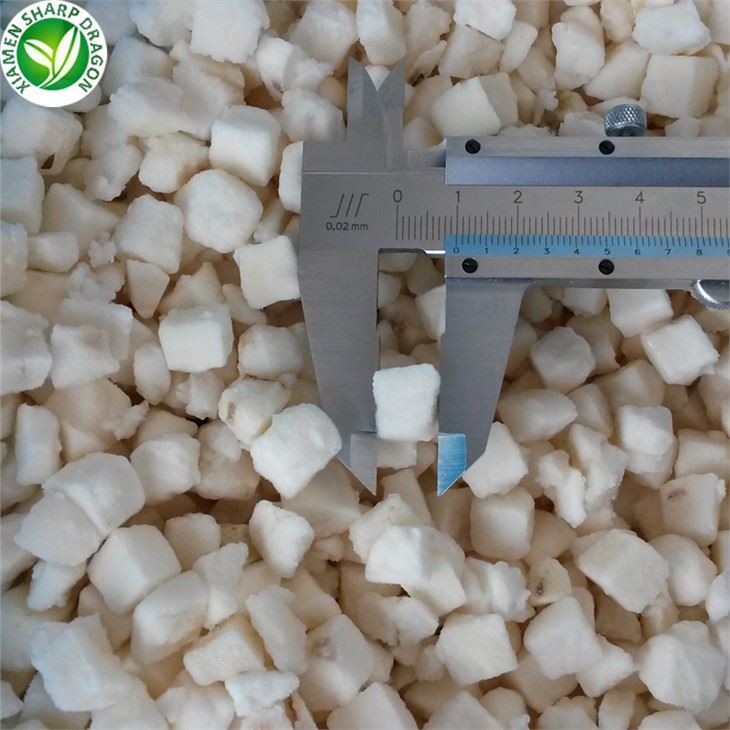
Dice spread the ingredient through a mixture. They are useful when a whole slice would interrupt a dumpling filling or make a spring roll harder to close. Smaller pieces distribute more evenly, but cutting extremely fine can make the desired crunch less distinct. Think about the size of the finished portion, not just the size that is easy to purchase.
Whole or halved corms suit dishes where a larger piece is deliberate. They require enough space in the serving and a cooking method that fits their size and starting state. In a small soup cup, a half or smaller piece may be easier to manage than a whole corm. In a plated dish, the larger form may be exactly what you want.
When selecting water chestnut slices, include thickness and broken-piece expectations in the discussion. For dice, consider all three dimensions and the amount of small material. The useful specification describes the pieces that will reach the diner, rather than relying on a broad cut name alone.

Use slices in stir-fries without diluting the sauce
The main aim in a stir-fry is contrast: water chestnut slices should remain distinct among the other ingredients, while the sauce coats the mixture. Start with the preparation required for the actual product. Drain canned pieces as directed by your recipe; handle frozen pieces according to their cooking instructions. Keep any discarded liquid out of the ingredient weight used for formulation.
Cook the components in an order that suits their different needs. A vegetable that needs longer cooking can enter earlier, while a prepared water chestnut component can enter at the appropriate later stage. Avoid assuming that all pieces in a mixed bag need the same treatment simply because they will be served together. Manage the total load so that the pan or wok can recover after each addition.
The University of Alaska Fairbanks' Chinese-Style Pod Peas recipe gives one concrete example: drained, chopped canned water chestnuts are cooked with the peas for two minutes before the remaining sauce ingredients are added and brought to a boil. That timing belongs to that canned-product recipe and its sequence. It is not a general cooking time for raw whole corms or every frozen cut.
If the sauce becomes thin, investigate the liquid balance before adding more thickener. Uncontrolled drainage, a changed frozen input or a heavier pan load may be responsible. Thickening the extra liquid can change how much sauce clings to the other ingredients and alter the finished flavour. A repeatable drainage and cooking method makes the result easier to adjust.
At service, check a slice together with the rest of a mouthful. A crisp piece that tastes balanced with the vegetables is the goal; hardness in isolation is not a useful score. Record the serving delay during a trial because the eating experience straight from the pan may differ from a catering portion held for service.
Use dice for dumplings and spring-roll fillings
Water chestnut dice can break up a uniform filling with small, crisp pieces. The challenge is to make those pieces frequent enough to notice without creating hard lumps, uneven portions or points that interfere with the wrapper. Begin with a cut suited to the portion size, then check how it distributes through the actual filling.
Prepare and drain the water chestnuts using the specified method before weighing them into the mix. If you change from fresh prepared pieces to frozen dice, test the effect on free liquid and mixing behaviour. A wetter filling can behave differently during shaping even if the water chestnut percentage on paper is unchanged. Record the ingredient state at mixing so the same recipe can be reproduced.
Add the pieces at a stage that distributes them without needless crushing. Watch the final portions rather than judging only the mixing bowl. A batch can look evenly mixed while some portions receive several large pieces and others receive very little. Cut size, mixing and portioning must work together.
Practical example: suppose a dumpling developer compares illustrative 6 mm and 10 mm dice in two otherwise identical small batches. Use the same prepared water chestnut mass, filling recipe, wrapper and portion weight. Check the sealed shape, distribution and cooked bite. If the larger pieces catch at the seam or dominate a small mouthful, test the smaller cut before reducing the ingredient to the point where its texture disappears.
The useful result is an approved cut and handling method for that dumpling, not a universal rule that small dice are better. A larger spring roll may accommodate a different cut. Cook the complete filling safely in both trials: FoodSafety.gov gives 165°F/74°C for poultry and 160°F/71°C for ground meat such as pork. Use a suitable thermometer and the preparation instructions for the complete product; a crunchy vegetable piece is not a doneness test.
Let soups and sauced dishes show the ingredient differently
In a clear soup, water chestnut can provide a distinct piece rather than disappearing into the broth. Whole or halved forms make the bite prominent; smaller pieces spread it across spoonfuls. Choose a size that can be eaten comfortably from the actual bowl and spoon, particularly for a portioned foodservice soup.
Plan the cooking sequence around both the water chestnut product and the rest of the soup. A long-simmered base may be prepared before a component that needs a shorter finishing stage. If the ingredient requires thorough cooking, build that into the process explicitly rather than assuming the hot broth will complete it immediately. Taste at the point where the soup is served and assess the centre of the larger pieces.
For a thick sauce or casserole, distribution becomes more important. Small dice can add texture throughout a portion, while slices create occasional larger bites. Mix carefully enough to distribute them and look at portions taken from different parts of the dish. A good overall batch percentage can still produce uneven individual servings.
When developing a chilled or frozen ready meal, run the full preparation route before choosing the ingredient. Cook, handle, store and reheat under the product's approved conditions, then compare texture, visible liquid and distribution at serving. Assessing only the first cooking step leaves out the operation your customer will actually perform.
Water chestnut flour or starch has a different job. Recipes for cakes or thickened foods may call for it, but it cannot replace the distinct bite of whole pieces or dice. Specify the form as well as the ingredient name.
Judge crispness in the finished food
For us, the useful texture question is whether the water chestnut improves the complete bite. A piece can be firm but unpleasantly dominant, or it can be small enough that the crunch is barely noticed. Decide what you want the diner to experience before building a numerical specification around raw piece size.
A practical sample comparison records three things separately: the bite of the water chestnut, its distribution in the food and the liquid around it. Use the same recipe and serving state for each sample. A plain cooked piece is useful for identifying a difference, but it should be followed by the dish test that decides whether that difference matters.
Retain a short description of the desired result. For example, "distinct small pieces throughout the filling, with no large hard pieces at the wrapper seam" says more than "good texture." Pair that description with an approved reference sample and preparation method. If several people evaluate the food, compare their interpretation before using their scores to select a supplier.
Where a change appears after storage or reheating, record when it first becomes noticeable. This helps separate an ingredient difference from a change in drainage, sauce formulation, portioning or the cooking route. Repeating the same test with controlled inputs is more useful than changing the ingredient and recipe together and hoping the result improves.
Worked example: turn a serving amount into purchase weight
Suppose a catering recipe calls for 15 g of prepared, drained water chestnut per portion and the kitchen plans 120 portions. The required prepared quantity is 15 g × 120 = 1,800 g, or 1.80 kg. These are illustrative recipe inputs, not a recommended dietary serving or an XMSD packing commitment.
If a preparation trial gives an illustrative usable yield of 90%, the purchase requirement is 1.80 kg ÷ 0.90 = 2.00 kg on the same purchase-weight basis.
The 0.20 kg difference represents material or liquid excluded by that trial's method. Identify that loss before comparing offers: packing liquid and peel are expected preparation differences, while rejected pieces require a separate explanation.
For canned product, define whether the purchase calculation begins with labelled net contents or a declared drained weight; do not deduct the packing liquid twice. For fresh product, measure the effect of peeling and trimming. For frozen product, establish how the specified preparation affects the amount that reaches the recipe. Keep these bases visible when comparing the formats.
Round the order to the actual available pack format only after calculating the prepared need. Then decide how any remainder will be handled under the product's storage instructions. This gives the catering buyer a useful result: enough usable ingredient for the planned service, with the handling allowance explained rather than hidden inside a larger estimate.
Make the sample match the foodservice job
The most useful product request describes the dish, cut, starting state and preparation route. For a stir-fry, send the desired slice appearance and pan method. For a dumpling, identify the portion and the kind of bite you want. For a soup, say whether the piece is intended to stand out or appear in most spoonfuls. These inputs turn a generic sample request into a comparison that can answer a real question.
Our foodservice and catering applications page is a starting point for channel-specific discussions. During evaluation, keep the initial preparation practical for the kitchen that will use the product. A trial that requires unusually careful hand-sorting or draining may flatter the sample while hiding the labour required for routine service.
Check the identity, cut distribution, visible condition and specified processing status alongside the eating result. The inspection methods should match the feature being assessed. An equipment image shows an inspection function; approval still needs the relevant product information and a sample that can be tied to the supply being considered.

Packing also affects how the ingredient is used. Review the frozen-food packaging options against your batch quantity, opening method, portioning and traceability needs. Trial a filled pack where possible. The ability to open, portion and identify the remainder can matter as much as the nominal pack weight in a busy kitchen.

Keep preparation and storage instructions with the ingredient
Label opened or prepared ingredients so their identity, lot and handling instructions remain clear. A decanted container of pale slices is easy to separate from its original packaging; retain the information needed to distinguish the form and its intended use. This is particularly helpful when a kitchen uses both canned and frozen versions of the same ingredient.
FoodSafety.gov gives 0°F/-18°C or below as the freezer condition for its cold-storage guidance. Use the product's own storage and quality-life instructions for the specific water chestnut pack. Record the opening date and retain the label so the handling decision stays connected to that product.
Prepare only the amount your operation can handle under its controlled process. If the product calls for cooking from frozen, keep that route consistent. If thawing is part of the approved method, include its conditions and the drainage basis in the recipe. Follow the separate instructions for an opened canned product rather than treating all forms as interchangeable leftovers.
The best use of water chestnuts is usually quite specific: a visible slice among vegetables, evenly distributed dice in a filling, or a deliberate larger piece in soup. Choose the form for that job, cook the complete food appropriately and judge the result at serving. That is how a versatile ingredient becomes a repeatable part of the recipe.
For a water chestnut sample discussion, send XMSD the dish, preferred cut, preparation route and required pack format. We can use those details to focus the comparison on the ingredient your kitchen will actually use.
References
- NParks GardeningSG: Water Chestnut
- FDA: Selecting and Serving Produce Safely
- CDC: About Fasciolopsis
- University of Alaska Fairbanks: Sugar Snap Peas, including Chinese-Style Pod Peas
- FoodSafety.gov: Safe Minimum Internal Temperature Chart
- FoodSafety.gov: Cold Food Storage Chart
- XMSD operational perspective on cut selection, recipe trials, usable quantity and foodservice packing. Both examples are illustrative.