


Choosing Dried Produce for Snacks, Soups and Baking
Apr 21, 2020

Choose dried produce by what you want it to do in the food: chewy fruit for a substantial bite, light freeze-dried pieces for a crisp garnish or an ingredient that wets readily, and suitably prepared dried vegetables for a cooked dish. Fried fruit and vegetable crisps belong to a separate recipe group because oil is part of the processing. The word "dried" alone does not tell you whether a product is sweetened, cooked, ready to eat or suitable for a quick soup.
Start with the eating moment. Will someone eat the ingredient straight from the pack, simmer it in a saucepan, stir it into a wet mixture or sprinkle it onto a dessert just before serving? That choice narrows the useful formats far more quickly than a claim that one drying method is always best.
Then read the product description and ingredients together. A plain dried mango slice, a sugar-treated mango piece and a fried mango crisp can all contain mango, but they are not interchangeable in texture, formulation or portion. Likewise, dry vegetable pieces intended for cooking should not be treated as a ready-to-eat snack merely because they look crisp.

The product name needs a second line of information
"Dried fruit" is a broad description of produce from which water has been removed. In ordinary shopping language, "dehydrated" often refers to a product dried with moving warm air, while "freeze-dried" identifies a different route that removes ice as vapor. Both reduce water, but the resulting food structure can be quite different. A manufacturer's actual product description is more useful than trying to infer the process from a photograph.
Conventionally dried fruit often has a denser, flexible or chewy bite. Freeze-dried fruit often has a more open, fragile structure and a light crunch while dry. These are tendencies, not pass-or-fail rules. Crop, ripeness, cut, pretreatment and the intended finished texture all matter. A leathery fruit strip can be exactly right for chewing and poorly suited to a fine powder application.
There is another distinction within the dried fruit range: whole pieces, slices, granules and powders are different ingredient forms. A slice gives the eater an identifiable piece of fruit. A small fragment distributes through a mix. A powder contributes flavor and color without that same piece identity. Selecting the form is part of selecting the ingredient, not a minor packing detail.
| Format | Useful starting application | Question to resolve |
|---|---|---|
| Chewy dried fruit | Snack mixes and fruit inclusions | Does the piece remain pleasant in the finished food? |
| Freeze-dried pieces | Crisp garnishes and selected instant-food applications | What happens after contact with moisture? |
| Dried vegetables for cooking | Soups, sauces and simmered dishes | Does the cooking method fully prepare this product? |
| Fried fruit or vegetable crisps | Finished snacks and crunchy accompaniments | Do oil, seasoning and bite fit the serving? |
Plain, sweetened and fried are recipe differences
An ingredient list can reveal something the front picture cannot. Look for the named fruit or vegetable, added sugars or syrups, cooking oil, seasoning, coatings and other ingredients relevant to your use. Drying removes water; adding sugar or oil changes the recipe. Neither change can be understood merely by counting the number of produce varieties pictured on the bag.
For a fruit inclusion in a lightly sweetened breakfast, a sugar-treated piece can bring more sweetness than expected. In a savory filling, salted or flavored vegetable pieces may alter the balance of the whole dish. These products may still be useful, but the recipe needs to allow for what they contribute. Taste the permitted ready-to-eat sample in context, rather than judging its suitability from a single dry piece alone.
The products in a vacuum-fried fruit and vegetable assortment are fried foods. Reduced pressure changes the frying conditions; it does not turn frying into freeze-drying or make the finished snack oil-free. If your purpose is a crisp accompaniment, this may be the format you want. If your purpose is an unseasoned vegetable ingredient for a broth, choose on that basis instead.

Rehydrating and cooking solve different problems
Rehydration adds water back to a dry ingredient. Cooking may also soften plant tissues, develop a desired flavor and provide a required food-safety treatment. One action can occur during the other, but the two words do not mean the same thing. A vegetable that absorbs some water is not necessarily fully cooked, tender enough for the recipe or ready to eat.
University extension guidance describes dried vegetables as useful ingredients in soups, stews, casseroles and sauces. Some can take up liquid during cooking, while other preparations involve soaking followed by simmering. Follow the directions for the particular commercial product and the dish. A hot-water pour is a different preparation from sustained cooking in a saucepan, even if both begin with boiling water.
Cut size becomes especially visible here. Small pieces and large pieces do not offer the same distance for water to travel into the center. A mixed soup ingredient can therefore contain one component that softens earlier than another. Examine several kinds of pieces rather than accepting the first soft fragment as a verdict on the entire mix.
Judge the center of the larger pieces as well as the broth.
Do a small preparation trial before making a large pot or buying a large quantity. Use the intended liquid, vessel and cooking method, and record the dry quantity so you can repeat the result. Adjusting the ingredient format may be more practical than extending the entire cooking process.
Example: a quick soup and a simmered soup need different ingredients
Consider a representative office caterer choosing vegetables for a soup that customers will prepare by adding hot water to a cup. The constraints are concrete: no stove, no separate soaking stage and a short wait before eating. A bag of dried carrot pieces that is intended to be simmered cannot be substituted simply because it is sold as a soup ingredient.
The caterer's first action is to obtain a product intended for that preparation method, with suitable ready-to-eat status or validated preparation directions. The next is a small trial in the actual cup, using the stated method. The useful result is a prepared soup with acceptable pieces throughout, not just a fragrant broth surrounding a hard center.
Suppose the candidate fails that texture trial despite correct preparation. The decision is to change the cut or product type, or to offer a genuinely cooked soup instead. Extending an instruction beyond what customers can realistically do is not a reliable solution. A kitchen with a saucepan has a wider choice of cooking ingredients than a kettle-only service.
In that same hypothetical comparison, a dried vegetable suitable for a longer simmer can still be an excellent choice for the kitchen's lunch pot. It is not an inferior ingredient because it failed the instant-cup application. Its preparation requirements and the available cooking process simply match a different job.
Fruit behaves differently inside a wet recipe
A dry fruit piece can look and taste very different after it has spent time in yogurt, batter, porridge or a sauce. Moisture moves between the ingredient and the surrounding food. A crisp piece may soften, a chewy piece may become more tender, and a powder may disperse through the mixture. The desired outcome should guide when and how the fruit is added.
For a dessert where visible crispness matters, adding the garnish close to service may be useful. For a fruit-flavored cream, allowing the flavor to distribute through the mixture may be the purpose. Those are different tests of success. It makes little sense to pay for intact decorative pieces and then intentionally grind every piece before use.
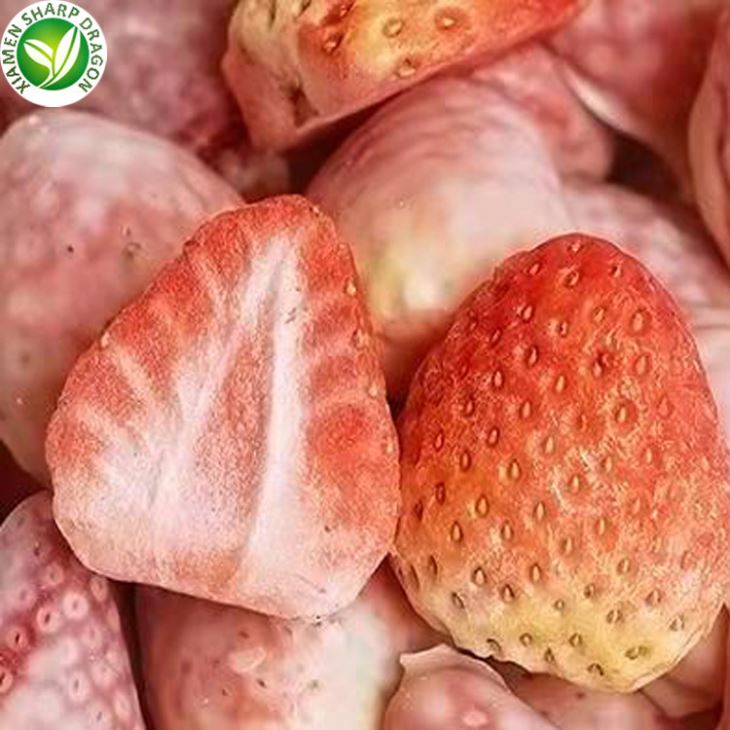
At XMSD, we would separate appearance from mixing performance when comparing freeze-dried strawberry forms. Whole pieces and slices deserve attention when the eater will see them. Fragments or a suitable powder deserve attention when even distribution is the job. The useful question is what survives or disperses during the actual preparation.
That comparison should include the point when the food is served, not only the moment of assembly. A topping that works immediately may behave differently after contact with a moist filling. Conversely, fruit that begins firm can be more pleasant once incorporated. Decide the intended texture first, then make the preparation sequence support it.
Example: choosing a fruit inclusion for twenty portions
Imagine a small bakery developing twenty individual desserts. The trial plan allows 3 grams of dried fruit per portion, so the initial ingredient quantity is 20 × 3 grams = 60 grams. This is an illustrative formulation choice, not a recommended serving or a claim about any commercial product. It provides a repeatable starting quantity for comparing two forms.
One version uses recognizable chewy fruit pieces in the filling. Another uses freeze-dried fragments, with a small separate garnish added at service. The baker keeps the other recipe ingredients and the serving interval consistent. The comparison asks whether the filling has the intended bite, whether fruit flavor is distributed pleasantly and whether the garnish still looks useful.
If the hypothetical chewy version gives the desired distinct fruit bite, it wins that particular inclusion task. If the fragments blend more effectively into the intended filling, they win that task instead. An unattractive result at the chosen serving point calls for a change in form, addition stage or formulation, rather than a claim that all dried fruit performs badly.
The same calculation also makes waste visible. Weigh the ingredient allocated to the trial and the quantity actually incorporated; note any pieces set aside because they do not suit the design. A visually impressive pack can be less useful than a simpler grade if much of it must be broken or rejected for the recipe. Evaluate usable form as well as purchase weight.

A snack is judged dry, but not without context
For food intended to be eaten directly, the first practical checks are the product's eating instructions, bite, flavor and portion. Chewy fruit, light freeze-dried fruit and fried crisps offer different experiences. A person who wants a sustained chew may not prefer a fragile crisp. Another may want a small crunchy accompaniment rather than a substantial fruit inclusion.
The physical size of a piece matters too. Very large slices can be awkward in a small serving container, while a pack dominated by tiny fragments may be inconvenient as a finger food. Try the planned container and serving utensil together with the product. A topping spoon and a grab-and-go snack cup have quite different requirements for the pieces they hold.
Plain dried fruit can contain naturally occurring sugar, so "no added sugar" does not mean "sugar-free." Nutrition information should be compared on the same stated weight basis and then related to the amount you actually eat. Comparing one large fresh fruit with one small handful of dry pieces by appearance alone is a poor way to estimate what the serving contains.

Water changes the weight basis, not the ingredient list
A dry ingredient and a prepared dish are different products for nutrition and recipe calculations. Adding water changes the weight of the serving without adding fruit or vegetable solids. Adding milk, stock, oil or sugar changes more than weight. Record what went into the dish before interpreting a value stated per serving or per 100 grams.
The dry product label is therefore a starting point, not a complete description of a finished soup or dessert. If the recipe contains several ingredients, account for those ingredients together. Also check whether the label's nutrition declaration describes the food as sold or as prepared; those bases cannot be exchanged without knowing the preparation.
There is no need to assign one universal fresh-to-dried substitution ratio to every fruit and vegetable. Different starting moisture, cuts, recipes and target textures make that misleading. A tested recipe or the specific ingredient's preparation information is a better starting point. For your own repeatable dish, record the quantity and liquid adjustment that actually produced the intended result.
This avoids a familiar practical mistake: replacing a fresh ingredient with the same apparent volume of dried pieces and leaving everything else unchanged. The dry pieces occupy space differently and interact with the dish's liquid. A small trial can reveal whether the recipe needs a different amount, more available liquid or an earlier addition stage.
Keep the useful texture through storage and service
Dry food still needs appropriate packaging. Protect it from moisture and follow the product's storage and after-opening directions. A crisp ingredient exposed repeatedly to humid air can lose the texture for which it was selected. A large economical pack is less attractive if its contents no longer suit the application by the time the pack is finished.
Avoid holding an open bag above a steaming pot.
Pour out the amount needed with clean, dry equipment, then close the container promptly. Separate the portion going into a wet recipe from the dry stock that will be stored. Keep the manufacturer's storage and after-opening directions with the remaining ingredient, especially if it is transferred to another container.
Specify pack size and handling requirements when comparing food packaging options. A dried product needs its own suitable packaging assessment: a material or storage instruction used for frozen produce should not automatically be transferred to a crisp dried ingredient. The food, moisture barrier, closure and expected use all have to fit together.

Once water is added, use the food as a prepared ingredient
Freeze-drying itself is not a dependable kill step for illness-causing microorganisms. A dry appearance cannot establish that a food is ready to eat. Obtain a product appropriate to the intended use, follow any required cooking directions and use clean handling throughout preparation.
After rehydration, treat the food as perishable rather than leaving it beside the dry pantry stock. Prepare the amount needed, use it promptly and follow appropriate refrigeration and food-handling instructions for the finished food. Do not extend a dry product's unopened shelf-life statement to a wet mixture.
Changes such as unexpected dampness, mold, damaged packaging or an unusual odor deserve attention before the ingredient is used. Re-drying or cooking a questionable product is not a general remedy for unknown storage damage. Where its condition is doubtful, stop using it and seek product-specific advice or discard it; tasting cannot establish safety.
Turn a successful kitchen trial into a repeatable choice
For an ongoing foodservice or retail requirement, describe the result you need in recognizable terms: chewy fruit in a filling, visible slices on a dessert, vegetable pieces prepared by a defined cooking method or a crisp finished snack. State the cut, recipe restrictions, intended handling and eating stage. That brief is more useful than asking for the best dried product without an application.
At XMSD, we would keep a successful sample tied to its exact form and intended use. A change from slices to fragments, plain to seasoned, or cooking ingredient to ready-to-eat format deserves a new application check. Similar names are not enough to show that the substitution will behave the same way.
For importers comparing ingredient options, the sample, written description and preparation instructions should all refer to the same product. Bring the kitchen's observations into that comparison: which pieces remained useful, which became too soft, and what the serving conditions were. Those details turn an individual preference into a requirement that can be discussed clearly.
The final choice may be different for different parts of a menu.
A chewy inclusion can suit a bake, a freeze-dried slice can suit a garnish, and a cooked dried vegetable can suit a soup. Matching each ingredient to its job is more useful than forcing one drying method to serve every purpose.

Tell us the fruit or vegetable, intended dish, preferred form and preparation method through the XMSD inquiry form. We can review the requirement and discuss suitable product information for your comparison.
References
- University of Minnesota Extension: Drying and using preserved foods
- University of Minnesota Extension: Freeze-drying and food safety
- University of Missouri Extension, hosted by UC ANR: How to Use Dehydrated Foods
- Utah State University Extension: Freeze Drying
- FDA: Added Sugars on the Nutrition Facts Label
- FDA: Are You Storing Food Safely?