


Why Is Frozen Sweet Potato Called Longevity Food?
Jun 22, 2022

Frozen sweet potato is called "longevity food" because the sweet potato itself has a long cultural association with nourishing staple diets, not because freezing has been shown to extend human life. Historical Chinese retellings connected sweet-potato eating with long-lived communities, while research on Okinawa describes sweet potato as an important part of a traditional dietary pattern associated with healthy aging. Neither line of evidence proves that one food causes longevity.
Modern nutrition helps explain why the nickname endured. Sweet potato supplies carbohydrate and fiber, and orange-fleshed varieties can supply beta-carotene, which the body can convert to vitamin A. Purple varieties contain anthocyanin pigments. Those facts support a place in a varied diet; they do not turn "longevity food" into a medical classification or authorize a life-extension claim.
The word frozen describes preservation and product format. It can make a peeled, cut product convenient and available across seasons, but the meaningful questions remain: Which variety is used? Is the product plain, steamed, blanched, fried, coated, or sweetened? How was it stored and cooked? For a commercial program, we also need measurable agreement on color, cut, texture, ingredients, packing, and cold-chain condition.
Direct answer: "Longevity food" is a cultural and nutritional reputation attached to sweet potato. Freezing preserves a chosen product form; it does not create a longevity effect. Use the phrase as historical context, then judge the food by its actual variety, ingredient statement, processing method, serving context, and evidence.

Frozen orange sweet potato strips show the commercial product form behind the question. The image documents cut and packing appearance, not a health outcome.
Where the "Longevity Food" Nickname Comes From
The nickname is best understood as a story about staple foods and dietary patterns. In China, popular accounts often repeat a saying that people who relied on sweet potato lived long lives. Some modern versions attribute the wording directly to the Ming-era physician Li Shizhen. That precise attribution is not cleanly established by the sources commonly cited online. A more traceable discussion places a similar saying in a later, Kangxi-era Dinghai county gazetteer. The prudent editorial choice is therefore to describe a historical Chinese saying without presenting a disputed quotation as settled medical authority.
Okinawa supplies a second, better documented strand. In a review of Okinawan food history, Sho Hiroko describes the Satsuma sweet potato as the largest source of dietary energy in the traditional pattern. The same paper also describes abundant green and yellow vegetables, legumes and soy foods, seaweed, fish, some pork, tea, and a supportive food culture. That wider context matters. An association between a long-lived population and a staple food cannot isolate the effect of the sweet potato from the rest of the diet, activity, social life, genetics, health care, or historical living conditions.
The phrase continues to appear in modern scientific writing. A 2025 food-processing study, for example, introduces sweet potato as "longevity food" before examining how steaming conditions affect physicochemical and eating qualities. The experiment measured processing outcomes, not lifespan. This is a useful reminder: a traditional label can appear in a scientific paper without becoming the tested conclusion of that paper.
A reputation is not a causal claim
There are three different levels of evidence here. First, historical evidence can show that a community valued or relied on a food. Second, composition evidence can show that a variety contains fiber, carotenoids, anthocyanins, or other compounds. Third, human outcome evidence would need to show that eating that food causes longer life under controlled or otherwise convincing conditions. The first two levels do not automatically establish the third.
Practical example: A retail panel could accurately say that sweet potato has a traditional reputation as a longevity food, provided the wording is clearly cultural and complies with the destination market's rules. "Proven to make you live longer" would be a different claim, and the historical sources, nutrient composition, and processing studies reviewed here do not substantiate it. The responsible action is to keep the cultural explanation and remove the promised health outcome.

A color reference can help define an orange-fleshed specification. It cannot measure beta-carotene content or prove a nutrition claim by appearance alone.
What Sweet Potato Nutrition Actually Supports
Sweet potato is a starchy root. It contributes carbohydrate, fiber, and a range of micronutrients, but a single universal nutrition number would be misleading. Cultivar, flesh color, maturity, growing conditions, peeling, cooking method, water gain or loss, and the reporting basis all affect the result. A raw-food database value, a boiled serving, a steamed frozen item, and a fried coated product are not interchangeable.
Orange flesh is especially relevant to beta-carotene. The U.S. National Institutes of Health explains that beta-carotene is a provitamin A carotenoid: the body can convert it to vitamin A. Vitamin A has established roles in normal vision, immune function, reproduction, growth, and development. That is a defensible nutrient-function chain. It is narrower and more accurate than saying orange sweet potato prevents disease or extends life.
Purple-fleshed sweet potatoes receive attention because their pigments include anthocyanins. Reviews describe antioxidant and other biological activities in laboratory, cellular, and animal models. Such work is useful for identifying compounds and research questions, but it does not by itself establish a clinical benefit in people, a therapeutic dose, or a longevity effect. We need to state the evidence level whenever a mechanism is discussed.
Fiber supplies another plausible reason for the food's healthy reputation. It contributes to the structure of the whole root and can support dietary fiber intake. The practical value still depends on the total meal and the finished product. A plain steamed piece, a sugar-glazed side, and a deep-fried coated fry can all begin with sweet potato while delivering different ingredient lists, energy density, sodium, fat, texture, and portion behavior.
Key takeaways
- The nickname belongs to tradition; it is not a clinical category.
- Orange color suggests carotenoid pigments, while purple color suggests anthocyanin pigments, but color is not a certificate of nutrient quantity.
- A nutrient's normal function is not proof that a food prevents disease or lengthens life.
- Judge the finished product and the whole meal, not the root ingredient in isolation.
This evidence boundary makes the answer more useful, not less. You can still value sweet potato as a versatile source of starch, fiber, and variety-dependent pigments. You simply do not need an exaggerated promise to explain its place in a balanced menu.

Purple frozen strips make color and cut measurable product attributes. Laboratory nutrient analysis would still be needed for a quantified composition claim.
Why Variety, Color, and Product Form Change the Answer
"Sweet potato" is not one standardized composition. Orange, purple, yellow, and pale-fleshed cultivars differ in pigments, dry matter, sweetness, texture, and cooking behavior. Even two roots with similar color can differ by cultivar and growing conditions. When nutrition matters, use a representative laboratory result or an approved database entry that matches the actual product and preparation. When application performance matters, test the chosen lot in the real process.
Cut geometry also changes the eating result. A thin strip has more surface area relative to its mass than a large chunk. It can heat, dry, brown, soften, or absorb surface ingredients differently. Cubes distribute differently in a ready meal; chunks may retain a more obvious sweet-potato identity; slices may suit a plated side. These are application decisions, not health rankings.
Processing state is equally important. "Frozen sweet potato" may mean raw or blanched IQF pieces, steamed pieces, par-fried fries, a coated product, mashed portions, or a sweetened prepared item. If you ignore those differences, you can compare unlike products while believing the ingredient name makes them equivalent.
| Product form | What you need to verify | Responsible interpretation |
|---|---|---|
| Plain cut pieces | Variety, cut, peel status, blanching or steaming, ingredient statement | Closest to discussing the root itself, but still preparation-specific |
| Coated or par-fried fries | Coating, oil, seasoning, cook method, serving basis | Judge the complete formulation rather than transferring claims from plain sweet potato |
| Sweetened or seasoned item | Added sugar, salt, fat, sauce, and declared portion | Treat it as a prepared food with its own nutrition and use case |
For an application discussion, begin with the result you need: orange visibility in a ready meal, purple color contrast in a mixed dish, a firm cube after reheating, or a soft steamed strip for direct serving. Then connect that result to variety, cut dimensions, pre-cook state, and a trial method. The XMSD frozen sweet potato range is useful for reviewing available format directions, while the final specification still needs to match the selected product and use.

Separate yellow and purple chunk samples show why flesh color belongs in the specification. Color does not make one format universally better.
What Freezing Changes-and What It Does Not
Freezing slows the reactions and microbial activity that otherwise limit storage life. It supports seasonal availability, portioning, and supply planning. It does not sterilize food, reverse poor handling, or turn an ordinary nutrient into a longevity treatment. The FDA notes that freezing at 0°F (-18°C) keeps properly handled food safe in frozen storage, while quality can still decline over time. It also notes that freezing does not kill most bacteria; cooking and hygienic handling remain relevant.
Vegetables are often blanched or otherwise heated before freezing to manage enzymes and prepare the desired product state. Sweet potato may also be steamed or partly cooked to achieve texture and handling goals. Heat, time, water contact, cut size, oxygen exposure, packaging, frozen-storage duration, and final cooking can each influence quality and measured nutrients. Asking whether "freezing preserves all nutrients" is therefore too broad. The better question names the nutrient, cultivar, process, storage condition, and comparison basis.
Comparative studies of fresh and frozen produce can inform this discussion, but they must not be overextended. Bouzari and colleagues found that, across eight tested fruits and vegetables, many mineral, fiber, and phenolic comparisons showed no significant fresh-versus-frozen difference. Sweet potato was not one of the eight commodities. The study supports a commodity-specific approach; it does not supply a sweet-potato retention percentage.
Physical quality is often easier to see. Ice crystals can disrupt cells, so thawing and heating may soften the tissue. Temperature fluctuation can encourage clumping, surface ice, dehydration, and freezer burn. Those changes may reduce visual or textural quality without automatically proving a safety failure. You need the storage record, package condition, product temperature, lot history, and agreed acceptance method before deciding.
Example: Suppose a recipe compares 200 g of plain frozen cubes with 200 g of coated, par-fried sweet potato fries. The root weight sounds similar, but the coating, absorbed oil, seasoning, cook loss, and final serving yield may differ. The correct action is to compare the complete ingredient statements and nutrition information on the same prepared basis, then run both products through the intended cooking method. The word "sweet potato" alone cannot settle the choice.

Cubes offer a different surface-area and portioning profile from strips or chunks. The choice should follow the cooking process and finished dish.
How to Use the Idea Responsibly in a Diet or Menu
At home or in foodservice, treat sweet potato as a starchy component of the meal, not as a supplement or a cure. Pairing it with vegetables, a suitable protein source, and the rest of a varied eating pattern reflects the lesson of the Okinawan evidence better than turning one root into a miracle ingredient. Portion and preparation can be adjusted to the person, menu, and nutrition goals.
Plain frozen pieces make the formulation easier to understand because added ingredients are limited. Steaming, roasting, air cooking, boiling, or incorporating pieces into soups and grain dishes will produce different textures and may change water content. A prepared fry or glazed side can still fit a menu, but it needs to be judged as that finished food. Added oil, sugar, salt, and sauce do not disappear because the base ingredient has a healthy reputation.
Cooking instructions also matter for safety and quality. Do not assume every frozen sweet potato item is ready to eat. Review the label and product specification for its pre-cook state, then follow a validated preparation method. Avoid leaving the product at room temperature merely to make pieces easier to separate; controlled frozen handling protects both quality and process consistency.
If you manage a health-related condition or need an individualized carbohydrate plan, the nickname is especially unhelpful. Use the actual serving, formulation, preparation, and professional dietary advice appropriate to the situation. The evidence discussed in this article is general food information, not medical treatment.
This approach preserves what is valuable in the tradition. Sweet potato can be an accessible, colorful, practical staple. Its value sits in a food pattern and a real preparation, not in an unlimited promise attached to a single ingredient.

This XMSD equipment collage illustrates frozen-food processing and packing controls. It is not sweet-potato-specific health evidence and does not replace lot documentation.
How We Turn the Nickname Into a Buyer Specification
For commercial sourcing, "longevity food" is not an acceptance criterion. We translate the story into product questions that can be sampled, measured, documented, and repeated. The three most useful perspectives are application performance, claim and label control, and arrival condition.
1. Application and specification perspective
Begin with the finished use. State the desired flesh color, peel status, cut shape, nominal dimensions and tolerance, pre-cook state, target texture, and cooking process. A visual reference is helpful for color, but it needs agreed lighting and a practical acceptance range. A caliper image illustrates measurement, but the contract needs the actual sampling method and tolerance. For a slice application, our frozen sweet potato slices page can start the format conversation; an approved sample and written specification finish it.
Run the sample in the intended process rather than judging a frozen piece alone. Record time and temperature, batch size, equipment, hold time, and the point at which texture or color is assessed. If two cuts are compared under different conditions, the result cannot distinguish the effect of cut from the effect of cooking.
2. Claim and label perspective
Review every claim against the actual formulation, representative data, intended serving basis, and destination-market rules. Historical wording can explain why people use the nickname, but it should not imply prevention, treatment, or guaranteed longevity. Color alone cannot substantiate a quantified beta-carotene or anthocyanin statement. If a declared nutrient value matters, agree on the testing basis and account for the selected processing state.
The ingredient statement must also match the product. Plain sweet potato, a processing aid where applicable, coating, oil, sugar, salt, and seasoning create different labeling tasks. Artwork approval should follow the confirmed specification, not an attractive historical story. For retail or foodservice packs, our overview of frozen-food packaging options can frame pack size, inner pouch, carton, label, and destination inputs.
3. Arrival and cold-chain perspective
At arrival, separate safety evidence from quality observations. Review the agreed temperature requirement and available records, then inspect seal integrity, carton condition, clumping, loose surface ice, dehydration, color, breakage, and foreign material under the sampling plan. A soft or broken piece may indicate a quality or process problem; one photograph cannot identify the full cause. A temperature deviation also needs time, product condition, and risk assessment rather than a slogan-based decision.
Define what happens after a nonconformity is found: isolate the lot, retain evidence, compare the approved sample and specification, and agree whether the decision is acceptance, concession, sorting, rework where lawful, or rejection. That action path is more valuable than describing the product as premium or healthy.
Worked example: A 10 kg case divided into 100 g target portions has a theoretical 100 portions: 10,000 g ÷ 100 g. In a hypothetical kitchen trial, Cut A produces 92% usable yield after sorting, cooking, and handling, or 92 equivalent target portions. Cut B produces 96%, or 96 portions. If both meet texture and color requirements, Cut B gives four more usable portions per case. These percentages are illustrative, not XMSD performance promises; measure them under your own controlled trial and purchasing specification.
The example shows the right hierarchy. First define the application and measurement basis. Then compare usable yield, sensory result, declared formulation, pack performance, and landed economics. The "longevity food" story may explain why your audience recognizes sweet potato, but it cannot replace the numbers that control a commercial decision.
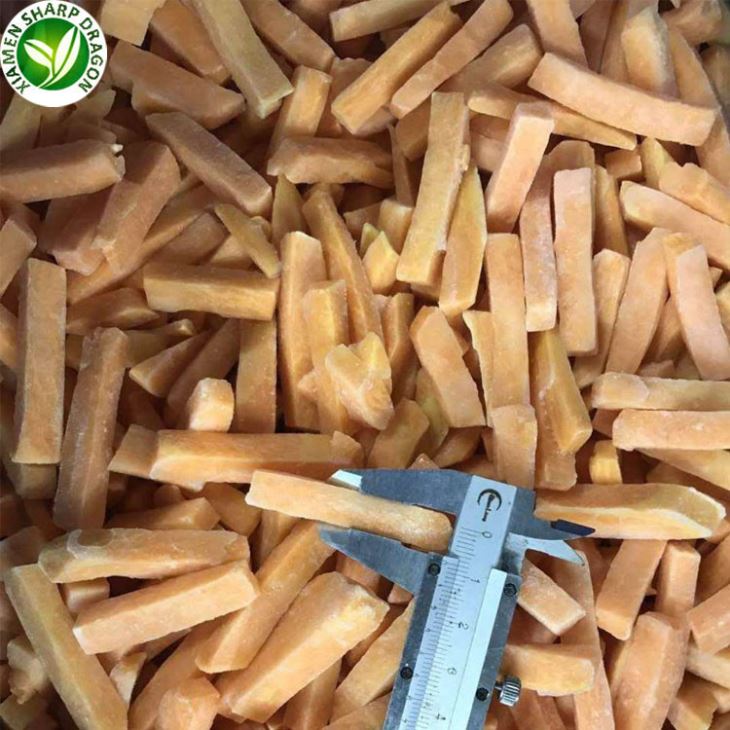
A caliper check turns a general cut description into a measurable attribute. The final tolerance and sampling plan still need written agreement.
Discuss a measurable frozen sweet potato specification. Tell us the flesh color, cut, pre-cook state, target recipe, pack format, destination market, and sample test you need. We can use those inputs to clarify a product direction and review basis.
The Bottom Line
Frozen sweet potato is called longevity food because a nutritious staple became associated with historical dietary traditions and long-lived populations. The strongest interpretation is cultural: the nickname reflects how people valued the food. The evidence supports discussing its fiber, variety-dependent pigments, beta-carotene in orange-fleshed types, and practical role in a varied diet. It does not prove that the food-or the act of freezing it-extends lifespan.
For everyday use, look at the complete product and meal. For sourcing, replace the nickname with a defined variety, color, cut, process state, ingredient list, pack, trial, and arrival standard. That keeps the story honest while making the product decision useful.
References
- Sho H. History and characteristics of Okinawan longevity food. Asia Pacific Journal of Clinical Nutrition (2001).
- Sanlian Lifeweek discussion of the traceable Chinese sweet-potato longevity saying and its historical context.
- U.S. National Institutes of Health Office of Dietary Supplements: Vitamin A and Carotenoids.
- Alam M.K. A comprehensive review of sweet potato: revisiting the associated health benefits. Trends in Food Science & Technology (2021).
- Frontiers in Nutrition: effects of high-pressure steaming on sweet-potato physicochemical and eating qualities (2025).
- Bouzari A., Holstege D., Barrett D.M. Mineral, fiber, and total phenolic retention in frozen fruits and vegetables. Journal of Agricultural and Food Chemistry (2015).
- U.S. Food and Drug Administration: Are You Storing Food Safely?
- USDA Food Safety and Inspection Service: Freezing and Food Safety.