


When Should You Eat Peaches? Timing, Portions and Food Form
Aug 06, 2019

You can eat peaches at breakfast, with a meal, between meals, around exercise or in the evening. There is no reliable peach-specific rule that noon is best, that the fruit must be eaten on an empty stomach, or that nutrients stop being absorbed after a particular hour. For most people, the useful time is the occasion that fits the rest of the meal, the intended portion and personal digestive comfort.
Timing can still matter for a practical reason. At breakfast, peach can replace part of a sweet topping and sit beside yogurt or oats. Between meals, a planned portion can bridge a long gap without becoming an extra uncounted eating occasion. Before prolonged exercise, peach contributes carbohydrate but is only one part of a fueling plan. At night, the clock does not make peach fattening, although a large serving or a sugary peach dessert can be uncomfortable or unnecessary. If reflux is a problem when you lie down, earlier eating may help.
Food form changes the answer. A whole fresh peach makes the portion visible. Unsweetened frozen peach can work in bowls, dairy products and smoothies year-round. Peaches packed with syrup, sweetened fruit preparations and candied forms bring ingredients and added sugars that are not present in plain fruit. Check the actual label and serving instead of giving every peach product the same timing advice.
Short answer: Eat peaches when they solve a real meal or snack need and feel comfortable for you. Choose the form and portion first; then use timing to support breakfast, hunger management, exercise, dessert substitution or symptom control. Noon has no special peach-nutrient advantage.

There Is No Universal Best Hour for Peaches
Claims for a perfect fruit hour often start with a real idea and add an unsupported conclusion. Digestion and absorption are active throughout the day. Eating fruit with other foods can change how quickly a mixed meal leaves the stomach, but it does not make the fruit rot there or block all nutrient uptake. No credible peach guidance shows that midday uniquely improves absorption.
A claim that peach ranks first among fruits for iron is also a poor reason to assign a noon eating rule. USDA FoodData Central treats raw yellow peach as a fruit with a measured nutrient profile, not as a leading iron food. If iron is your dietary priority, build the meal around dependable iron sources and the overall eating pattern rather than expecting the clock to transform a peach into an iron-rich food.
General meal-timing research should not be turned into a peach command either. An American Heart Association scientific statement discusses intentional meal patterns, regularity and the distribution of energy across the day. It does not identify one fruit or one universal cutoff. A consistent schedule may help some people plan hunger and portions, but that is different from saying a peach is beneficial at 12:00 and harmful at 20:00.
| Situation | Useful timing decision | What to check |
|---|---|---|
| Breakfast | Include peach when it improves a complete meal or replaces a sweeter topping | Protein or grain context, actual peach portion, added sweeteners |
| Between meals | Use a planned snack if the next meal is far away and you are genuinely hungry | Substitution versus addition, package serving, hunger response |
| Before exercise | Use as one carbohydrate component when the activity and tested tolerance call for fuel | Exercise duration, total carbohydrate target, gut comfort, time available |
| After exercise | Include with the next meal or recovery snack; there is no peach-only recovery window | Overall carbohydrate, protein, fluid and next-session needs |
| Evening | Eat a modest portion if it fits the day and does not worsen symptoms | Reflux, lying-down time, syrup or dessert additions, habitual grazing |
| Sensitive digestion | Test a smaller amount at a calm, repeatable meal rather than chasing a clock rule | Peach form, portion, sorbitol exposure, other foods and recorded symptoms |
Use the table as a decision aid, not a schedule that every person must follow. Breakfast, snack and evening are labels for different jobs. If the same portion feels good and fits the same daily intake at another hour, moving it is unlikely to create a special peach effect.
Breakfast Works When Peach Has a Clear Role in the Meal
Peach fits breakfast because the flavor works with oats, yogurt, cottage cheese, cereal, pancakes and savory grain bowls. That convenience is the reason, not a special morning absorption mechanism. If your current breakfast is only a peach and you become hungry soon after, add the other components your day requires rather than doubling the fruit and calling the timing wrong.
A useful comparison is what the peach replaces. Plain peach pieces on oatmeal are different from peach pie filling, peach-flavored syrup or a yogurt already high in added sugars. A fresh or unsweetened frozen portion may provide fruit flavor without another sweet topping. If honey, granola, sweetened yogurt and syrup are all added as well, the peach has been stacked onto the meal rather than used to simplify it.
Practical example: building a breakfast rather than a fruit-only rule. You normally eat oats with two tablespoons of sweet syrup. Replace the syrup with a measured portion of thawed unsweetened peach and cinnamon, then keep the oats and your chosen protein source consistent. Judge the change by taste, hunger before lunch and the product label. If the bowl still needs syrup for the intended flavor, record both ingredients instead of treating the peach as a no-sugar replacement.
The nutritional role of peach belongs in a separate evidence discussion. The guide to the benefits of eating peaches addresses what the fruit contributes without creating a required breakfast or noon window. Timing should help you use the food consistently, not inflate the nutrient claim.

Between Meals, Decide Whether Peach Replaces or Adds
A peach can be a practical mid-morning or afternoon snack when there is a long interval between meals. The key question is not whether 10:30 or 15:30 is metabolically perfect. Check your hunger, the time remaining until the next meal and what you would otherwise eat. A planned fruit snack that replaces confectionery has a different daily effect from a peach added after an adequate snack simply because fruit carries a healthy image.
Whole fruit makes this decision visible: one peach is a discrete unit. Frozen pieces, canned fruit and foodservice scoops need a stated measure. The American Diabetes Association uses a small piece of whole fruit or about one-half cup of frozen or canned fruit as general examples that contain roughly 15 g carbohydrate. That is a carbohydrate-planning reference, not a command that every person must eat exactly that amount.
If you manage diabetes, take insulin or use a prescribed carbohydrate plan, the time and quantity may need to match medication, activity and blood-glucose guidance. Count the actual carbohydrate instead of labeling a peach "free" because its sugar is naturally occurring. Fresh, frozen and canned fruit without added sugars can fit; the relevant choice is the portion and your plan. Do not change medication timing without guidance from your care team.
Snack timing alone does not prove a weight effect. Substitution, total intake and food form do the important work, which is why the separate analysis of whether peaches are useful for weight management focuses on portions and what the fruit replaces. A peach before lunch is not a weight-loss treatment, and adding one does not guarantee that the later meal becomes smaller.

Before Exercise, Peach Is One Fuel Component
For a walk or ordinary short workout, you may not need a special peach snack at all if your normal meals cover the session. For prolonged or demanding exercise, carbohydrate timing becomes more relevant. The joint position of the Academy of Nutrition and Dietetics, Dietitians of Canada and the American College of Sports Medicine gives a broad pre-event range of 1–4 g carbohydrate per kilogram of body weight in the 1–4 hours before exercise lasting more than about 60 minutes, chosen for the event and individual tolerance.
Worked example: placing one peach inside a pre-event target. For a 70 kg athlete, that broad range is 70 × 1 = 70 g to 70 × 4 = 280 g carbohydrate during the stated window. Using the ADA's approximate 15 g carbohydrate fruit serving as the peach portion, the fruit supplies about 15 ÷ 70 = 21.4% of the low end or 15 ÷ 280 = 5.4% of the high end. A peach can contribute, but it is not a complete fueling plan for that event.
Do not apply this calculation to every workout. The range is intentionally broad because duration, intensity, prior meals, body mass, climate, access to carbohydrate during exercise and personal experience differ. If fiber or sorbitol feels uncomfortable close to exercise, try a smaller tested portion, a longer interval or another familiar carbohydrate source. Event day is not the time to test a large peach smoothie for the first time.
After exercise, peach can join the next meal or snack, but it has no unique recovery window. Recovery planning considers the next session, total carbohydrate, protein, fluid and overall daily intake. Peach with yogurt may be convenient; peach alone may be adequate after light activity but insufficient after long, glycogen-depleting work. Let the activity define the recovery need.

Peaches at Night Are a Comfort and Pattern Decision
A peach does not acquire extra calories when the sun sets, and an evening serving does not automatically become body fat. Check your hunger, the serving's place in the day's intake, the product form and how close you are to lying down. A plain peach after dinner is not equivalent to a large peach cobbler, sweetened cream dessert or bowl of syrup-packed fruit.
Habit matters. If an evening peach replaces a more energy-dense dessert and leaves you satisfied, that is a clear role. If it becomes the first item in an hour of grazing, the problem is the open-ended eating pattern rather than the peach clock. Portion the fruit before sitting down instead of eating directly from a large frozen bag, can or foodservice container.
Nighttime reflux changes the decision. NIDDK advises people with GERD symptoms at night or when lying down that eating meals at least three hours before lying down or bed may improve symptoms. This is a general reflux strategy, not evidence that peach is a universal trigger. If peach repeatedly produces symptoms, record the portion, preparation, other foods and lying-down interval, then discuss persistent symptoms with a clinician.
If you work shifts, use the same logic rather than borrowing daytime labels. "Breakfast" may occur in the afternoon, and the last meal may be in the morning. Anchor the decision to wake time, activity, main meals, planned sleep and symptoms. A clock time without that context is not useful.
Digestive Tolerance Can Matter More Than Meal Position
Some people can eat a full peach at any meal without discomfort. Others notice bloating, gas, loose stool or cramping after a larger serving. Monash University identifies peaches among fruits particularly rich in sorbitol, a fermentable polyol. In people with IBS, the response can depend on dose, other FODMAPs eaten that day and individual sensitivity. That makes a smaller repeatable test more informative than a rule such as "always eat peach on an empty stomach."
Test one variable at a time. Keep the peach form and meal similar, begin with a smaller measured portion and note symptoms over the relevant hours. Do not compare a few fresh slices at breakfast with a large peach smoothie containing milk, sweetener and several fruits at night and then blame timing. The amount and combined ingredients changed at the same time.
This tolerance discussion does not turn peach into a guaranteed laxative or constipation treatment. For a closer look at bowel effects and their evidence limits, see whether peaches act as a laxative. For timing, the action is simpler: reduce the test portion, avoid stacking triggers and seek professional guidance for persistent or severe symptoms.
An itchy mouth, hives, facial or throat swelling, wheezing or breathing difficulty is not ordinary digestive intolerance and should not be managed by moving peach to another hour. Peach can be involved in food allergy and pollen-food syndrome. Follow your allergy plan, seek medical assessment for suspected reactions and obtain urgent emergency help for breathing or throat symptoms.

Fresh, Frozen and Syrup-Packed Peaches Need Separate Decisions
Fresh peach is convenient for direct eating when ripe. The fruit's natural unit helps portion visibility, although edible weight changes with size and the pit. Frozen peach removes the seasonal and ripeness-timing problem for menu planning. Halves, slices and dice can be weighed while frozen or after thawing, but the specification should state which basis is used and how drain or drip loss is handled.
Unsweetened frozen peach is not the same as a prepared smoothie. Once several handfuls are blended with juice, sweetened yogurt or syrup, the recipe can contain multiple fruit portions and additional sugars even though it still looks like one cup. Measure the ingredients before blending. Texture after thawing may suit oatmeal, sauces, dairy and baking better than hand-held snacking; that is an application difference, not a nutrition failure.
Canned or cup-packed peaches require both an ingredient-list and a Nutrition Facts check. Fruit packed in water or its own juice differs from fruit in light or heavy syrup, and "drained" weight differs from net package weight. FDA explains that Total Sugars includes naturally occurring and added sugars, while Added Sugars is included within Total Sugars. Do not add those two label lines together. CDC currently advises looking for canned fruit in juice instead of syrup when reducing hidden added sugars.
Candied peach, jam, pie filling and sweetened fruit preparation are formulated foods. They may be appropriate for dessert, bakery or dairy applications, but their portion should follow that product's recipe and label. Calling them "fruit" does not make their serving equivalent to a plain peach. Conversely, there is no reason to avoid unsweetened frozen peach at breakfast or night merely because it passed through a freezer.
Example: the same menu time, three different products. A café serves peach yogurt at 08:00. Version A uses 100 g unsweetened IQF peach dice. Version B uses 100 g drained syrup-packed peach, and Version C uses 100 g sweetened peach preparation. The clock is identical, but ingredient declarations, added-sugar values, peach solids, texture and cost-in-use differ. Compare specifications and labels before calling the portions equivalent.
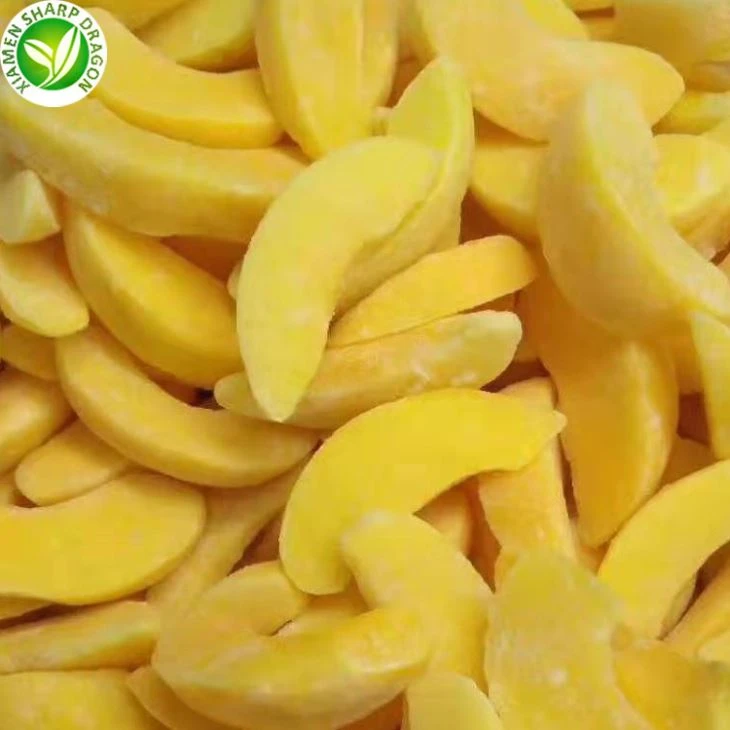
XMSD format note: The frozen yellow peach range shows halves, slices and dice for different serving and processing jobs. For a retail or foodservice pack, connect cut, net weight, ingredient statement and serving instructions to the approved artwork through the private-label process.

For Foodservice, Timing Starts with a Repeatable Portion
A menu statement such as "peach at breakfast" is incomplete without a portion and form. Define whether the serving is one fresh fruit, 100 g frozen dice as packed, 100 g after thawing and draining, or a 120 g sweetened preparation. The number influences purchasing, nutrition calculation, bowl fill, cost and the eating experience.
Worked example: calculating a breakfast service quantity. A hotel plans 80 bowls with 120 g drained peach in each. Required edible peach is 80 × 120 g = 9,600 g, or 9.6 kg. A controlled thaw-and-drain trial gives a 92% yield from the frozen packed weight. Gross requirement is 9.6 ÷ 0.92 = 10.43 kg. Add the operation's documented contingency separately; do not hide an assumed loss inside an oversized scoop.
The same calculation supports honest label and cost comparison. If another product quotes net weight including syrup or glaze, convert it to the edible basis used by the menu before comparing price per kilogram. Record the thaw time, temperature, drainage method, screen and duration used in the trial so another shift can reproduce the yield. For procurement, "breakfast portion" becomes useful only when it translates into a release and usage basis.
Quality changes can also change when the product works best. Firm slices may suit visible topping; softer thawed pieces may be better folded into oats or sauce. Dice distribute more evenly but reduce the visual identity of a peach half. Confirm cut tolerance, ripeness/color direction, Brix basis if specified, defects, separation, drip loss, pack size, storage and label wording against the application.
A Simple Personal Decision Method
First identify the job. Are you completing breakfast, replacing a dessert, bridging a long interval, fueling prolonged exercise or simply enjoying ripe fruit? A clear job prevents "eat fruit because it is healthy" from becoming an unplanned addition at every meal.
Second define the product and portion. Record fresh whole fruit, unsweetened frozen pieces, canned fruit in juice, syrup-packed fruit or a sweetened preparation. Use one visible unit, a cup measure, grams or the package serving. For carbohydrate counting, use the actual label or a reliable database and follow the plan given for your needs.
Third observe the result. Did the portion satisfy the intended gap? Did it cause reflux, bloating, oral itching or exercise discomfort? What else was in the meal? Repeat under similar conditions before blaming breakfast, noon or night. Stop self-testing and seek appropriate care when symptoms suggest allergy, are severe, persist or involve unexplained weight loss, bleeding, dehydration or significant pain.
Finally keep the rule narrow. "I tolerate half a peach with breakfast better than a large smoothie late at night" is useful personal evidence. "Nobody should eat peaches after 18:00" is not. Good timing guidance stays tied to the portion, form, purpose and observed response that produced it.
Plan the serving before the shipment. Share your peach cut, ingredient requirement, target portion, application, pack size, annual volume, destination and delivery window through the XMSD inquiry page. We can review whether the frozen form, sampling points and packing brief match the intended menu or retail use.
Final Answer
There is no universal best time to eat peaches. Noon does not uniquely improve nutrient absorption, fruit does not need an empty stomach, and an evening peach does not automatically cause weight gain. Breakfast, between-meal, exercise and evening use can all be reasonable when the portion serves a defined purpose and feels comfortable.
Let context make the decision. Use peach at breakfast to complete or simplify the meal; use it as a planned snack rather than an automatic addition; count it as only one part of prolonged-exercise fueling; and move it earlier if lying down after eating worsens reflux. For IBS or sorbitol sensitivity, test a smaller measured portion under repeatable conditions.
Always name the form. Whole fresh, unsweetened frozen, juice-packed, syrup-packed and sweetened peach preparations are not interchangeable. The best time is therefore the time when the right peach product, in the right portion, fits your meal, activity and tolerance.
References
- USDA FoodData Central. Food search for peaches, yellow, raw.
- St-Onge, M.-P. et al. American Heart Association. Meal Timing and Frequency: Implications for Cardiovascular Disease Prevention.
- American Diabetes Association. Best Fruit Choices for Diabetes.
- Thomas, D. T., Erdman, K. A. and Burke, L. M. Nutrition and Athletic Performance: Joint Position Statement.
- National Institute of Diabetes and Digestive and Kidney Diseases. Eating, Diet, and Nutrition for GER and GERD.
- Monash University FODMAP. Where FODMAPs Are Found in Foods.
- U.S. Food and Drug Administration. Added Sugars on the Nutrition Facts Label.
- Centers for Disease Control and Prevention. Spotting Hidden Sugars in Everyday Foods.
- NHS. Food Allergy: Symptoms and Emergency Signs.