


Papaya Explained: Fruit Identity, Ripeness and Product Forms
Dec 09, 2019

Papaya is the fruit of Carica papaya, a tropical species in the Caricaceae family. Botanically, the edible structure is a large berry. It develops around a central cavity filled with many dark seeds, while the surrounding flesh changes from firm and pale to softer yellow, orange or red as the fruit ripens.
In everyday food use, "papaya" can refer to two quite different ingredients. Mature ripe fruit is sweet, aromatic and usually eaten as fruit. Green or unripe papaya is firmer, less sweet and prepared as a vegetable in salads, pickles, curries and cooked dishes. A frozen orange dice, a green shred, a purée and a dried piece cannot be treated as one product.
The plural is "papayas." Product identity still requires more than the common name: species, cultivar where relevant, maturity, flesh color, seed removal, cut, processing state, ingredients and pack all change the expected result. Establish those fields before comparing appearance, flavor, nutrition or price.
Short answer: papaya is a climacteric tropical fruit that continues ripening after harvest. Ripe papaya is a soft, sweet fruit; green papaya is a firm culinary ingredient. Frozen pieces preserve a selected stage and cut, so the label and specification-not orange color alone-tell a kitchen or buyer what it is receiving.

The Botanical Identity Is Specific
Royal Botanic Gardens, Kew accepts the name Carica papaya L. and places it in Caricaceae. Kew describes a native range from southern Mexico to Venezuela and records its spread through tropical and subtropical production regions. The plant grows upright with a soft, often unbranched trunk and large leaves held near the top.
Flowers arise close to the trunk, and fruit form and size vary with plant type, cultivar, growing conditions and pollination. Commercial fruit may be small and pear-shaped or much larger and elongated. Flesh can range from yellow to deep orange-red. Those differences are normal categories until a contract defines tighter limits.
The word "tree" is convenient in trade, though the plant's structure is not a conventional woody orchard tree. That distinction rarely changes a purchase, but it explains why generic descriptions can conflict. For food identification, the accepted species, edible fruit and maturity matter more than the casual plant label.
Do not confuse tropical papaya with North American pawpaw, Asimina triloba. Kew places that temperate species in Annonaceae, a different family. Both may be called "pawpaw" in English. An import document, ingredient statement or technical specification should use a scientific name when the common term creates ambiguity.
Fruit Anatomy Explains the Product Forms
A papaya has skin, edible flesh, a central seed cavity, seeds and connective tissue. The skin is normally removed for processed frozen fruit. Seeds may be scraped out, yet small fragments can remain unless the defect standard excludes them. The cavity side and skin side of one piece can differ in color and firmness.
Latex is most evident in less ripe tissue. Papain and related proteases derived from papaya latex have commercial uses, including meat tenderizing. That fact does not mean every ripe dice delivers a standardized enzyme dose. Ripening, heat, processing, storage and the part of the fruit all change the system.
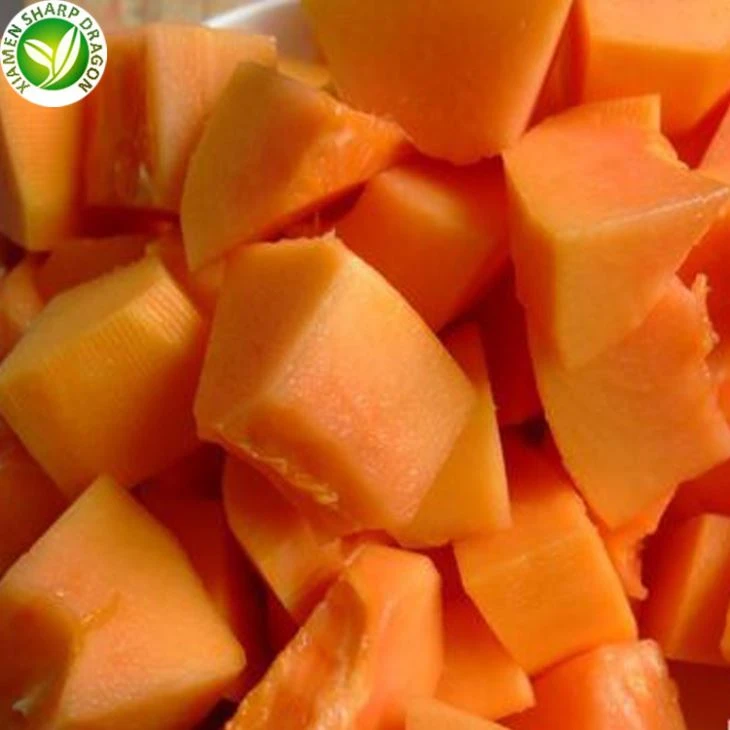
Cut geometry begins with anatomy. A cube from thick central flesh can meet all dimensions; a piece near the curved surface may taper. A specification can allow natural shapes or require a defined percentage within a dice tolerance. The IQF papaya dice format shows a commercial cut, while lot approval sets the actual distribution.
Chunks retain more natural geometry and can create a larger visible fruit piece. The frozen papaya chunk format can suit smoothie packs, fruit preparations or further processing. It should not be renamed a dice if irregularity is part of the approved form.

Green Papaya and Ripe Papaya Are Different Ingredients
Green papaya is harvested before the ripe-fruit texture and aroma develop. Its flesh is pale, firm and suitable for shredding or cooking. It can carry acid, chili, herbs, fish sauce or a curry base without behaving like a dessert fruit. The intended product is defined by maturity, not by waiting for an immature item to imitate ripe papaya in every recipe.
Ripe papaya softens, becomes aromatic and develops yellow-orange to red flesh depending on cultivar. It suits direct fruit service, smoothies, fruit mixtures, purée and sweet preparations. Very soft fruit may deliver strong flavor but poor dice integrity. A processor therefore selects a ripeness window that balances flavor with the mechanical stress of peeling, cutting and freezing.
Color break at the skin is one maturity cue. FAO postharvest guidance notes different harvest points for long-distance marketing and local use, with more color change acceptable for the shorter route. USDA storage literature identifies papaya as climacteric and describes yellowing from the blossom end. Neither cue replaces a cut-fruit check for flesh color, firmness, aroma and defects.
A fruit harvested too immature may change skin color yet fail to develop the same eating quality as fruit harvested at fuller maturity. Research indexed by FAO AGRIS found that fruit at or near full maturity produced better eating quality after ripening than dark-green immature fruit. The shipment decision must protect both market life and final eating quality.
Practical example: representative scenario for a restaurant importer. A menu uses green papaya salad, but the offered frozen sample consists of soft orange ripe dice. Both products are correctly called papaya, yet the sample cannot deliver the required shred, neutral flavor or crisp bite.
The importer rejects the substitution and specifies mature-green flesh, julienne dimensions, blanch state, texture after thaw and pack. The decision function is ingredient identity for a savory application, not whether the fruit is generally acceptable.

Ripeness Is a Moving Condition
Climacteric fruit continues through a coordinated ripening process after harvest. Respiration and ethylene are part of the change, while flesh softens and color and aroma develop. That makes fresh papaya valuable but time-sensitive. A carton that is suitable for wholesale distribution today may be too soft for machine dicing several days later.
Temperature management is not simply "colder is better." Papaya is sensitive to chilling, and susceptibility varies with maturity. USDA commercial storage guidance describes different tolerances for mature-green and more yellow fruit. A handler needs the cultivar, maturity, treatment, route and sales window before choosing conditions.
External yellow color can advance at a different pace from inner softening. Bruising may also appear after handling. Inspect several representative fruit by lot, not only the brightest carton. For processing, record firmness or a validated sensory scale, flesh color and soluble-solids measurement where it belongs in the specification.
Freezing stops the fresh-ripening sequence by turning the product into a frozen ingredient, but it does not reverse maturity. A bland immature fruit does not become an aromatic ripe dice merely because it is frozen. The processor has to select the desired stage before cutting and freezing.
Frozen Papaya Is a Defined Ingredient, Not Fresh Fruit on Pause
Freezing preserves a selected raw material and slows deterioration, yet ice formation changes tissue. Thawed papaya is commonly softer and releases liquid. That can be useful in smoothies, purées and cooked preparations but less suitable where crisp fresh-fruit structure is essential. Evaluate it in the final application.
IQF means pieces are frozen so they can remain individually separable when correctly produced, packed and stored. It does not state cultivar, sweetness, exact ripeness, microbial status or intended consumption without cooking. The IQF frozen papaya format is a starting category; a lot specification adds the decisive details.
Bulk-packed fruit suits further processing when the operation can manage the liner, portioning and cold exposure. Smaller retail or foodservice bags may reduce repeated opening. The bulk papaya format needs net weight, liner, carton, pallet and loading decisions tied to the destination.
Added sugar, syrup, acid, antioxidant treatment or another ingredient changes identity and labeling. "Frozen papaya" should not hide a formulation. Request the ingredient statement and treatment disclosure, then compare data on the same basis: as packed, drained, thawed or finished recipe.
Names on Menus and Specifications Need Different Precision
A consumer menu can say papaya smoothie or green papaya salad. A purchase specification has to go deeper. State Carica papaya, green or ripe use, flesh-color range, seed and skin removal, cut, size tolerance, broken or mushy allowance, ingredients, pack and temperature requirement.
"Red papaya" and "yellow papaya" may refer to cultivar or flesh-color grouping, but suppliers and markets do not always use the terms identically. Attach an approved color reference and sample. A photographed orange under warm light is not a stable specification unless capture conditions and an objective method support it.
"Chunks," "dice" and "pieces" also overlap in loose speech. Define nominal dimensions and tolerances. State whether natural tapered shapes count, how broken pieces are measured and whether fines are screened. For a beverage, small variation may disappear after blending; for a visible fruit cup, it may control acceptance.
The preparation route affects the name in use. Thawed fruit, fruit preparation, purée, sweetened inclusion and dried fruit have different moisture and application behavior. The guide to papaya preparation and use covers serving routes; product identity still begins at the approved source form.
Two XMSD Checks Resolve Color and Texture Ambiguity
In our frozen papaya reviews, we thaw a measured sample under the intended condition and assess flesh color, aroma, firmness, drip, seed fragments, peel remnants and size distribution. Frozen color alone can overstate firmness. We compare the same pieces before and after thaw so the acceptance reflects the stage used in the recipe.
We also separate natural color variation from mixed maturity. A range of orange shades can be acceptable when flavor and texture remain within the approved window. Pale, hard pieces mixed with collapsing dark pieces signal a different problem. The sample record links visual range to bite and application rather than ranking one photograph in isolation.
For a commercial review, connect those findings to processing date, lot, pack and cold-chain evidence. A strong identity record lets the team distinguish a cultivar difference, a maturity problem, a cutting defect and temperature abuse. Each calls for a different action.

Representative Decisions Show Why Identity Comes First
Example: representative scenario for a beverage developer. A smoothie formula needs strong ripe aroma and complete blending. Two orange frozen-dice samples look similar, but one stays hard and pale inside after controlled thaw while the other becomes soft and aromatic.
The developer selects the second sample, defines a ripe-flesh color and sensory window, and accepts moderate drip because the complete liquid enters the blend. The decision function is flavor release in a homogenized drink, distinct from the green-papaya restaurant case.
Worked example: converting a bulk sample into usable fruit-cup portions. A 10.00 kg frozen-dice trial produces 0.35 kg separated drip and 0.25 kg pieces outside the approved visible grade. Usable fruit is 10.00 − 0.35 − 0.25 = 9.40 kg.
At 125 g per cup, 9,400 g ÷ 125 g equals 75 full cups with 25 g remaining. If off-grade pieces are approved for purée, record that recovery separately; do not count them twice. The worked yield turns a broad product name into an application-specific purchasing measure.

Common Misidentifications and Release Mistakes
Orange color does not automatically mean ready-to-eat status. Ready-to-eat is a food-safety and process designation supported by the product system. Conversely, a pale frozen piece is not automatically green papaya for salad; it may be under-ripe material cut for another purpose. Confirm identity and instructions.
Softness alone does not prove decay. Ripe papaya is naturally tender, and thawed pieces soften further. Assess odor, visible mold, package integrity, temperature history, leakage and abnormal fermentation. A sour or alcoholic note outside the approved profile needs investigation even when color looks attractive.
Black seeds in the cavity belong to mature fruit, but fragments in a seedless dice may still be a defect against contract. White immature seeds or pale cavity tissue can accompany earlier maturity. Define the allowed fragments and inspection method rather than treating every dark speck as foreign material.
Do not infer origin from flesh color or shape. Cultivar, field conditions and maturity can create overlapping appearances. Origin claims require traceability documents; organic claims require valid certification and scope. Visual identity and documentary identity meet at lot release but do not replace one another.

What Papaya Is Not
Papaya is not mango, melon or pumpkin even when a cut piece shares their orange color. Those foods come from different botanical families and have different aromas, fibers, seed structures and handling behavior. A mixed-fruit pack may make visual sorting difficult after dicing. If identity matters for allergen review, formulation, customs or authenticity, use traceability and supplier records rather than a color guess.
Papaya is not automatically a sweet ingredient. Green papaya can be deliberately selected for a savory dish, while ripe fruit may vary widely in soluble solids and aroma. A specification that says only "papaya" allows both readings. When you request a sample, state whether the application expects fruit sweetness, a neutral vegetable base or a controlled intermediate maturity.
Papaya flavor is also distinct from a flavoring labeled papaya. Yogurt, candy, beverage powder and bakery filling may use natural flavor, artificial flavor, color, purée, concentrate or a small amount of fruit. Inspect the ingredient statement and quantitative formula. A papaya illustration on packaging does not establish that the product contains intact flesh, and intact flesh does not establish a standardized enzyme activity.
Frozen papaya is not a claim about agricultural method. Conventional, organic and other production descriptions require their own documentation. Freezing describes physical preservation; IQF describes piece separation in the freezing process. It does not prove organic status, pesticide compliance, origin, Kosher or Halal status, or the absence of every allergen cross-contact. Each requested attribute needs current evidence with the correct facility and product scope.
Finally, papaya is not one immutable eating stage. Fresh fruit may soften during distribution, while a frozen lot holds the stage chosen before freezing and reveals its final texture after thaw. Compare products at the same practical point. A fresh ripe slice at room temperature and a partly frozen dice are not a fair sensory match, even if both began with the same cultivar.
A Practical Identity Checklist
For fresh fruit, confirm accepted name, origin, cultivar if material, harvest maturity, ripeness at delivery, count or weight, defect limits, treatment, pack and temperature route. For processed fruit, add skin and seed removal, cut, tolerance, ingredients, processing state, net weight, frozen storage and intended preparation.
Then test the selected item in its real use. Green shreds must keep a suitable bite after dressing. Ripe dice must release the required aroma without collapsing before service. Smoothie fruit must blend at the equipment's time and temperature. A single generic description cannot cover all three.
Papaya is therefore easy to name but easy to underspecify. Its identity spans one accepted species and many commercial states. The useful answer combines botany with ripeness, anatomy, cut, process and application, producing a description that can survive from farm record to finished serving.
XMSD sourcing note: Send the ripe or green requirement, flesh color, cut, application, pack, destination and thaw endpoint. We can align a frozen papaya sample and specification review with the required product identity.
References
- Royal Botanic Gardens, Kew: Carica papaya L.
- Royal Botanic Gardens, Kew: Asimina triloba (North American Pawpaw)
- USDA ARS: The Commercial Storage of Fruits, Vegetables, and Florist and Nursery Stocks
- FAO: Pawpaw/Papaya Post-Harvest Operations
- FAO AGRIS: Harvest Maturity, Ripening and Papaya Eating Quality
- XMSD operational perspective on ripe and green identity, flesh color, cut distribution, thawed texture, drip, packing and usable yield.