


Are Frozen Carrots Good for You? Nutrition and Buyer Guide
Jan 18, 2019

Yes. Plain frozen carrots are a good vegetable choice for most people. They still provide fiber and carotenoids, including beta-carotene that the body can convert into vitamin A. They are also washed, cut, available year-round, and easy to portion. Those advantages can make it simpler for households, restaurants, and food manufacturers to use carrots consistently.
The careful answer is not that freezing keeps every nutrient unchanged. Carrot variety, maturity, time before processing, blanching, cut size, freezing speed, storage, temperature fluctuation, and final cooking can all affect the product. Frozen carrots also become softer than raw fresh carrots, so the better format depends on the dish. Plain IQF carrots fit soups, stews, ready meals, mixed vegetables, sauces, and many cooked side dishes; fresh carrots are usually better when raw crunch is the main requirement.
The short answer: Choose plain frozen carrots with a simple ingredient list, keep them properly frozen, and cook them according to the package or product specification. For commercial sourcing, judge the cut, free-flowing condition, cooked texture, color, defects, packaging, and cold-chain history together.

Why Frozen Carrots Can Be a Good Choice
They still count as vegetables
The USDA MyPlate Vegetable Group includes vegetables in fresh, frozen, canned, dried, raw, and cooked forms. MedlinePlus likewise notes that frozen fruits and vegetables can be healthy choices. These are general dietary references, not personal prescriptions; individual needs depend on age, energy needs, the rest of the diet, and medical advice where relevant.
Carotenoids are the nutritional headline
Orange carrots contain provitamin A carotenoids, especially beta-carotene. The NIH Office of Dietary Supplements explains that the body can convert some carotenoids into vitamin A. Vitamin A is important for normal vision, immune function, reproduction, growth, and development. The precise conclusion is that carrots can contribute to vitamin A intake. Eating carrots does not guarantee better-than-normal eyesight or prevent infection.
Carrots also contribute dietary fiber and a range of micronutrients. However, a nutrition table for raw carrots should not be copied onto every frozen-carrot product. Blanching and processing can change water content and some measured nutrient levels, while sauce, butter, sugar, or salt can change the nutrition profile of the finished product. The label and ingredient statement describe the product actually being purchased.

Frozen vs Fresh Carrots: Better Depends on the Decision
Fresh and frozen carrots are not identical, but the comparison is more useful when it focuses on the intended use. A fresh carrot may offer the strongest raw crunch. A plain frozen carrot offers preparation savings, portion control, and longer frozen availability. A seasoned frozen carrot may be convenient, but its added ingredients need separate review.
| Form | Best fit | Main check |
|---|---|---|
| Fresh carrots | Raw crunch, sticks, salads, garnish, and short cooking | Freshness, trimming yield, and preparation labor |
| Plain frozen carrots | Soups, stews, sides, mixes, sauces, and ready meals | Cut, frost, clumping, ingredient list, and cooked result |
| Prepared frozen carrots | Convenience-led retail and foodservice menus | Sauce, salt, sugar, fat, allergens, portion, and reheating result |
A nutrition comparison also depends on the baseline. A carrot analyzed soon after harvest is different from one that has spent time in transport, distribution, a store, and a refrigerator. A frozen sample has its own history: harvest maturity, pre-freezing delay, blanching, freezing, and storage. Published comparisons therefore do not support a universal rule that one form always contains more of every nutrient. They support a simpler decision: both forms can contribute vegetables, while the product and handling details determine the exact result.
For a household, the best choice is often the form that will actually be eaten before quality is lost. For a kitchen or factory, the comparison should include usable yield, preparation labor, waste, storage capacity, cook time, and consistency. Frozen carrots can reduce washing, peeling, trimming, and cutting work, but they require freezer space and a stable cold chain. Fresh carrots offer more flexibility for raw and lightly cooked uses, but their trimming yield and condition can vary from delivery to delivery.
Practical example: compare cost per usable kilogram
Assume your trial starts with 100 kilograms of fresh carrots. After removing crowns, peel, damaged areas, and off-size roots, you record 82 kilograms ready for cutting. The delivered yield is therefore 82%. If the fresh lot costs $0.70 per delivered kilogram, its raw-material cost is $70. Dividing $70 by 82 usable kilograms gives about $0.85 per usable kilogram before washing, peeling, cutting, labor, water, waste handling, and cooking.
Now assume a 100-kilogram frozen diced-carrot lot costs $0.92 per kilogram and your receiving and cooking trial records 97 kilograms suitable for the formula. Raw-material cost is $92 ÷ 97, or about $0.95 per usable kilogram. The frozen option is still more expensive on this narrow calculation, but the decision is not finished: you would add preparation labor, line time, waste disposal, freezer energy, cooking yield, and any difference in finished-product quality. If faster batching saves more than the $0.10-per-kilogram gap, frozen may have the lower total process cost. If your dish needs raw crunch, the frozen option can still be unsuitable regardless of cost.
These numbers are deliberately illustrative. Use the delivered price, measured trimming yield, cooked yield, labor rate, energy use, and defect definition from your own controlled trial. That keeps the comparison tied to your plant and recipe instead of turning one hypothetical result into a universal fresh-versus-frozen rule.

What Blanching and Freezing Actually Change
Commercial frozen carrots are commonly washed, trimmed, cut, blanched, cooled, drained, frozen, inspected, packed, and held in a frozen cold chain. Blanching is a brief heat treatment used to slow enzyme activity that could otherwise damage color, flavor, and texture during storage. It is not the same as fully cooking the product for every intended use.
Quick freezing helps form smaller ice crystals than slow, uncontrolled freezing, but it does not leave plant cells perfectly unchanged. Research on industrially frozen carrots has reported tissue fissures and softer texture after blanching, freezing, storage, and cooking. This matters most when you need a firm bite or a clean visible cut, especially after a defined hold or reheat step. It matters less in puree, soup, sauce, or a long-cooked filling.
A stated temperature of -18°C normally describes frozen storage and transport, not the freezing rate itself. The current XMSD frozen carrot specification, for example, separates the IQF process from storage and transport at -18°C or below. When you review a supplier, ask about the freezing process and the later cold chain as two related but different controls.
Nutrient outcomes are also more nuanced than the phrase "locks in nutrients." A study of processed carrot raw materials reported that processing and storage results vary and that the literature on carrot carotenoids is not uniform. The practical conclusion is that frozen carrots retain useful nutritional value, while exact retention depends on the nutrient, process, product, and comparison point. A freshly harvested carrot and a carrot stored for days before eating are not the same control.
Our overview of how frozen vegetables are processed explains why raw-material selection, blanching, drainage, freezing, sorting, packing, and storage must be treated as one quality chain.

Texture, Cooking, and the Best Uses
Frozen carrots are usually most successful in cooked applications. Add them directly to soups, stews, sauces, casseroles, ready meals, or mixed-vegetable dishes when the recipe permits. Routine room-temperature thawing is unnecessary and can make handling harder. Follow the package directions or the supplier's intended-use statement, especially when a frozen vegetable is labeled "cook before eating."
Cooking method changes quality. In one study comparing raw and industrially frozen carrots, microwaving retained initial texture and color better than steaming or boiling under the study conditions. That does not establish one universal best method: piece size, load, equipment, time, temperature, recipe moisture, and the target texture all change the result. For soup, boiling liquid remains part of the dish; for a stand-alone side, a shorter process with less water may better protect shape and color.
Cooking can also change how much beta-carotene the body can access. In a small human feeding study, stir-fried carrots delivered more bioavailable beta-carotene than raw carrots under the tested meal conditions. This supports the narrower point that heat, matrix disruption, and meal composition can affect absorption. It does not prove that one cooking method is always healthiest or that every frozen carrot meal produces the same result.
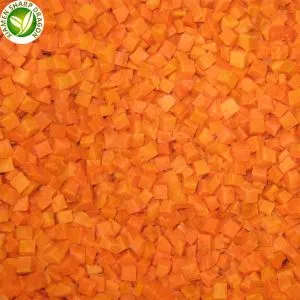
Match the cut to the heat process. Small dice distribute evenly and cook quickly in soup, fried rice, fillings, and prepared meals. Standard rounds are familiar in sides and stews. Crinkle cuts offer more visual texture but have thin ridges that soften quickly. Flower cuts can support a premium or child-friendly presentation. The current XMSD IQF frozen carrot range includes dice, slices, strips, crinkle cuts, and customized formats.

Read the Label and Handle the Product Correctly
Plain carrots and prepared carrot dishes should not be evaluated as if they were the same product. Start with the ingredient statement. A bag containing only carrots gives the cook control over salt, sugar, and fat. A glazed, buttered, or seasoned product may still fit a menu, but its nutrition information, allergens, portion size, and preparation directions need review as a complete formulation.
Freezing controls growth; it is not sterilization. The USDA Food Safety and Inspection Service explains that microbes can become active again after thawing. Keep the product frozen as specified, protect the package, prevent cross-contamination, and use the cooking or handling directions supplied for that product. If a carton arrives partly thawed, heavily clumped, wet, damaged, or warmer than the contractual limit, record the evidence and apply the buyer's receiving procedure rather than judging safety from appearance alone.
Repeated temperature changes can also reduce quality. Research on repeated carrot freezing and thawing found changes in mechanical and structural properties. In practice, excessive frost, fused pieces, dehydrated surfaces, and damaged cuts can signal weak drainage, package failure, or temperature fluctuation. These signs do not by themselves identify the cause, so receiving records, temperatures, packaging condition, and batch traceability should be checked together.
Do not use color alone as a safety test. Normal carrot color can vary with variety, maturity, blanching, lighting, and storage, while a microbiological hazard may not be visible. Commercial acceptance should combine sensory review with the agreed specification, supplier controls, relevant test records, package integrity, and receiving temperature. If the buyer's use is ready-to-eat rather than cook-before-eating, that difference must be declared and validated explicitly; it should never be assumed from the word "frozen."

How to Check Frozen Carrots Before Ordering
Three perspectives change your approval decision. If you lead product development, the carrot must survive the recipe and heat process. If you own quality approval, you need measurable limits, traceability, and evidence that the lot conforms. If you run operations, you need a free-flowing ingredient that stores, portions, and feeds through equipment predictably. A strong specification connects all three; a weak one describes only appearance.
Price per kilogram should therefore be reviewed with usable yield and process cost. A lower-priced lot can become expensive if it contains more broken pieces, creates excessive water release, requires manual separation, misses portion weights, or produces an unacceptable cooked texture. The following sequence turns a broad sourcing question into a repeatable approval process.
1. Define the application before the cut
Start with the finished dish, heating method, target bite, visible presentation, portion weight, and manufacturing line. The same carrot will behave differently as an 8 mm dice in fried rice, a round in soup, a strip in a stir-fry, or a crinkle cut in a retail side dish. Define size tolerance and cut geometry in measurable terms instead of ordering only "frozen carrot."
2. Inspect the frozen sample and the cooked sample
Review color uniformity, cut consistency, broken pieces, peel or crown residue, black or discolored pieces, foreign material, surface frost, ice, and free-flowing condition. Then cook the sample in the real product or a controlled pilot formula. Record cooked yield, texture, color, flavor, water release, piece integrity, and performance after the intended hold or reheat step. A visually attractive frozen sample can still fail after cooking.
Worked example: turn a kitchen trial into an approval decision
Suppose you test two 10-kilogram frozen carrot samples in the same ready-meal formula. Candidate A gives 9.3 kilograms of usable pieces after frozen inspection and 8.6 kilograms after the defined cook-and-hold cycle. Candidate B gives 9.6 kilograms after inspection and 9.0 kilograms after cooking. Candidate B has the higher recorded yield, but your panel finds it too soft after a 20-minute hot hold. Candidate A remains within the target bite and keeps more visible piece definition.
The decision depends on the product. For a visible vegetable side, Candidate A may be the better fit despite lower yield. For a soup where softness is acceptable, Candidate B may offer better recovery. Record the cut dimensions, sample condition, exact cooking time and temperature, hold time, weighing basis, panel method, and acceptance limits. Then repeat the trial with representative production lots before final approval. The result is a defensible application decision, not a claim that either candidate is universally higher quality.
3. Lock the acceptance standard
The purchase specification should identify ingredient, cut and size tolerance, blanching or intended-use status, sensory targets, permitted defects, microbiological and residue requirements, net weight, pack format, storage temperature, shelf life, coding, documents, and destination-market requirements. Regulatory and customer standards differ by market, so confirm the current requirements for the importing country and sales channel.
4. Test packaging and cold-chain fit
A retail pouch, foodservice bag, and industrial liner solve different handling problems. Confirm bag weight, film performance, seal quality, case dimensions, pallet pattern, labeling, and expected handling at the destination. Review our frozen food packaging options when the project needs bulk, foodservice, or private-label formats.
5. Approve the supply plan, not only one sample
Confirm crop window, inventory plan, order quantity, production timing, loading plan, inspection method, change control, and repeat-order tolerances. If you work across retail, foodservice, and manufacturing, compare the relevant XMSD frozen food solutions before fixing one specification for every channel.
Need a frozen carrot specification for your application?
Tell us the cut, cooking process, pack format, destination market, and expected volume. We can discuss a sample and the quality points that should be locked before an order.
Final Answer
Frozen carrots are good when they are plain, properly processed, kept under a stable cold chain, and used in an application that suits their softer cooked texture. They remain a practical source of vegetables, fiber, and provitamin A carotenoids. Fresh carrots are not automatically more nutritious in every real-world comparison, and frozen carrots are not nutritionally identical to fresh ones in every case.
For home use, check the ingredient list and follow the cooking directions. If you buy for foodservice, retail, or manufacturing, ask whether the carrot cut, blanching, frozen condition, cooked performance, defect tolerance, packaging, documents, and supply plan fit your finished product. Approve against a written specification and a representative cooked trial, then keep the same measurements for repeat lots. That evidence is more reliable than a broad claim that freezing either destroys or perfectly preserves the carrot.
References
- USDA MyPlate: Vegetable Group
- NIH Office of Dietary Supplements: Vitamin A and Carotenoids
- MedlinePlus: Foods - Fresh vs. Frozen or Canned
- USDA FSIS: Freezing and Food Safety
- Paciulli et al.: Effect of Different Cooking Methods on Industrially Frozen Carrots
- Ghavami et al.: Food Preparation and Carrot Carotenoid Bioavailability
- Wu et al.: Carrot Properties after Multiple Freezing and Thawing
- Stahl et al.: Quality Assessment of Processed Carrot Raw Materials