


Freeze-Dried Fruit Antioxidants: What the Evidence Means
Mar 30, 2020

Plain freeze-dried fruit can be a useful way to include fruit in snacks, cereals and other foods. It still needs to be judged as food, not as a treatment. A high antioxidant result on a laboratory report tells you something about the tested sample under that method. It does not tell you that a bag of fruit will prevent disease, improve memory or make someone lose weight.
The useful distinction is between what is in the fruit, how it behaves in an analytical test, and what happens when people eat a defined amount. Those are related questions, but they require different evidence. Drying also changes the weight and volume of a serving, so a fresh-versus-dried comparison can be misleading before any health interpretation begins.
For everyday use, start with the ingredient list and the quantity you will actually eat. For product development, add the fruit form, its behavior in the recipe and a report that matches the supplied material. The strongest antioxidant headline is rarely enough to choose between a whole strawberry, a raspberry crumble and a sweetened fruit snack.

Antioxidants describe a role, not a complete food rating
Antioxidants are not one ingredient with one effect. The body has its own systems for managing reactive substances, including antioxidant enzymes. Foods contribute a mixture of nutrients and other compounds. NCCIH explains that these substances differ and that larger amounts of isolated antioxidants are not automatically more beneficial. A fruit ingredient and a high-dose supplement therefore belong in different conversations.
A familiar food example is vitamin C. NIH lists 49 mg in half a cup of fresh, sliced strawberries. Vitamin C has established roles in collagen formation and helps the absorption of nonheme iron, alongside its antioxidant function. That is a useful description of a defined fresh food. It is not a specification for half a cup of freeze-dried strawberries, whose water content and packing density are different.
If a dry product is being chosen specifically for vitamin C, use its own relevant composition information. Assess color and crispness separately as eating-quality attributes. A vitamin analysis measures a particular nutrient; a total antioxidant result summarizes a response in a different test. Keeping those two requests separate gives the laboratory and supplier a question they can actually answer.
This also makes shopping simpler. You do not need to maximize a laboratory score to make a reasonable food choice. Decide whether the fruit fits a varied meal pattern, has the ingredients you want and comes in a portion that works for you. Its flavor and convenience matter because an ingredient that remains unused contributes nothing to the meal.
What an antioxidant laboratory test actually measures
Reports may contain abbreviations such as DPPH, FRAP or ORAC. They refer to different analytical approaches, not interchangeable health units. Some tests observe a reaction with a chemical probe; others assess reducing activity or the handling of particular radicals. Reviews of antioxidant methods explain why the chemistry, purpose and limitations of the chosen method matter.
For a practical comparison, request the method name, units, sample identity and reporting basis together. A number per gram of dry material is different from a number per gram of extract. A report on a concentrated extract is also different from one on the fruit pieces that will enter a cereal. Copying the biggest value into a buying decision without those details can reverse the apparent ranking.
The laboratory result can still be useful. It may help compare closely matched samples or investigate how a process changes a defined analytical property. Keep the work within that purpose. If the actual question is whether a fruit topping tastes stale after storage, sensory and product-stability checks answer a more direct question than an unrelated antioxidant assay.
| Evidence | Useful question | Keep separate |
|---|---|---|
| Nutrient analysis | How much of a named nutrient is present? | An individual's response |
| Antioxidant assay | How does this sample respond in this test? | A disease outcome |
| Human feeding trial | What changed with the studied food and intake? | Every fruit, dose or consumer |
Human berry studies give narrower answers than broad claims
Some human studies use defined portions of freeze-dried fruit powder. To interpret the finding, keep the fruit species, dose, comparison food, participant group and measured outcome together. A powder study is most informative when the material and use being discussed match those details.
A 2013 randomized, double-blind trial included 36 adults with type 2 diabetes. It compared a daily beverage containing 50 g of freeze-dried strawberry powder with a matched placebo for six weeks. The abstract reports improvements in selected measures, including total antioxidant status, but no significant change in serum glucose concentrations or body measurements. The appropriate conclusion is about those measured responses in that trial, not a recommendation to replace diabetes treatment with fruit powder.
A separate 2021 placebo-controlled blueberry study analyzed 49 participants after eight weeks of 50 g of powder daily. It examined conventional cardiometabolic measures as well as exploratory biological pathways. Traditional cardiometabolic outcomes did not significantly improve between treatments. Interesting molecular observations and an absent effect on the main clinical measurements can both be true.
Read a claim with the same discipline you would use for an ingredient specification. Which fruit was tested? Was it a powder, whole food or extract? How much was consumed, for how long, and by whom? Most importantly, was the headline about a laboratory marker or about a health event that people experienced? These questions prevent a modest finding from becoming a universal promise.
Drying can preserve useful compounds without preserving everything
Freeze-drying removes water from frozen food under reduced pressure. Its relatively gentle drying conditions can help protect heat-sensitive quality compared with some alternatives, but the outcome still changes with the food and processing conditions. The method name alone is not a retention percentage. IFT describes both the quality advantages and the practical limitations of the process.
A study of raspberries compared freeze-drying with microwave-vacuum, hot-air and combined drying. The researchers found losses in measured polyphenols, anthocyanins and antioxidant activity after dehydration. Different methods performed differently for particular compounds. This is a useful reminder that a drying method can retain a characteristic relatively well without retaining all of it. The experiment's measurements belong to those materials and conditions, not to every commercial raspberry product.
For us, a meaningful ingredient comparison begins by holding the raw-material and product-form questions steady. Comparing a whole dried strawberry with a finely milled raspberry powder changes more than the drying method. Start with the fruit identity, then the form and any added ingredients, before asking how the processing route affected a particular quality attribute.
The freeze-dried fruit range illustrates why the category needs that extra description. Whole pieces, slices and crumbles can solve different food-use problems. Choosing a suitable form is a separate decision from evaluating an antioxidant statement, and neither decision should be made from the category name alone.

Compare portions before comparing concentration
Removing water makes a food lighter. Consequently, the composition per 100 g of dry fruit can look very different from the composition per 100 g of fresh fruit. Those are equal weights, not necessarily equal amounts of starting fruit. A large numerical difference can reflect concentration as well as changes during processing.
Use a comparison that matches the decision. For dietary use, compare the portions actually eaten. For process evaluation, compare equivalent starting material or a clearly stated dry-matter basis. For a finished recipe, calculate the amount of fruit supplied by one serving. Switching between these bases halfway through a calculation makes an attractive but unreliable story.
Suppose a product label hypothetically lists 4 g of fiber per 25 g serving. A 10 g portion would contribute 4 × 10 ÷ 25 = 1.6 g of fiber. This is a label-reading calculation, not a published composition value for XMSD fruit. Use the actual label rather than assuming every dry fruit has the same fiber concentration.
Volume needs care as well. A cup of whole hollow-looking pieces can contain a different mass from a cup of small crumbs. For a repeat recipe, weigh the ingredient during development and record the intended portion. A convenient scoop can be selected afterwards, once its normal filled weight has been checked with the actual product.
Worked example: a higher assay value can give a smaller inclusion
Take a cereal developer comparing two hypothetical fruit ingredients tested by the same laboratory with the same method and reporting basis. Ingredient A reports 120 analytical units per gram and is used at 8 g per serving. Ingredient B reports 160 units per gram but is used at 4 g per serving because of its stronger flavor. The figures are invented solely to show the arithmetic, not to represent a real report or an acceptable specification.
The simple contribution calculation gives A: 120 × 8 = 960 analytical units per serving; B: 160 × 4 = 640. B has the larger number per gram, yet A contributes more of that measured quantity at the proposed inclusion level. The calculation is an initial comparison of defined inputs. It is not an absorbed antioxidant dose or a prediction of health benefit.
Even this analytical estimate needs the recipe context. Mixing, heating, other ingredients and the test method used on the finished cereal may change the result. If the final product needs a substantiated analytical value, test the final product using a suitable method instead of treating ingredient multiplication as the finished-food measurement.
The immediate decision is still useful: compare the real serving, then evaluate flavor, distribution and eating quality at that serving. A formula chosen only for the highest raw-ingredient number may put too little fruit into the bowl to achieve the intended appearance or taste. Keep the calculation beside the recipe sheet so the commercial and technical discussions use the same quantity.

Plain fruit, coated snacks and extracts are different purchases
A one-ingredient fruit product gives a relatively straightforward starting point. A yogurt-coated piece, chocolate-coated bite, sweetened powder or mixed snack introduces other ingredients that need their own assessment. Describe the complete snack, including its coating or base, rather than treating the fruit component as the whole product.
In the US Nutrition Facts format, added sugars are included within total sugars; they are not extra grams to add on top of the total. FDA also distinguishes sugars added during processing from those naturally present in foods such as fruit. Read the ingredient list alongside the panel, then compare the portion you intend to eat. Include any sugar and oil from the entire recipe in that comparison.
Extracts deserve a separate check. A standardized fruit extract can have a different composition from whole-fruit powder. Identify what was removed, concentrated or added, then establish whether the material in the research matches the purchased ingredient. A fruit species name is only the first part of that match.
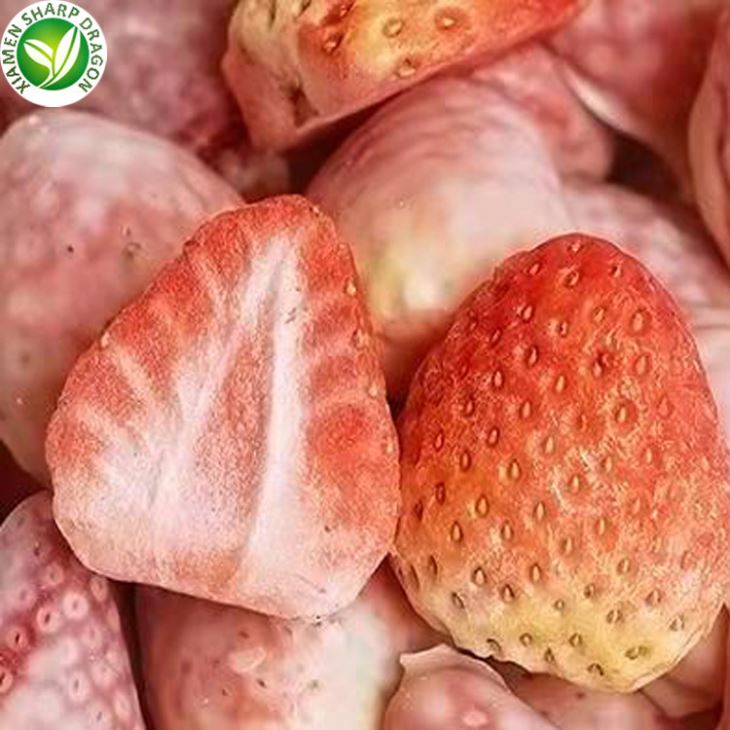
With whole, sliced or cubed freeze-dried strawberries, the useful starting description is the form and ingredient composition. After that, decide whether the intended role is a visible topping, a distributed inclusion or a powdered flavor component. That description helps a reader understand the food without dressing an ordinary snack in clinical language.
Practical example: evaluate a chocolate-coated fruit snack
Suppose a retail developer makes an illustrative snack from 40 g of plain freeze-dried strawberry and 60 g of chocolate coating. Assuming an even coating and no processing loss, fruit makes up 40% of the 100 g finished snack. A 20 g serving therefore contains 8 g of the original dry fruit, alongside 12 g of coating. These are recipe assumptions, not an XMSD product specification.
For this application, we would compare whole pieces and larger fragments during the actual coating trial. The decision is about the finished bite: fruit-to-coating balance, broken pieces and recognizable fruit inside the coating. A delicate slice that looks attractive on a plate may break during the proposed mixing operation. Changing to a suitable fragment can be a practical choice when a whole-fruit presentation is unnecessary.
Keep the fruit report in the ingredient file, and assess nutrition and any proposed consumer statement for the complete coated snack. Sample different pieces and portions because the coating may not be distributed perfectly in practice. Record the actual recipe and finished weights before preparing the label information. The development goal is a repeatable fruit-to-coating balance, not an assumed health advantage from the uncoated ingredient's analytical result.
If a dessert instead needs a soft fruit filling or sauce, consider a suitable ingredient from the frozen strawberry options. That change calls for a different recipe and preparation method, including any required cooking. A dry ingredient's coating performance tells you little about the performance of a thawed or cooked filling with a different water content.

Ask for a report that belongs to the material you will use
Before spending more on an antioxidant positioning idea, match the report to the ingredient. The product name, lot or sampling reference, testing date, method and unit should describe the material under consideration. Separate any background papers or historical reports from the records identifying the sample on your bench, so the basis of each comparison stays visible.
We would keep that analytical comparison separate from the form assessment. Whole pieces may be attractive on a dessert yet break during mixing. Crumbles may distribute well but create more fine material than the recipe tolerates. The useful acceptance question is whether the product performs at the agreed inclusion and handling method, not whether every piece looks identical in a promotional photograph.
This matters especially in food-manufacturing applications, where the ingredient may pass through mixing, portioning and packing before the consumer sees it. Evaluate a representative sample using those operations. Record the intended fruit percentage, the handling that causes breakage and which changes are acceptable in the final food.
If a health-related statement is being considered for packaging, have it assessed for the destination and exact wording before artwork is approved. A technically valid laboratory report and a permitted consumer statement are separate requirements. Resolving that distinction early avoids building the pack concept around evidence that answers a different question.

Keep quality, safety and health claims separate after opening
Freeze-dried food readily takes up moisture, so the package and the way it is used after opening matter. UMN advises prompt, suitable moisture-resistant packaging and explains that freeze-drying is not a reliable microbial kill step. A dry texture is a quality observation, not proof that an ingredient is ready to eat. Use a product made and controlled for its intended use.
For a small kitchen or portioning operation, choose a pack size that fits the expected use rate. Repeatedly opening a large bag exposes more product than opening a smaller inner pack when needed. Keep utensils dry, close the container promptly and follow the supplier's storage instructions. Once fruit is mixed into a wet dish, manage that dish under its own storage and handling requirements.
There is no need to turn a normal fruit choice into a search for a therapeutic dose. If you have a fruit allergy, a prescribed diet or a condition requiring carbohydrate management, select the product and portion with appropriate professional guidance. Keep those existing requirements central when comparing ordinary snacks, powders and mixed foods.

The most useful outcome is a fruit product you can describe plainly: which fruit it contains, how it was prepared, how much goes into a serving, and what it contributes to the food you actually eat. Analytical data can support that description when it is relevant. It should never be asked to stand in for the whole decision.
For an ingredient comparison, send the fruit type, desired form, serving quantity and intended recipe through our fruit application inquiry. Include any analytical requirement so the sample discussion starts on a matching basis.
References
- NCCIH: Antioxidant Supplements: What You Need To Know
- NIH Office of Dietary Supplements: Vitamin C
- Amorati and Valgimigli: Advantages and limitations of common testing methods for antioxidants
- Moazen et al.: Freeze-dried strawberry supplementation in adults with type 2 diabetes
- An 8-week freeze-dried blueberry supplement impacts immune-related pathways: randomized placebo-controlled trial
- Mejia-Meza et al.: Effect of dehydration on raspberries
- IFT: Freeze-Drying Fundamentals
- FDA: Added Sugars on the Nutrition Facts Label
- University of Minnesota Extension: Preserving food at home: Freeze-drying