


Vacuum Frying: Separate Water Loss, Moisture and Product Yield
Apr 24, 2020

Vacuum frying removes water from produce while oil and heat change its structure. A lighter finished batch therefore does not tell you, by itself, how much water evaporated or whether every piece reached an acceptable endpoint. Read three different results: moisture content for the amount of water remaining, water activity for its availability, and yield for the mass recovered at a defined processing stage.
Keep texture alongside those measurements. A low moisture result cannot establish that an apple slice has a pleasant bite, that an okra piece remains intact or that a packed snack will stay acceptable throughout its proposed shelf life. The useful endpoint combines measured product properties with the eating quality and handling performance required for the application.
For a purchasing or production review, start with the material entering the fryer and finish with the accepted, packed product. Record what changed between those points. Water removal, oil uptake, seasoning additions and rejected pieces affect the mass calculation in different ways. Separating them makes a process comparison much more useful than describing one batch as simply "drier" or "higher yield."

Why losing batch weight does not measure water loss
The scale measures everything present, including water, native food solids, retained oil and any additions made before weighing. During frying, water can leave while oil enters. Pieces may also be lost during draining, transfer or sorting. A change in total mass combines those movements; it does not identify each one separately.
Choose a weighing boundary before doing the arithmetic. Whole incoming vegetables, washed and trimmed produce, drained slices and finished seasoned crisps are different starting or ending materials. Comparing a prepared-slice yield with a whole-crop yield makes the process look different even when the equipment produces exactly the same result.
In an XMSD sample comparison, we would keep the prepared input, recovered fried product and accepted saleable output as separate entries. That preserves the distinction between drying performance and commercial recovery. A process that removes water efficiently but breaks too many pieces may be unsuitable for a whole-slice retail pack, even when the fragments remain useful elsewhere.
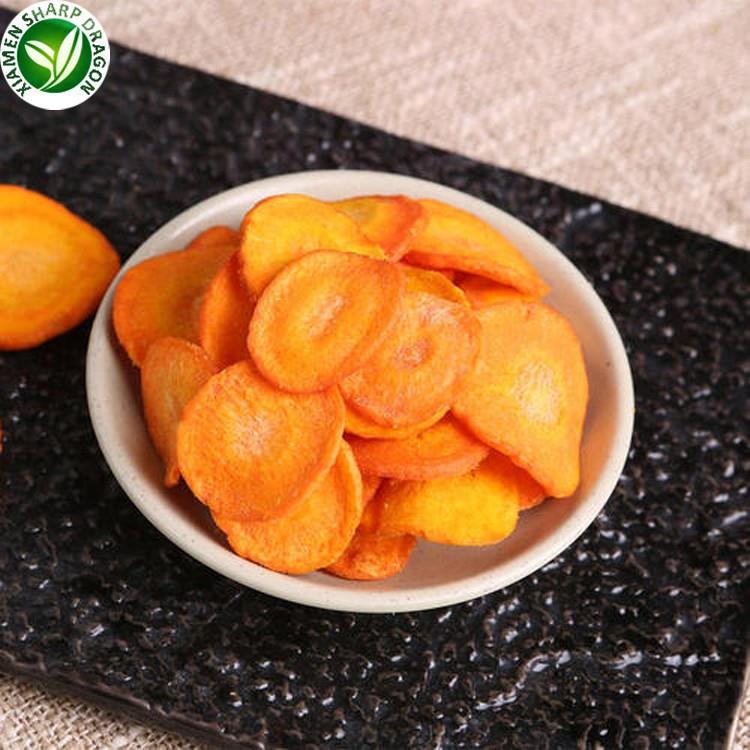
The closest product form matters here. Our vacuum-fried fruit and vegetable range includes visibly different structures, so a weight result needs the ingredient and cut beside it. The photographs in this article illustrate product forms; they are not measurements of moisture, water activity or frying performance.

A worked example: water removal and oil uptake move together
Consider a hypothetical prepared batch weighing 100 kg. For this simplified calculation, it contains 80 kg of water and 20 kg of other solids. Assume frying removes 79 kg of water, the product retains 4 kg of added oil, and no other material is lost or added before the final weighing. These are illustrative inputs, not a production specification.
The recovered product weighs 25 kg: 20 kg of original non-water solids, 1 kg of remaining water and 4 kg of retained oil. The scale shows a net loss of 75 kg. However, the water removed is 79 kg. Oil entering the product explains the 4 kg difference between those two results.
On a wet-weight basis, the finished moisture content is 1 divided by 25, multiplied by 100: 4%. The recovered mass yield is 25 divided by 100, multiplied by 100: 25%. Those percentages answer different questions. Neither establishes water activity, an acceptable sensory result or a validated shelf life.
Now suppose sorting leaves 22 kg suitable for the intended whole-piece pack. Saleable recovery is 22% of prepared input, while the sorting acceptance rate is 88% of the recovered fried output. Record the 3 kg difference and its disposition. It could include pieces unsuitable for this pack without being evidence that an extra 3 kg of water evaporated.
The decision is to compare quotations and trials on the same saleable-output basis while retaining the separate process figures. Otherwise, a promising gross yield can hide a costly sorting loss. In a real balance, include measured material losses, additions and uncertainty instead of forcing every unexplained difference into the water column.
Moisture content needs a declared reporting basis
Moisture content expresses how much water is present relative to a specified mass. Wet-basis reporting uses the mass of the water-containing sample as the denominator. Dry-basis reporting relates water to dry matter. A percentage without its basis can therefore be misleading, especially when reports from different laboratories or research papers are placed side by side.
For a finished snack, retain the laboratory method, sample description and units with the result. Ask whether the tested material was unseasoned product, seasoned product, a ground composite or selected pieces. Oil, coatings and the distribution of different ingredients can change what a small sample represents.
Do not calculate moisture from the difference between incoming and finished batch weights unless a suitable material balance supports that calculation. The worked example shows why retained oil matters. Trimming losses, syrup treatments, added salt and fragments left in equipment create further differences that a simple before-and-after scale reading cannot resolve.
A report can be precise without being representative. Several measurements of the same finely mixed sample describe that sample well but may miss a few unusually thick or wet pieces elsewhere in the batch. Agree the sampling approach before comparing numerical results, and retain enough detail to repeat the test meaningfully.

Water activity answers a separate question
Water activity describes the availability of water in a food rather than its total quantity. The FDA's technical explanation defines it through the equilibrium vapor pressure of the food relative to pure water at the same temperature. Ingredients that bind water help explain why two foods with similar moisture contents can have different water activities.
You cannot reliably convert a moisture percentage into water activity using one universal formula for all fruit and vegetable crisps. Composition and structure matter. A relationship established for one formulation and measurement condition is not automatically transferable to another ingredient, coating or maturity level.
Request the water activity result together with the measurement temperature, sample preparation and laboratory procedure. Temperature control and allowing the measurement to reach the required equilibrium are part of obtaining a meaningful result. A number copied without that context is a weak basis for judging a small difference between samples.
Water activity contributes to food stability assessment, but a single reading is not a complete safety or shelf-life decision. The product's hazards, process controls, packaging and storage conditions still need their own evaluation. In particular, do not use a low reading to imply that a snack has been sterilized or that every quality change has stopped.
For this article's practical purpose, the distinction is straightforward: measure moisture to describe remaining water and measure water activity to assess a different property of that water. Use the appropriate expertise to establish product-specific acceptance limits rather than borrowing a threshold from an unrelated snack.
Raw material can change the drying pattern
A 2020 study of vacuum-fried Kent mango compared ripe and unripe material and followed moisture, fat and other quality properties. The reported water loss was faster in the unripe mango under the study conditions. This supports checking maturity when interpreting a trial; it does not provide a universal frying schedule for every mango or other fruit.
The same study described a rapid initial decrease in moisture followed by a more gradual stage. That distinction matters when assessing an endpoint: an early visible change does not establish how the later part of the process behaves. Avoid treating the average water removal over an entire run as a constant rate that applies at every moment.
Record the variety or supplied ingredient identity, maturity description, preparation, slice dimensions and starting condition. If a trial changes both the raw material and the cooking schedule, its results cannot cleanly identify which change caused a different endpoint. The information may still support product selection, but it is weaker evidence for a specific process adjustment.
We would ask for another comparable sample before treating a single unusually crisp batch as the new reference. The useful question is whether the agreed raw-material range produces acceptable results repeatedly. That is more relevant to supply continuity than choosing the most attractive piece from one demonstration.
A second example: the same timer gives different samples
Imagine a hypothetical retail apple-crisp project receiving two prepared lots with visibly different maturity and a slightly different distribution of slice thickness. Both trials run for the same recorded time. One sample breaks cleanly; the other includes a small group of pieces with a noticeably tougher center. No numerical moisture limit has yet been agreed.
The immediate trade-off is between extending the process for every piece and finding out whether the inconsistent pieces arise from the material distribution. Extending the run might improve some centers while changing the color or fragility of the rest. Releasing the batch because its average appearance looks acceptable would leave the original uncertainty unresolved.
The trial team separates representative normal and suspect pieces, records their locations and thicknesses, and requests comparable moisture and water activity measurements. It also repeats the texture assessment under the same sample handling conditions, retaining the records for each lot separately so that the next comparison can address the observed difference.
The comparison determines what to test next. If the suspect pieces differ consistently, review preparation tolerances and the process window before repeating the trial. If the analytical and sensory evidence does not align, investigate sampling and measurement conditions instead of changing the timer on intuition alone.
Only a subsequent acceptable trial supports the revised approach. The example illustrates why a time record is useful evidence of what happened, while measured finished-product properties and representative sampling are needed to judge what was achieved.

The driest result may not be the preferred snack
A 2023 vacuum-fried asparagus study reported moisture content, water activity and yield separately and also assessed texture and other quality attributes. The selected condition was not simply the treatment with the lowest moisture result. Its relevance is the multi-property comparison within that experiment, not a transferable specification for commercial apple, banana or okra crisps.
Dryness and a desirable bite are not interchangeable descriptions. A piece may be hard, fragile, hollow, tough or pleasantly crisp, and different applications tolerate those properties differently. Describe what happens during eating and handling instead of assigning every unfavorable result to "too much moisture."
For a whole-piece retail snack, include the proportion of acceptable pieces after normal packing and transport simulation in the review. For a topping, assess the intended serving conditions and the time between application and consumption. A dry crisp placed on a moist food may behave differently from the same piece eaten directly from its pouch.
Instrumental texture results also need their test method. Breaking force, probe geometry, sample orientation and piece dimensions affect interpretation. Compare like with like, and pair the instrumental result with a clearly described sensory assessment. A smaller numerical force does not automatically mean the better commercial product.
Our preferred product discussion starts with the required eating experience and works back to measurements that can help control it. We would not promise a universal moisture figure for all cuts. An acceptance range becomes useful when it is linked to a defined product and evidence that the chosen range supports its intended use.

Sample after a defined finishing stage
Decide whether results refer to product immediately after frying, after de-oiling and cooling, after seasoning or after packing. Those stages are not interchangeable. A comparison made at different stages can create an apparent process difference that actually comes from sample handling or a later addition.
Oil deserves its own record. The discussion of assessing oil and de-oiling results explains why reporting basis matters for that measurement too. Keep the oil result alongside the moisture result rather than using one as a substitute for the other.
Identify samples so that the ingredient lot, trial conditions, collection stage and testing request remain connected. Note unusual exposure before sealing or testing. A retained sample without a reliable history can help show appearance, but it is less useful for resolving a disagreement about the original endpoint.
Do not combine every piece into one average before deciding what variation needs investigation. Where the concern is inconsistent centers or a difference between ingredients in a mix, preserve separate samples as well as any planned composite. That allows the laboratory and product review to address the actual question.
Packaging and storage can change the later result
An acceptable fresh sample establishes its condition at that assessment, not its condition months later. Moisture exchange through the package or an imperfect seal can change a crisp product during storage. The relevant evaluation uses the actual food, pack construction, seals and foreseeable storage conditions together.
Nitrogen filling is a separate packaging variable; it does not replace the assessment of moisture protection or prove a shelf life. Our guide to checking nitrogen packaging for crisps separates the gas result from the wider package and product performance questions.
Retain a fresh reference and compare stored samples using a planned schedule and consistent assessment conditions. Follow the properties that matter to the product, including eating quality and any relevant analytical indicators. Assign shelf life through an appropriate validation process rather than extending a date because the original moisture result looked low.
For mixed products, consider whether different components remain acceptable together in the proposed package. A result from a single ingredient does not establish the behavior of a blend. Test the actual mixture and proportions intended for sale, especially when the ingredients begin with noticeably different textures.

What to request in the next trial report
Ask for a connected record: prepared input mass and condition, process identification, recovered mass, accepted output, moisture basis, water activity measurement conditions and texture observations. Include additions and losses that explain the material balance. This makes the report interpretable without relying on someone's memory of the demonstration.
For a comparison of process settings, hold the other relevant inputs consistent or clearly identify the differences. The guide to planning vacuum-frying trials develops that comparison approach. Check that the trial question is narrow enough for the available measurements to answer.
Review discrepancies before ranking the results. A high yield accompanied by an unexplained mass balance, mixed sampling stages or missing reporting units needs clarification. A lower yield may be commercially acceptable if it consistently delivers more usable product in the required format, but that judgment needs the accepted-output calculation.
Specify how close to an acceptance boundary the evidence can reasonably support a decision. A rounded result at the limit, inconsistent repeat measurements or a sample with uncertain history deserves review with the laboratory and the person responsible for release. Adding more decimal places to a spreadsheet does not improve the underlying sampling or measurement. Record the agreed response to borderline results before routine deliveries begin, so that a disagreement does not turn into an improvised change of specification.
Keep gross product recovery and commercial recovery visible when comparing costs. Include the preparation stage used as the denominator and identify whether acceptable fragments have a separate use. If one proposal counts all fragments as saleable and another counts only intact pieces, reconcile that difference before deciding which process is more economical. The comparison should reflect your intended product, rather than the most favorable definition available for each trial.
Finish with a written decision: accept the tested product for the defined next step, repeat a specific comparison or investigate an identified problem. Keep the raw data and the retained-sample details with that decision. Water loss, moisture, water activity and yield become useful when they explain the product you can actually use.
For an XMSD product review, send the ingredient, preferred cut and intended application, together with the sampling stage, reporting basis and product properties you need to compare.