


Water Chestnut Fibre in Recipes: Contribution and Claim Checks
Jul 18, 2023

Water chestnuts contribute dietary fibre to a recipe, but their presence alone does not make a finished dumpling, vegetable mix or ready meal a source of fibre. The useful calculation starts with the amount actually incorporated, the fibre value appropriate to that ingredient and the weight of the finished food. A claim then needs a separate check against the rules for the market where that food will be sold.
For an initial reference, USDA's SR Legacy record for raw Chinese water chestnuts lists 3.0 g of total dietary fibre per 100 g of edible food. At a hypothetical 15% inclusion, that would contribute 0.45 g per 100 g of an unchanged-weight recipe before counting other ingredients. It is a screening calculation, not a tested value for frozen or canned water chestnuts, and not a finished-product label declaration.
Keep the two buying decisions separate: select water chestnuts for the bite and appearance your application needs, then establish whether the whole formula supports the intended nutrition wording. The distinction matters most when marketing has already requested a fibre claim. Increasing the amount of a crunchy ingredient may change the eating quality well before it supplies the additional fibre the claim requires.

Start with the food that will carry the claim
A water chestnut ingredient specification, a filling specification and a retail dumpling label describe different foods. The ingredient may account for only part of the filling, while the filling accounts for only part of the dumpling. A sauce or wrapper changes the composition again. Write the name and preparation state of the food being assessed at the top of the calculation before entering any nutrient figures.
For a food processor, the first question is usually whether a proposed inclusion level makes a meaningful contribution to the recipe target. A private-label buyer needs a further answer: which wording could be supported on the specific product offered to consumers? The ingredient buyer can help with the first question by obtaining a suitable product record. The second belongs with the team responsible for the complete recipe and destination-market label review.
A practical brief therefore says more than "high-fibre water chestnuts wanted." Describe the finished food, its intended market, the water chestnut form and the proposed inclusion.
If there is no nutrition claim planned, say that too. Fibre can still be accounted for in the nutrition declaration without turning a texture ingredient into the main nutritional selling point.
What the raw reference value can tell you
The USDA reference used here is "Waterchestnuts, chinese, (matai), raw," FDC ID 170066, from SR Legacy. Its 3.0 g fibre value uses a 100 g edible-food basis. It is historical reference data currently available through FoodData Central, not a new analysis of an XMSD lot. Keep that identity attached to the number wherever it appears in an early formulation worksheet.
Use the reference to estimate the scale of a contribution and decide whether further development is worthwhile. Replace it with an appropriate, supported value for the actual supplied ingredient before final approval. A peeled frozen product, a canned drained ingredient and a raw reference entry should not silently share one nutrition specification. Their names may be close while the material being measured differs.
The differences between raw-food nutrition and supplied forms are discussed in our water chestnut nutrition and product-form guide. In recipe development, the ingredient value becomes useful only when combined with the amount incorporated. A generous nutrient figure for a standalone ingredient may still translate into a small contribution when that ingredient occupies a modest share of the recipe.

Calculate contribution before considering a claim
Work in grams or kilograms consistently. With an ingredient fibre value expressed in grams per 100 g, multiply the ingredient weight by that value divided by 100. The result is the fibre mass contributed by that ingredient. Sum the contributions from all relevant ingredients, then express the total against the finished-food weight on the basis being assessed.
There is a convenient shortcut when the formula totals 100 kg and processing leaves that weight unchanged: inclusion percentage multiplied by ingredient fibre per 100 g, divided by 100, gives that ingredient's contribution in grams per 100 g of recipe. The shortcut stops being reliable when the denominator changes. A filling that later becomes part of a wrapped product requires another calculation for the complete food.
The water chestnut contribution is not the recipe total. Other vegetables, cereal components or seasonings may add fibre, and some ingredients may add none. Account for the complete formula using suitable information rather than presenting a subtotal as the result for the whole product.
Show the ingredient subtotal and the full-recipe total on separate lines. This lets a colleague see both the water chestnut contribution and the figure needed for the complete food.
Example 1: Does more water chestnut solve a filling target?
Worked example: A hypothetical development team is preparing 100 kg of filling and comparing 15 kg with 20 kg of prepared frozen water chestnut dice. For an early screen only, it uses the USDA raw reference of 3.0 g fibre per 100 g. The calculation assumes no weight change or fibre loss and is not an XMSD product specification or a production trial result.
At 15 kg inclusion, the reference-based fibre contribution is 15,000 g × 3.0 / 100 = 450 g per batch. Across 100,000 g of filling, that is 0.45 g per 100 g. At 20 kg inclusion, the contribution becomes 600 g per batch, or 0.60 g per 100 g. Adding five percentage points of water chestnuts therefore adds only 0.15 g fibre per 100 g from that ingredient under these assumptions.
That is the gross increase before considering what the extra water chestnuts replace. If the displaced ingredient contributes fibre, the net increase is smaller; if it contributes more fibre at the replaced weight, the total could decrease. The team keeps the other ingredient values in the worksheet and compares complete formulas rather than assuming that more water chestnut always means more fibre overall.
The decision is to retain the inclusion that gives the preferred filling texture and develop the nutritional target across the whole recipe. Procurement requests actual ingredient data for the next calculation. The result of this illustrative screen is a better development brief: water chestnut inclusion is no longer being raised on the mistaken assumption that a small change will necessarily deliver a large fibre increase.
Check the substitution as well as the added ingredient
In a fixed-weight recipe, an addition usually displaces something. Replacing water changes fibre concentration differently from replacing another vegetable or a cereal ingredient. Record the ingredient removed, the amount removed and the replacement amount beside the proposed change. Otherwise, two teams can calculate different nutritional outcomes from the same instruction to "increase water chestnut."
We would keep the sensory trial and the nutrition calculation linked by one formula version. Record what was actually weighed and attach the corresponding ingredient specifications. A preferred sample prepared from one recipe is a poor basis for approving a nutrition calculation made from another, even when the difference looks minor on the ingredient list.
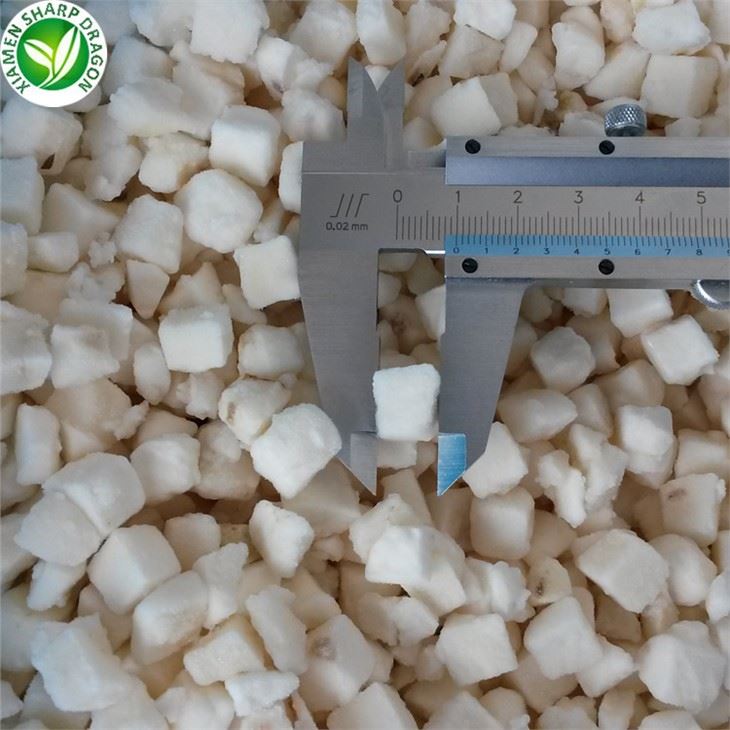
For a slice-based application, IQF sliced water chestnut provides a relevant starting point for the product discussion. Select the physical form for the intended application; ask for its supporting composition separately. A photograph can help identify the offered form, but it cannot establish dietary fibre concentration or support a nutrition claim.
Keep a short sensory decision with the calculation: acceptable bite, acceptable distribution and the inclusion actually chosen. This prevents a nutritional target from becoming an instruction to keep adding pieces regardless of product quality. If the claim is essential to the launch brief, the full formula may need redesign rather than a larger order of the same ingredient.

Changing from frozen to canned needs a new calculation
A substitution between frozen and canned water chestnuts should be assessed using the ingredient as it enters your recipe. If canned material is drained before weighing, record the drained input rather than the unopened can weight. If liquid is deliberately retained, include it in the formulation and use information consistent with that preparation. Neither approach should be inferred from a photograph or a pack size.
The supplier's nutrition record must describe the material used. Ask whether the value is for the contents as sold, the drained solids or another stated preparation. Our canned water chestnut product page is a separate route for discussing that form; it is not a reason to transfer the raw reference figure into a canned-product specification.
Treat the form change as a formula revision even if the recipe name stays the same. Recheck the incorporation weight, retained liquid and sensory result. The previous calculation belongs to the previous combination of ingredient and preparation.
EU fibre claims have two numerical routes
For an EU-focused assessment, the European Commission lists "source of fibre" at a minimum of 3 g fibre per 100 g or 1.5 g per 100 kcal. "High fibre" requires at least 6 g per 100 g or 3 g per 100 kcal. The word "or" matters: a food can meet an energy-based route without meeting the corresponding mass-based route.
| EU claim | Mass-based minimum | Alternative energy-based minimum |
|---|---|---|
| Source of fibre | 3 g fibre per 100 g | 1.5 g fibre per 100 kcal |
| High fibre | 6 g fibre per 100 g | 3 g fibre per 100 kcal |
Apply those checks to the food concerned, not to the water chestnut component alone. Under Article 5(3) of Regulation (EC) No 1924/2006, claims concern food ready for consumption according to the manufacturer's instructions. For the examples here, the finished meal is assessed on that basis. Other markets require their own review; the EU figures are not universal fibre-claim thresholds.
Passing a numerical screen is only one part of approving wording. The responsible reviewer still needs a substantiated composition, the correct product basis and compliance with the other applicable conditions. Use the table to decide which route needs examination, not as permission to print a claim. A proposal that fails one column should not be rejected before the alternative route has been checked.

Example 2: A meal below 3 g can pass the energy screen
Practical example: A hypothetical private-label team has a water-chestnut-containing meal with complete, assumed values of 2.5 g fibre and 150 kcal per 100 g of the food ready for consumption. These are illustrative whole-meal inputs, not measurements of an XMSD product or values derived from the first example. The team is considering the EU wording "source of fibre."
The meal falls below the 3 g per 100 g mass threshold. Its energy-based figure is 2.5 / 150 × 100 = approximately 1.67 g fibre per 100 kcal. That exceeds the 1.5 g energy threshold for the source claim. It does not meet the high-fibre screen: 2.5 is below 6 g per 100 g, and 1.67 is below 3 g per 100 kcal.
The action is to send the source-claim proposal, the complete composition and its supporting records for formal label review. The result is a candidate that passes one numerical route, not an approved retail claim.
Rejecting this meal solely because the per-100-g figure is below 3 would miss a relevant route. Calling it high fibre would overstate the calculation. The correct next step is review of the source claim.
Now suppose a reformulation raises energy to an illustrative 180 kcal per 100 g while fibre stays at 2.5 g. The energy result becomes approximately 1.39 g per 100 kcal, so neither source-claim route passes. The team reopens the wording decision. This sensitivity check shows why energy belongs in the same controlled calculation as fibre, rather than in a separate file updated after artwork approval.
Agree what the supplier record must support
For procurement, a useful request specifies total dietary fibre, units, the food state and the intended use of the information. Ask whether the value comes from analysis or calculation and which product it represents. The response needs to connect with the supplied item, not merely with a generic water chestnut description. It is easier to resolve that question before several departments start using different numbers.
If testing is part of the plan, the laboratory and label reviewer should agree the appropriate method and sample preparation for the destination and food. Do not silently substitute a figure described as crude fibre for total dietary fibre. A report with unfamiliar terminology needs interpretation before it enters the claim calculation; a smaller or larger number is not automatically the more appropriate one.
On our side of an ingredient discussion, we would ask what the customer needs the figure to decide. A preliminary recipe screen and a claim-bearing product launch are different requests. The first may start with a clearly identified reference. The second needs support tied to the actual product and complete food, with responsibility for approval assigned before a purchasing decision is mistaken for a label decision.
For food-processing applications, include the formula code and relevant preparation in the document request. That small amount of context helps keep sample, specification and recipe discussions aligned. A supplier can address the ingredient supplied; the finished-food owner must combine that information with the rest of the formula and the actual preparation basis.

Keep variation and formula changes visible
A claim decision should not rest on a best-looking sample or a conveniently rounded value. Discuss with the responsible technical reviewer how the available composition information represents the supplied food and how variation will be assessed. No single safety margin can be recommended for every ingredient, method and finished recipe. Agree the assessment using the actual data rather than adding an arbitrary buffer to the calculation.
Keep the underlying figures and calculation precision in the approval file. Rounding for presentation is a later step, not a way to turn a result below a threshold into a passing one. The same applies to changing the serving size: for the EU fibre routes above, an attractive portion figure does not replace the specified per-100-g or per-100-kcal checks.
A supplier change, a new water chestnut form, a different sauce, a wrapper revision or altered preparation instructions can all justify reopening the calculation. Ask whether the approved composition and food basis still describe what will be sold.
Record the reviewer and the effect on the selected claim route. An unchanged product name is no assurance that the composition behind the wording has stayed the same.
The purchasing consequence is straightforward. Do not treat two offers as nutritionally interchangeable just because both are described as water chestnuts. Compare their intended application and supporting product information, then assess any substitution within the actual recipe. A lower ingredient price is useful only if the replacement remains acceptable for the product brief, including any wording the brand intends to retain.
Release the formula and wording together
Before artwork is approved, assemble one identifiable version of the formula, the ingredient records used, the finished-food calculation and the proposed claim wording. Include the preparation state and destination market. The file should let another reviewer reproduce the decision without searching for an old spreadsheet or guessing whether a fibre value referred to raw, frozen or drained material.
In a private-label ingredient project, we would separate approval of the water chestnut sample from approval of the finished pack's nutrition wording. The sample decision answers whether the ingredient fits the product. The label decision covers the complete food and its market. Linking those decisions through the same specification version is more useful than asking one broad "approved?" question.

Keep the final outcome explicit: no fibre claim planned, a numerical candidate awaiting review, or wording approved by the responsible team for the identified product. Purchasing can then see when a proposed substitution needs further technical review before it proceeds.
Water chestnuts can remain the right ingredient even when a proposed fibre claim is unsuitable. Their role in the formula and the nutrition wording should each earn approval on their own terms. Calculate the contribution, assess the whole food and retain the product version behind the decision; then the buying brief can support both eating quality and a defensible label.
Send XMSD the water chestnut form, recipe application, destination market and product information your team needs. We can review the ingredient request while your technical team retains responsibility for the complete food and its label wording.
References
- USDA FoodData Central: SR Legacy April 2018 dataset - Waterchestnuts, chinese, (matai), raw; FDC 170066
- European Commission: Nutrition Claims - Source of Fibre and High Fibre
- Regulation (EC) No 1924/2006: Article 5(3), Article 6 and Annex; current consolidated text
- FAO: Food Energy, Chapter 2 - Methods of Food Analysis, dietary fibre methods
- XMSD operational judgment on ingredient selection, recipe versions and supplier-document requests. Both examples are illustrative, not customer histories. Raw reference data and assumed meal values are not XMSD product measurements or label approvals.