


King Oyster Mushroom Nutrition: Frozen Quality and Buyer Guide
Oct 08, 2023

King oyster mushroom, or Pleurotus eryngii, is a low-fat edible mushroom whose thick stem provides a firm, substantial bite. A current Japanese government food-composition entry for the raw mushroom reports 31 kcal, 90.2 g water, 2.8 g protein, 0.4 g fat, 6.0 g carbohydrate and 3.4 g dietary fiber per 100 g edible portion. Those figures answer a raw-food reference question; they do not automatically describe a frozen commercial lot, a cooked serving or a destination-market label.
For frozen sourcing, nutrition is only one decision layer. You also need the correct species, cut dimensions, pretreatment status, freezing form, water release, cooked texture, defect rules, packing and cold-chain evidence. We evaluate those variables together because a mushroom can have a sound reference nutrient profile yet deliver poor usable yield if slices vary widely, thaw water is excessive or the stem becomes rubbery after the real cooking step.
Direct answer: Use an authoritative raw king oyster mushroom table to understand the food, but use product-specific evidence for a frozen order. Approve the commercial item through species identity, frozen form, cut distribution, water release, cooked texture, usable yield and a nutrition-label basis that matches the actual product and destination.

Confirm the Species Before Comparing Nutrition
King oyster mushroom and king trumpet mushroom are common English names for Pleurotus eryngii. The Japanese food database calls the item "king oyster mushrooms, raw" and gives the same scientific name. That identity matters because ordinary oyster mushroom usually refers to Pleurotus ostreatus, while shiitake is Lentinula edodes. They are all edible mushrooms, but one species table cannot be silently transferred to another.
The physical identity is also useful commercially. King oyster mushrooms generally have a thick pale stem and a smaller brown cap. Their stem supports rounds, lengthwise slices, strips and dice that would not behave like a thin fan-shaped oyster cap. When you review the XMSD frozen mushroom range, keep the scientific name in the item description and do not rely on "oyster mushroom" alone.
Ask the specification to state the species, part used, cut, frozen state and any pretreatment. If the order uses both cap and stem, define whether the expected ratio is controlled or simply natural. If a recipe depends on the white stem appearance, set a reasonable discoloration rule. A photograph helps with initial alignment, but identity and acceptance still belong in written product and traceability records.
Practical example: A hypothetical ready-meal developer needs 20 mm stem rounds that stay visibly separate after reheating. A sample described only as "frozen oyster mushroom slices" contains thin cap pieces and irregular stems. The name is technically broad but operationally unusable. Change the item to Pleurotus eryngii stem rounds, define the diameter and thickness bands, and approve it in the finished meal rather than accepting the generic name.

Read the 100 g Nutrition Table on the Correct Basis
The most defensible public reference we found is food number 08025 in Japan's Standard Tables of Food Composition, 2023 supplement. It identifies raw Pleurotus eryngii and reports values per 100 g edible portion. The selected figures below are a compact reading aid, not a ready-made label for an XMSD product.
| Component | Per 100 g raw edible portion | How to interpret it |
|---|---|---|
| Energy | 31 kcal / 128 kJ | Raw reference, not cooked dish energy |
| Water | 90.2 g | Explains why water balance strongly affects texture and yield |
| Protein | 2.8 g | Do not position the mushroom as a high-protein replacement without recipe-level evidence |
| Fat | 0.4 g | Added oil or sauce changes the prepared value |
| Carbohydrate | 6.0 g | The table also reports 3.4 g total dietary fiber |
| Potassium | 340 mg | Reference amount depends on the raw edible basis |
Water is the dominant component, so concentration changes can move every per-100 g number. Draining, thaw loss, frying, boiling, sauce uptake and dehydration alter the ratio between water and solids. A cooked mushroom may show a higher nutrient concentration per 100 g because water was lost, even though cooking did not create those nutrients. Conversely, water uptake can dilute the concentration.
A peer-reviewed study of commercial mushrooms, including P. eryngii, found that raw and cooked composition differed and that values varied across commercial mushroom samples. This supports a simple rule: state the species and preparation basis whenever you quote a figure. Do not combine the lowest energy value from one table, the highest protein value from a different sample and a cooked fiber value from a third source into an artificial "nutrition facts" panel.
The official Japanese entry also lists vitamin D, B vitamins and minerals. Their presence is nutrition information, not proof that a serving prevents or treats disease. If you need an on-pack claim such as "source of fiber" or another nutrient claim, apply the destination-market definition to the actual serving and final product. The legal threshold, rounding rule and reference intake are not interchangeable across markets.
Why Frozen-Lot Values Can Differ from a Raw Reference
Species is only the first variable. Growing substrate, strain, maturity, cap-to-stem ratio, harvest condition and analytical method can influence composition. Processing then adds more variables: trimming changes the edible fraction, washing changes surface water, cutting exposes more tissue, heat treatment can leach soluble material, and freezing plus thawing can release cell water.
The original short nutrition table for this topic was close to the current Japanese energy figure but differed on protein, carbohydrate and fiber. Without a named food-code version, sample description and analytical source, a neat set of numbers is not sufficient evidence. We would retain it only as an archival clue and rebuild the commercial label basis from a current recognized database or product analysis.
For preliminary recipe work, a recognized raw table can be a transparent starting point if you cite it and identify the form. For final retail artwork, tender documents or a regulated nutrient claim, confirm which source hierarchy the destination accepts. Some projects can use an official database entry; others require calculation from verified ingredients or laboratory analysis of the product as sold.
Example: Suppose you calculate nutrition for 100 g of finished mushrooms using the raw Japanese entry, but the product is supplied with a glaze and loses 12% of its received mass during the agreed cooking method. Do not simply multiply every raw figure by 1.12. Establish whether the declared basis is as sold, drained or prepared, determine the product's actual solids and ingredients, and use the destination rule to select calculation or testing.
Treat Health Claims as a Separate Evidence Question
Research on Pleurotus mushrooms discusses fiber, beta-glucans, phenolic compounds and other bioactive fractions. The evidence types are not equal. A laboratory assay can characterize a compound; an animal experiment can explore a mechanism; a small human study can test a defined preparation; and a systematic clinical evidence base is needed for a reliable therapeutic conclusion.
A 2025 review of Pleurotus nutrition and health research noted variability and a lack of standardized formulations as barriers to definitive therapeutic conclusions. That limitation is especially important when moving from an extract or supplement study to a whole frozen mushroom. We therefore describe king oyster mushroom as food and report properly sourced nutrients. We do not turn preliminary evidence into claims that it treats diabetes, lowers cholesterol, prevents cancer or replaces medical care.
If a product brief needs a nutrition message, start with facts that can be substantiated on the correct basis: the food identity, serving size, energy and declared nutrients. Then screen every phrase against destination rules. "Contains 3.4 g fiber per 100 g raw edible portion in the cited Japanese table" is an evidence statement. "Improves immunity" is a health outcome claim and requires a different standard of proof and legal review.

Choose the Cut from the Finished Application
The thick stem is the main structural advantage of king oyster mushroom, but the cut determines how that advantage reaches the plate or production line. Lengthwise slices can present a broad searing surface. Rounds provide a regular cross-section. Strips can imitate a pulled or shredded texture after cooking. Dice suit measured filling and blended products. Whole or large pieces create stronger identity but require more control of natural size variation.
Do not specify one nominal dimension and ignore the distribution. Define the target band, allowable undersize and oversize portions, broken pieces, cap fragments and measurement method. State whether results are measured by mass, count or dimensions. A mass result can hide numerous small fragments, while piece count can overemphasize them. Choose the basis that predicts your filler, cook and presentation.
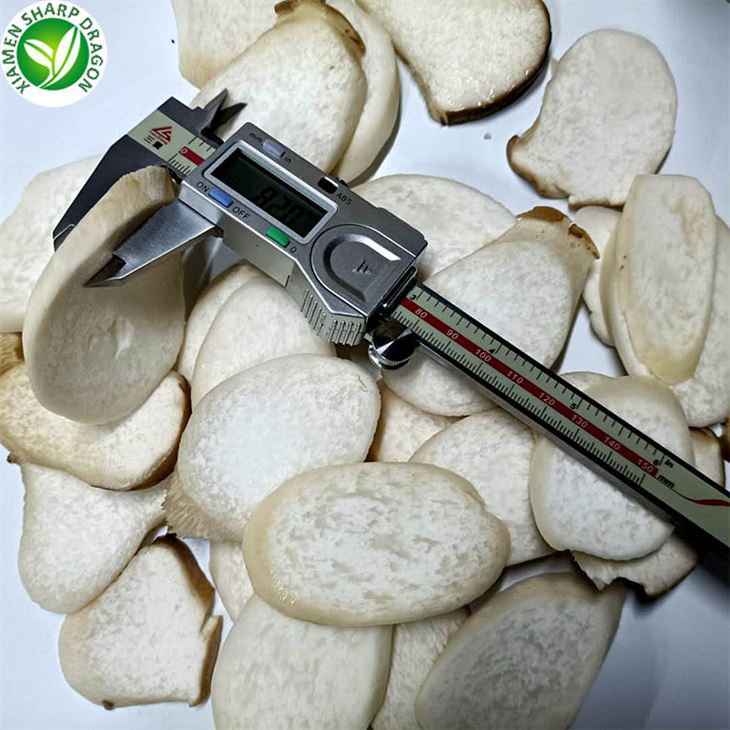
Thickness is usually the most important cooking variable for rounds and lengthwise slices. Width and length still matter for visual coverage, pack dosing and equipment. Review several frozen pieces with a calibrated tool, then cook a representative sample. A caliper result proves dimensions at the measuring point; it does not prove tenderness, water release or survival after mixing.
Practical example: A hypothetical sauce line targets 10 mm slices. Supplier A delivers an average of 10.1 mm, but 18% of sampled mass is below 7 mm. Supplier B averages 10.6 mm and keeps 95% between 8 and 13 mm. If thin pieces tear during agitation, Supplier B's tighter distribution is more useful even though its average is farther from the nominal number. Add separate lower-tail and upper-tail limits.

Control Freezing, Thawing and Water Release as One System
King oyster mushroom tissue contains roughly 90% water in the official raw reference. Ice formation and thawing therefore affect the cell structure that holds water and creates bite. Faster freezing can form smaller ice crystals than slow static freezing under comparable conditions, but the finished result still depends on piece size, loading, inlet temperature, airflow, pretreatment and storage history.
A 2018 study compared natural freezing at −20°C with IQF at −62.5°C and 8.23 m/s for diced and mini P. eryngii, then compared several thawing methods. Under that experiment, the IQF samples showed better water-holding capacity, lower thawing loss, greater hardness and better-preserved cell structure than the naturally frozen samples. The exact freezer temperature, air speed and thaw route belong to that study; they are not universal settings for every commercial cut.
The practical lesson is to approve a measurable outcome. State whether the product must be free-flowing, how clumps are separated and counted, how surface ice is assessed, and which thaw or direct-cook method represents use. The broader guide on freezing mushrooms explains the general mechanism; king oyster approval still needs its own cut and cooked-texture test.
Do not assess water release only after passive thawing if the kitchen cooks directly from frozen. Run the actual pan, steam, oven, soup or sauce method with a defined sample mass, equipment load, time and endpoint. Record free liquid, cooked mass and texture. A mushroom that loses water early may dilute sauce or prevent browning; the same release may be acceptable in soup.

Build an Application Test That Can Be Repeated
"Good texture" is not an acceptance method. Define the initial mass, frozen or thawed start, thaw procedure if used, pan or vessel, added water or oil, heat input, cooking time, target core condition, hold time and scoring scale. Use a retained reference where practical. If two people describe the same piece as "firm" and "rubbery," the test needs clearer anchors.
For stir-fry or seared applications, watch surface browning, water release and bite. For soups, check whether the piece survives simmering without becoming spongy or tough. For ready meals, test freezing, storage and the consumer reheat that follows industrial assembly. For a plant-based formulation, evaluate the complete recipe because salt, acid, fat, mixing and repeated heat can change the mushroom result.
A food-processing plant may also need dosing and equipment evidence. Measure whether pieces bridge in a hopper, fracture at transfer points, separate on the belt and fill consistently. The food-processing application page is useful when your decision extends beyond appearance to line handling, recipe integration and industrial packing.
Keep sensory failure categories separate. Excessive softness, rubbery bite, fibrous stem, browning, off-odor, excessive free water and breakage do not have the same cause or corrective action. Link each result to cut, pretreatment, freeze history and cook conditions. That connection is more useful than one combined score that can pass while hiding a critical defect.
Inspect the Frozen Lot Beyond the Top Layer
Sample across cartons and positions that represent the lot. Review product identity, cut distribution, cap-to-stem appearance where relevant, color, broken pieces, foreign material, clumps, loose ice and odor after the defined preparation. Record the sample plan and defect basis. Ten attractive pieces selected from one open bag cannot represent a container.
Inspect separation without damaging the evidence. Lightly connected pieces that separate under the stated method may be acceptable; a solid frozen block suggests a different issue. Define the force or handling allowed, then weigh the nonconforming fraction. If loose ice is excluded from net product evaluation, record it separately rather than folding it into "damaged pieces."
Link the finished sample to the production and packing code. The supporting file should make it possible to trace a selected case back to the processing interval and raw-material lots, and to trace a raw lot forward to finished codes. Review holds, deviations and release decisions for the represented run. A certificate for the facility cannot replace the lot-specific result.
Compare Cost at the Usable Cooked Endpoint
Quoted price per delivered kilogram ignores pieces you cannot use and mass lost before the target application endpoint. Separate frozen saleable yield from cooked yield. First remove defined off-size pieces, defects, excessive ice and unusable breakage. Then cook a representative portion of the accepted frozen mass by the agreed method and measure the usable cooked mass.
Worked example: A hypothetical 100 kg delivery costs USD 2.40 per kg. Inspection excludes 3.0 kg of off-size pieces, 1.0 kg of excessive ice and 1.5 kg of damaged or discolored product. Frozen saleable mass is 94.5 kg, or 94.5%. A 20.0 kg cooking trial of accepted product yields 16.8 kg at the target texture, so cooked yield is 84.0%. Combined usable yield is 0.945 × 0.84 = 79.38%.
The delivered mushroom cost per usable cooked kilogram is USD 2.40 ÷ 0.7938, or about USD 3.02, before labor, energy and other ingredients. A competing lot at USD 2.50 per delivered kilogram with 96% frozen saleable yield and 89% cooked yield gives 85.44% combined yield and costs about USD 2.93 per usable cooked kilogram. The higher invoice price produces the lower recipe cost in this example.
These are teaching values, not an XMSD quotation or lot result. Replace them with representative measurements and the same acceptance method for every supplier. If one sample is cooked longer or drained more aggressively, the cost comparison is no longer controlled.

Lock Packaging, Label Basis and Cold-Chain Evidence
Choose the inner-pack size from actual opening and use, not from a generic catalog. A kitchen that consumes 5 kg per batch may control exposure better with 5 kg bags than one large liner repeatedly opened in a humid room. A high-volume line may prefer a larger industrial pack to reduce handling. Verify seal performance, carton strength and pallet pattern against the route.
Our frozen packaging guide shows several bag, carton and pallet directions. For the mushroom order, state net weight, inner material, seal, outer carton, label fields, lot code, storage statement and pallet limits. Artwork approval and technical pack approval are separate; an attractive printed bag does not prove moisture barrier, sealing or case performance.
Nutrition data must match the label basis. Record the food table or laboratory report used, product form, serving basis, calculation file, rounding method, regulatory review and artwork version. When recipe or processing changes, assess whether the declared values need recalculation or retesting. Keep the evidence linked to the specific formula and destination.
For transport, review loading condition, case integrity, pallet stability, reefer set point and temperature records agreed for the order. Arrival inspection should combine representative case condition with route data. A good temperature reading at one carton cannot reconstruct the complete journey, while a logger trace cannot show crushed cases or seal failures.
XMSD sourcing note: Send the scientific name, required cut and dimensions, application, cooking test, defect limits, pack, destination, annual quantity and nutrition-document requirement. We can review your request against an available frozen Pleurotus eryngii format and a suitable partner-factory route.
Frequently Asked Questions
Is king oyster mushroom the same as oyster mushroom?
King oyster mushroom normally means Pleurotus eryngii. Ordinary oyster mushroom commonly means Pleurotus ostreatus. Confirm the scientific name because their shapes, cuts and food-composition entries are not interchangeable.
How many calories are in 100 g of raw king oyster mushroom?
Japan's 2023 supplementary food-composition table reports 31 kcal per 100 g edible portion of raw Pleurotus eryngii. Treat that as a cited raw reference. A frozen, glazed, cooked or recipe product may require its own calculation or analysis.
Does freezing destroy king oyster mushroom nutrition?
Freezing does not make the food nutritionally empty, but composition and per-100 g values can change through trimming, pretreatment, leaching, storage, thaw loss and cooking. Evaluate the actual product form rather than using "fresh" or "frozen" as a universal verdict.
Should frozen king oyster mushroom be thawed before cooking?
Use the method validated for the application. Direct cooking may reduce handling and can suit soups or stir-fries; controlled thawing may be required for another recipe or test. Compare water release and texture under the exact method you will use, and follow the product's food-safety instructions.
Which documents support a commercial nutrition declaration?
Keep the recognized database entry or laboratory report, sample and product description, recipe or calculation file, serving basis, destination rule, rounding method, reviewer approval and final artwork version. The evidence must describe the product and form being declared.
Final Decision
King oyster mushroom has a useful raw food-composition profile, but a commercial frozen decision cannot stop at a 100 g table. Confirm Pleurotus eryngii, use form-specific nutrition evidence, control cut tails, test water release and texture in the real application, compare cost at usable cooked yield, and preserve the label and cold-chain evidence for the lot. That sequence turns nutrition from a loose marketing claim into one verified part of product performance.
References
- Ministry of Education, Culture, Sports, Science and Technology, Japan. Food number 08025: king oyster mushrooms, raw, Standard Tables of Food Composition 2023 supplement.
- Manzi P, Marconi S, Aguzzi A, Pizzoferrato L. Commercial mushrooms: nutritional quality and effect of cooking. Food Chemistry. 2004;84(2):201–206.
- Guo Y, et al. Advances in Postharvest Storage and Preservation Strategies for Pleurotus eryngii. Foods. 2023;12(5):1046.
- Lee J, et al. Evaluation of the effects of different freezing and thawing methods on the quality preservation of Pleurotus eryngii. Applied Biological Chemistry. 2018.
- Pleurotus mushrooms in nutrition and health. Clinical and preclinical insights for nutraceutical development. 2025 review indexed by PubMed.