


Processed Peaches for Weight-Loss Menus: Form and Yield
Aug 08, 2019

A frozen, canned or puréed peach product can fit a weight-loss menu, but the word "peach" does not make the finished food a weight-loss product. The practical result depends on the ingredient list, the portion actually used, whether packing liquid is consumed, the usable fruit yield after thawing or draining, and what the peach component replaces in the formula. An unsweetened IQF peach and a sweetened peach preparation may share a flavor name while contributing very different amounts of fruit, liquid and added sugar.
For product development, compare every option on the same basis: grams entering the recipe, grams of accepted usable fruit, nutrition per declared serving or per 100 g, and contribution to the complete finished serving. Do not copy a fresh-peach nutrition figure onto a canned syrup pack or a dairy fruit preparation. Do not call a reformulation successful until the final batch calculation shows what was removed, what was added and how the verified yield changes the serving.
That boundary matters because whole-fruit evidence is not evidence that every processed form causes weight loss. A systematic review found that greater whole fresh fruit intake was generally compatible with weight maintenance or modest loss, but it did not establish a peach-specific effect or validate syrup-packed fruit and formulated purée.[1] If you need the general personal-portion answer, use our peach portion and recipe guide. The decision here is narrower: how to execute a processed-peach substitution without losing control of yield, label basis or formula totals.
Short answer: Start with an unsweetened or clearly specified peach form, normalize products to the same usable-weight basis, calculate the complete serving, and verify that the new peach ingredient replaces rather than merely accompanies an energy-containing component. Choose by formula and yield, not by the front-of-pack fruit image.

A Product-Form Decision, Not a Slimming Claim
The strongest honest claim is that a defined peach ingredient may help you build a lower-energy serving when it replaces a more energy-dense ingredient and the new food remains acceptable. It is not accurate to promise fat burning, faster metabolism or a predictable change in body weight. A controlled trial review found no discernible weight-loss effect from simply advising people to eat more fruit and vegetables without reducing other energy sources.[2] That is why the substitution needs to appear in the formula, not only in the marketing description.
Begin by defining the job. Is the peach supplying visible pieces in yogurt, bulk in a smoothie, fruit solids in a filling, sweetness in a sauce or a shelf-stable topping? A slice, dice, half, purée and canned segment solve different manufacturing problems. They also create different dosing errors. A line operator can count or weigh free-flowing pieces; a purée is pumped by mass or volume; canned fruit brings a packing medium; a sweetened preparation carries a multi-ingredient formula. The nutrition comparison is meaningful only after the physical job is fixed.
Next, decide the reference point. Retail Nutrition Facts are generally stated per serving, and the FDA notes that eating two servings means twice the listed calories and nutrients.[3] Industrial specifications may instead report values per 100 g of product as supplied. A recipe may dose thawed fruit, drained fruit, fruit plus exudate or the complete contents of a can. Those numbers are not interchangeable. Put the basis beside every value in your comparison sheet.
Finally, keep claims separate from product choice. "No added sugar," "reduced calorie," "source of fiber" and weight-related wording may have regulated definitions in the destination market. Choosing fruit-only frozen peaches may simplify a formula, but it does not automatically qualify the finished product for any claim. The other ingredients, processing losses, serving size, comparison food, rounding rules and local review still control the answer.
Compare Peach Forms on One Measurement Basis
A useful comparison sheet has two layers. The first describes the ingredient as purchased: pack weight, ingredient list, fruit percentage if declared, packing medium, nutrition basis and price. The second describes it as used: thaw or drain method, accepted usable mass, liquid retained in the recipe, loss from sorting, and grams dosed per serving. If you compare the purchase price of one product with the usable cost of another, the lower-priced option can win for the wrong reason.
| Peach form | Basis to record | Main formulation risk | Best operational fit |
|---|---|---|---|
| Unsweetened IQF dice or slices | Frozen input, thawed usable yield, retained exudate | Assuming frozen weight equals plated fruit weight | Visible pieces, portioned bowls, dairy and bakery use |
| Canned in water | Net and drained weight, liquid use, serving basis | Counting discarded liquid as usable fruit | Shelf-stable service where gentle texture is acceptable |
| Canned in juice | Fruit and juice separately if the formula treats them differently | Treating juice as equivalent to water | Fruit cups, sauces or recipes that deliberately retain liquid |
| Canned in syrup | Syrup strength, drained basis, calories and added sugars | Applying an unsweetened-fruit value | Dessert applications where syrup is an intentional ingredient |
| Peach purée or preparation | Complete ingredient formula, soluble solids and dose | Calling a sweetened preparation "plain purée" | Smooth texture, pumping, fillings, beverages and swirls |
Do not rank the rows as universally best or worst. Unsweetened IQF pieces offer clean formula control, yet they may release liquid during thawing. Canned water-pack fruit can be consistent and shelf stable, yet its drained yield and softer texture may not suit a visible topping. Syrup-packed fruit can have a valid dessert role when the syrup is intentionally counted. Purée can dose accurately, yet it removes the visual and chewing characteristics of pieces. The application decides which trade-off matters.

Unsweetened Frozen Peaches: Measure Thawed Usable Yield
Freezing does not itself add sugar. Still, the ingredient list must confirm whether the SKU contains only peaches or includes sugar, syrup or another component. For a fruit-only product, the harder commercial question is often not sweetness but how much accepted peach remains after your actual thawing and handling procedure. Released juice, broken pieces and out-of-tolerance fragments can change both the dose and the cost per usable kilogram.
Write a short test method before comparing samples. Fix the sample mass, thaw temperature, thaw time, container, draining screen, drain time, whether gentle agitation is allowed, which liquid is retained, and the defect criteria. Run replicate samples from representative cases rather than selecting one attractive bag. Record frozen input, liquid separated, pieces rejected and accepted usable fruit. A changed drain time can change the result even when the lot has not changed.
USDA's frozen-peach grade standard provides a public example of a defined drained-weight method: a thawed sample is placed on a specified screen and allowed to drain for one minute before the liquid is weighed and subtracted.[4] That method is useful because it makes the word "drained" measurable. It does not automatically become your purchase contract. If your kitchen partially thaws fruit and retains all juice in a smoothie, a fully drained laboratory number may understate the formula input. If you need clean pieces for a dry topping, the same liquid may be a real loss.
Piece geometry also changes use. Dice distribute evenly and can make a target fruit mass easier to deliver across many cups. Slices give a larger visible identity but can bridge in a depositor or vary by count. Halves are countable and visually clear, though they may require cutting on your line. Our frozen yellow peach formats show common starting shapes. Your approved sample still needs a signed size, tolerance, defect and sensory standard.

Worked Example: Convert Pack Weight into Usable Portions
Worked example: A foodservice program needs 100 finished cups, each with 80 g of accepted peach pieces. The required usable mass is 100 × 80 g = 8,000 g, or 8.00 kg. Two hypothetical products pass the sensory review. Your controlled trial finds an 86% accepted yield for unsweetened IQF pieces after the selected partial-thaw procedure and a 62% accepted drained yield for a canned product after its specified draining procedure. These figures are examples, not standard yields or XMSD guarantees.
| Trial input | IQF example | Canned example |
|---|---|---|
| Required accepted fruit | 8.00 kg | 8.00 kg |
| Measured accepted yield | 86% | 62% |
| As-packed quantity to issue | 8.00 ÷ 0.86 = 9.30 kg | 8.00 ÷ 0.62 = 12.90 kg |
| Planning result | Issue at least 9.30 kg plus agreed process allowance | Issue at least 12.90 kg plus agreed process allowance |
The usable-yield formula is accepted usable peach ÷ as-packed input × 100. The issue formula reverses it: required usable peach ÷ yield fraction. The calculation shows why pack kilograms alone do not describe how many portions you can serve. It does not prove that the IQF option is more economical. Multiply the purchase price by the required as-packed quantity, then include storage, handling, labor, discarded liquid, packaging and any value recovered from liquid used elsewhere.
The nutrition basis must follow the process too. If the canned label applies to fruit and liquid together but only drained fruit enters the cup, obtain data appropriate to the drained product rather than dividing the as-packed declaration by an improvised yield. If IQF exudate is retained in a yogurt swirl, it remains part of the formula. Yield mathematics controls how much you issue; it does not authorize an unsupported nutrient conversion.
Run the same trial after the production process is stable. A bench colander, a factory hopper and a catering kitchen may produce different residence times and losses. Agree whether the approved yield is a planning value, a minimum acceptance value or an information-only result. That distinction prevents a useful trial number from turning into an unintended guarantee.

Canned Peaches: Separate the Fruit from the Packing Medium
A canned-peach comparison should name the medium: water, juice, light syrup, heavy syrup or the exact formulation stated by the supplier. "Canned peach" is not a nutrient specification. Water pack, juice pack and syrup pack can differ in sweetness, soluble solids, ingredient statement, calories and added sugars. They can also behave differently after draining because the fruit and medium exchange water and soluble components during storage.
Read the label basis before entering a value. Does the declared serving include the liquid? Is there a drained-weight declaration? Will your recipe retain the liquid, discard it, rinse the fruit or convert it into a sauce? "In juice" does not mean "in water," and a familiar fresh-peach value cannot replace the actual pack data. If two products use different serving weights, convert both to the same unit before comparing them.
The FDA explains that Total Sugars includes naturally occurring and added sugars, while Added Sugars is the portion added during processing; syrups and certain concentrated fruit juices added as sweeteners fall within the added-sugar definition.[5] Read both lines where the applicable label provides them, then check the ingredients. A high total-sugar number does not by itself tell you how much was added, and a front-panel fruit statement does not remove added sugar from the formula.
Draining is a physical operation, not a magic deletion of every syrup component. Some packing medium leaves with the liquid; some soluble material may remain with the fruit. A rinse may change flavor, texture and the amount retained, but an online estimate for "sugar removed by rinsing" is not a reliable label calculation. If a weight-related product brief requires a precise finished declaration, use controlled formulation data and the analytical or calculation method accepted for your market.
Practical example: A hotel breakfast cup needs 70 g of visible peach pieces and no sweet packing liquid in the cup. A water-pack canned product may meet the process if its verified drained yield, texture and ingredient statement pass. A juice-pack product needs a separate taste and label review; "juice" is not automatically disqualifying, but it is not interchangeable with water. A syrup-packed product would be a poor default for this brief because the sweetened medium conflicts with the intended formulation. The action is to compare actual labels and drained trials, not to ban all canned fruit.
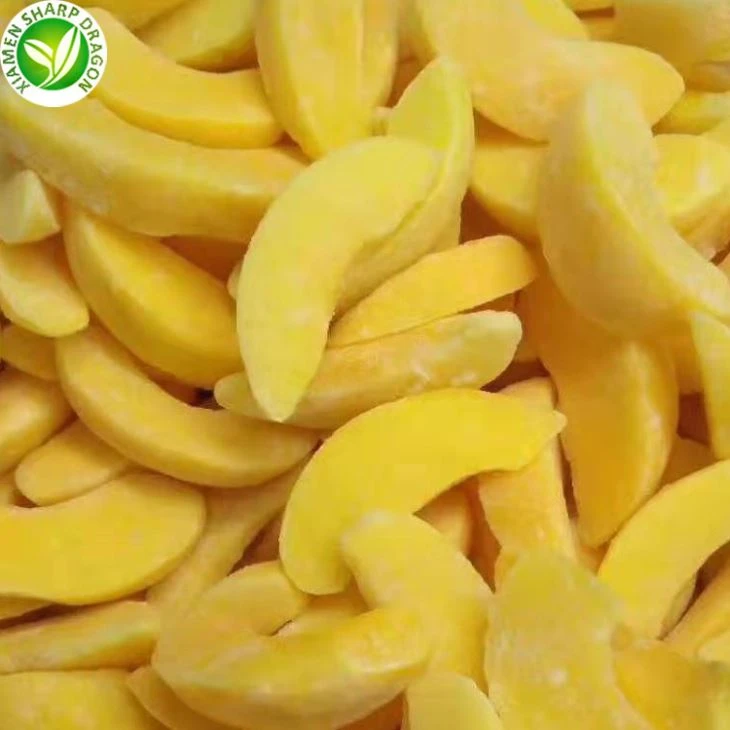
Purée and Peach Preparation: Recalculate the Finished Formula
"Peach purée" can mean fruit reduced to a smooth form, while "peach preparation" may describe a formulated ingredient containing fruit, sugar, syrup, starch, acid, flavor or stabilizer. Confirm the legal and commercial name, complete ingredient statement, fruit percentage if supplied, soluble-solids target, acidity, viscosity, heat treatment and storage condition. A photograph or flavor name cannot answer those questions.
Purée can improve dosing consistency and distribute flavor evenly, but the smooth form changes how the finished product is eaten. It should not inherit evidence about chewing whole fruit. It also may add more liquid than pieces and change the required starch, dairy solids or process time. If a reformulation reduces one sweetened component but then adds sugar elsewhere to recover the old taste, calculate the net change rather than celebrating the ingredient swap.
Worked formulation check: Imagine a 1,000 kg dairy batch that uses 200 kg of a hypothetical sweetened peach preparation. Its controlled specification indicates 18 g of added sugar per 100 g of preparation, so that ingredient contributes 200 kg × 18% = 36 kg added sugar to the batch. A trial replaces it with 200 kg of one-ingredient peach purée and 12 kg of separately added sugar. The stated sugar addition becomes 12 kg, a reduction of 36 − 12 = 24 kg per 1,000 kg batch.
That 24 kg difference is not a finished-label conclusion. You must recalculate every sugar-contributing ingredient, total carbohydrates, energy, actual yield and declared serving under the applicable rules. If water evaporates during processing or the new purée changes finished yield, values per 100 g can shift. The trial must also pass taste, viscosity, color, shelf-life and microbial controls. A lower number that produces an unstable product is not an executable substitution.
For a menu smoothie, the same discipline applies at a smaller scale. A pump count is reliable only when pump output, purée density and line viscosity are controlled. Measure grams delivered, not just "two pumps." Count yogurt, milk, juice, sweetener, toppings and the peach component. Water and ice may change volume without adding energy, while unequal cup fills can still change energy per served cup.

Execute a Substitution That Survives Production
CDC guidance on using fruit and vegetables in weight management makes an important distinction: substitution can reduce a meal's calories, while adding fruit to an unchanged intake adds calories.[6] For a manufactured food, write the same distinction into the change record. Name the old ingredient and dose, the new ingredient and dose, any compensating ingredients, the old and new finished yield, and the declared serving. If the removed column is blank, you are testing an addition.
Do not optimize energy in isolation. A successful replacement needs to deliver the required fruit identity, sweetness, texture, appearance, process tolerance, microbiological safety, shelf life and cost. Replacing a thick peach preparation with loose IQF dice may lower one formulation input but damage cup-fill accuracy. Replacing pieces with purée may simplify pumping but remove visible fruit. Replacing syrup-packed segments with drained water-pack fruit may change gloss and flavor. The application trial tells you whether the numerical improvement can be served or sold.
Run the test in a sequence you can audit: lock the product specification; measure usable yield; make a controlled batch; record all adjustments; verify finished mass; calculate the proposed serving; review nutrition and claims; then complete sensory, stability and safety work. Our food-processing application overview describes the operating questions we expect before matching a frozen ingredient to a line. The formula remains yours to approve.
For retail packs, artwork comes after the controlled inputs. The serving should match the product and relevant market rules. The ingredient declaration should match the approved formula. Nutrition data need an accepted calculation or analysis route. Claims need legal review and supporting records. If you are developing a store-brand line, our private-label and OEM overview can frame packing and project inputs, but it does not replace your destination-market label approval.

Build the Specification Around the Decision
A usable peach specification starts with identity: cultivar or approved type where relevant, country or production origin, fruit-only or formulated status, cut form, dimensions and tolerances. Add color, flavor, texture, ripeness expectation, pit or pit-fragment limits, foreign-material limits, defect definitions, microbiological criteria, pesticide or contaminant requirements, packing format, storage temperature, coding and document needs. Do not let a calorie objective weaken normal food-safety controls.
Then attach the test basis. State whether size is measured frozen or thawed, how thawing occurs, whether exudate is included, how accepted yield is calculated and which sample plan applies. If you will dose frozen dice directly, a fully thawed firmness score may not predict line behavior. If your cup needs intact thawed slices, frozen appearance alone is insufficient. The XMSD review of frozen peach quality provides useful background, while the signed project specification controls the order.
Request product-specific composition rather than a generic peach table. Clarify whether values are typical, calculated, analytically tested or guaranteed; whether they apply as supplied or after a defined preparation; and which revision is current. Keep the supplier specification, ingredient statement, nutrition source, trial record, approved sample and artwork input under revision control. A later change in fruit source, syrup formula, solids target or processing method may trigger a fresh review.
Price should also use a common denominator. Compare cost per accepted usable kilogram, cost per finished serving and cost of the complete formula. Include the value or disposal cost of packing liquid, labor for draining or cutting, cold storage, thaw loss and downtime risk. A higher purchase price can be rational if yield and line performance are better; a lower price can remain attractive if the liquid is deliberately used and the application tolerates the texture. The calculation must reflect your process.
Before approval, ask five final questions. Is the product identity accurate? Are nutrition values on the same basis as the dose? Is usable yield measured by the intended process? Does the complete finished serving improve the target comparison? Can QA reproduce the result from the controlled records? Five clear answers are more defensible than a broad statement that peaches are "good for weight loss."
Final Decision
Use processed peaches in a weight-loss-oriented menu only as a defined formulation choice. Unsweetened IQF pieces are often straightforward when you need visible fruit and control over added ingredients. Water- or juice-packed canned fruit can work when the packing medium, drained yield and label basis are handled correctly. Syrup-packed peaches are not forbidden, but the syrup belongs in the calculation. A one-ingredient purée and a sweetened peach preparation are different ingredients and need different formula data.
The defensible workflow is simple: normalize the data, measure usable yield, calculate the complete serving, identify the ingredient being replaced, test production performance and review the final claim. That work cannot promise weight loss, but it can show whether a peach substitution genuinely changes the finished product in the intended direction.
Share your application, required cut, fruit-only requirement, thaw method, target dose, packing, destination and volume. We can review a suitable XMSD frozen peach starting point for your own yield and formulation approval.
References
- Guyenet SJ, et al. Impact of Whole, Fresh Fruit Consumption on Energy Intake and Adiposity: A Systematic Review. Frontiers in Nutrition. 2019;6:66.
- Kaiser KA, et al. Increased fruit and vegetable intake has no discernible effect on weight loss: a systematic review and meta-analysis. American Journal of Clinical Nutrition. 2014;100(2):567–576.
- U.S. Food and Drug Administration. Serving Size on the Nutrition Facts Label. Accessed August 27, 2026.
- USDA Agricultural Marketing Service. United States Standards for Grades of Frozen Peaches. Effective October 23, 1956; accessed August 27, 2026.
- U.S. Food and Drug Administration. Added Sugars on the Nutrition Facts Label. Accessed August 27, 2026.
- U.S. Centers for Disease Control and Prevention. Healthy Habits: Fruits and Vegetables to Manage Weight. December 4, 2025.