


XMSD Corn vs Rice: Which Fits Your Product Better?
May 21, 2019

Corn is not universally better than rice, and rice is not universally better than corn. If you are comparing plain cooked yellow sweet corn with plain cooked enriched long-grain white rice on the same 100 g cooked basis, the USDA reference entries put the corn lower in energy and carbohydrate and higher in dietary fiber. Rice, however, gives a softer, more neutral starch base, and enrichment can change its micronutrient profile. Brown rice, whole-grain corn, canned corn, corn on the cob, sauces, oil, and different cooking yields create different comparisons.
For a retail meal, restaurant recipe, frozen side, or institutional menu, the useful question is not simply "Is corn better than rice?" It is "Which exact form performs better for this serving, label, sensory target, process, and customer?" Define the cooked weight, read the actual nutrition data, and test the complete recipe before making a claim or changing a formula.
Quick answer: Cooked sweet corn can be the better choice when you want visible vegetable character, more fiber on the cited cooked basis, yellow color, mild sweetness, and distinct pieces. Cooked white rice can be better when you need a neutral, cohesive, economical starch base. A blend often works better than an all-or-nothing substitution.

First Define What "Corn" and "Rice" Mean
Sweet corn eaten as kernels is commonly handled as a vegetable in meals, although botanically corn is a grain. Field corn processed into cornmeal, grits, polenta, starch, or flour has a different composition and culinary function. A frozen corn cob also includes an inedible core, so its package weight is not equivalent to an equal weight of rice or loose kernels. This article focuses on plain cooked sweet corn kernels because that is the relevant edible format for many XMSD frozen corn applications.
Rice also needs a full name. White or brown, long-, medium-, or short-grain, enriched or unenriched, parboiled or ordinary, freshly cooked or chilled and reheated are not interchangeable descriptions. Water absorption during cooking changes the weight and therefore every per-100 g cooked number. Comparing 100 g of dry rice with 100 g of cooked corn would produce a dramatic but meaningless result.
Use one of three honest bases. For menu nutrition, compare the labeled serving in the finished meal. For formulation, compare equal cooked edible weights after the approved preparation. For purchasing, compare the cost needed to produce one approved cooked kilogram or one saleable serving. Keep those bases separate. A food can look favorable per cooked gram because it contains more water while requiring more or less purchased material to produce that gram.
A Like-for-Like Nutrition Comparison
The table below uses legacy USDA reference records linked through FoodData Central: yellow sweet corn, cooked, boiled, drained, without salt; and white long-grain rice, regular, enriched, cooked. The values are useful reference points, not guaranteed specifications for an XMSD lot, another rice variety, or your finished product. Laboratory results, supplier specifications, recipes, water uptake, and local labeling rules control the values you can place on a commercial label.
| Per 100 g cooked edible food | Yellow sweet corn | Enriched long-grain white rice | What the number does not decide |
|---|---|---|---|
| Energy | 96 kcal | 130 kcal | Calories in the sauce, oil, protein, and complete serving |
| Carbohydrate | 20.98 g | 28.17 g | Portion size, recipe, and individual dietary needs |
| Dietary fiber | 2.4 g | 0.4 g | How brown rice or another whole-grain choice would compare |
| Protein | 3.41 g | 2.69 g | Protein quality or the protein in the complete meal |
On this narrowly defined basis, sweet corn supplies about 34 fewer kilocalories, 7.19 g less carbohydrate, and 2.0 g more fiber per 100 g. That does not turn corn into a low-carbohydrate food, and it does not make rice unhealthy. Both still contribute carbohydrate. The comparison changes when the rice is brown, the corn is processed into meal, or the recipe adds butter, cream, sugar, coconut milk, sauce, or frying oil.
Micronutrient headlines require the same care. Yellow corn contains carotenoid pigments, but the amount depends on variety and processing. Enriched white rice may have thiamin, niacin, folic acid, and iron added according to the product and market. Brown rice retains bran and germ components removed during white-rice milling. If a nutrient claim matters, compare the actual certificates, laboratory basis, Nutrition Facts calculation, and applicable threshold instead of converting this general article into label copy.

"Better" Depends on the Job in the Finished Product
| Product objective | Corn may fit better when | Rice may fit better when |
|---|---|---|
| Visual identity | Yellow kernels should remain visible as a named vegetable component | A pale, neutral base should carry sauce and other inclusions |
| Texture | Distinct kernels and a firmer bite are desirable | Softness, cohesion, or grain separation defines the dish |
| Flavor | Mild sweetness supports vegetables, soups, fillings, or colorful sides | A restrained background is needed for curry, sauce, or seasoned protein |
| Menu structure | You want to increase vegetable variety within a controlled formula | Rice is the expected cultural or culinary staple |
| Processing | Free-flowing kernels must dose as separate pieces | The process is designed around controlled rice hydration and starch behavior |
Corn cannot duplicate rice one for one in every dish. Rice absorbs cooking water and builds the bulk and starch structure of pilaf, congee, sushi, risotto, or a plain steamed serving. Sweet corn contributes its own moisture, skin, sweetness, color, and kernel geometry. Replacing all rice with corn changes the identity of the meal, not just the nutrition panel.
That is why partial replacement often gives a more useful result. A corn-and-rice blend can preserve the familiar rice base while adding color, bite, and vegetable variety. The correct share depends on the tray geometry, sauce level, reheating method, target cost, local recipe expectations, and whether the corn enters frozen, thawed, preheated, or fully cooked.

Practical example: A 300 kg cooked side currently contains 300 kg of plain enriched long-grain white rice. The development team tests a formula with 210 kg rice and 90 kg cooked sweet corn, keeping the total side weight at 300 kg. Using the USDA reference values above, the 90 kg portion moved from rice to corn represents 900 units of 100 g.
The reference difference across that 90 kg is 30,600 kcal less energy, about 6.47 kg less carbohydrate, and about 1.80 kg more dietary fiber for the complete batch. In a 250 g tray containing 75 g of this side, the difference works out to about 7.65 kcal less energy, 1.62 g less carbohydrate, and 0.45 g more fiber per tray.
Those calculations only screen the idea. The team must recalculate with its actual ingredient data and cooked yields, then test taste, kernel distribution, rice texture, sauce pickup, freezing, reheating, declared serving, and legal rounding. A small numerical difference may not support a front-label claim, and a favorable nutrition change is not useful if the customer rejects the texture.
Moisture, Freezing, and Reheating Can Reverse a Good Idea
Rice preparation is a hydration process. The dry grain takes up water, and the cooking ratio, resting time, grain type, and equipment determine finished weight and texture. Frozen sweet corn is already a high-moisture vegetable. It may bring surface ice or release some water during heating, but it is not designed to absorb water and replace the rice matrix. Formulate each component by its own cooked yield before combining them.
For frozen ready meals, test the worst realistic hold and reheat condition. Rice can dry at exposed tray edges or become hard after poor freeze-thaw control. Corn can lose firmness, wrinkle, or release water if it is overcooked or exposed to temperature abuse. Sauce may protect one component while making the other too wet. A successful fresh-kitchen sample does not prove that the formula will survive commercial freezing, storage, distribution, and consumer reheating.
Run a component test and a finished-product test. First, measure the corn after the preparation route printed on its specification and the rice after the approved cooking schedule. Then combine them at the proposed ratio and freeze or hot-hold the complete formula. Score rice hardness, kernel firmness, free water, color, sweetness, sauce balance, piece distribution, center temperature, and condition after the full serving period.
If the application is fried rice, a wide hot surface and controlled moisture help preserve grain separation. Cooking the vegetables separately until hot and nearly tender can make it easier to remove surface water before they meet the rice. For soup, corn can enter later to preserve bite. For a molded rice portion, too many rolling kernels may weaken the shape. These are product-development questions, not reasons to declare either ingredient universally superior.

Gluten-Free Does Not Mean Cross-Contact-Free
Plain corn and rice do not naturally contain the gluten proteins found in wheat, rye, and barley. That makes both useful starting ingredients for some gluten-free formulations, but the complete product, processing environment, and label claim still need control. Seasoning, soy sauce, stock, breaded inclusions, shared lines, rework, storage bins, and transport can introduce gluten-containing material.
For food regulated by the U.S. FDA, a voluntary "gluten-free" claim has defined conditions, including that unavoidable gluten be below 20 parts per million. Other destination markets may use their own rules, documentation, sampling, and wording. Do not treat a supplier statement that corn or rice is naturally gluten-free as proof that the final multi-ingredient meal qualifies for the claim.
Your approval file may need an ingredient statement, allergen statement, cross-contact declaration, facility questionnaire, certificate of analysis where agreed, and finished-product verification under the applicable market plan. Rice and corn allergies also exist even though neither is one of the wheat-based gluten grains. Medical suitability belongs with qualified healthcare advice and controlled labeling, not an ingredient comparison headline.
Compare Cost on Finished Output, Not Purchase Price Alone
Dry rice and frozen corn have completely different purchase-to-cooked-yield relationships. Rice gains water during cooking. Frozen kernels may lose a small amount through surface ice, drainage, breakage, sorting, or quality rejection. A price per purchased kilogram therefore says very little until you convert both ingredients to an approved finished-output basis.
Include storage, energy, labor, water, preparation loss, rejected pieces, packaging disposal, and the effect on line speed. Then include the commercial value of the result: a colorful premium vegetable rice may justify a different cost than an economy plain side. If you need a broader method for measuring usable yield, portion control, and cost per serving, see the related XMSD frozen corn benefits guide.
Worked example: A project needs 10,000 trays, each with a 120 g cooked corn-rice component. The proposed 70:30 formula means 84 g cooked rice and 36 g approved cooked corn per tray. The production target is therefore 840 kg cooked rice and 360 kg cooked corn before any declared overfill allowance.
A rice trial shows 2.75 kg approved cooked output per kilogram of dry rice, so the theoretical dry-rice requirement is 840 ÷ 2.75 = 305.45 kg. A frozen corn trial shows 96% approved yield after ice, drainage, and defect rejection, so the theoretical frozen-corn requirement is 360 ÷ 0.96 = 375 kg. Those are the quantities to which the respective quotes, labor, cooking energy, frozen storage, and handling costs should be applied.
If you compared 305.45 kg of dry rice with 375 kg of frozen corn as if both were equal purchased kilograms, you would distort the decision. Add the planned process allowance only after measuring stable trials, and reconcile issued material, approved output, overfill, work in process, and waste during the commercial run.
Specify the Corn for the Intended Rice Application
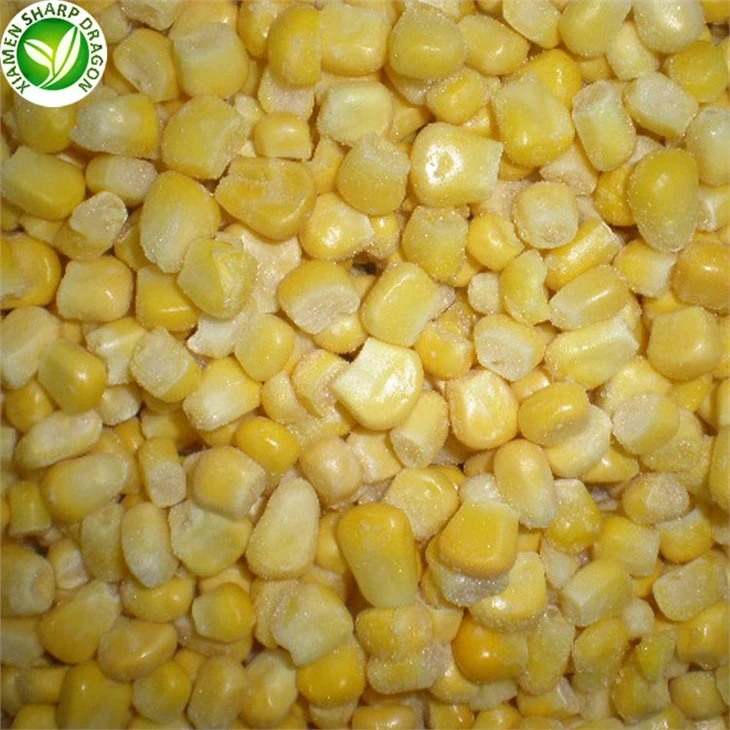
"Frozen corn" is not a complete buying specification. For rice dishes and tray meals, loose whole kernels normally make more sense than cob formats. Define species or type as appropriate, kernel color, maturity or tenderness target, size distribution, broken-kernel tolerance, loose-skin and cob-material limits, foreign-material controls, blanching or cooking status, ingredient statement, microbiological criteria, pack size, net weight, storage temperature, shelf life, and label language.
Free-flowing condition matters because clumps distort every portion. A 100 g frozen clump may not distribute across several trays as the formula expects, and a large cluster may heat differently from separate kernels. Review the actual XMSD frozen corn range by form, then narrow the discussion to a kernel product such as the frozen sweet corn kernel specification route when the recipe requires separate edible pieces.
A representative sample should go through the real rice process. Test it in the sauce, seasoning, oil, protein, and packaging system, not only in plain water. If the formula is a multi-vegetable rice, define the percentage and cut of every component; the XMSD frozen mixed vegetable range shows why corn may arrive as part of a blend rather than as a stand-alone addition.
Build acceptance around the application. A soup can tolerate a different kernel texture than fried rice. A school-meal portion may prioritize consistent weight and a restrained ingredient list. A retail pouch may prioritize bright appearance after microwave reheating. Use the frozen sweet corn quality standard overview as a starting point, then record the project-specific limits in the approved contract and sample.

A Seven-Step Decision Check
- Name both foods precisely. Record corn form, rice type, enrichment status, preparation, sauce, and whether the weights are raw, drained, frozen, or cooked.
- Choose one comparison basis. Use the same cooked edible weight for nutrition, approved cooked output for cost, or the complete declared serving for menu decisions.
- Set the product objective. Decide whether color, sweetness, grain structure, fiber, cultural fit, gluten controls, cost, or processing simplicity has priority.
- Calculate with real data. Use the exact ingredient label, laboratory or database source, measured yield, recipe, serving weight, and destination-market rules.
- Trial at more than one ratio. Include the current control, a partial corn inclusion, and any full replacement being considered.
- Run the full process. Cook, combine, freeze or hold, pack, store, reheat, and serve under realistic conditions before scoring the result.
- Approve the commercial specification. Tie the accepted sample to measurable limits for form, defects, texture, moisture, pack, temperature, documents, and lot release.
The sequence prevents one attractive number from deciding the whole project. If the nutrition calculation improves but the frozen tray reheats poorly, revise the ratio or process. If the sensory trial passes but the cost model used raw rice against cooked corn, correct the basis. Release the formula only when the same defined version passes all required gates.

XMSD sourcing note: Tell us the rice dish or finished application, required corn form, target inclusion rate, cooked texture, pack size, annual volume, destination market, and planned heating process. We can review a frozen sweet corn specification and sample route for your trial. XMSD supplies through qualified partner factories and confirms the project conditions order by order.
FAQ About Corn vs Rice
Which has more carbohydrate, corn or rice?
In the specific USDA cooked reference comparison used here, enriched long-grain white rice has 28.17 g carbohydrate per 100 g and boiled yellow sweet corn has 20.98 g. Do not apply that gap to dry weights, other corn products, other rice types, or a finished recipe without recalculation.
Can frozen corn replace cooked rice one for one?
It can replace some cooked rice by weight in a trial, but it will not reproduce rice structure, water absorption, neutral flavor, or starch behavior. Partial replacement is usually easier to control. Keep total serving weight constant, recalculate the nutrition and cost, and validate the complete cook-freeze-reheat cycle.
Are corn and rice both gluten-free?
Plain corn and rice do not naturally contain wheat, rye, or barley gluten. A commercial gluten-free claim still depends on every ingredient, cross-contact control, the finished product, and destination-market law. In the United States, FDA-regulated foods using the claim must meet the federal definition, including less than 20 ppm unavoidable gluten.
Final Thoughts from XMSD
Corn can be a better component when a product needs visible color, mild sweetness, separate pieces, and the fiber advantage shown by the defined cooked comparison. Rice can be the better foundation when a neutral staple, hydration-driven yield, cohesion, or a familiar grain texture matters. Neither conclusion survives a vague comparison.
Define the exact foods, use equal cooked edible weight, separate nutrition from purchasing yield, and test the complete commercial process. In many products, the best answer is not corn or rice but a controlled blend whose ratio, specification, cost, label, and reheated performance have all been verified.
References
- USDA FoodData Central: Corn, sweet, yellow, cooked, boiled, drained, without salt
- USDA FoodData Central: Rice, white, long-grain, regular, enriched, cooked
- USDA National Agricultural Library: Total Dietary Fiber Content of Selected Foods
- U.S. Food and Drug Administration: Gluten and Food Labeling
- USDA MyPlate: Make Half Your Grains Whole Grains
- University of Florida IFAS Extension: Sweet Corn-It's a Vegetable and a Grain!
- XMSD operational experience in frozen corn specification review, application trials, packaging, cold-chain handling, and B2B export coordination.