


Is Baby Corn Different from Regular Corn? A Practical Guide
Jul 04, 2019

Yes. Baby corn and the full-size corn you eat from a cob are both maize, Zea mays, but they are harvested at very different development stages. Baby corn is the young, undeveloped ear collected around silk emergence, before plump kernels form. Because the central cob is still tender, you eat the whole ear. Full-size sweet corn stays on the plant longer, develops juicy kernels around a fibrous cob, and is eaten mainly for those kernels.
Baby corn is therefore not a miniature artificial corn and not always a separate dwarf variety. Many ordinary sweet-corn and field-corn cultivars can produce it when their ears are picked young, while specialty baby-corn cultivars may be chosen because they set more suitable ears. Harvest stage creates the main eating difference: baby corn is mild and crisp-tender; full-size sweet corn is sweeter, juicier and more kernel-dominant.
The decisive distinction: Baby corn describes an immature whole-ear ingredient. "Regular corn" may mean full-size sweet corn, dry field corn or popcorn, and those products are not interchangeable. Decide by harvest stage, edible part and intended use-not by the shared word "corn."
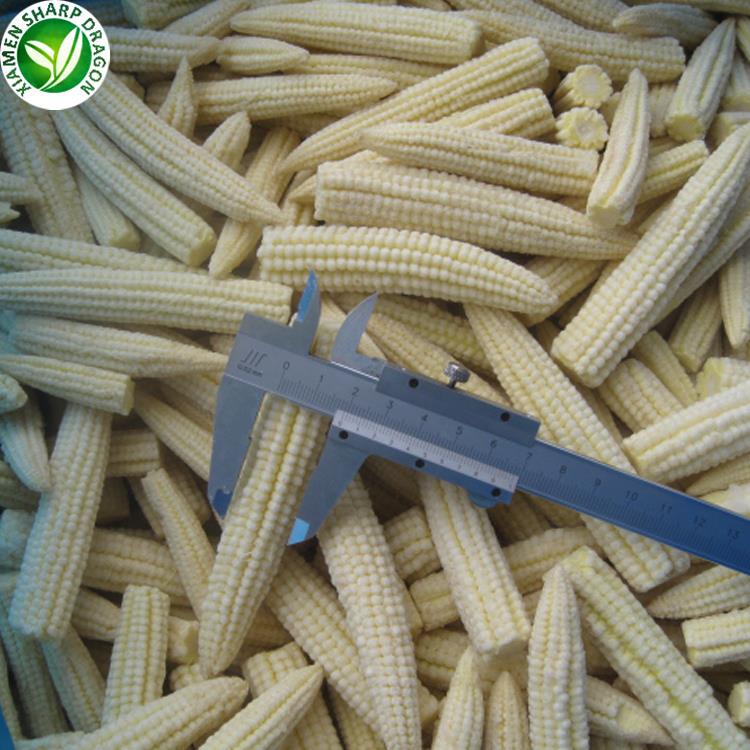
Baby Corn Is Real Maize Harvested Very Young
The crop identity is straightforward. Codex defines fresh baby corn as prepared cobs from commercial varieties of Zea mays, with silk, husk and anthers removed. Washington State University Extension describes the small ears as immature ears from regular-sized plants. Those definitions rule out two common myths: baby corn is neither a different botanical species nor a mature cob that has been mechanically reduced.
Variety still matters, but not in the way the size suggests. The WSU production publication notes that specialty baby-corn cultivars exist and often produce more ears per plant. It also reports that many sweet-corn and field-corn cultivars can produce acceptable baby corn. Oregon State University Extension adds that a grower can collect lower ears as baby corn and allow a top ear on the same plant to develop for sweet or field corn.
This is why the sentence "baby corn comes from the same plant" needs one qualification. It can come from the same species, the same type of full-size plant and even the same individual plant. Commercial production may nevertheless use a cultivar selected specifically for multiple ears, shape, yield or harvest efficiency. If you need the short identity answer without the frozen-product detail, our expanded baby corn identity explanation separates the botanical and market meanings.
Pollination language also deserves care. Commercial baby corn is normally picked at or shortly after silk emergence, before fertilization and kernel filling create full-size kernels. WSU describes harvest generally within three days of silk emergence; Iowa State Extension gives one to three days for many cultivars. That narrow window explains the product more accurately than saying the plant simply "has no pollination." The commercial target is an undeveloped ear, not a lifelong property of the plant.

Baby Corn and Full-Size Sweet Corn Differ by Structure and Use
In everyday food use, "regular corn" usually means full-size sweet corn rather than dry field grain. That is the useful direct comparison. Sweet corn for fresh consumption is still botanically immature, but it is harvested much later than baby corn. UC Davis describes the eating-stage ear as firm, with dried pollination silks and plump, milky kernels. The baby ear has not reached that kernel-filled stage.
| Decision factor | Baby corn | Full-size sweet corn |
|---|---|---|
| Harvest point | Around silk emergence, before developed kernels | Later eating stage with plump, milky kernels |
| Edible portion | The complete tender ear, including the core | Mostly the developed kernels; central cob is normally discarded |
| Eating quality | Mild, lightly sweet, crisp-tender, with visible whole-ear form | Sweeter and juicier, with a stronger kernel and starch contribution |
| Common formats | Fresh whole ears, canned or pickled ears, IQF whole or cut pieces | Whole cobs, cob segments, loose kernels, canned or frozen kernels |
| Best application signal | Choose when the dish needs a visible, sauce-holding, crisp vegetable piece | Choose when the dish needs loose sweet kernels or a conventional corn cob |
Dry field corn and popcorn create a third category. They remain on the plant until the kernels develop and dry for grain, meal, starch, feed or popping. A baby ear cannot be dried into a normal popcorn kernel because it never developed the required mature kernel structure. The shared species does not create shared functional performance.
Practical example: You are preparing a stir-fry that needs pieces large enough to pick up with chopsticks and retain a light crunch under sauce. One hundred grams of whole baby corn provides visible tapered ears. One hundred grams of loose sweet-corn kernels spreads through the dish and gives more kernel sweetness. The weights match, but the appearance, bite and sauce distribution do not. Choose by the finished dish, not by equal kilograms.

Taste, Texture and Nutrition Change with Maturity
Baby corn is not simply sweet corn in a smaller serving. Its undeveloped kernel rows contain less of the sweet, starchy kernel material that defines a full-size ear. WSU describes baby corn as crisp with a subtle, slightly sweet corn flavor, and its production publication reports no general taste advantage from using a sweet-corn rather than a field-corn cultivar at this very young stage. Harvest timing can outweigh the adult identity of the cultivar.
A 2017 laboratory analysis provides a useful composition example. In the researchers' raw samples, baby corn contained 92.39% moisture and 18 kilocalories per 100 grams, while raw sweet corn contained 74.70% moisture and 84 kilocalories per 100 grams. The same table reported 1.14 grams of available carbohydrate per 100 grams in the baby-corn sample and 13.39 grams in the sweet-corn sample. The results fit the maturity difference, but they are not a universal nutrition label for every cultivar or product.
Carbohydrate contributes food energy, while the edible young cob also changes the fiber and water balance. That composition does not prove one form is "healthier" for every person or every meal. The study compared defined raw samples; canned baby corn in brine, plain frozen baby corn, buttered sweet corn and a creamy corn dish have different ingredient lists and preparation states. A health outcome cannot be inferred from one 100-gram comparison.
For a real label comparison, hold the basis constant. Compare per 100 grams drained or per stated serving, note whether the product is raw, cooked, canned or frozen, and include the complete recipe. Check sodium on canned or seasoned products and added fat or sugar in the finished dish. If you count carbohydrate for a medical diet, use the label or database entry for the exact food form and follow personal clinical guidance rather than transferring the laboratory sample values.

Fresh, Canned and Frozen Baby Corn Are Different Product States
Fresh baby corn shows the natural crispness and needs rapid postharvest handling. Canned or pickled baby corn has received a heat process and remains in a packing liquid, so its flavor, salt, acidity and bite depend on the formulation. Frozen baby corn is commonly prepared, blanched where the process calls for it, quick-frozen and held through a frozen cold chain. None of these states should borrow the other's label directions or texture promise.
The edible identity remains the same whole young ear, but the intended use may not. A canned product can be ready to use after draining if its label says so. An IQF product may be supplied ready to cook and require a validated heat step. A fresh product needs washing, trimming and hygienic handling appropriate to its service. Read the actual label and specification; "baby corn" alone does not establish ready-to-eat status.
For frozen applications, size and maturity survive into the cooked result. Freezing does not make an overdeveloped core tender, remove attached silk or repair a broken tip. It can make year-round portioning easier, but only when the ears remain separated and the pack protects them from dehydration, clumping and handling damage. You can see the whole-ear frozen format in our IQF baby corn product reference.
Use a Product Name That Identifies the Corn Form
The word "corn" is too broad for a purchase order or finished-food formula. Write the stage and form into the item name: fresh whole baby corn, canned baby corn in brine, IQF whole baby corn, frozen cut baby corn, IQF sweet-corn kernels, or frozen sweet-corn cob segments. Add the ingredient statement and preparation status beside the name. This prevents a shared species name from becoming a receiving dispute.
"Young corn," "baby sweet corn" and "corn shoots" may be understood in some markets, but they can hide different assumptions. A name containing "sweet" does not prove that the baby ear came from a sweet-corn cultivar, and it does not create the sweetness of full-size kernels. The scientific name Zea mays confirms crop identity but still does not state whether the pack contains whole immature ears, developed kernels or cob segments.
Align four records before approval: the signed specification, ingredient declaration, inner or retail artwork and outer-carton description. If one says "baby corn," another says "sweet corn" and a third shows loose kernels, stop the artwork release. The legal naming rule at destination can add required wording, but your commercial file should still describe the same physical food at every handoff.
Practical example: Your 400-gram frozen retail bag shows whole baby ears, but the ingredient master lists only "sweet corn." That wording could send loose kernels to packing even though the approved artwork promises whole ears. Revise the master to "IQF whole baby corn, ready to cook," attach the approved ear photograph and size definition, then make the carton and artwork repeat that form. The correction happens before printing and production, where it costs less than a market withdrawal.
Keep the visual reference controlled. A beauty image can show the desired color and general form, but it cannot define every tolerance. Pair it with measurement photographs, defect definitions and a representative approved sample. If the supplied product changes from whole to cut ears, treat that as a new form with a new distribution and application test rather than an invisible wording edit.

Do Not Use a Sweet-Corn Specification for Baby Corn
The biological difference becomes a commercial specification difference. Full-size sweet-corn kernels are commonly judged by sweetness, color, whole-kernel integrity, cut quality and free flow. Whole baby corn needs ear length, base diameter, taper, straightness, maturity, undeveloped row appearance, silk and husk removal, base trim, breakage and cooked core tenderness. A Brix result for loose sweet corn cannot approve a baby-corn ear.
Codex CXS 188-1993 provides a useful fresh-produce reference: size codes of 5.0–7.0, 7.0–9.0 and 9.0–12.0 centimeters, with width from 1.0 to 2.0 centimeters. The standard explicitly applies to fresh consumer baby corn and excludes product for industrial processing. Do not copy those bands automatically into an IQF contract. Use them to understand the order of magnitude, then approve the frozen size distribution and finished cook that your application requires.
Define how the dimensions are measured. Length along the centerline differs from straight end-to-end distance on a curved ear. Diameter at the base differs from diameter at the midpoint. A frozen measurement can include frost; a thawed measurement can change with drainage and softening. Put the state, tool, location and sampling plan next to the tolerance so another inspector can repeat it.
The failure signal for maturity is not merely "too large." Look for raised or enlarged kernels, a thick core, reduced taper and a hard bite after the agreed cooking method. Very small ears can also fail if they are fragile, incomplete or too short for the visible dish. Our frozen baby corn maturity and ear-size guide develops the inspection method, including silk, trim, breakage and cooked texture.
Baby Corn and Sweet Corn Are Not One-for-One Recipe Substitutes
You can replace one with the other in a formula, but the result becomes a different product. Whole baby corn creates long visible pieces and a tender core that carries sauce on its textured surface. Loose sweet-corn kernels distribute more evenly and contribute a sweeter kernel note. Full-size cob segments create another eating format with an inedible central cob. Keep the ingredient name aligned with the actual form.
Worked example: A 240-kilogram frozen vegetable blend assigns 12% to baby corn. The target is 240 kg × 0.12 = 28.8 kg of baby corn, leaving 211.2 kg for the other components. Replacing that 28.8 kg with loose sweet-corn kernels keeps total batch weight at 240 kg, but it removes every whole-ear piece and changes sweetness, piece count and visual distribution. Reapprove the recipe, label, sensory result and component statement rather than calling it an equivalent substitution.
Mixed products make distribution visible. If a small bag contains only one or two whole ears, variation in ear mass can make some units look underfilled even when total net weight is correct. Set the component ratio by mass, then review piece count and bag-to-bag appearance from the actual fill line. The frozen Asian vegetable mix format shows one natural application where baby corn remains a distinct component rather than disappearing into loose kernels.
Cooking sequence changes too. Large frozen ears need enough heat through the core without becoming soft outside, while loose kernels heat quickly and release differently through a sauce. Test the complete dish from the same frozen state, batch load and equipment intended for production. Accept the ingredient only after the final reheated product meets texture and appearance targets.

Compare Usable Yield, Not Only the Quoted Kilogram
Whole baby corn carries different loss risks from loose kernels. Broken tips, overmature ears, attached silk, long bases and severe size outliers can reduce saleable whole-ear yield. Sweet-corn kernels have their own defects, such as broken or damaged kernels, color variation, clumps and foreign material. A price comparison that ignores the two defect systems can reward the wrong product.
Worked example: Two hypothetical 1,000-kilogram baby-corn offers are evaluated under the same whole-ear acceptance method. Offer A costs $1.08/kg but loses 4%, leaving 960 kg usable; $1,080 ÷ 960 = $1.125 per usable kilogram. Offer B costs $1.11/kg and loses 1%, leaving 990 kg usable; $1,110 ÷ 990 = about $1.121 per usable kilogram. The higher quoted price produces the slightly lower usable cost. Repeat the calculation with your actual defects, currency, freight and handling.
Sampling must represent the lot. Pull cartons from more than one pallet position, record frozen product temperature and inspect separation before aggressive handling creates new breaks. Classify size failure, maturity failure, silk, base trim and breakage separately. One total reject percentage tells you cost; the defect categories tell you what process or raw-material decision needs correction.
Pack size should follow the quantity opened per shift and the fragility of the whole ears. A large liner may be efficient for continuous production but expose more product during intermittent use. Smaller inner bags can protect portion control but add material and handling. Review the frozen packaging variables, then test the chosen bag, carton and pallet route with the product's actual size and breakage sensitivity.

XMSD sourcing note: We can review whether your application needs IQF whole baby corn, cut young ears, loose sweet-corn kernels or a mixed-vegetable format, then align size and packing inputs with the order.
Final Thoughts
Baby corn is different from regular table corn because it is the entire maize ear harvested before full kernel development. It can grow from common corn cultivars or from specialty cultivars selected for baby-corn production. The plant is full sized; the ear is young. That early harvest keeps the core edible and produces the mild, crisp whole-ear ingredient seen in stir-fries, mixed vegetables and ready meals.
For cooking, choose baby corn when visible tender ears matter and sweet corn when developed kernels or conventional cobs matter. For nutrition, compare the same food state and full recipe rather than applying one raw sample to every product. For purchasing, keep the specifications separate: baby corn needs maturity, ear size, silk, trim, breakage and cooked-core controls, while sweet corn needs kernel or cob criteria suited to its later harvest stage.
References
- Washington State University Extension: Baby Corn, PNW 532
- Oregon State University Extension: Harvest baby corn from your own garden
- Iowa State University Extension: Are special corn varieties grown for baby corn?
- Codex Standard for Baby Corn, CXS 188-1993
- UC Davis Postharvest Research and Extension Center: Corn (Sweet)
- Prasanthi et al.: Compositional variability of nutrients and phytochemicals in corn after processing