


How to Protect Apples from Browning and Quality Loss
Aug 21, 2026

Protecting apples is not one treatment. Whole fruit can lose quality through bruising, dehydration, decay, chilling or freeze injury, while cut apple browns when damaged cells expose enzymes and phenolic compounds to oxygen. A color dip may slow that cut-surface reaction, but it cannot reverse bruising, correct over-mature fruit or replace hygienic processing. If the apple will be frozen, you must also control the interval from cutting to freezing, piece dimensions, treatment carryover, freezing performance, package integrity and the cold chain.
A reliable plan begins with the intended product. A pale bakery filling, visible skin-on slice, diced yogurt preparation and cooked sauce can accept different color, texture and defect levels. Write those endpoints first. Then qualify the cultivar and maturity, prevent impact damage, validate any anti-browning treatment on the real cut, and inspect frozen, thawed and processed samples. Use an untreated control or an approved reference lot so that a color judgment has a meaningful basis.
The short answer: prevent mechanical injury before cutting, match raw maturity to the intended texture, limit and measure cut-surface exposure, validate treatment conditions instead of copying one formula, freeze promptly under a defined process, and release each lot against measurable color, defect, firmness and package criteria.

Separate the Three Problems That Look Like Browning
The first problem is enzymatic browning on a fresh cut. Cutting ruptures cells, oxygen reaches the tissue and polyphenol oxidase helps form brown pigments. The speed changes with cultivar, maturity, tissue condition, cut geometry, temperature, oxygen exposure and treatment. This is the problem most likely to respond to an approved acid or antioxidant system, lower exposure, a thermal step or a combination validated for the product.
The second problem is mechanical damage. An impact may break tissue under apparently intact skin. The bruise can darken and soften later, so a fruit that looks acceptable at unloading can deteriorate during holding or cutting. No surface dip repairs that internal damage. Prevention depends on drop height, transfer design, container fill, pressure, vibration, fruit firmness and gentle handling. Your receiving sample should therefore include cut-open inspection, not only an external look.
The third problem is physiological or temperature-related internal discoloration. Storage disorders, senescence and accidental freezing of fresh fruit can create browning or glassy, water-soaked tissue that differs from ordinary cut-surface color change. Penn State's guidance for apples exposed to a freezing event recommends avoiding handling while the fruit remains frozen, allowing controlled thawing and segregating suspect lots for evaluation. That field or storage injury must not be confused with a controlled commercial process for producing frozen apple slices or dice.
Describe the symptom before choosing the response. Record whether the discoloration is on the cut surface, below the skin, around an impact site, near the core or dispersed through the flesh. Note when it appears: at receiving, immediately after cutting, after a defined air exposure, after freezing, after thawing or after the finished heat process. A symptom map and timeline usually narrow the cause faster than an unstructured search for a stronger treatment.
Start Protection at Raw-Apple Receiving
Raw maturity determines how much protection the process can realistically deliver. Under-mature fruit may be firm but lack the flavor and soluble-solids balance needed in the finished product. Over-mature fruit can arrive sweet yet lose shape during cutting, freezing or cooking. Apple maturity programs commonly combine firmness, soluble solids and starch conversion with cultivar and intended storage or processing use. One reading cannot replace the complete pattern.
Build a receiving record around your outcome. For visible frozen slices, useful inputs include cultivar or declared blend, harvest or packing date where available, fruit temperature, firmness method and sample size, soluble solids, external decay, skin breaks, bruising, internal defects, odor and dimensional range. For dice that will enter a cooked filling, appearance tolerances may be wider while firmness, core removal and yield receive more weight. The quality plan should explain that trade-off.
UC Davis lists firmness, crispness, flavor, soluble solids, acidity and the absence of bruising, decay, cracks, bitter pit, scald, internal browning, shrivel and watercore among quality indices for Red Delicious. Its stated storage conditions apply to that cultivar and handling system, not automatically to every apple program. Use cultivar-specific guidance to design trials, then establish limits with your own raw material, storage duration and finished application.
Worked example: bruise incidence. Suppose your written receiving plan calls for 50 apples selected across the load. Six show qualifying bruises after both external and cut-open inspection. The observed incidence is 6 ÷ 50 × 100 = 12%. Compare 12% with the contractual limit and sampling rule; do not hide the result by averaging it with unrelated defects. If the limit is 5%, hold the lot and investigate impact points, fruit firmness and sample representativeness before deciding on segregation, rework or rejection.

Reduce Bruising Before You Ask Chemistry to Fix Color
Bruise prevention is an equipment and handling discipline. Follow the fruit from bin unloading through washing, sorting, peeling, coring and cutting. At each transfer, review drop height, hard contact surfaces, sharp edges, pinch points, belt speed changes, container overfill and accumulated fruit pressure. A single severe transfer can create more later discoloration than modest changes to an antioxidant bath can conceal.
Measure damage after a realistic reveal period because some bruises are delayed. Use the same cultivar, maturity and fruit temperature when comparing two handling settings. Mark the sampling point, hold the fruit for the defined interval, cut through suspicious areas and classify depth or diameter by the agreed method. If you adjust a conveyor, compare damage rates before and after the change instead of relying on a quick visual impression.
Whole-fruit holding also affects resilience. Long or poorly controlled storage can reduce firmness, increase shrivel and change the response to cutting. Relative humidity, temperature and atmosphere recommendations vary by cultivar, maturity and target storage period. A published condition for Red Delicious is useful evidence for that named cultivar, but transferring it to Granny Smith, Gala or a mixed industrial lot without validation can create a false sense of control.
If fresh fruit has experienced an unintended freeze, isolate it from normal material. Do not move or grade it aggressively while frozen. After controlled thawing, compare firmness, internal appearance, leakage and decay development with an unaffected reference. Only a documented evaluation can show whether the lot remains suitable for processing; the fact that the intended finished product will later be frozen does not erase raw-fruit freeze injury.

Control Cutting and Oxygen Exposure as One Timed Step
Once apples are peeled, cored or cut, delay becomes a process variable. Start the clock at the point that produces the exposed flesh relevant to your test. Stop it when the piece enters the validated treatment, thermal step, freezer or other defined control. A statement such as "processed quickly" cannot be audited. A measured cut-to-treatment and treatment-to-freezer interval can.
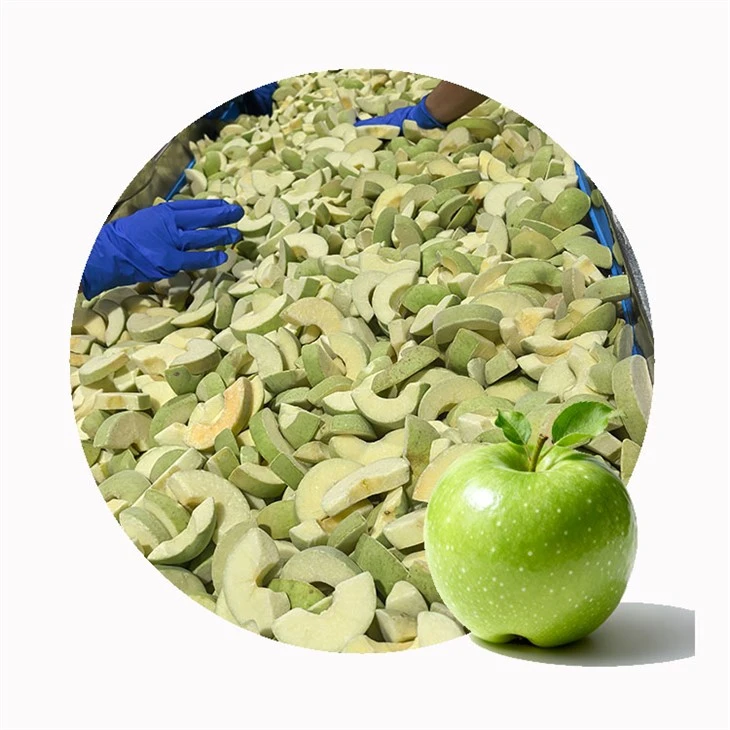
Cut geometry changes the challenge. Dice have more exposed area per kilogram than large wedges, while thin slices have a high surface-to-volume ratio and can soften rapidly. Dull blades crush tissue and create irregular surfaces that are harder to protect evenly. Specify nominal dimensions, measurement method, allowed distribution, blade inspection and broken-piece classification. The frozen green apple slice reference shows one commercial format, while frozen apple dice illustrate a different surface-area and dosing decision. Neither format is universally better.
Temperature matters because reaction rate and texture change with the material and environment. Keep the apple temperature, room conditions, wash or treatment temperature and exposure time in the test record. When two trials use different starting temperatures, a color difference cannot be assigned confidently to the treatment alone. Design the trial so only the intended variable changes, or acknowledge the confounding factors.
Worked example: exposure control. Imagine a pilot specification that allows no more than 8 minutes from final cut to treatment entry. Three trays record 5, 7 and 11 minutes. The first two meet that hypothetical process limit; the third does not. Segregate the third tray and compare its color after the specified hold and freeze-thaw test. Do not average the three times to 7.7 minutes and release all material, because the average hides a discrete excursion.

Validate Anti-Browning Treatment on the Real Product
Ascorbic acid and citric acid are common color-protection tools, and FDA lists them among ingredients used to retard color, flavor or texture changes. Published apple studies also evaluate acid combinations and heat. Those findings show possible mechanisms and trial ranges; they do not create a universal commercial formula. Cultivar, maturity, cut, concentration, solution temperature, contact time, fruit-to-solution ratio, solution age and subsequent freezing all change the result.
Start with an approved ingredient and legal-use review for the destination market. Define the ingredient identity, grade, concentration basis, make-up sequence, water quality, tank volume, contact time, drain time and solution-management rule. If your process uses pH, conductivity, titration or another verification, connect the reading to an operating action. A tank can keep the same nominal volume while organic load and effective composition change throughout a shift.
Worked example: solution make-up. A hypothetical trial calls for 1.0% weight/volume ascorbic acid in a final working volume of 100 L. The arithmetic is 1.0 g per 100 mL, or 1.0 kg brought to a final 100 L. That calculation is not a process recommendation. Before plant use, verify the food-grade specification, permitted use and declaration, water volume convention, dissolution sequence, measuring-device accuracy, contact condition and replenishment rule. Record the actual lot and result.
Judge treatment with a comparison set. At minimum, include the proposed treatment and an untreated control under the same cutting, temperature and exposure conditions. An approved reference lot can add a practical commercial benchmark. Measure color at fixed times under fixed lighting; instrument readings such as L*, a*, b*, total color difference or a defined browning index can strengthen the visual result. Also record firmness, drip, flavor, odor and any surface residue, because the palest sample is not automatically the best ingredient.
Continue the comparison after freezing, thawing and the intended application process. A treatment that looks effective after ten minutes on the bench may not protect the apple through frozen storage or baking. Conversely, a small raw color difference may disappear in a cinnamon filling but remain obvious in a pale yogurt preparation. Set the acceptance point where the material creates value, not where it is easiest to photograph.
Keep Color Control Separate from Food-Safety Control
An anti-browning dip is not automatically a microbial kill step. FDA's current guidance defines fresh-cut produce as fruit or vegetables physically altered but not additionally processed by steps such as blanching, freezing or cooking. Frozen cut apples fall outside that exact fresh-cut definition, yet the guidance remains useful for understanding hygienic design around washing, cutting and exposed tissue. Your hazard analysis must address the actual product, process, intended use and market.
Water control deserves attention because a shared wash or treatment system can transfer contamination if it is poorly managed. FDA guidance notes that effectiveness depends on water quality, organic load and the control system. It also discusses the potential for some produce, including apples, to internalize water when wash water is colder than the fruit. That does not prescribe one universal temperature difference; it tells you to evaluate your equipment, fruit condition and water-management plan rather than assuming visibly clean water is controlled.
Define raw and ready-to-eat traffic, employee practices, tool sanitation, water monitoring, corrective action, environmental controls where applicable and product testing within the site food-safety system. If the fruit will be consumed without a further validated kill step, that intended use changes the evidence required. Freezing stops or slows growth for many organisms but should not be described as sterilization.
Keep two records when a dip has both quality and food-safety relevance. The quality record demonstrates color, firmness and sensory performance. The food-safety record demonstrates the validated control, monitoring and corrective action required by the hazard plan. One attractive color result cannot substitute for microbiological evidence, and a microbiologically controlled process can still deliver unacceptable brown or soft fruit.
Freeze, Pack and Hold Without Losing the Earlier Control
Freezing preserves the state produced by the earlier process; it does not rebuild damaged tissue. A fast, controlled freeze can reduce the time spent in the major ice-crystal formation range and improve piece separation, yet cultivar, maturity, treatment and cut size still influence thawed texture. Define loading pattern, piece bed depth, freezer operating limits, product exit criterion and action for an excursion. Our processing equipment overview provides context for IQF handling, but your lot approval still needs product-specific evidence.
Codex CXC 8 describes quick freezing in terms of passing rapidly through maximum crystallization and reaching a thermal-center temperature of −18°C or colder after thermal stabilization. Treat that as a process framework, then define how your plant measures product temperature and how the destination cold chain maintains the required state. An air-temperature display alone does not prove the center temperature or uniformity of every piece.
Package performance affects dehydration, oxidation, odor pickup and physical breakage. State material structure or performance requirement, net mass, closure, headspace or evacuation condition where relevant, coding, case configuration and seal inspection. The frozen packaging reference shows available packing directions. Select the barrier and format through product, storage, distribution and filling-line trials rather than appearance alone.
Temperature fluctuation can produce clumping, frost movement and quality loss. At receipt, compare logger evidence, pallet position, case and bag condition, product temperature under the agreed method, free-flow expectation and sensory state. A few loose ice crystals do not prove abuse, and a solid block does not identify one cause. Combine observations before assigning disposition.

Turn "Protected" into a Lot-Acceptance Method
A useful apple specification separates identity, process and performance. Identity covers cultivar or declared blend, peeled or skin-on condition, slice or dice dimensions, treatment ingredients and packing medium. Process evidence can include raw maturity basis, cut-to-treatment interval, treatment control, freezing criterion and cold-chain records. Performance covers color, character, defects, free-flow state, thawed drip and behavior in the intended application.
The USDA frozen apple standard provides a structured example. Grade A requires at least 85 points and Grade C at least 70, with color, flavor, size uniformity, defects and character among the evaluated attributes. Its defect allowances include no more than 5% damaged and 1% seriously damaged by weight for Grade A, compared with 15% and 3% for Grade C. Those numbers apply when the grade and methods form part of the deal; they should not be presented as the default specification for every shipment.
Worked example: defect calculation. In a hypothetical 10.00 kg representative frozen sample, 0.38 kg is classified as damaged and 0.06 kg as seriously damaged. The results are 3.8% and 0.6% by weight. Both sit below the USDA Grade A numerical caps, but that arithmetic does not establish Grade A by itself. The lot must still satisfy the applicable sampling, color, flavor, size, defect-definition, character and total-score requirements.
For color, define the sample state, lighting or instrument, temperature, exposure time and comparator. For firmness or character, state whether the test is frozen, thawed, cooked or after a finished-product hold. For free liquid, define thaw temperature, time, screen, drainage period and whether you press the fruit. For dimensional uniformity, state how many pieces are measured and how broken pieces enter the result. Method detail turns a preference into a reproducible decision.
Inspect across the pallet or production interval instead of selecting one attractive bag. Keep the retain sample under the stated condition and link results to lot code, production date, treatment batch and packaging run. If a result is marginal, test the material in the real filling, sauce, beverage base or other application before granting a broad waiver. The intended use determines whether a color or texture deviation is harmless, visible or line-stopping.
A separate IQF diced apple format reference can help you compare offered cut and packing directions. Use it as a starting point for a sample request, then issue your own acceptance table with the methods that protect the finished result.

A Practical Approval Sequence
First, describe the finished apple state that matters: visible pale slices after baking, free-flow dice for automated dosing, a defined drained yield, or controlled breakdown in sauce. Second, select raw cultivars and maturity ranges that can produce that state. Third, map mechanical damage and timing from receiving to freezer. Fourth, compare treatment options under controlled conditions. Fifth, verify food-safety controls separately. Sixth, freeze and pack the pilot under production-representative conditions. Finally, inspect frozen, thawed and application-processed samples before locking the specification.
Do not change several variables and then claim to know which one worked. If cultivar, concentration, contact time and cut size all change between trials, you have compared two systems rather than learned the effect of one factor. That comparison may still identify a commercially useful option, but the scale-up plan must preserve the entire tested system. Factorial or staged trials provide stronger evidence when several variables matter.
Set failure rules before seeing the result. Define what triggers hold, retest, segregation, rework or rejection. Identify who can approve a deviation and what application evidence supports it. Without a pre-agreed rule, the same brown spot, soft piece or clumped bag may receive different decisions on different days.
To qualify a frozen apple supply: send us your cut, peel condition, treatment or clean-label boundary, color reference, defect limits, application, packing and destination requirements. We can match the request to an available format and coordinate a sample for your own thawing and application test.
Frequently Asked Questions
Why do apples turn brown after cutting?
Cutting breaks cells and brings enzymes, phenolic compounds and oxygen together. Cultivar, maturity, tissue damage, surface area, temperature, exposure time and treatment change the rate. Measure the color under a defined condition rather than treating all brown appearance as the same problem.
Does lemon juice or citric acid always prevent apple browning?
No single acid condition works equally for every cultivar, cut and product. Acidification can slow enzymatic browning, while ascorbic acid can act as an antioxidant, but concentration, contact, temperature, solution condition and later processing affect performance. Commercial use also needs ingredient-grade, legal and labeling review for the destination market.
Can freezing stop apples from turning brown?
Freezing slows reactions while the product remains frozen, but it does not repair color or tissue damage already present. Color can also change during processing, temperature fluctuation or thawing. Control the cut-to-freezer sequence and assess the fruit after the intended freeze, storage, thaw and application cycle.
Is an anti-browning dip a food-safety treatment?
Not automatically. A quality dip may be designed for color without being a validated microbial control. Keep hygienic design, water control, sanitation, hazard analysis, monitoring and corrective action in the food-safety plan, and validate any kill or reduction claim for the actual process.
How should frozen apples be checked on arrival?
Use the agreed sampling plan and inspect coding, package and seal condition, product temperature, free-flow state, frost, color, odor, piece size and defects. Then run the defined thaw test for drip and character and, where performance matters, process the fruit in the intended formula. Compare the result with the approved reference or numerical limits.
References
- USDA Agricultural Marketing Service. Frozen Apples Grades and Standards. Accessed August 21, 2026.
- USDA Agricultural Marketing Service. United States Standards for Grades of Frozen Apples. Accessed August 21, 2026.
- UC Davis Postharvest Research and Extension Center. Apple: Red Delicious Produce Facts. Accessed August 21, 2026.
- Penn State Extension. Determining Apple Fruit Maturity and Optimal Harvest Date. Accessed August 21, 2026.
- Penn State Extension. Fruit Harvest: Handling of Frozen Apples. Accessed August 21, 2026.
- FDA. Guide to Minimize Microbial Food Safety Hazards of Fresh-cut Fruits and Vegetables. Accessed August 21, 2026.
- FDA. Guide to Minimize Microbial Food Safety Hazards for Fresh Fruits and Vegetables. Accessed August 21, 2026.
- FDA. Types of Food Ingredients. Accessed August 21, 2026.
- Shrestha L, et al. Optimisation of Physical and Chemical Treatments to Control Browning Development and Enzymatic Activity on Fresh-cut Apple Slices. Accessed August 21, 2026.
- USDA Agricultural Research Service. Use of Anti-browning Agents on Fresh-cut Apples. Accessed August 21, 2026.
- Codex Alimentarius Commission. CXC 8-1976, Code of Practice for the Processing and Handling of Quick Frozen Foods.