


Can You Freeze Kiwi Fruit? Form, Texture & Buyer Guide
Aug 21, 2026

Yes, kiwi fruit can be frozen, but the useful answer depends on what you need after freezing. Whole peeled fruit, slices, dice and pulp do not thaw into the same working material. Freezing normally makes kiwifruit softer and increases juice release, so an attractive frozen piece may still fail a garnish, yogurt or fruit-preparation trial. Choose the form from the application, then approve ripeness, size, frozen separation, thaw loss, color, flavor and usable yield by a written method.
For household preservation, ripe kiwi may be frozen whole, sliced or crushed. For commercial supply, we usually prefer peeled slices or controlled dice when portioning, dosing and repeatable thawing matter. Whole peeled kiwi can suit later cutting or blending, but it transfers knife work and variable yield to your operation. The specification should also name the variety or color type, intended use, treatment status, pack, safety evidence and release rule.
The short answer: Freeze ripe, sound fruit in the form you will actually use. Do not promise fresh-fruit firmness after thawing. For a purchase decision, compare at least one frozen-state test and one application test, then calculate accepted yield rather than judging only the invoice price.
Separate Fresh-Fruit Chilling From Intentional Freezing
Fresh kiwifruit storage and frozen-ingredient production are different systems. UC Davis describes 0°C as the optimum fresh-storage temperature for kiwifruit and warns that susceptible early-picked fruit can suffer freezing injury below 0°C. That warning concerns accidental injury to fruit intended to remain fresh. It does not mean that prepared kiwi cannot be frozen for a frozen application.
Intentional freezing accepts a state change. Ice formation disrupts fruit structure, and the thawed tissue usually becomes softer and releases more liquid. Your decision is therefore not "Did the kiwi stay exactly fresh?" It is "Does the selected frozen form deliver the color, flavor, piece integrity, drain behavior and process yield required by the finished product?" A smoothie base and a clear fruit garnish will answer that question differently.
Do not use fresh defects and frozen defects interchangeably. Fresh bruising, decay, hard core, uneven ripeness and poor flavor remain raw-material concerns. In the frozen pack, add peel remnants, cut-size variation, fragments, fused pieces, loose ice, dehydration and thaw drip. One source problem can appear in several ways after freezing, so preserve raw-lot identity and a retained finished sample when the order is quality-sensitive.
Choose Whole, Sliced, Diced or Pulp by the Final Job
Oregon State University Extension notes that fully ripe kiwifruit may be frozen sliced, crushed or whole. Its preservation guidance also describes individually freezing slices before packing. That is practical household advice, and it reveals a commercial principle: form controls handling. A piece that is easy to separate, weigh and transfer creates a different operating result from one solid mass or one whole fruit.
| Frozen form | Where it can fit | Main acceptance risk | Test before approval |
|---|---|---|---|
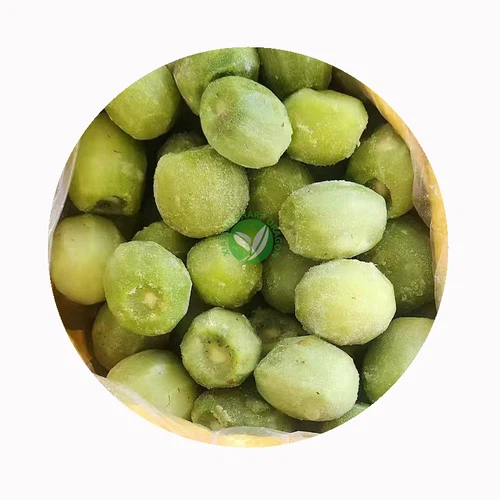
| Whole peeled | Further cutting, blending or puree | Variable thaw time, core, trimming and labor | Thaw profile, trim yield and flavor distribution |
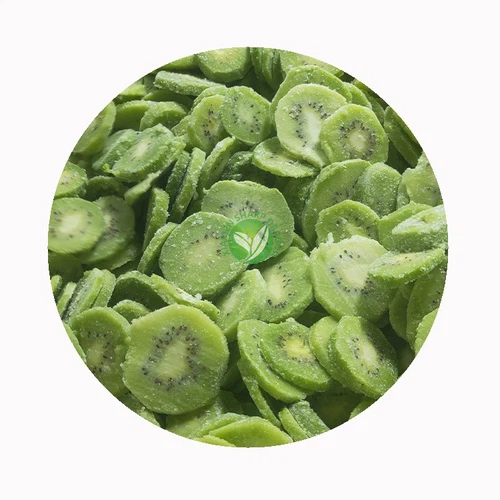
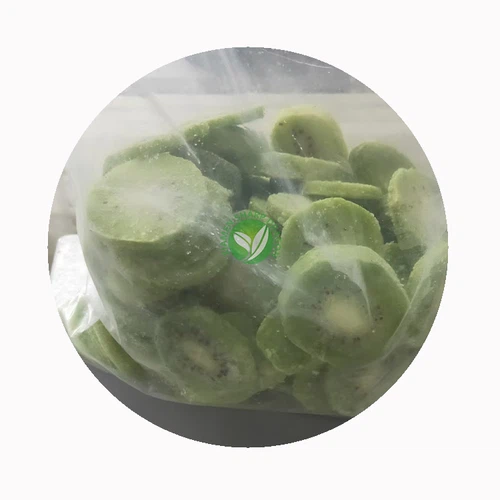
| Slices | Desserts, topping, garnish and retail mixes | Breakage, sticking, translucency and soft edges | Thickness distribution, separation and display hold |
| Dice | Yogurt fruit prep, bakery, beverage and portion dosing | Small fragments, juice loss and size variation | Screen or caliper method, usable yield and mixing trial |
| Crushed or pulp | Sauce, beverage, sorbet and blended systems | Separation, seed level, Brix basis and enzyme activity | Mixing, settling, flavor and finished-recipe trial |
Whole fruit is not automatically more premium. If whole fruit forces you to temper, trim a hard core and cut every piece before use, it may have the highest usable cost. Dice is not automatically efficient either: very small pieces have more cut surface, can release more juice and can disappear into a sauce. Approve the form that removes the right work without creating a new quality loss.
If you sell retail mixed fruit, inspect how kiwi pieces behave beside berries or mango during filling and consumer thawing. If you run a beverage line, focus on pumpability, seed distribution, screen blockage and flavor. If you prepare desserts, test visibility, edge integrity and hold time. These are different buyer perspectives, so one "good frozen kiwi" sample cannot answer all three.
Ripeness Changes Flavor, Firmness and Frozen Yield
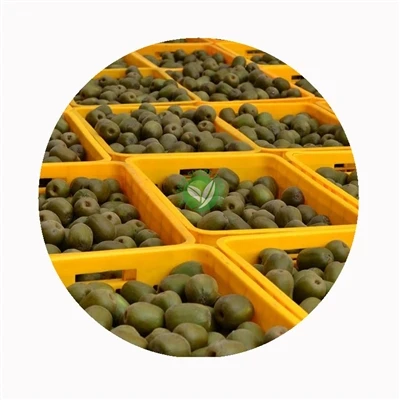
Raw maturity is one of the strongest decision variables. Fruit picked too early can be firm but weak in flavor and uneven in ripening. Over-soft fruit can taste developed but lose shape during peeling, cutting, freezing and thawing. OSU recommends fully ripe fruit for freezing while rejecting soft or mushy material; that distinction is more useful than the word "ripe" alone.
UC Davis reports fresh kiwifruit maturity indices including at least 6.5% soluble solids at harvest and at least 14% soluble solids when ripe. Those figures describe its fresh postharvest guidance, not a universal frozen-kiwi purchase limit. Variety, production region, crop, destination, added ingredients and application can change the appropriate Brix target. Use the published figures to understand the maturity path, then write an order-specific frozen specification supported by your approved sample.
State how soluble solids are measured: sample preparation, temperature correction, number of pieces, pooled or individual test, and instrument. A pooled Brix value can hide a mixed lot with bland and overripe fruit. For a visible retail piece, also score color, core condition, seed distribution, characteristic aroma, sourness and any fermented or stale note. For a blended application, the pooled result may matter more; run the actual recipe and record flavor, separation and finished yield before approval.
Green, gold and other commercial kiwifruit types should not be treated as color variants of one identical ingredient. Their flavor, pigments, acid balance and protease activity can differ. Name the accepted variety or color type, or define what substitutions require a new sample. A silent change can alter dessert appearance, dairy behavior, sweetness balance and label artwork even when the carton still says frozen kiwi.

Write the Cut, Defect and Frozen-Separation Methods
A nominal cut size needs a tolerance and a method. For dice, state whether dimensions are checked with a caliper, a screen, or a defined piece sample. Name the acceptable range, the share that may fall outside it and the minimum fragment dimension or mass used during inspection. For slices, state thickness, diameter basis, whole-ring or partial-slice allowance, and whether edge fractures enter the broken total.
Keep cut defects separate from raw-material defects. Peel residue, stem-end tissue, hard core, yellow or brown areas, bruised flesh, decay, misshapen pieces and foreign material should not disappear into one total. Write one rule for overlapping defects before inspection. Otherwise, your inspectors may count the same small discolored fragment under size, color and broken-piece categories, producing a total that cannot be repeated.
Frozen separation also needs a physical rule. State the sample temperature, mass, clump definition, whether gentle hand pressure is allowed, and how loose ice is weighed. A bag may contain individually recognizable slices yet still be too fused for your dosing system. Conversely, a few lightly joined pieces may separate without labor and have no commercial effect. Tie the limit to the operation rather than asking only whether the label says IQF.
Photographs are useful only when the viewing condition is controlled. Compare the same frozen or thawed state, lighting, sample depth and background. Color cards can help communication, but the approved physical sample remains important because kiwifruit translucency and wetness change the visual result. Retain both the image and the written defect definition.

Use a Thaw Test That Matches the Application
A thaw result is meaningful only when the method is repeatable. Name the frozen sample mass, container, thaw temperature, endpoint, drain screen, drain time and handling. A sample thawed overnight in a covered refrigerator cannot be compared directly with one warmed in an open room or rinsed under water. The XMSD frozen-food thawing guide gives general method boundaries; your kiwi trial still needs its own time, temperature and evaluation point.
Measure thaw loss as drained liquid mass ÷ frozen sample mass × 100, if that basis matches your use. Record drained fruit mass separately. For a piece application, sort accepted pieces after draining and calculate accepted-piece yield as accepted piece mass ÷ frozen sample mass × 100. For puree, drained liquid may remain in the recipe, so separation and remixing behavior can matter more than drained yield.
Worked example: A hypothetical 1,000 g frozen slice sample produces 82 g of free liquid after the agreed refrigerator-thaw and five-minute drain. Thaw loss is 82 ÷ 1,000 × 100 = 8.2%. The drained fruit weighs 918 g, but only 856 g meets the garnish definition after broken and translucent pieces are removed. Accepted-piece yield is 856 ÷ 1,000 × 100 = 85.6%. A purchase limit should say whether it controls the 8.2% liquid, the 85.6% accepted yield, or both.
Test frozen use as well as thawed use. A smoothie process may add pieces from frozen and never create a separate drain step. A dessert plant may temper only enough to place slices. A fruit-preparation line may heat and mix the complete pack. Run the actual sequence and record blend time, pump or depositor behavior, visible piece retention, flavor and finished-product hold.
Test Actinidin in Dairy, Gelatin and Protein Applications
Kiwifruit is not a passive flavor particle in every recipe. Green kiwifruit contains actinidin, a proteolytic enzyme that can break down proteins. Peer-reviewed work shows that green and SunGold kiwifruit differ in actinidin activity and that kiwifruit extracts can change the breakdown of several food proteins. That evidence explains why recipe behavior may change; it does not predict your commercial formula without a trial.
OSU preservation guidance warns that fresh and frozen kiwifruit should be heated to boiling before use in gelatin dishes. For a commercial gel, yogurt, dairy dessert, plant-protein drink or meat marinade, define the fruit type, addition rate, contact time, pH, heat treatment and hold condition. Then compare viscosity, gel set, syneresis, flavor and piece condition against a control. Do not assume freezing has deactivated the enzyme.
Application example: If you add green kiwi dice to a chilled dairy cup, test the complete cup at initial release and through the declared shelf-life checkpoints. If viscosity falls or whey separation rises, investigate fruit addition rate, protease activity, heat sequence and contact time. The answer may be a validated heat-treated fruit preparation, a different variety, a later addition step or a reformulated stabilizer system. It is not enough to approve the fruit by taste alone.
For a smoothie, protease behavior may be commercially unimportant because the drink is blended and consumed quickly. For a formed gel or protein-rich product, it may decide whether the formula works. Put the application test in the specification or product-development file when the consequence is material.
Keep Food Safety Separate From Frozen Appearance
Freezing is not a substitute for hygienic raw-material handling. OSU's freezing guidance notes that freezing does not kill most microorganisms. A green color, hard-frozen state and clean flavor cannot establish microbiological status. Confirm intended use, destination requirements, supplier hazard controls, agreed organisms and limits, sampling plan, laboratory method, reporting unit and lot connection.
Ready-to-eat, ready-to-use and intended-for-processing are different declarations. If the kiwi will enter a smoothie, garnish or dairy product without a later validated kill step, review the evidence and environmental-control expectations for that use. If it enters a validated heated filling, record the process responsibility and preparation instruction. Do not infer use status from the word peeled or IQF.
At receipt, quarantine damaged or leaking packs and preserve lot identity. Compare seal condition, carton marks, frozen state, temperature evidence, clumps, loose ice, dehydration, color and odor with the approved rule. The XMSD quick-frozen food receiving guide explains how accept, hold and reject decisions need evidence rather than one visual sign.
Match Packaging and Cold Chain to Withdrawal Rate
Packaging should protect the form you approved. Slices can fracture when headspace, carton compression or handling permits movement. Dice may fuse when surface water, sealing or temperature cycling is poorly controlled. Whole peeled fruit may tolerate some physical pressure but creates a larger thawing unit. Specify inner material, seal, nominal net weight, weight-control rule, units per carton, carton strength, lot code, pallet pattern and storage statement.
Pack size should match the amount withdrawn per batch. A 10 kg liner can reduce packaging cost for a continuous line, but repeated opening in a low-volume kitchen can expose the remaining fruit to moisture and temperature change. Smaller sealed units add material and handling but may protect separation and reduce unused thawed product. The XMSD frozen-food packaging overview provides format context; use the signed kiwi pack specification and approved artwork as the order controls.
Write the deviation response before shipment. Name the temperature measurement method, evidence hierarchy, quarantine responsibility, notification window, sample checks and disposition authority. A brief reefer-air rise does not by itself prove that fruit softened, while fused pieces or heavy loose ice do not identify one cause. Combine logger, pack, product and application evidence before release.
Compare Usable Cost Instead of Delivered Price Alone
The lowest price per kilogram can be expensive after peel residue, hard core, fragments, clumps, drip and off-spec color are removed. Calculate usable cost as delivered price ÷ accepted-yield fraction. Define accepted yield for the real job. A smoothie may use soft pieces and juice that a garnish program rejects, so the same physical lot can produce two legitimate yield results.
Worked cost comparison: Sample A costs USD 2.10/kg and gives 91% accepted output under a fruit-preparation trial. Its usable cost is 2.10 ÷ 0.91 = about USD 2.31 per accepted kilogram. Sample B costs USD 2.00/kg but gives 84% accepted output, so its usable cost is 2.00 ÷ 0.84 = about USD 2.38. Under those assumptions, the higher delivered price is the lower usable cost. Repeat the calculation with your own labor, drain, reject and process data.
Add operational cost when it changes the result. Free-flowing dice can reduce manual breakup. A stable distribution can improve depositor accuracy. Whole peeled fruit can add tempering and cutting labor. A larger bag can reduce material cost but increase partial-pack waste. Record the difference during a controlled trial instead of turning one sample impression into a purchase promise.
XMSD sourcing note: Compare the available XMSD frozen kiwi forms and the peeled kiwi product format. Use them as a starting range, then lock the nominated item, sample, variety, size, treatment, pack and lot evidence in the order specification.
Use One Approval Sequence From Sample to Arrival
Sequence prevents a late commercial change from invalidating an earlier technical decision. There is little value in approving slice appearance before the application and thaw method are fixed, or in approving retail artwork before ingredients, treatment state and destination language are known. Work from identity to method, application, evidence, pack and arrival so each decision has the inputs it needs. If a step changes, trace which later approvals must be repeated instead of assuming the first sample still represents the order.
- Lock identity and use. State green, gold or accepted variety; whole, slice, dice or pulp; peel status; ingredients; treatment state; intended use and destination.
- Define the sample and methods. Name sample mass, number of packs, conditioning state, Brix method, dimension test, defect glossary, clump test and thaw protocol.
- Run the application trial. Test smoothie, dairy, gel, dessert, fruit preparation or retail mix under the actual recipe, equipment, hold and display conditions.
- Approve safety and label evidence. Match intended use to hazard controls, microbiological criteria, laboratory scope, lot documents and destination label requirements.
- Lock pack and shipment controls. Approve liner, unit weight, carton, marks, pallet pattern, frozen storage, loading records and deviation response.
- Repeat the decision at arrival. Verify identity, evidence and condition; apply the same frozen, thaw and application methods; calculate accepted yield; release or hold under the written rule.
Keep one controlled specification with version and approval date. If variety, raw maturity, plant, process route, cut, treatment, pack or label changes, name which approvals must be repeated. The product name alone cannot protect texture, enzyme behavior or yield.
Frequently Asked Questions
Can kiwi fruit be frozen whole?
Yes. Fully ripe sound kiwi can be frozen whole, but whole fruit is slower to thaw and harder to portion. Peeled slices or dice are usually more practical when you need controlled dosing, quick application trials or visible pieces.
Why is kiwi soft after thawing?
Ice formation damages fruit structure, so thawed kiwi normally loses firmness and releases juice. Judge it in the intended application and use a written thaw-loss or accepted-yield method rather than requiring it to behave like freshly cut fruit.
Can frozen kiwi be used in gelatin or dairy products?
It can, but green kiwifruit contains the protein-breaking enzyme actinidin. OSU advises heating fresh or frozen kiwi to boiling before gelatin use. Commercial dairy, gel and protein formulas need a trial covering variety, fruit dose, heat sequence, contact time and hold.
Should frozen kiwi be thawed before blending?
Not always. Smoothie and beverage systems often use fruit from frozen, while pumps, mixers or recipes may require controlled tempering. Follow the validated equipment and recipe method, then compare blend time, temperature, separation and flavor.
Send your intended use, variety or color type, form, size, Brix method, defect limits, thaw test, pack, destination and annual volume through the XMSD inquiry form. We can organize the questions needed for a nominated frozen kiwi sample and order-specific specification.
Final Thoughts from XMSD
Kiwi fruit freezes successfully when the frozen form is chosen for a real job. The strongest decision starts with ripe, sound raw material, defines whole, slice, dice or pulp precisely, accepts the normal texture change, and measures frozen separation, thaw loss, application behavior and usable yield.
For commercial orders, add the actinidin question where proteins or gels matter, keep safety evidence separate from appearance, and carry one test method from sample approval through arrival. That approach gives you a defensible specification instead of a simple yes-or-no answer.
References
- Oregon State University Extension: Preserving Kiwifruit.
- Oregon State University Extension: Freezing Fruits and Vegetables.
- UC Davis Postharvest Research and Extension Center: Kiwifruit Produce Facts.
- University of Minnesota Extension: How to Freeze Fruit Safely.
- Kaur et al.: Actinidin in Green and SunGold Kiwifruit and Alternative-Protein Digestion.
- Study of Color, Texture and Flavor Changes in Frozen-Stored Xuxiang Kiwifruit Pulp.