


How Lotus Root Grows: Frozen Quality Guide | XMSD
Dec 11, 2019

Lotus root grows as an underground storage rhizome of Nelumbo nucifera. It develops horizontally in saturated soil beneath shallow water while leaves and flowers rise above the surface. The edible chain of connected segments is therefore not a tree root, a flower fruit, or a seed pod. That identity explains why water depth, soil condition, planting material, cultivar, growth temperature, maturity, and harvest method can influence the raw material that reaches a freezing line.
For frozen supply, the useful question is not only how the plant grows. You need to know how the crop system affects segment diameter, internode length, hole pattern, flesh color, tenderness, starch development, field soil, surface injury, trimming loss, browning risk, cut yield, and supply timing. We connect those farm variables with an agreed frozen specification, a representative sample, and records from the nominated source and processing facility.

The edible product is a chain of swollen underground rhizome segments; field conditions and harvest handling shape the usable raw material.
Quick Answer: How Does Lotus Root Grow?
A production crop normally begins with a selected rhizome piece carrying viable buds. In warm flooded or waterlogged soil, buds sprout and send shoots upward. Floating and standing leaves capture energy while horizontal runners expand through the soil. As the plant moves toward maturity, terminal portions enlarge into starch-storing rhizomes made of recognizable nodes and internodes. Growers then lift the rhizomes from mud or saturated soil, taking care to limit cuts, bruises, broken ends, and embedded foreign material.
Auburn University research describes lotus planted in tilled ponds or rice fields for vegetable production and notes that large edible-rhizome types differ from small ornamental types. The same research reports faster growth in warm conditions, with 22–32°C cited as an optimum range in the reviewed literature, and discusses yield responses to water depth. Treat those figures as biological context, not a universal purchase limit: cultivar, latitude, field design, soil, planting date, and management change the commercial result.
A Southern University agricultural guide describes sacred lotus as an aquatic crop suited to nutrient-rich loamy soil and warm conditions, with mature rhizome harvest around six to nine months. Your contract still needs the actual crop window and processing date. A calendar estimate cannot replace lot-level evidence or a cut-and-cook trial.
The Edible "Root" Is a Rhizome
A true root absorbs water and nutrients and anchors the plant. A rhizome is a modified stem that grows horizontally, carries nodes and buds, and stores reserves. Lotus produces fine true roots as well as the thick edible rhizome. The commercial name "lotus root" remains correct in food trade, but the botanical distinction helps you understand its repeating chambers, segment joints, buds, branching, and chain-like shape.
Every cross-section reveals air canals arranged in the familiar hole pattern. The number, shape, and symmetry can vary with cultivar and segment position. Do not approve a crop by one perfect ring. Define the acceptable diameter band, thickness, hole appearance, broken-ring limit, edge condition, peel residue, discoloration, and texture for the actual cut.
Our IQF frozen lotus root range gives a commercial view of available forms. For a serious comparison, add a drawing or measured reference photograph to the specification so both sides use the same definition of slice diameter, thickness, intact hole pattern, and damaged edge.
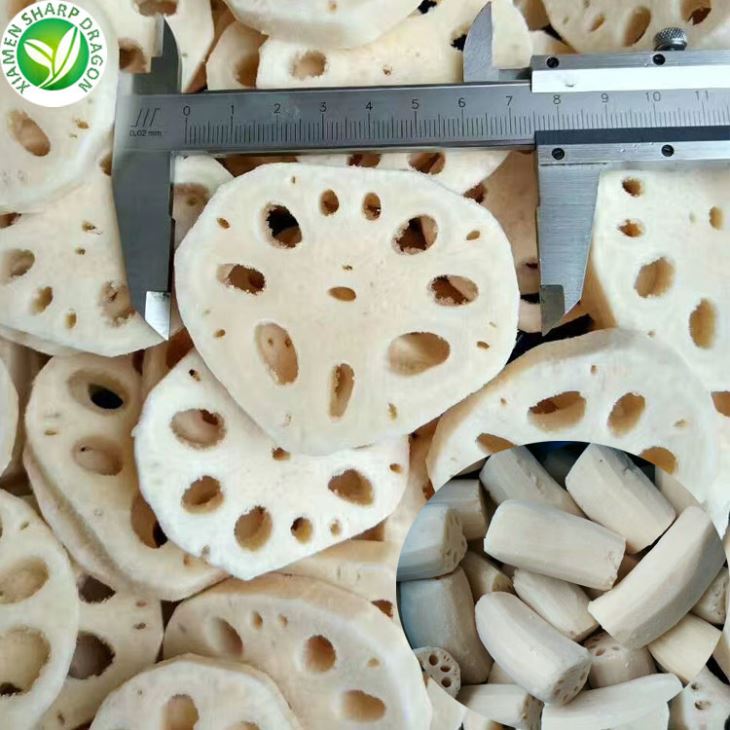
Nodes, internodes, and air canals create the recognizable ring; commercial acceptance still depends on a measured cut distribution.
Growth Stages That Matter to Frozen Supply
Planting material sets the biological starting point. Healthy rhizome pieces with suitable buds support establishment, while weak, damaged, diseased, or mixed planting stock can create uneven stands. For traceable supply, request the crop type or cultivar name where available, planting source, field or pond identifier, planting period, and agricultural-control records. These details are especially useful when you need repeat color, diameter, texture, or harvest timing.
During vegetative growth, shoots and leaves expand while runners spread through submerged soil. Water level, nutrient status, temperature, competition, pests, and disease affect vigor. A strong canopy does not automatically guarantee a suitable processing rhizome. Your supply review needs to connect field observations with harvested segment measurements and factory yield, because the food output is below the surface.
Rhizome swelling and reserve accumulation determine much of the commercial maturity. Very young material can be small and tender with a different cooking response. More mature material can be larger and starchier, yet excessive age or unsuitable conditions can bring coarse texture, internal discoloration, cracks, decay, or variable segment geometry. Avoid a universal "young is best" or "large is best" rule. Link maturity to the target cut, cooked bite, yield, and visual grade.
Senescence and harvest timing complete the crop cycle. Regional weather, crop purpose, cultivar, and planting period can create more than one commercial window. Frozen inventory can support shipment beyond the fresh harvest, but it does not erase crop identity. Ask for production date, lot code, frozen-storage history, remaining shelf life, and evidence that the offered sample represents the stock you will receive.
Practical example: maturity must match the application
A hot-pot program wants attractive 7–9 mm rings that keep a crisp-tender bite after a short cook. A filling plant dices the product and cooks it for longer in a seasoned mixture. The first program may value ring symmetry, narrower diameter bands, and structural integrity more heavily; the second may accept less visual uniformity but demand predictable dice yield and moisture behavior. Run both cooking methods before choosing one crop profile for both uses.
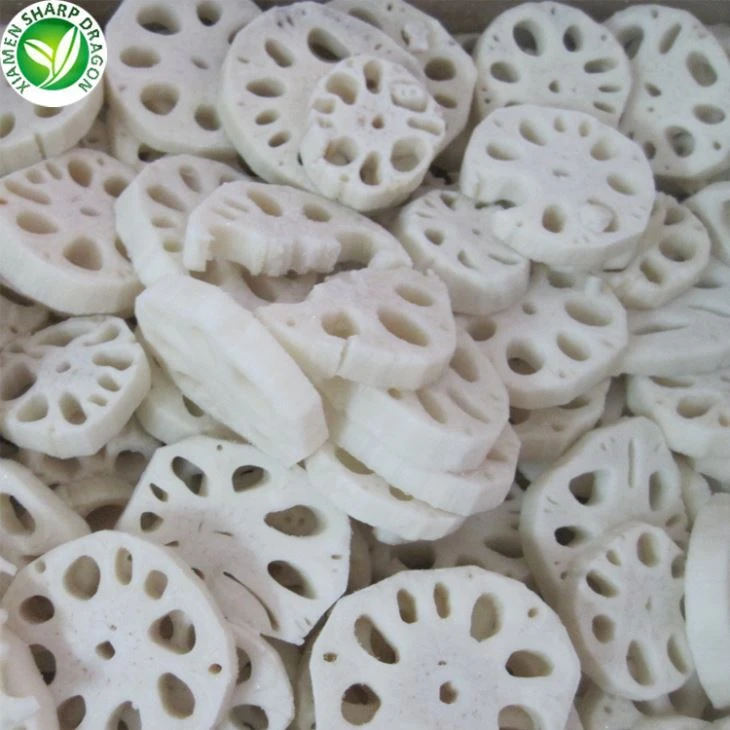
Use the required cooking method to decide whether crop maturity, diameter, and ring structure suit the intended product.
Water, Soil, and Temperature Affect the Raw Material
Lotus is adapted to aquatic cultivation, but "grown in water" is too vague for qualification. The rhizomes develop in soil beneath the water, so field depth, sediment character, drainage or flooding management, nutrient supply, and harvest access matter. Auburn's production research found that shallow water could support higher biomass or yield in studied systems and cited roughly 10–20 cm as an ideal depth in one source. Large and small types respond differently, so do not turn a research value into a supplier guarantee without crop-specific evidence.
Soil texture affects root-zone aeration, nutrient availability, rhizome expansion, adhering mud, and harvest difficulty. Heavy compacted conditions can make lifting harder; stones or hard debris raise physical-damage and foreign-material risk. Very loose or poorly managed beds can create another set of stability problems. Ask how the source controls field selection, water quality, agricultural inputs, harvest hygiene, soil removal, and lot segregation.
Warmth drives sprouting and active growth, while cool conditions slow development. Heat totals, not one daytime reading, shape maturity. Weather can also affect pest pressure, disease, water management, and harvest access. Instead of demanding an unsupported climatic promise, request the named origin, crop period, supplier risk review, and any material change that could affect volume or quality.
Our farm-base sourcing framework links crop-region selection with raw-material and supply planning. For your lot, we confirm the nominated source and partner facility, then align any farm evidence with the frozen product specification rather than relying on a generic farm claim.
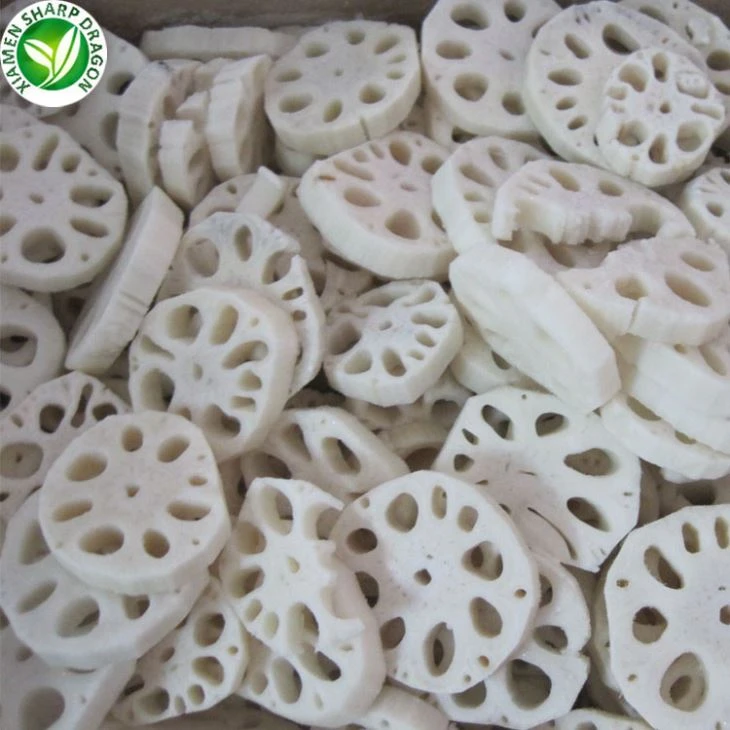
Field conditions matter only when their effects are checked against color, damage, geometry, texture, and processing yield.
Harvest Damage Can Become a Frozen Defect
Harvesting an edible rhizome from mud is physically demanding. Lifting, digging, washing, piling, loading, and transport can cut or bruise segments. Broken ends expose internal tissue, increase trimming, accelerate discoloration, and create entry points for decay. Damage that looks minor on a muddy raw segment can become an obvious dark edge or broken ring after peeling and slicing.
Build a receiving standard around soundness, freshness, segment diameter, damage, cracks, decay, pest injury, abnormal odor, mud, stones, other foreign material, and suitability for the nominated cut. State how the load will be sampled and weighed. Separate intake rejection, trim loss, downgrade, and disposal so your yield data show where value is lost.
Harvest-to-processing time matters because exposed flesh browns readily and fresh material continues to change after lifting. Do not rely on a marketing phrase such as "processed quickly." Record the harvest or receipt window, transport condition, receiving time, storage condition before preparation, and production start. Investigate any delay alongside color, odor, firmness, decay, trim, and microbiological controls.
Practical example: score a raw-material delivery
From a defined receiving sample, record 100 segment units. Suppose 72 are sound and in the target diameter band, 12 are sound but off-size, 8 have harvest cuts requiring extra trim, 5 show dark internal damage, and 3 show decay. Do not report "80% good" by combining unlike conditions. Keep the 72% target-grade result, 12% usable off-size result, 8% trim-risk result, and 8% serious-defect result separate, then compare each category with the agreed limit and disposition.
From Muddy Rhizome to IQF Lotus Root
A typical frozen route includes raw receiving, sorting, soil removal, washing, peeling, trimming, slicing or dicing, rinsing or validated color-control treatment where specified, blanching or enzyme deactivation where required, cooling, drainage, IQF freezing, inspection, foreign-material controls, weighing, packing, and frozen storage. The exact route, equipment, processing aids, and control limits must match the facility, intended use, destination rules, and customer specification.
Codex CXS 320-2015 defines quick-frozen vegetables as sound raw material prepared by operations such as washing, peeling, grading, cutting, and blanching as appropriate. It requires the maximum ice-crystallization range to be passed quickly and the thermal center to reach −18°C after stabilization. The standard also calls for reasonably uniform characteristic color, soundness, cleanliness, freedom from grit and foreign material, and normal flavor and odor.
Peeling and trimming control the trade-off between appearance and yield. Insufficient removal leaves peel, dark tissue, joints, or damaged areas. Excess removal wastes edible flesh and changes ring diameter. Cutting blades and feed settings influence thickness distribution, edge tearing, broken holes, and fines. Blanching and cooling affect enzyme control, color, texture, flavor, microbial load, and cooking behavior. Validate the process with the exact slice or dice, not an unrelated root vegetable.
Review the standard flow and commercial formats on our IQF lotus root slices page. Our role is to match your specification with a qualified production route, confirm evidence for the selected facility, and keep the released lot tied to the approved sample.
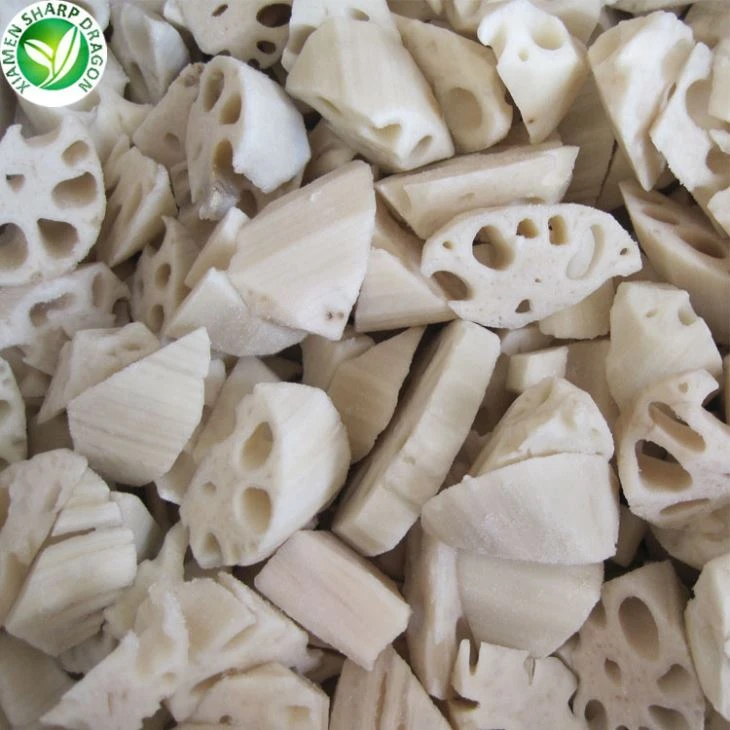
Peeling depth, blade condition, blanching, cooling, and freezing must protect the agreed color, shape, and cooked bite.
Turn Crop Variation into a Measurable Specification
Start with identity: Nelumbo nucifera, edible rhizome, frozen state, processing state, ingredients, and any treatment or additive declaration. Then define style. For rings, state diameter bands, thickness, measurement state, in-range percentage by mass or count, broken-ring definition, partial rings, end pieces, and hole-pattern requirements. For dice or irregular cuts, define three dimensions, undersize, oversize, fines, and misshapen pieces.
Set appearance limits for expected color, browning, black spots, vascular discoloration, peel residue, mud, decay, pest damage, mechanical damage, and foreign material. Use reference photographs with clear labels. Frozen frost can hide surface color, so name the inspection state. If you thaw or cook the product, standardize time, temperature, water or sauce ratio, drainage, hold time, and evaluation temperature.
Texture needs an application method. "Crisp" can describe a short hot-pot cook, a stir-fry, or a refrigerated tasting method with different results. State the equipment, starting state, portion, heating conditions, endpoint, and target. Record fibrousness, mealiness, toughness, fracture, internal resistance, and structural integrity separately.
| Crop or process variable | Frozen lot signal | What to specify or record |
|---|---|---|
| Cultivar and maturity | Diameter, color, starchiness, tenderness, hole pattern | Source identity, crop window, cut-and-cook result |
| Soil and harvest | Mud, stones, cuts, bruises, broken ends, trim loss | Receiving defect categories and disposition |
| Peeling and cutting | Peel residue, missing flesh, torn edges, variable thickness | In-range distribution and defect limits |
| Blanching and cooling | Color, enzyme stability, softness, flavor, cook time | Validated route and application test |
| Freezing and storage | Clumping, ice, dehydration, breakage, texture loss | Product temperature, pack, lot date, storage evidence |
Practical example: measure the whole slice distribution
An agreed ring specification calls for 50–60 mm diameter and 7–9 mm thickness. In a 50-slice test, 45 pieces meet both ranges, 2 are thin, 1 is thick, and 2 are below the diameter band. In-range result = 45 ÷ 50 × 100 = 90%. If the contract minimum is 92%, place the sample on hold even if its average diameter and average thickness appear acceptable. An average can hide the tails that disrupt cooking and pack appearance.
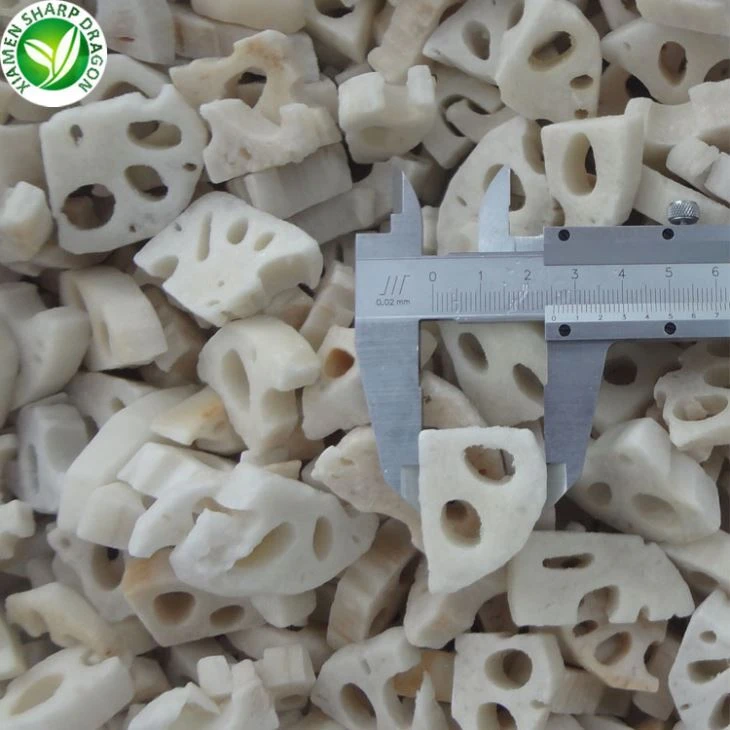
Measure diameter and thickness as a distribution, then record broken rings, torn edges, dark spots, and peel residue separately.
Calculate Raw Need and Usable Cost
Raw lotus root does not convert one-for-one into released IQF product. Intake rejection, mud and field material, broken ends, peel, joints, damaged tissue, trim, off-size rings, cutting fines, blanching and drainage changes, freezer loss, final sorting, and packing defects all affect output. Define each weighing point and keep prime product, downgrade, rework, and waste separate.
Worked example: calculate raw rhizome for an 18,000 kg order
Representative trial data show 89% remaining after intake rejection and trimming, 96% accepted after peeling and cutting defects, and 94% released after blanching, freezing, and final sorting. Combined yield = 0.89 × 0.96 × 0.94 = 0.802944, or 80.2944%. Required raw lotus root = 18,000 ÷ 0.802944 = 22,418 kg. This is a planning example, not a yield promise; use records from the named crop, cut, plant, and acceptance plan.
The same discipline improves quotation comparison. Supplier A offers at USD 1.05/kg delivered, with 96% accepted frozen product and 90% usable mass after the customer cook. Usable cost = 1.05 ÷ (0.96 × 0.90) = USD 1.22/kg. Supplier B quotes USD 1.09/kg, with 98.5% accepted product and 94% cook retention. Usable cost = 1.09 ÷ (0.985 × 0.94) = USD 1.18/kg. The higher invoice price produces the lower usable cost in the trial.
Add packing, freight, duty, thaw or cook loss, labor, line interruption, downgrade, and complaint exposure where relevant. A crop story has commercial value only when it helps explain repeatable output, supply timing, risk, and landed performance.
Residues, Hygiene, Traceability, and Release Evidence
Aquatic cultivation does not remove the need for a farm hazard review. Map agricultural chemicals, irrigation or pond water, neighboring activity, soil contaminants, harvest tools, containers, workers, transport, mud removal, and raw holding. Test pesticide residues against the destination maximum residue limits and customer restrictions for the crop and origin. Build heavy-metal or other contaminant testing from risk, law, and supplier history rather than attaching one generic panel to every program.
At the facility, connect raw receiving, water quality, sanitation, exposed-product controls, blanching where used, cooling, foreign-material prevention, freezing, packing, and storage to the hazard analysis. Freezing inhibits growth but is not a kill step for all contamination. State whether the frozen lotus root is raw, blanched, partially cooked, or ready for a validated further cook, and align label directions and microbiological criteria with that status.
A release file can include farm or sourcing code, harvest or receipt period, raw-material lot, production date, finished lot, specification results, COA, applicable microbiological and residue reports, traceability record, process checks, foreign-material controls, net-weight result, pack and label approval, product temperature, and nonconformance disposition. Use our certification overview to start the document discussion, then match every certificate to the legal entity, site, product scope, standard, issuer, and validity dates for the nominated facility.
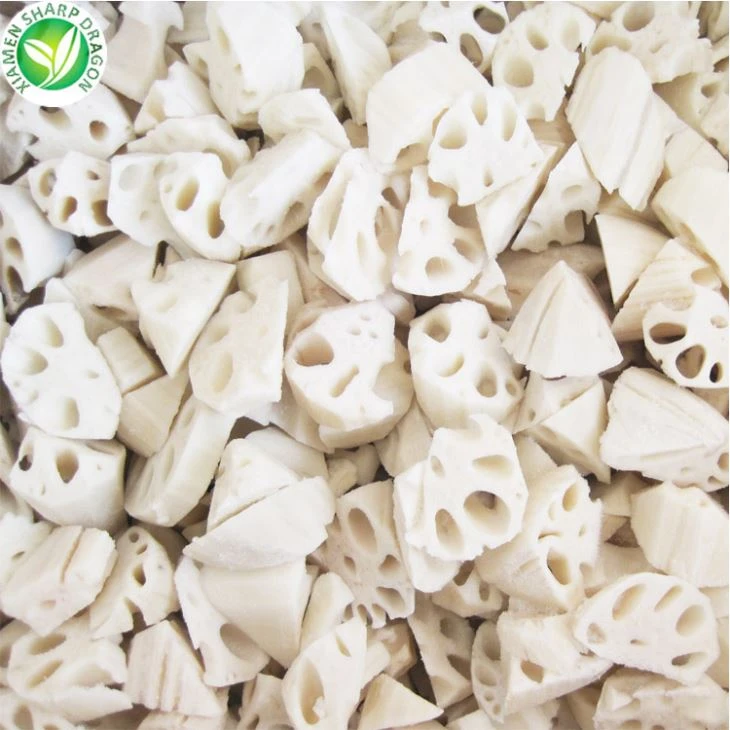
Tie the released pack to crop source, production lot, specification results, temperature evidence, and the agreed document set.
Packing, Frozen Storage, and Arrival Checks
Choose bag size, liner, seal, carton strength, net weight, artwork, coding, pallet pattern, and loading plan for the route and channel. Foodservice packs emphasize handling and portioning; retail packs also need artwork control, seal appearance, barcodes, cooking directions, and consumer information. Confirm food-contact compliance and destination labeling before printing.
Codex calls for quick-frozen vegetables to be maintained at −18°C or colder through the cold chain, subject to permitted tolerances. Set product-temperature limits, measurement method, loading checks, container condition, data-logger arrangement where agreed, and response rules. Temperature fluctuation can increase clumping, surface ice, dehydration, breakage, and texture change.
At arrival, inspect seal and container condition, carton damage, product-temperature evidence, lot codes, bag seals, net weight, color, free-flowing condition, ice, clumps, slice distribution, broken rings, peel residue, dark tissue, odor, and cooked performance. Quarantine disputed stock and connect the claim to identified samples, photographs, methods, affected quantity, and storage history. When planning mixed loading, check product compatibility, packing strength, pallet pattern, delivery sequence, and the temperature requirements of every SKU.
Build a Comparable Lotus Root RFQ
Send the botanical and commercial identity, cut, diameter and thickness bands, in-range requirement, color reference, texture method, blanching or cooking status, ingredient declaration, defect limits, foreign-material rule, pack, label, volume, shipment plan, destination, intended use, shelf life, storage temperature, certificates, tests, and release documents. Add the required crop-source disclosure, harvest or production window, sample route, and change-notification triggers.
Approve a representative sample from the named supply route and record frozen inspection, dimensions, cook method, usable yield, photographs, and packaging. Define reapproval triggers for origin, cultivar or crop type, crop window, partner facility, line, peeling or cutting route, blanching conditions, pack, and specification changes. Natural variation is expected; controlled change keeps that variation visible before shipment.
We can review your lotus root program against sourcing availability, partner-facility capability, sample evidence, packing, documents, and frozen shipment needs. Use our contact channel to send the measurable requirements, not only a product name.
Share your cut, diameter, thickness, quality limits, cooking method, pack, volume, destination, crop-source requirements, and release documents. We will review the matched source, partner facility, sample route, and commercial terms for your program.
Request a frozen lotus root quotationFrequently Asked Questions
Does lotus root grow underwater?
The edible rhizome develops in saturated soil beneath shallow water, while leaf stalks and flowers rise above the surface. Commercial production may use ponds, flooded fields, or related aquatic systems designed for the cultivar and region.
Is lotus root a true root?
Botanically, the edible structure is a swollen underground rhizome, which is a modified stem with nodes and buds. "Lotus root" remains the established food and trade name.
How long does lotus root take to grow?
A Southern University guide places mature rhizome harvest around six to nine months, but the commercial period varies with cultivar, planting material, climate, field system, and crop purpose. Ask for the actual origin, crop window, harvest or receipt evidence, and production lot.
Which farm factors affect frozen lotus root quality?
Cultivar, maturity, water and soil conditions, agricultural inputs, weather, pest or disease pressure, harvest timing, lifting damage, mud removal, and transport can affect diameter, color, texture, defects, trimming loss, residue risk, and supply timing.
What evidence belongs in a frozen lotus root approval file?
Include source and facility identity, crop and production dates, specification, sample approval, dimensional and defect results, cook test, usable-yield data, process and hazard-control evidence, applicable certificates and tests, COA, traceability, packing approval, temperature evidence, and arrival checks.
References
- Auburn University - Container Production and Post-Harvest Handling of Lotus. Production systems, water depth, temperature, cultivar, growth, and postharvest research.
- Southern University Agricultural Research and Extension Center - Ethnic Vegetable Planting Guide. Sacred-lotus identity, crop conditions, and mature-rhizome harvest guidance.
- North Carolina Extension Gardener Plant Toolbox - Nelumbo nucifera. Botanical identity and plant form.
- Codex Alimentarius CXS 320-2015 - Standard for Quick Frozen Vegetables. Raw-material quality, preparation, freezing, temperature, defects, hygiene, and labeling framework.
- Codex Alimentarius - Code of Practice for Processing and Handling Quick Frozen Foods. Cold-chain, packaging, storage, monitoring, and handling guidance.