


How to Keep Bananas from Ripening Too Quickly: Storage Guide
Jul 02, 2019

To slow banana ripening, keep unripe fruit at room temperature in the coolest practical spot away from direct sun, cooking heat and other ethylene-producing fruit. Use an open, ventilated arrangement rather than a paper bag or closed container. Protect the bunch from pressure and bruising. Once the bananas reach the ripeness you actually want, move them to the refrigerator to slow further softening; the peel may darken even while the flesh remains usable.
No household trick stops ripening permanently. Bananas are climacteric fruit: after harvest, ethylene signaling and respiration drive changes in color, texture, sweetness and aroma. Your strongest controls are the ripeness stage you buy, the fruit temperature, exposure to additional ethylene and the amount of time before use. Wrapping the crown can be tried as a secondary measure, but it is not a substitute for those four controls and does not justify a guaranteed number of extra days.
If you will not use sound ripe bananas in time, peel and freeze them before the flesh becomes excessively soft or begins to decay. Freezing is a change of product form, not a way to restore damaged fruit. The practical plan is therefore slow, stage, refrigerate, then freeze-not "keep every banana green."
Best starting method: Buy mixed ripeness, keep green-to-yellow bananas out of bags and away from heat and ripe apples, pears or avocados, move only ready-to-eat fruit into the refrigerator, and freeze sound extras for cooking or blending.

Why Bananas Keep Ripening After You Buy Them
Bananas are harvested mature-green and can complete ripening after harvest. The UC Davis Postharvest Research and Extension Center describes the visible sequence: green peel changes toward yellow, pulp softens, starch converts into sugars, acidity falls and aroma increases. Ethylene is the signal that coordinates much of this process; it is not a contaminant that can simply be rinsed off the peel.
Temperature changes the rate. UC Davis reports that mature-green bananas respond to ethylene between 12°C and 30°C, with faster ripening at higher temperatures within that range. That is why a bunch beside a sunny window, hot appliance, bakery oven or warm receiving door can move through its yellow stage faster than the same fruit in a stable, cooler position.
Nearby fruit can add to the ethylene environment. Apples, pears, avocados and other climacteric fruit are commonly used to speed banana ripening; enclosing them together concentrates the effect. If your aim is the opposite, separate the bananas and give the surrounding air a way to move. Separation will not stop the banana's own ethylene production, but it removes an avoidable source of additional exposure.
Physical injury is a separate accelerator of quality loss. Pressure at the bottom of a fruit bowl, a hard drop or abrasion can bruise delicate flesh and darken peel. A hanger or a shallow single layer is useful mainly because it reduces pressure points and lets you see which fruit has advanced first. It is not an ethylene-removal device.
Practical example: Two equally yellow bunches are stored for tomorrow's service. One sits in an open tray away from the prep line; the other is sealed in a bag beside ripe pears and a warm appliance. The second bunch combines trapped ethylene, extra ethylene and heat, so it carries more conditions that favor rapid change. Move it, open the enclosure and inspect for bruising rather than relying on a stem-wrap trick alone.
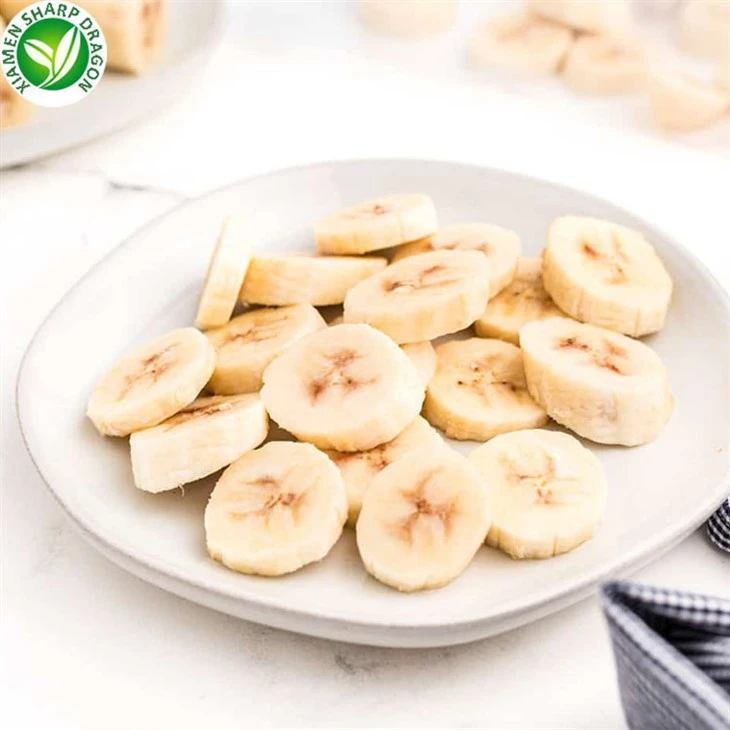
The Four Controls That Matter Most at Home
Start at purchase. If every banana is already fully yellow and you eat one per day, storage is being asked to solve a buying problem. Select a mix: some fruit close to your preferred stage and some with more green at the tips or along the peel. Exact timing varies with cultivar, pre-ripening treatment, season, temperature and handling, so use appearance and firmness as stage signals rather than a promised calendar.
Next, choose the location. EUFIC gives about 20°C as an ordinary room-temperature reference and says bananas may last roughly 3–7 days under that kind of household condition. Treat that as a broad planning range, not a guarantee. A 20°C counter away from sunlight is not equivalent to a 27°C shelf over an appliance, and fruit bought almost ripe will not behave like mature-green fruit.
Third, keep the atmosphere open and the neighbors deliberate. A paper bag is a ripening tool because it holds ethylene around the fruit. A closed plastic box can also trap gas and moisture. When you want slower change, use an open tray or hanger and move apples, pears, avocados, peaches and already overripe bananas elsewhere. Do not crowd the bunch against a wall where warm air or condensation collects.
Fourth, prevent avoidable damage. Lift the bunch by supporting it rather than dropping it into a bowl. Remove a split, leaking or badly bruised banana from contact with sound fruit. Hanging can reduce bottom pressure, but a shallow tray works too if it keeps fingers from being crushed and allows inspection. The goal is not a decorative setup; it is lower mechanical damage and better visibility.
Worked household example: You buy seven bananas and plan to eat one per day. Instead of taking seven at the same yellow stage, choose three close to ready and four greener. Keep the four greener fruit away from the ready group. After the first three reach your preferred stage, refrigerate only those you cannot eat immediately. The arithmetic is simple-3 ready + 4 later = 7 days of planned use-but actual transition time still comes from daily color and firmness checks.

Does wrapping the banana crown help?
Current EUFIC and University of Nebraska–Lincoln guidance both suggest wrapping the joined crown with reusable film or foil as a way to slow ripening. It is a low-cost experiment, but the guidance does not establish one universal extension such as "exactly five extra days." The whole fruit remains biologically active, and temperature, starting stage and neighboring fruit still dominate the result.
If you want to judge the method, split one comparable bunch into two groups, wrap the crown of one group, keep both groups in the same location and record color and firmness at the same time each day. Do not put one group beside a window and the other in shade, because that tests two variables at once. Keep the method only if it gives a useful difference under your real conditions.
When Refrigeration Helps-and When It Hurts
Refrigeration is most useful after the banana has reached the eating stage you prefer. EUFIC and Nebraska Extension both advise moving ripe bananas into the refrigerator to gain a few more days of usable life. The peel may turn brown or black faster in the cold while the interior changes more slowly. Judge the flesh after peeling rather than discarding sound fruit from peel color alone.
Green bananas need different treatment. UC Davis identifies bananas as chilling-sensitive and places commercial storage and transport for mature-green Cavendish bananas at 13–14°C. Exposure below 13°C can cause chilling injury, depending on cultivar, maturity, temperature and time. Symptoms may include dull or smoky peel, dark streaks beneath the peel, flesh browning or failure to ripen normally.
A household refrigerator is normally much colder than 13°C. Putting hard green bananas into it can therefore delay visible change while damaging normal ripening. That is not successful preservation. Keep green fruit at a stable room temperature until it reaches the desired stage; then refrigerate it as a short holding step.
Commercial figures require commercial context. UC Davis gives 13–14°C for storage and transport, 15–20°C for ripening and 90–95% relative humidity for Cavendish bananas. These are controlled postharvest conditions, not instructions to improvise a sealed home chamber. The same source stresses that fruit or pulp temperature, not merely the room-air reading, determines the response.
| Banana condition | Recommended action | Main risk to watch |
|---|---|---|
| Green and firm | Open, shaded room-temperature storage | Cold injury or unwanted added ethylene |
| At preferred yellow stage | Eat soon or refrigerate briefly | Peel darkening can hide still-usable flesh |
| Ripe, sound and surplus | Peel, portion and freeze | Soft thawed texture; use as an ingredient |
| Moldy, leaking or rotten-smelling | Discard | Do not confuse decay with harmless peel spotting |

Storage Myths That Make Bananas Ripen Faster
Adding apples or pears is the clearest example. These fruits release ethylene and are used deliberately when the goal is faster ripening. Putting two apples into a bag with green bananas for several days does the opposite of slowing them down. Keep that method for a day when the fruit is too green, not for shelf-life extension.
A sealed bag is another wrong tool for the stated goal. Enclosure holds ethylene close to the fruit and can trap moisture. An open basket does not remove all gas, but ventilation avoids intentionally concentrating it. If fruit flies are the concern, improve sanitation and remove overripe or leaking fruit rather than sealing a sound green bunch into a ripening chamber.
Rinsing the peel is not an ethylene-control method. FDA advice is to wash produce under running water before preparing or eating it, including produce that will be peeled, and not to use soap, detergent or commercial produce wash. Wash for safe preparation, not because water is expected to reverse internal ripening. Dry the surface with a clean towel after washing.
Do not apply household chemicals or agricultural ripening agents to manage timing. Commercial ripening uses controlled rooms, measured ethylene, temperature, humidity and ventilation. UC Davis describes 100–150 ppm ethylene for 24–48 hours at 15–20°C as a commercial uniform-ripening treatment for many cultivars. That figure explains why professional control is precise; it is not a home recipe and it speeds ripening rather than delaying it.
Finally, do not confuse a very cold room with better storage. Below the chilling threshold, green bananas may fail to develop normal color, texture and flavor. If a room cannot hold the intended range evenly, map the actual fruit temperature in different positions and move the cartons away from cold-air discharge rather than lowering the set point again.

Know When to Eat, Refrigerate, Freeze or Discard
Peel color is a maturity and quality signal, not a complete safety verdict. Brown freckles on an otherwise sound banana usually indicate advanced ripeness. Refrigerator-blackened peel can cover lighter flesh. Open the fruit and assess the interior, aroma and texture. The FDA's broad produce rule remains the safe boundary: cut away bruised or damaged areas where appropriate and throw away produce that looks rotten.
Use sound soft fruit promptly in baking, blending or purée applications. If it will not be used, freeze it before decay. Peeling first saves later handling, while portioning helps you remove only what a recipe needs. Our detailed guide to freezing whole bananas and choosing a practical form covers that method without turning freezing into part of the fresh-ripening advice.
Expect texture change. Ice crystals disrupt soft banana tissue, so thawed pieces become softer and may release liquid. That can be useful for smoothies, banana bread, fillings, sauce or purée, but it will not recreate a firm fresh snack. Select the endpoint before freezing: intact appearance for a frozen application, measured portions for blending or a consistent mass for formulation.
Black peel alone and actual spoilage also belong to different decisions. The XMSD guide to banana risks, spoilage signs and product-form limits handles the broader safety boundary. Here, the key action is to intervene while the banana is sound rather than waiting for a storage trick to reverse decay.
Practical example: A bunch has five bananas. Two are yellow and firm, two are heavily spotted but smell normal and have sound flesh, and one is leaking with a fermented odor. Eat or refrigerate the first two, peel and freeze the sound spotted pair for a blended use, and discard the leaking fruit. One action for the whole bunch would waste usable fruit or retain a clearly unsuitable piece.

Plan Ripeness for Retail and Foodservice Instead of Chasing It
For repeated commercial use, the best control begins with demand and receipt stage. Define the color and firmness needed on each use day, then buy or release cartons in stages. A single label such as "green" or "yellow" is not enough unless the reference photo, tolerance and assessment time are agreed. The outside peel, pulp firmness and intended application all matter.
Measure fruit temperature at receipt and during holding. Air at 18°C does not prove that warm fruit in the center of a pallet is also 18°C. UC Davis specifically distinguishes fruit temperature from air temperature because ripening response follows the fruit. Record the instrument, sampling positions and time after unloading so a later color change can be traced to actual conditions.
Worked foodservice example: A site receives 168 bananas and uses 42 per day. The theoretical cover is 168 ÷ 42 = 4 days. A sensible starting allocation is 84 ready or nearly ready for days 1–2 and 84 greener for days 3–4. If actual use falls to 35 per day, four days consume 140 bananas and leave 28 exposed to additional ripening. The next action is to reduce the order, redirect the 28 early or freeze sound surplus for an approved recipe-not to lower every banana into a chilling range.
Track usable yield, not only carton count. Bruising, splits, crown rot, severe softness and out-of-stage fruit reduce the number available for the planned channel. Record accepted units, diverted sound units and discarded units separately. This reveals whether loss originates in ordering, receipt maturity, temperature, handling or slow rotation.
When fresh ripeness variation is structurally difficult for a smoothie, bakery or dessert program, a defined frozen ingredient may be the better system. The XMSD overview of commercial frozen banana forms and applications distinguishes slices, chunks, dice and purée. The decision is not "fresh is bad"; it is whether fresh display quality or ingredient consistency has higher value in the intended use.
Turn Ripeness Control into a Measurable Buying Specification
For a fresh-banana program, write the required stage at dispatch, receipt and use-not just one maturity word. Include reference photos, acceptable peel-color variation, pulp firmness method if used, fruit or pulp temperature, defect tolerances, carton ventilation, lot identification and the time window between receipt and display. A sample approved at one temperature does not define performance after a different transit history.
For a frozen route, replace fresh shelf-life language with product-form acceptance. The current XMSD IQF frozen banana page provides context for slices and chunks. Your order still needs the target ripeness before processing, cut method, size tolerance, color, permitted ingredients, piece separation, pack, storage condition, microbiological and residue requirements, label fields and application test.
Packaging protects the frozen endpoint but does not repair poor raw fruit. Review inner-bag seal, odor barrier, carton condition, lot code and net weight, then connect them to loading and arrival inspection. The XMSD guide to frozen-fruit inner and outer packaging checks shows the separate decisions that follow after ripeness has been fixed by processing.
A useful deviation report contains the lot, quantity, product form, receipt temperature, storage record, dated photographs, opening condition and the exact test method. "Ripe too fast" is not enough. State where the fruit was stored, which neighboring produce was present, whether it was enclosed, the fruit temperature and the day-by-day stage. With that evidence, you can separate a starting-maturity problem from heat exposure, added ethylene, bruising or demand mismatch.

Final Answer
Keep bananas from ripening too quickly by buying mixed stages, storing unripe fruit in an open shaded place away from heat and ethylene-producing fruit, and preventing bruising. Refrigerate bananas only after they reach the stage you want; accept that the peel can darken before the flesh is unusable. Freeze sound ripe surplus before decay when the intended use can accept softer thawed texture.
Do not use apples, pears, a paper bag or a sealed box when the goal is slower ripening. Do not treat a household refrigerator like a 13–14°C commercial green-banana room, and do not use chemical ripening treatments at home. For repeat purchasing, calculate daily use, stage the incoming fruit and record fruit temperature and losses. The best storage method is the one that delivers the right maturity on the day of use.
XMSD sourcing note: If fresh ripeness loss is disrupting a smoothie, bakery or foodservice program, send your daily use, target maturity, required frozen form, cut, pack and application test. We can review whether a defined frozen banana specification fits the operation.
References
- UC Davis Postharvest Research and Extension Center - Banana (Cavendish) maturity, storage, ethylene and chilling injury
- UC Davis Postharvest Research and Extension Center - Banana response to ethylene and fruit temperature
- USDA Food and Nutrition Administration - Storing Fresh Produce
- European Food Information Council - How to store bananas so they ripen more slowly
- University of Nebraska–Lincoln - Prolonging the Life of Bananas
- U.S. Food and Drug Administration - Selecting and Serving Produce Safely
- XMSD operational experience in frozen-banana form review, packaging, cold-chain checks and B2B specification coordination.