


Frozen Fruit for Beverage Manufacturing: Format Selection Guide
Aug 22, 2026

The best frozen-fruit format for a beverage depends on the job the fruit must perform. IQF pieces are useful when you want flexible frozen stock or will mill the fruit in your own process. Puree supplies body, suspended pulp and a strong whole-fruit impression. Pulp can preserve characteristic seeds or coarse material. Concentrate can deliver soluble solids, acidity or flavor at a lower dose, but it does not automatically reproduce the mouthfeel of single-strength puree.
Do not compare quotations only by price per kilogram or the Brix number printed on a data sheet. Convert each option to the same finished-beverage target, then compare fruit-equivalent contribution, usable yield, dilution water, process losses, packaging, frozen or ambient storage, dosing accuracy and sensory performance. At XMSD, we begin with your drink style and process because a smoothie base, clear refreshment, nectar-style drink and foodservice slush require different fruit evidence.
The short answer: choose IQF fruit when you need flexible pieces or control your own milling; choose puree when body and fruit texture matter; choose pulp when characteristic coarse material is intentional; and evaluate concentrate only after reconstitution math and a finished-formula trial. Lock identity, Brix basis, acidity, particle distribution, heat history, microbiological status, pack and storage before comparing cost.

Define the Beverage Before You Define the Fruit
Write a one-page beverage brief before requesting samples. State whether the product is a smoothie, nectar-style beverage, juice, juice drink, dairy beverage, plant-based drink, carbonated drink, frozen slush or foodservice base. Add the destination market, label name under legal review, target fruit statement, package, fill process, heat process, shelf-life route, serving method and whether visible particles are acceptable.
Codex CXS 247-2005 distinguishes fruit juice, concentrated fruit juice, water-extracted fruit juice, fruit puree, concentrated fruit puree and fruit nectar. Those definitions matter because commercial words such as "base," "pulp," "crush" or "compound" can mean different things between suppliers. Your ingredient name, finished-beverage name and percentage statements need local regulatory review; a frozen-fruit invoice cannot settle the final label.
Use the XMSD frozen fruit range to identify possible fruit forms, then ask what is actually available for your program. Whole fruit, chunks and dice can be suitable raw material for in-house crushing or blending. Puree and pulp require separate confirmation of screen, seed, fiber, added ingredients, heat treatment and pack. Never infer those details from a photograph.
Compare IQF Fruit, Puree, Pulp and Concentrate on the Same Basis
| Format | What it contributes | Main process question |
|---|---|---|
| IQF pieces | Flexible frozen stock, fruit identity, controllable in-house size reduction | Can you thaw, mill, screen and transfer it at the required yield? |
| Single-strength puree | Natural water, pulp, body, color and characteristic mouthfeel | Will viscosity, fiber and sediment remain controlled through heat and storage? |
| Pulp or seeded pulp | Coarse fruit character, sacs, seeds or visible texture | Are particles intentional, measurable and compatible with the filler? |
| Concentrate | Higher soluble-solids density, compact storage and precise low-volume dosing | What is the reconstitution basis, aroma history and finished sensory result? |
A supplier can truthfully describe each format as high quality while the formats remain non-equivalent. Puree may give a smoothie the body you need but overload a small filler opening. Concentrate may lower freight per unit of soluble solids but require added water and a separate body system. IQF pieces may give you the cleanest control over fruit identity but add thawing, crushing, seed removal and sanitation work.
Use a two-stage screen. First, remove formats that cannot perform the essential job: reject visible pieces for a narrow-valve line, for example, or reject a fully smooth base when seeds are part of the intended drink identity. Second, compare the remaining formats through a common batch model. Include dose, added water, usable recovery, preparation time, frozen-storage positions, opened-pack exposure and cleaning burden. This prevents a compact ingredient from winning the quotation comparison while creating an unworkable production step.
Worked combination example: a 1,000 kg smoothie formula needs fruit body plus a bright top note. A bench team can compare 180 kg of single-strength puree with a second formula containing 140 kg of puree and a small, defined concentrate dose. Both formulas must be adjusted to the same final batch mass and target soluble solids before sensory review. Record water, acid and sweetener changes rather than hiding them in the trial. If the combined formula improves aroma but increases sediment or creates a hard-to-control concentrate dose, the saving is not established. Approve the complete formula and the allowed ingredient ranges together.

Use a Solids Balance Before Comparing Prices
Brix is a refractometric soluble-solids result, not a complete measure of fruit content, sweetness or quality. State the sample preparation and temperature compensation. In a puree, insoluble pulp contributes body but not the refractometer result in the same way as dissolved material. In a concentrate, a high Brix usually reflects removed water, yet the aroma, acidity and insoluble fraction still need separate evaluation.
Normalize every offer to your formula. Identify ingredient mass, measured Brix, expected process recovery, water addition, final batch mass and target finished Brix. Keep natural fruit soluble solids separate from added sugar or syrup. If a product is standardized with another juice or sweetener, the ingredient statement and analytical basis must make that clear. Use the XMSD frozen strawberry puree reference as one format example, then confirm the commercial lot specification and formulation basis rather than assuming one fruit puree represents every crop or process.
Worked soluble-solids comparison
Worked example: Option A is 100 kg of mango puree at 15°Bx, contributing about 15 kg of soluble solids before process loss. Option B is mango concentrate at 60°Bx. To contribute the same 15 kg, the simple requirement is 15 ÷ 0.60 = 25 kg of concentrate, plus enough formula water to reach the desired batch mass. This is not proof that 25 kg of concentrate tastes or feels like 100 kg of puree. Run both formulas at equal finished mass and compare acidity, aroma, color, pulp, viscosity and label effect.
Apply recovery after the format decision. If in-house milling of 1,000 kg of IQF mango yields 920 kg of screened base, usable yield is 92%. Divide delivered cost by 0.92 before comparing it with a ready-to-dose puree. Add labor, sanitation, energy, disposal, thaw-space and production-time cost. A lower ingredient price can produce a higher cost in use when recovery is poor.
Match Particle Size and Fiber to Pumps, Screens and Fillers
Particle distribution controls mouthfeel, settling, valve clearance and filtration loss. Ask for screen or finish details, seed content, peel particles, long fibers and the method used to measure them. A puree described as "smooth" can still contain fibers that collect on an inline screen. A seeded passion-fruit pulp can deliver the intended identity in a foodservice drink but be unsuitable for a narrow ready-to-drink closure.
The XMSD frozen mango dice format gives you control over the starting piece before in-house milling. Approval still needs maturity, fiber, defect and yield limits. Test the planned mill gap, screen, flow rate and recirculation. Measure material retained on the screen and compare the beverage before and after thermal processing.
Worked screen-loss check
Worked example: You feed 50.0 kg of thawed mango through the pilot mill and finishing screen. The accepted tank receives 46.3 kg, the screen retains 2.8 kg, and 0.9 kg remains in hoses and equipment. Accepted recovery is 46.3 ÷ 50.0 × 100 = 92.6%. If the offer price is USD 1.80/kg delivered, fruit cost per accepted kilogram is 1.80 ÷ 0.926 = about USD 1.94 before labor and processing cost.
Treat Seeds, Sacs and Coarse Pulp as Designed Attributes
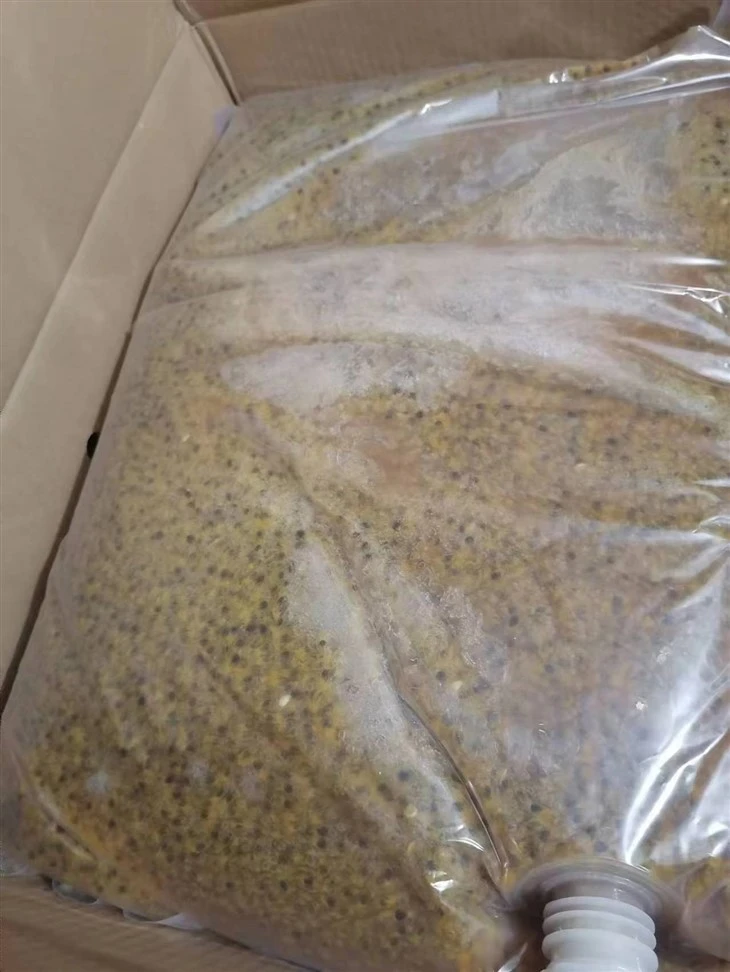
Passion fruit, berry and citrus materials may include seeds, sacs or coarse pulp. Decide whether they communicate authenticity or create a defect. Write the permitted distribution and use a sample mass large enough to show variation. "With seeds" does not define seed percentage, broken seed, dark particles, peel, foreign material or flow behavior.
For passion fruit, compare seeded and seedless formats in the final drink. The frozen passion fruit puree and pulp reference provides a useful starting form. Confirm whether the commercial sample is puree, pulp or juice; whether seeds remain; the natural Brix and acidity basis; added ingredients; heat history; pack; and intended-use status.
Do not solve coarse-particle trouble only by stronger shear. High shear can reduce visible material but may alter viscosity, release more color, break bitter seeds or introduce air. Compare a different screen, a seedless format, lower recirculation or a two-component formula. The correct action depends on the target drinking experience.
Control Acidity, Color and Aroma Through the Real Heat Process
pH and titratable acidity answer different questions. pH affects microbial and protein-system behavior; titratable acidity helps describe the acid load and sensory balance. Measure both where relevant. Pair them with Brix-acid ratio, flavor and aroma rather than forcing every lot to one sweetness number.
Heat, oxygen, light and metal contact can change fruit color and aroma. Strawberry red may dull, mango aroma may flatten, and pineapple can shift from fresh to cooked notes. Evaluate the fruit in the planned pasteurization or hot-fill route and in the actual package. A bright raw sample is only the starting point. Record inlet temperature, hold, cooling, dissolved-oxygen strategy and observation time.
Use pineapple cut fruit when your plant wants to build its own crushed base. The frozen pineapple chunks need an application trial for Brix, acidity, fiber, core material, color, thaw liquid and milling recovery. Pineapple pieces with the same Brix can still differ in aroma, acid balance and fibrous defects.

Lock Intended Use and Safety Controls Before Scale-Up
Frozen does not mean pasteurized, sterile or ready to drink. State whether the ingredient will receive a validated lethal treatment in your beverage process. If it enters after that step, require a supplier and ingredient program suitable for the resulting ready-to-eat use. Review the facility scope, hazard analysis, agricultural and process controls, microbiological plan, lot traceability, positive-release rules and deviation history appropriate to your market.
In the United States, juice processors need to evaluate 21 CFR Part 120 and applicable FDA juice HACCP guidance. Other destinations have different product definitions and safety rules. Codex CXC 8 covers handling of quick-frozen food; CXS 247 covers juice and nectar identities. Neither replaces the legal review and validated process for your finished drink.
Ask how a lot code connects raw fruit, production date, line, pack and test results. Define certificate content and notification timing. Keep allergen cross-contact, cleaning, foreign-material control, residues and contaminants in the approval plan. A certificate of analysis is useful evidence only when the sample, method, specification and commercial lot are connected.
Plan Frozen Storage, Thawing and Dosing as One System
Codex CXC 8 uses -18°C or colder as the quick-frozen cold-chain baseline, subject to applicable tolerances and local rules. Stable storage reduces clumping, dehydration and texture damage. It does not remove the need to control thawing. Define the thaw room, target product temperature, maximum hold, vessel, mixing, partial-pack policy and disposition of unused ingredient.
Match pack size to one controlled use window. A large liner can lower packaging cost yet create a long thaw and leftover material. Small bags improve dosing and traceability but create more openings and packaging. For puree in bag-in-box or drum liners, inspect closure, liner folds, damage, purge space and how the frozen block will be removed safely.
Record mass at each step. If a 20 kg bag leaves 0.6 kg on the liner and vessel, transfer yield is 97%. A concentrate may reduce this residue in mass terms but require more precise low-volume dosing. Compare the complete batch operation, not only warehouse density.

Write a Format-Specific Purchase Specification
| Block | Required detail | Approval evidence |
|---|---|---|
| Identity | Fruit, variety/type, origin if required, IQF/puree/pulp/concentrate, single strength or concentration basis | Ingredient statement, process description and traceable sample |
| Composition | Brix method, pH, titratable acidity, added water/sugar/juice, concentration or reconstitution basis | Laboratory result and finished-formula mass balance |
| Physical | Cut, screen, seeds, fibers, peel, defects, foreign material, viscosity and sediment | Defined sample method plus mill, screen and filler trial |
| Sensory | Color, aroma, characteristic flavor, off-flavor and heat-process performance | Blind finished-beverage comparison and shelf-life samples |
| Safety | Intended use, microbiological criteria, chemical limits, process status and change notification | Facility scope, controls, lot test and traceability evidence |
| Delivery | Inner pack, drum/carton, net mass, label, storage, loading, temperature and shelf life | Pack sample, shipping record and receiving plan |
Add a change-control clause. Origin, variety, harvest maturity, factory, finish screen, evaporation condition, heat treatment, pack material or standardization practice can change application behavior. State which changes require notice, a new sample or full reapproval.
Connect every limit to a sampling and decision rule. Define the number of packs or containers sampled, how frozen material will be composited, the thaw condition used for analytical work and what happens when one result misses a limit. Separate critical release criteria from descriptive targets and trend data. A single retained cup may be useful for investigation but cannot represent a large lot unless the sampling plan justifies it. Record who can release, hold, re-test or reject the material, and preserve the sample identity through the finished-drink trial. When the supplier changes a declared variable, compare the new sample with the approved benchmark under the same formula, equipment and heat process before allowing routine delivery.

Approve the Format Through a Five-Stage Pilot
Stage 1 - bench normalization: bring formats to the same batch mass and soluble-solids target where a fair comparison requires it. Record all water and sugar changes. Taste the complete formula, not undiluted concentrate against single-strength puree.
Stage 2 - process fit: run the intended thaw, mill, screen, mix, pump, heat and fill sequence. Record recovery, retained solids, pressure, temperature, flow and downtime. Photograph deposits and collected screen material.
Stage 3 - finished-product measurement: check Brix, pH, titratable acidity, viscosity, color, sediment, separation, particle result and fill consistency by defined methods. Use sensory panels appropriate to your development procedure.
Stage 4 - shelf-life and pack: store the beverage in the intended package and conditions. Review color, aroma, ring, sediment, gas, viscosity and microbial release criteria at planned intervals. Include a distribution challenge only when it is designed and approved by your technical function.
Stage 5 - commercial verification: compare the first shipment with the approved sample, documents and pilot boundaries. Use representative lot sampling, keep a retain, and define the response to any missed limit before production.
Frequently Asked Questions
Is puree always better than concentrate for a smoothie?
No. Puree often provides useful body and pulp, while concentrate can deliver solids and flavor efficiently. The best result may use one format or a controlled combination. Normalize the formula and compare mouthfeel, aroma, stability, processing and cost in use.
Can IQF fruit be milled directly into a beverage base?
Yes, when your validated process, equipment and ingredient status support it. Define the thaw or frozen-feed condition, mill, screen, yield, sanitation, heat process and holding rules. A household blender trial does not represent commercial recovery or safety.
Does 60°Bx concentrate equal four times as much fruit as 15°Bx puree?
It contains four times the soluble solids per unit mass in that simple comparison, but fruit equivalence, labeling and sensory equivalence require the applicable identity standard, reconstitution basis and formulation review. Insoluble pulp, aroma and heat history may differ.
Which tests belong on a frozen fruit puree specification?
Common blocks include identity, ingredient statement, Brix method, pH, titratable acidity, color, flavor, viscosity, screen or particle result, defects, microbiological criteria, contaminants, pack, storage, shelf life and traceability. Final limits depend on fruit, process, destination and intended use.
How should you request a beverage trial sample?
Send the drink type, target fruit role, batch size, desired format, Brix and acidity direction, particle restriction, heat process, pack, destination and trial quantity. Ask for a traceable sample with the exact product specification and intended-use status.

Share your drink style, process, fruit role, particle limit, Brix direction, pack and trial quantity. We can review relevant XMSD frozen-fruit forms and organize a sample discussion around your mass balance and pilot checks.
References
- Codex Alimentarius, General Standard for Fruit Juices and Nectars, CXS 247-2005.
- Codex Alimentarius, Code of Practice for Quick Frozen Foods, CXC 8-1976.
- Electronic Code of Federal Regulations, 21 CFR Part 120, Hazard Analysis and Critical Control Point Systems.
- FAO, Principles and Practices of Small- and Medium-Scale Fruit Juice Processing.
- Eurobras Food, Fruit Purée, Concentrate or Combination, live English comparison reviewed August 2026.