


Freeze-Drying Technology: Process, Quality and Use
Mar 11, 2020

Freeze-drying removes water from food after freezing it. Under reduced pressure, controlled heat supplies the energy for ice to change directly into vapor; a cold condenser collects that vapor. A later stage removes additional unfrozen moisture. A suitably processed and protected product can provide a light, porous ingredient for a dry snack or a recipe that adds water again.
The distinctive step is sublimation: ice changes to vapor without first becoming liquid water. An ordinary freezer does not perform the full process, and a food dehydrator normally removes liquid water through evaporation. Freeze-drying combines freezing, vacuum control, heat transfer and vapor collection in specialized equipment.
The process can produce crisp fruit pieces and useful dry ingredients, but drying is not a reliable microbial kill step. Food safety depends on the raw material, appropriate validated controls, hygienic handling, packing and intended use. Shelf stability also belongs to a defined food, package and storage condition; the process name alone does not guarantee it.
For a snack, that may mean a clean snap and recognizable fruit. For soup or a filling, it may mean even wetting and a pleasant texture after liquid is added. Those outcomes need different evaluations.

Three stages, three different jobs
| Stage | What happens to the water | What needs attention |
|---|---|---|
| Freezing | Much of the available water forms ice. | The food, its preparation and its freezing history. |
| Primary drying | Ice leaves by sublimation under reduced pressure. | Energy supply, vapor removal and the condition of the product. |
| Secondary drying | Remaining unfrozen moisture is reduced through desorption. | The required final dryness and protection of product quality. |
The machine has to provide both cooling and heat. This is not a contradiction. Cooling establishes the frozen starting condition and supports the condenser, while the drying process needs an energy input. A cold condenser collects water vapor as ice. The vacuum system helps maintain the low-pressure environment. Shelves, trays, the chamber and the food all participate in heat and mass transfer.
Primary drying needs both heat reaching the frozen material and a path for vapor to leave. As a dry layer develops, vapor must travel through that layer toward the condenser. A deeper bed or a different cut can change the distance and resistance. Too little available heat slows removal; excessive product heating can damage structure. Shelf temperature and the temperature inside a food piece are different measurements.
Secondary drying addresses the moisture that freezing and sublimation did not remove. Its endpoint should match a defined product, not a wish to keep the machine running until every possible water molecule has disappeared. Excessive processing can add time and cost without creating a better ingredient. A suitable cycle balances drying completion with the qualities worth retaining. The IFT processing overview and the 2025 Food Engineering Reviews paper explain these distinct stages.
A practical process record connects the freezing conditions, tray load, chamber pressure and product temperature to the observed end point. The vacuum pump maintains reduced pressure, while the condenser provides a cold surface for vapor to deposit as ice. Turning up heat alone does not solve a vapor-removal constraint. Compare product temperature and representative pieces across the load before changing a cycle.
Why one drying schedule will not fit every food
A strawberry slice, an intact berry and a tray of fruit purée present different routes for water to leave. Thickness, skins and the way food covers the tray influence that route. Uniform preparation makes the load easier to control. A few oversized pieces among many thin ones deserve attention because an attractive surface says little about their centers.
Composition matters too. A sugary formulation and a comparatively lean vegetable are different drying materials. Utah State University's current guidance identifies high sugar, fat and dense outer layers as practical challenges. That is a reason to develop a suitable process for the formulation, not to label every sweet fruit unsuitable. The amount and distribution of those components matter alongside the equipment.
At XMSD, we would start a technical discussion with the actual form: whole, sliced, diced, chopped or puréed. Describing everything as 'fruit' hides the decision that most directly changes how a sample should be assessed. A picture of the agreed cut, an input-weight basis and a description of tray loading make a proposed trial much more useful than a bare drying-time claim.
Keep changes traceable. If you alter the cut and increase the loading together, a slower batch leaves two possible explanations. A controlled comparison changes one important input at a time while keeping the other conditions documented. The outcome should be evaluated in the food itself, including representative pieces from the load, rather than inferred from the clock alone.
Freeze-dried, frozen and conventionally dried are different products
Frozen food retains most of its water and needs the storage conditions specified for the frozen product. Freeze-dried food loses much of that water and requires a package that protects the intended dry state. The frozen-vegetable processing guide covers the separate freezing route: draining surface water before freezing does not dry the interior of the food.
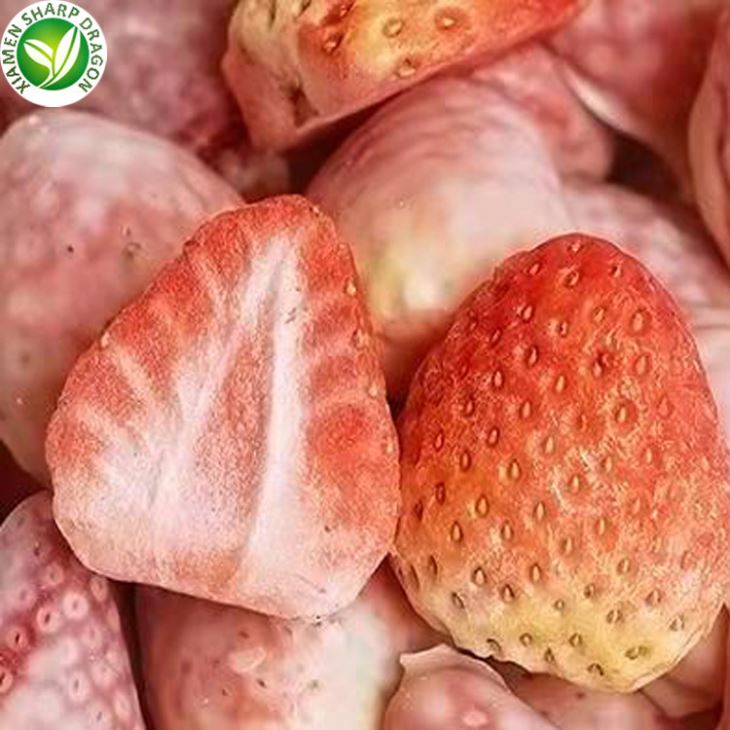
Conventional drying commonly uses evaporation, and its eating texture may be chewy, leathery or firm. Freeze-dried fruit often has a more porous, brittle structure. That contrast is useful when choosing a topping, but neither texture is automatically superior. A chewy fruit inclusion can be exactly what a bar needs; a crisp slice can be more useful when a dry breakfast mix needs an immediate fruit bite.
A process name is separate from an ingredient list. Sweeteners, coatings or seasonings may be included in a finished product. The freeze-dried fruit range illustrates product formats; compare the actual ingredient statement, intended use and preparation directions before selecting a sample.

Worked example: calculate a drying yield on a stated basis
Consider a hypothetical development batch containing 200 kg of prepared fruit at 80% water by weight. The developer wants to understand the theoretical mass after drying to 4% final moisture on a wet basis. These figures are selected only to demonstrate the calculation. They are not an XMSD production record, a recommended moisture target or a guaranteed yield.
The starting material contains 160 kg water and 40 kg dry solids. If those dry solids are retained, they must make up 96% of the final mass because the remaining 4% is water. Divide the dry-solids mass by that fraction to find the theoretical final product weight.
| Calculation | Illustrative result |
|---|---|
| Starting dry solids: 200 kg × 20% | 40 kg |
| Final mass: 40 kg ÷ 0.96 | 41.67 kg |
| Water remaining: 41.67 kg − 40 kg | 1.67 kg |
| Water removed: 160 kg − 1.67 kg | 158.33 kg |
The result explains why a modest bag of dry fruit can represent a much larger input weight. It also shows why '4% moisture' must identify its basis. Here it means water divided by the total final product mass. A dry-basis percentage uses dry solids as the denominator and gives a different number.
The practical action is to compare measured input and output on matching bases. Separate peel and trimming losses, spills, retained tray material and rejected pieces from water removal. The simple calculation assumes those losses are absent; a real yield record must account for them. If a quote uses raw whole-fruit weight but your formula uses prepared edible fruit, correct that mismatch before comparing suppliers.
This exercise is not a drying-completion test. A batch can reach a similar total weight while moisture is distributed unevenly among pieces. Use the mass balance to understand yield and investigate discrepancies, then use suitable product measurements to judge the drying result.
Appearance, nutrients and texture: retain what matters
Freeze-drying can limit some heat-related quality losses, and the porous structure often makes rehydration practical. A dry strawberry has a different bite from a fresh one, and water removal changes what a given serving weight represents. A pale interior, visible seeds and an intact outline are appearance observations, not a nutrient analysis.
Assess quality against a purpose. For a garnish, look at recognizable shape and the amount of fine material in the pack. For powder, uniform milling and dispersion may matter more than an intact silhouette. For a rehydrated ingredient, the useful result is the texture after liquid addition and the next preparation step. Compare samples within the same use so the result answers the right question.
Nutrient-retention claims need a comparison that identifies the nutrient, the food and the measurement basis. Comparing 100 g of fresh fruit with 100 g of dried fruit can make concentration look like improved retention. To ask how much survived processing, compare equivalent starting material or a consistent dry-solids basis. Storage conditions and time also belong in the comparison.
We would rather approve a clear sensory description than an impressive but vague 'fresh-like' claim. For example, record whether the target is a brittle slice, a visible red fragment or a soft rehydrated piece. That language gives purchasing and product-development colleagues the same thing to evaluate. It is more useful than asking two people whether the sample is simply 'premium'.

Moisture content and water activity answer different questions
Moisture content describes how much water is present. Water activity describes its availability, measured in relation to pure water at the same temperature. Food composition influences the relationship between them. Two foods with the same moisture percentage can therefore have different water activities. The University of California explanation and FDA's technical guide distinguish these measurements.
For commercial evaluation, specify the method and sample basis alongside the result. A moisture figure without a method is difficult to compare with another laboratory's figure. Water-activity measurements also require attention to measurement conditions. Temperature control and equilibration matter; the FDA guide explains why they affect the reading.
Pair the sensory check for a crisp snap with a suitable sampling and testing plan. A large piece, a small fragment and different positions in a load may tell different stories. Decide which material will be sampled and how the result relates to the lot being accepted. Keep the retained sample identifiable so a later investigation can compare like with like.
The final target belongs to the actual product and its intended storage and use. Avoid lifting a single limit from a generic description and applying it to every fruit, vegetable or formulated meal. A specification should connect dryness, safety controls, sensory quality and packaging performance. A number that is suitable on release also needs to remain suitable through the claimed storage period.
Practical example: a crunchy topping and a wet dessert need different trials
Imagine a developer choosing a strawberry ingredient for two proposed products: a dry cereal mix and a chilled yogurt pot. For the cereal trial, the illustrative recipe uses 30 g of freeze-dried slices in a 1 kg dry blend, giving a 3% inclusion. The commercial aim is recognizable pieces that remain pleasant to bite after normal packing and handling.
The developer mixes gently, measures the amount of fine material before and after blending, and checks whether fruit pieces distribute reasonably through several portions. The decision is about particle survival and distribution. A smaller cut may spread more evenly, while a larger slice may provide stronger visual identity. These are trial questions, not claims that a particular sample has already passed.
For the second concept, 3 g of the same fruit is placed with 150 g of yogurt. Now the important difference is contact with a wet food. The dry fruit can absorb moisture and soften. Test a portion added just before serving separately from a portion held in contact with the yogurt under its required chilled conditions. Record the intended serving or holding time and evaluate at that point.
The resulting design choice is clear even before commercial approval: use a separately packed topping if a crisp eating experience is essential, or develop the recipe around a softened fruit inclusion if it will be mixed in advance. A dry-ingredient specification alone cannot decide whether the finished dessert meets the target. Moisture migration makes the whole recipe and the package relevant.
For strawberry piece comparisons, the freeze-dried strawberry product information is a starting point. Test the selected form in the actual application. The cereal and yogurt examples are development plans; approval requires results from the proposed recipe and pack.

Rehydration example: a developer weighs 20 g of a product suitable for the intended application and adds 60 g of water. If the whole contents are retained and there is no handling loss, the mixture weighs 80 g. This is a mass calculation, not proof that the pieces absorb all the water or regain fresh texture. Record liquid temperature, contact time, any liquid discarded and the product's required preparation. Use the actual rehydrated weight and intended holding procedure when scaling the recipe.
Separate the measurements
Moisture content measures how much water remains. Water activity helps assess whether the remaining water is available for microbial growth. Record both where the product specification calls for them.
Drying is not a microbial kill step
University of Minnesota Extension warns that freeze-drying does not reliably kill illness-causing microorganisms. Low water activity may limit growth while organisms remain viable. A crisp, dry food is not evidence that contamination has been eliminated. Ready-to-eat status must be supported by the appropriate safety controls for the exact food and process.
A processor should distinguish raw material preparation, any validated lethality treatment, hygienic handling, drying and packing. Each has a different purpose. Washing performance and final color answer narrower questions than whether the complete food-safety system is effective. For an ingredient that requires cooking, retain that intended-use requirement through the product description and instructions.
When water is added back, the dry product's storage conditions no longer describe the prepared food. Follow its rehydration and cooking instructions and apply the appropriate time, temperature and hygiene controls for the complete wet recipe. Adding water or briefly warming a product is not automatically a validated pathogen-control step.
Ask a specific safety question: what controls support this product being eaten as supplied? Ask for the applicable process and food-safety documentation, rather than treating a microbiological result from one sample as the entire answer. Where safety status is unclear, hold the material for review rather than using taste or smell to decide.
Protect the dry food after the chamber opens
Freeze-dried foods readily take up moisture, so the handling and packaging stage protects an outcome that the dryer has already created. University of Minnesota and University of Arizona guidance both emphasize prompt, suitable packing and protection from humidity. A bag that closes is not automatically a demonstrated barrier for the intended shelf life.
Choose a pack around the expected use. A large bag opened repeatedly in a busy kitchen exposes more product at every opening. Smaller inner packs can reduce that exposure, although they add packaging work and material. Decide how much will normally be used at once, then test whether the opening and resealing routine protects the remainder under the actual conditions.
We would assess fragile whole fruit differently from a powder at the packing stage. Whole pieces need protection against crushing as well as moisture ingress; powder raises questions about flow and clumping. For either format, sample the food after representative handling. A perfect piece placed gently into a sample pot may not represent the product after filling, carton movement and routine unloading.
Light, oxygen and heat can also affect quality during storage. Packaging material, seal performance and the storage environment work together. Use a shelf-life assessment for the actual food-pack combination. Generic claims of decades of storage are not a substitute for the declared conditions and evidence for the product being offered.

For a bulk user, we would compare pack sizes against the actual quantity needed during one shift. A small inner pack can limit the dry fruit exposed to humid air; a larger pack can reduce handling and packaging if the whole contents are used quickly. Evaluate the proposed pack against its own barrier and shelf-life evidence. Ask how long an opened pack can be held under the humidity and handling conditions on the line.
If the end use is a crisp snack, review the vacuum frying guide before comparing samples. Vacuum frying heats produce in oil under reduced pressure; freeze-drying removes ice as vapor. Ask for the ingredient list, check whether oil is part of the product and taste both samples in the intended application.
Check the pack as used
Test the same sealed product and pack size that will ship. Record the seal, the conditions after opening and how quickly the application uses an opened pack.
Compare useful output, not just dryer capacity
A nameplate capacity may describe wet input, tray area or another equipment basis. A buyer of ingredients needs saleable output in the agreed form. The 200 kg mass balance illustrates how far those quantities can differ. A meaningful capacity discussion also includes the product, cycle duration, loading, unloading, defrosting and the way rejected material is counted.
For a development comparison, write down the whole operation being evaluated. Include preparation labor, energy, handling losses, packaging and the time taken to produce acceptable material. The 2025 technical review identifies energy demand, lengthy processing and maintenance among the technology's commercial challenges. Any projected saving from a new method needs a defined food, load and comparison process.
Treat a proposed faster process as a testable option. Ask which quality attribute remains equivalent, how drying completion is checked and what the calculation includes. A shorter cycle is attractive only when the required outcome survives. Conversely, an unnecessarily strict whole-piece requirement can make an ingredient expensive when the recipe will grind it into powder immediately.
For food-processing applications, the most useful brief combines the intended recipe with a practical acceptance method. State whether the fruit will be dry-blended, coated, milled or rehydrated, and which characteristic drives rejection. That helps keep process choices tied to food performance instead of equipment terminology.
A practical way to use the finished ingredient
Start with the label and the product's intended use. Keep the unopened food under its specified storage conditions. When portioning, use clean, dry utensils and close the remaining pack promptly. Avoid working over steam or allowing wet utensils to carry moisture into the bag. If the packaging is damaged or the food has changed unexpectedly, stop using it until the cause has been assessed.
For a recipe that needs rehydration, define the liquid amount, temperature, contact time and any subsequent cooking step. A water instruction is not automatically a cooking instruction. Record the actual result and keep the product label's intended-use requirement with the batch. A fruit piece need not recover the exact fresh texture to be useful in the recipe.
Make the final choice from that preparation, not from a process label alone. Freeze-drying is valuable when its combination of low weight, dry texture and rehydration behavior solves the food's actual problem. The strongest specification describes that problem clearly, connects it to a measured product and protects the result through packing and use.

Send XMSD the fruit, required form, application and packing routine through our ingredient inquiry form. We will review the current product information against the qualities your recipe needs.
References
- Institute of Food Technologists: Freeze-Drying Fundamentals
- Food Engineering Reviews: Technological Innovations in Freeze Drying (2025)
- University of Minnesota Extension: Preserving food at home-Freeze-drying
- Utah State University Extension: Can I Freeze-Dry That? (2026)
- University of California: Water Activity and its Role in Food Preservation (2025)
- FDA: Water Activity (aw) in Foods
- University of Arizona Cooperative Extension: Preparing and Storing Your Freeze Dried Products (2025)