


Frozen Mango Variety, Ripeness, Cut Size and Thaw Guide
Apr 22, 2019

The old version of this page treated mango as a remedy for vomiting, high blood pressure, cough, asthma, infection and several other conditions. Those claims are not an acceptable basis for a commercial frozen-fruit decision. This replacement focuses on what importers, distributors, food manufacturers and quality teams can actually specify and verify: cultivar, maturity, Brix-acid balance, flesh color, fiber, cut distribution, peel and pit residue, frozen separation, thaw drip, texture, packing, cold-chain evidence and usable application yield.
Mango quality is not captured by one sweetness number. UC Davis notes that skin color is not a dependable maturity index for every cultivar, while cheek development, flesh color and cultivar-specific behavior are more useful. During ripening, starch changes to sugars, acidity declines, aroma develops and flesh softens. The correct harvest and processing window therefore depends on both the mango variety and the finished application.
A smoothie base, bakery inclusion, yogurt preparation, retail fruit pack and foodservice garnish do not need the same firmness, fiber level or geometry. Start with intended use, then approve a representative production lot under one written method. A beautiful reference photo or a high average Brix cannot replace distribution data, defect inspection and a standardized thaw test.
The short answer: Lock Mangifera indica, cultivar, origin, maturity window, Brix and acidity methods, flesh color, cut style and size distribution, defect definitions, individual quick-freezing performance, thaw protocol and application acceptance. Compare cost per usable kilogram after off-size pieces, drip and rejects, not only the delivered carton price.

Define the Product Before Comparing Mango Offers
Specify mango as Mangifera indica and name the approved cultivar or a documented equivalent. Cultivars differ in sweetness, acidity, aroma, flesh color, fiber, stone geometry and softening behavior. A supplier substitution may still look yellow in a photograph while producing more fibers, faster collapse or a different flavor after thawing. Require written approval before cultivar or origin changes.
State the style: halves or cheeks, slices, strips, dice, chunks or irregular pieces. Then define nominal dimensions, tolerances, how curved pieces are measured and whether natural end pieces count as in-size. A label such as "mango chunks" does not tell a depositor operator, bakery developer or retail buyer whether the pieces will dose evenly.
Record ingredient declaration and treatment. Confirm whether the product is mango only, whether sugar or antioxidant is added, and whether water glazing is used. If glaze is present, agree the measurement method and net fruit weight. Do not compare glazed and unglazed products on gross carton weight.
The XMSD frozen mango range is a useful starting point for format discussions. Use it to identify a product family, then confirm the actual partner facility, crop window, cultivar, cut, pack and evidence set for the order.
Lock Cultivar and Ripeness Together
A mango specification should not say "ripe" without a measurable release method. UC Davis lists cheek development, skin and flesh color as maturity indicators, while warning that red skin color has little relationship to maturity in many cultivars. Build a cultivar-specific photo scale for flesh color and internal condition. Combine it with firmness, soluble solids, acidity and sensory checks.
Cut representative fruit before processing. Examine flesh beside the pit and near the peel, because one external color can hide uneven maturity. Record hard pale tissue, jelly-like breakdown, internal discoloration, soft nose, stem-end cavity, bruising and decay separately. The Codex mango standard requires fruit to be sound, clean, firm and sufficiently mature to continue normal ripening, and it identifies damage and defects that affect suitability.
For freezing, the most advanced ripeness is not automatically the best. Very soft, fully aromatic fruit may taste attractive but deform during peeling and cutting, release more juice and become fragile after thawing. Less-ripe fruit may cut cleanly but taste starchy, sour or undeveloped. Freeze pilot samples from defined ripeness bands and choose the band that gives the required finished texture and flavor.
Peer-reviewed work on frozen mango has shown that cultivar and maturity can influence firmness, structural damage and drip after thawing. The exact ranking in one study should not be generalized to every origin or process, but the commercial lesson is strong: validate the proposed cultivar and ripeness under the buyer's cut, freezer and thaw method.
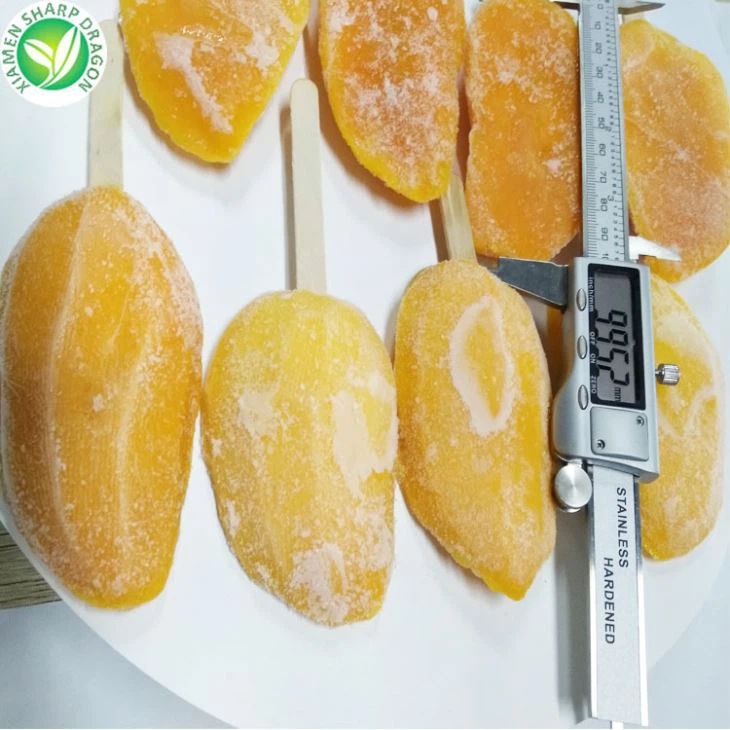
Use Brix, Acidity, Color and Sensory Results as a Set
Degrees Brix estimates soluble solids; it does not directly measure all sugars or eating quality. Define the sample state, number of pieces, thaw temperature, juice preparation, refractometer calibration, temperature compensation and reporting rule. Decide whether results are individual, composite or both. An average can hide a mixture of bland and overripe pieces.
Measure titratable acidity under a defined endpoint and acid basis. Do not treat pH as interchangeable with titratable acidity. The balance between soluble solids and acidity often explains flavor better than either value alone. A smoothie manufacturer may accept a sharper profile that is balanced by other ingredients, while a plain retail pack may require a rounder sweet-acid balance.
Flesh color should be compared under controlled lighting or a validated instrument method. Define acceptable yellow-to-orange range and separately record green, pale, brown, gray or water-soaked tissue. Do not adjust a photograph until weak color appears acceptable. Keep a signed reference sample or calibrated color target where practical.
Sensory review should use the intended state. Score aroma, sweetness, acidity, mango identity, fibrousness, mealiness, fermented notes and aftertaste after a fixed thaw. If the product will be blended, baked or mixed into yogurt, run a second application trial. A piece that tastes satisfactory when eaten alone may disappear in a flavored formula.
The IQF mango slice reference helps frame thickness and visual-quality discussions. Approve chemistry and sensory limits on the actual production sample rather than copying a number from a different cultivar or application.
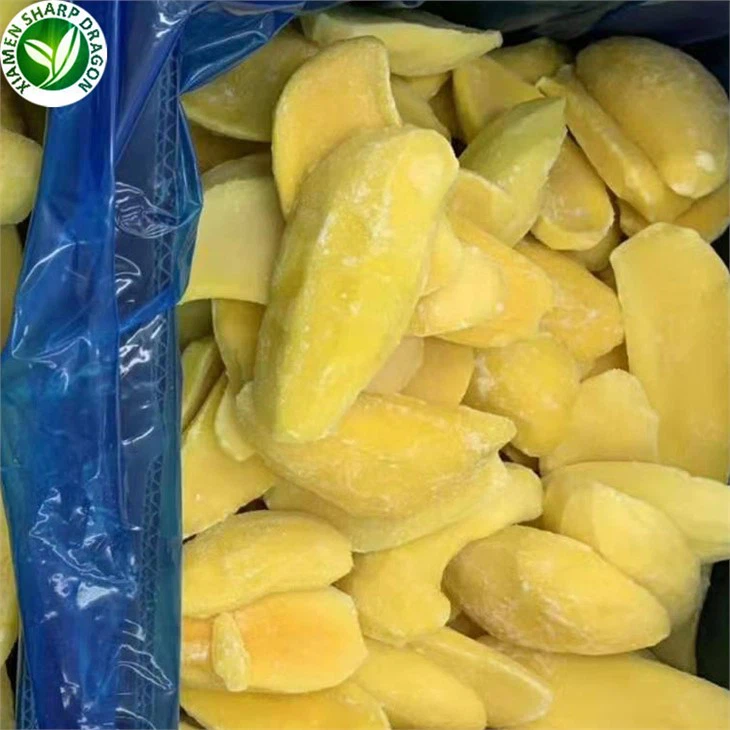
Measure Cut Distribution, Not One Perfect Piece
Define every relevant dimension. For dice, state length, width and thickness; for slices, state thickness, minimum length and acceptable taper; for cheeks, define mass or geometry. A single nominal value is incomplete unless the tolerance and sampling method are clear.
Thaw only enough to separate and measure without compressing the flesh, or measure frozen pieces with a documented allowance. Randomize the sample across cartons and positions. Sort pieces into in-size, undersize, oversize, broken and fused categories. Report count and mass when both dosing and yield matter.
Worked example: A buyer evaluates 500 mango pieces from ten cartons against a 20 to 30 millimeter chunk specification. By count, 421 pieces are in-size, 38 are undersize, 17 are oversize, 15 are broken and 9 are fused. The in-size rate is 84.2%. The contract requires at least 90% in-size, no more than 5% broken and no more than 2% fused. Broken and fused rates pass, but the distribution fails. The lot is held even though the 20-piece display tray looked uniform.
Link cut choice to equipment. Large irregular pieces may bridge a depositor; thin slices can tear in mixing; small dice may disappear in a bakery filling; thick cheeks may thaw unevenly. Confirm dimensional capability on a production run and record cutter settings, blade condition and check frequency.
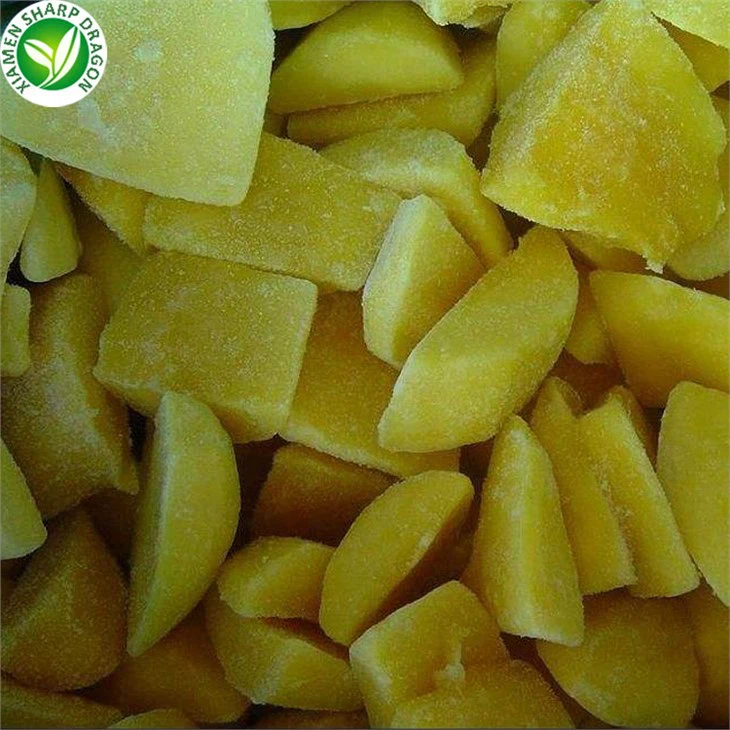
Separate Peel, Pit, Fiber and Cosmetic Defects
Create non-overlapping defect categories. Peel means external skin tissue; pit or stone residue means hard endocarp material; core-like fiber means tough tissue close to the stone; brown or black areas record discoloration; decay records decomposed tissue. Do not hide severe findings inside one broad "foreign matter and defects" total.
Define severity with photographs and measurable rules. A tiny surface peel spot and a large leathery peel sheet do not create the same consumer or process risk. State area, length, hardness or affected-piece criteria. For pit fragments and hazardous foreign material, set a distinct lot action based on the product risk assessment.
Fiber is partly cultivar-dependent and partly influenced by trimming. Inspect long visible strands, tough tissue and mouthfeel after thawing. A puree or beverage route may tolerate more soft fiber than a premium retail slice, but hard stone-adjacent tissue is still a different defect. Use route-specific limits without relabeling poor trimming as natural variation.
Record defects by affected units and mass where useful. Keep photos of the unsorted composite, each defect class and the accepted remainder. Apply a classification priority so one damaged area is not deducted twice. Decay, fermentation and safety-related contamination remain separate hold triggers rather than commercial trim allowances.
The frozen mango supplier reference can support discussions about available formats and controls. Request current lot photos, defect data and traceability from the quoted route.

Verify IQF Separation and Frozen Condition
Individually quick frozen does not mean that every piece will always pour freely. Surface moisture, slow freezing, warm packing, temperature fluctuation and pressure can create clusters. Define free-flow at a stated product temperature, sample mass and test action. Separate slight contact from hard fused blocks that cannot be broken without damaging the fruit.
Inspect ice and frost patterns. Light surface frost may occur during normal handling, while heavy snow, glazing not declared in the specification, ice sheets or large refrozen masses can signal moisture exposure or temperature abuse. Review carton liners, seals and master-carton condition together with logger data.
Codex's General Standard for Quick Frozen Foods requires the freezing process to pass quickly through the zone of maximum crystallization and defines completion when thermal stabilization at the thermal center reaches minus 18 degrees C or colder. It also expects the cold chain to maintain quality with permitted short fluctuations only under recognized practice. Translate that framework into facility-specific freezer, packing, storage and shipment records.
Do not infer core temperature from warehouse air alone. Verify the facility's validated relationship among piece size, belt load, freezer conditions and product exit temperature. Review loading temperature, cold-store history, container set point, pre-cooling, logger position and receiving temperature under the agreed plan.

Standardize Thaw Drip, Firmness and Application Testing
Thaw method changes the result. Research on frozen mango has reported differences in drip, firmness, color and sensory properties among thawing approaches. A buyer and supplier can reach opposite conclusions if one tests overnight under refrigeration and the other uses warm water or a microwave. Fix the method before comparing samples.
Write starting mass, piece size, container, thaw temperature, endpoint, drainage device, drainage time and calculation. A practical method might thaw a defined mass at 4 degrees C until the geometric center reaches a target range, drain for a fixed time without pressing, and weigh the retained pieces and liquid. The exact method must suit the application and be repeatable.
Measure more than drip. Score piece integrity, firmness, smear, fibrousness, color, aroma and flavor. If texture is instrumental, define probe, speed, sample geometry and temperature. If sensory scoring is used, provide anchors such as firm-intact, soft-usable, collapsed or mealy.
Run the real application. Smoothies value flavor and controlled fibers; fruit preparations need pumpable yet recognizable pieces; bakery fillings need manageable water release; retail packs need shape and visual appeal. Approve both thawed fruit and the final formula where the application can amplify or hide a weakness.
Use the mango market and quotation context only after the technical comparison is aligned. Crop timing matters, but a lower price does not recover failed texture or excessive drip.
Compare Usable Yield and Application Cost
Delivered weight can include undersize pieces, broken pieces, peel, pit residue, fused product and liquid lost during thawing. Decide which losses make product unusable in the target process and which can be routed to a secondary application. Prevent double counting when the same piece is both off-size and discolored.
Practical example: Offer A costs USD 2,200 for 1,000 kilograms delivered. Inspection finds 4% off-size unusable for the filling line, 1% severe defects and 8% standardized thaw loss, leaving 870 kilograms before formulation. Effective fruit cost is about USD 2.53 per usable kilogram. Offer B costs USD 2,300, with 2% off-size, 0.5% severe defects and 5% thaw loss, leaving 925 kilograms. Its effective cost is about USD 2.49 per usable kilogram. The higher carton price is commercially better if the safety, flavor and service gates also pass.
Keep the calculation specific to use. A smoothie plant may recover sound small pieces that a premium retail program rejects. A puree line may accept irregular geometry but not peel, stone, fermentation or uncontrolled fibers. State every permitted diversion and preserve lot identity through the secondary route.
Track causes over time. A rise in off-size pieces can point to cutter wear; excessive drip to maturity or freezing variation; fused product to surface water or temperature fluctuation; peel to trimming control. Correct the cause rather than normalizing the loss inside a broad allowance.

Confirm Safety, Traceability, Packing and Documents
Define intended use: ready to eat, ready to use in a validated downstream process or ready to cook. Freezing is not sterilization. Set microbiological criteria by organism, method, sample unit, plan and lot action. Verify wash-water controls, sanitation, personnel practices, environmental hygiene, foreign-material controls and post-peel exposure according to the product risk assessment.
Review pesticide-residue requirements for the destination and customer. The evidence should identify the farm or raw lot, laboratory, method, analytical scope, reporting limits and applicable maximum residue levels. A generic mango certificate or one old result cannot release every crop lot.
Trace backward from carton code to packing, inspection, freezer batch, cutting and peeling run, receiving lot, cultivar, grower or farm and harvest window. Trace forward to cold-store position, container and customer shipment. Verify facility certificate holder, site address, activity, product scope and validity instead of recording only a logo.
Specify inner liner, seal, net weight, master-carton strength, pallet pattern, label content, lot code and destination language. Check carton condition after a route simulation or actual shipment. A strong product can still arrive fused or dehydrated if liner, pallet or cold-chain controls fail.
The wider XMSD frozen fruit range helps coordinate mango with pineapple, papaya and berries. For mixed packs, align piece size, thaw rate, color stability and usable yield across all components.
Use Stage Gates for Approval and Change Control
Approve in stages because a later result cannot erase an earlier failure. High Brix cannot compensate for fermentation; good cut distribution cannot excuse pit fragments; attractive samples cannot prove facility scope; a valid certificate cannot guarantee thaw performance. Reopen the affected gate whenever cultivar, origin, crop window, facility, cut, ingredient, pack or intended use changes.
- Lock identity: Mangifera indica, cultivar, origin, crop window and intended use.
- Lock maturity: flesh color, firmness, Brix, acidity, aroma and defect anchors.
- Lock geometry: style, dimensions, distribution, broken pieces and measurement method.
- Lock defects: peel, pit, fiber, discoloration, decay and classification priority.
- Verify freezing: separation, frost, freezer records, product temperature and frozen chain.
- Approve performance: thaw drip, firmness, color, sensory result and real application.
- Approve evidence: safety plan, residues, traceability, facility scope, pack and shipment records.
Keep one approval sheet that connects each requirement to method, sample size, result, owner, evidence and decision date. Share the same formulas and photo anchors with the supplier. When a lot fails, record the exact category and disposition instead of writing only "quality issue."
Send cultivar, maturity target, Brix-acid method, cut distribution, peel and pit limits, thaw protocol, pack, destination, volume, intended use and document list. We can review a suitable frozen mango route before price comparisons are treated as equivalent.
XMSD sourcing note: Tell us your mango cultivar, ripeness, cut, Brix-acid method, defect limits, thaw test, pack, destination and application. We will review a suitable frozen mango and partner-facility route.
Discuss Your Frozen Mango RequirementFrequently Asked Questions
Does red mango skin prove the fruit is ripe?
No. UC Davis notes that red skin color is not a dependable maturity indicator for many cultivars. Use cultivar-specific cheek development, flesh color, firmness, chemistry and sensory checks.
Is the highest Brix always the best frozen mango?
No. Brix must be considered with acidity, aroma, fiber, firmness, cut integrity and application. Very ripe high-Brix fruit may soften or drip more after thawing.
How should frozen mango thaw loss be compared?
Use the same starting mass, piece size, container, temperature, endpoint, drainage device and drainage time. Record retained fruit, liquid and piece condition without pressing the sample.
Can small mango pieces be counted only as a cosmetic defect?
That depends on use. Small pieces may be recoverable in a smoothie or puree route but unacceptable for retail or automated dosing. Define the approved route and cost impact.
Does a pre-shipment sample approve every future mango lot?
No. The sample anchors the specification. Each production lot still needs the agreed inspection, traceability and release evidence, and material changes require renewed approval.
References
- USDA Agricultural Marketing Service, Mango Grades and Standards. Fresh mango maturity, cleanliness, form, trimming and defect terminology.
- UC Davis Postharvest Research and Extension Center, Mango. Cultivar, maturity indices, ripening behavior, storage and physiological or pathological disorders.
- Codex Alimentarius, Standard for Mangoes, CXS 184-1993. Identity, minimum quality, maturity, classification, sizing, presentation and hygiene framework.
- International Journal of Food Properties, effect of cultivar and ripeness on frozen mango quality. Evidence that cultivar and maturity can affect firmness, structure and drip after thawing.
- Peer-reviewed study of thawing methods and frozen mango quality. Thaw approach can change drip loss, firmness, color and sensory results.
- Codex Alimentarius, General Standard for Quick Frozen Foods, CXS 8-1981. Quick-freezing process, thermal center and cold-chain principles.
Disclaimer: This article provides general frozen-food procurement and product-development information, not medical, legal or process-validation advice. Confirm identity, specification, processing, intended use, food safety, labeling and destination compliance on the actual product, partner facility and shipment.