


Broccoli Cutting and Washing Process: Floret Quality Controls
Nov 14, 2022

The broccoli cutting and washing process starts with sound heads, removes leaves and unsuitable stem material, separates the crown into the required florets, washes the exposed branches, and drains the product before the next processing stage. A preliminary wash may remove field dirt before cutting; washing the separated florets then gives better access to the spaces beneath the crown. The precise arrangement belongs to the processor's approved line design. More cutting or more forceful washing is not automatically better: both can create loose buds and broken pieces.
For fresh broccoli prepared in a kitchen, FDA guidance is to wash produce under running water before preparation and use clean hands, tools and surfaces. An industrial line also needs control of the water that contacts successive batches. Washing can reduce contamination, but it does not make broccoli sterile. Cut quality, visible cleanliness and food-safety control therefore need different evidence.
For us, the useful starting question is what must remain intact after your broccoli is cooked. A large crown with a thick stem may look impressive when frozen but perform differently from a smaller, more evenly cut floret. Judge the cutting and washing stages by the pieces they deliver, the losses they create and the records connecting those pieces to the processing run.
Cutting and washing are separate jobs
Cutting establishes the shape of the ingredient. Washing removes accessible dirt and loose material while the line's water-management controls limit the opportunity for contamination to spread. Each stage has its own limitations. Woody stems require a trimming decision, and a neatly cut crown can still carry material between its branches.
A useful front-end sequence is receipt and inspection, removal of unsuitable material, preliminary cleaning where needed, floret separation, inspection or grading, washing, and drainage. Some lines change the position of a grading or inspection step. AIT's equipment description, for example, includes floretting, inspection conveyors, washing, draining and size sorting within a complete preparation line. Treat that as an example of functions to account for, rather than a compulsory arrangement for every facility.
Separate incoming heads from washed product when reviewing the physical layout. Follow how hands, tools, containers and conveyors move between those areas. A diagram that shows only arrows between machines can miss the return route of a tote or the way rejected pieces are collected. Ask the processor to explain those movements alongside the product route.
The XMSD video below shows the topic's cutting and washing operations. Use a process video to understand handling and layout; the operating records establish the conditions for a particular lot. The wider sequence after this front end is covered in our frozen broccoli production process guide.
Trim for the finished floret, not just a clean-looking head
Start by deciding the intended product style. A floret retains a crown and its supporting stem; a chopped ingredient can contain smaller crown and stem pieces. A request for "broccoli pieces" leaves too much room for these different forms. Describe the visible result you want before discussing how the knife or machine should produce it.
Remove unsuitable leaves and woody portions, then use the natural branch structure to guide separation. The goal is a sound supporting stem under the crown. Cutting repeatedly through the tight bud surface creates a different result from dividing at a branch junction. Where a large piece must be split, inspect the split face and the amount of loose material created rather than accepting size reduction as the only outcome.
We would review crown size and stem proportion together. A purchase description based only on the widest green part can admit long, heavy stems that change the appearance of a serving. Rejecting every visible stem is equally unhelpful when the ingredient is intended for soup or further chopping. Set the expectation around the food in which the broccoli will be used.
Raw heads also vary. Looser crowns, uneven branching and visibly deteriorated material should trigger a receiving or trimming decision, not a demand for harsher washing. Keep avoidable trim waste separate from material removed for safety or suitability. That distinction matters when reviewing yield: a higher recovery figure is not an improvement if it comes from retaining pieces outside the agreed product style.
The IQF broccoli floret product page provides a starting point for discussing form. For an actual sample comparison, use a written definition and a reference image with a scale, rather than assuming every supplier uses "floret" in precisely the same way.

Measure size before judging whether the cut is consistent
"Even-sized" needs a measurement method. State whether size means crown width, total piece length, a sieve classification or another agreed dimension. Include how an irregular floret is positioned during measurement. A width taken across the crown and a length taken from bud tip to stem end answer different questions, even when both are written in millimetres.
For a purchase trial, lay out a representative sample without selecting the best pieces. Photograph the spread with a scale, measure according to the agreed method, and keep undersize pieces, oversized pieces and loose buds in separate groups.
Record the mass or count basis used for each result. When pieces vary substantially in weight, percentages by number and by mass describe different distributions. Use the same basis for both samples.
Keep the sampling state consistent as well. Measuring a frozen piece, a thawed piece and a cooked piece creates different handling conditions. Define the state used for size grading, then conduct a separate cooked-use trial when tenderness and appearance matter. Do not quietly change the assessment method between the approval sample and the delivered lot.
An especially useful check is to compare the extremes. Look at the largest crown and thickest stem alongside the smallest accepted pieces. If they cannot reach your desired cooked texture together, a visually attractive average is hiding an application problem. Narrowing the useful cut distribution may be more valuable than choosing a larger nominal grade.

Wash florets without breaking the crown
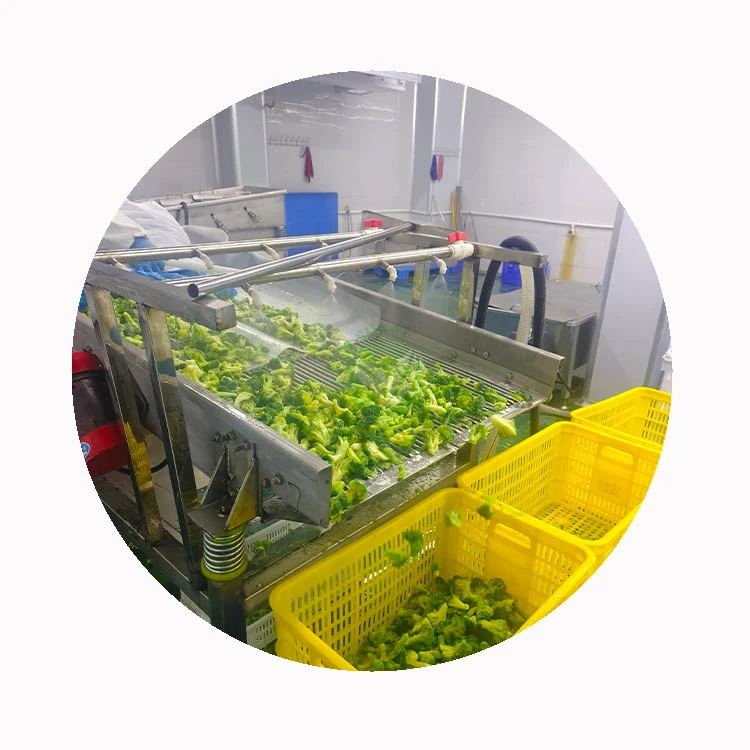
Separated florets expose spaces that are difficult to inspect in a whole head. The wash should move water around those surfaces and remove loosened material while limiting unnecessary damage. Inspect the underside of the crown as well as the top. A clean photograph taken from above gives little information about branch junctions.
The right operating assessment combines cleaning performance with product integrity. More agitation, a longer route or a greater drop between conveyors may improve movement through a system while increasing breakage. KRONEN's broccoli washing discussion describes product immersion and preliminary dewatering as equipment-specific functions. Its published machine settings are not a transferable recipe for a different washer, product load or floret size.
Compare product at the washer entrance and exit under comparable sampling conditions. If loose buds increase sharply after washing, inspect the operating conditions and transfers before blaming the cutting stage. If dirt remains on intact florets, investigate loading, access to the branch spaces and the removal of dirty water or debris. One adjustment may improve cleaning while making damage worse, so record both outcomes during the same trial.
Do not use the number of washes as a quality score. Two poorly controlled stages can be less useful than a well-designed sequence with a clear purpose for each contact. Ask what each stage removes or controls, where debris leaves the system, and how the processor decides the stage is operating acceptably. The answer should describe observable conditions and records, not just a machine name.
Keep wash-water control separate from visible cleanliness
Clear-looking broccoli is an appearance result. The water-control log addresses a different question: whether the washing system was operated to manage contamination during that run. FDA's fresh-produce guidance identifies contaminated wash water as a route for spreading contamination and discusses monitoring the conditions that affect antimicrobial performance. It also emphasizes prevention rather than expecting a wash to correct prior contamination.
Where an approved antimicrobial treatment is used, review the agent, authorized application, monitoring method and action limits in the processor's procedure. Relevant conditions can include concentration, contact time, pH or temperature, depending on the system. A generic sanitizer figure taken from an article is not enough to set a commercial broccoli process. The actual treatment must fit the product, equipment, applicable rules and validated controls.
For a buyer reviewing records, look for continuity. Can the wash log be connected to the lot and production interval? Are checks recorded during operation, and does a deviation have a documented response? Request the run history alongside any final satisfactory reading. Review the finished-product report separately: its sample, method and acceptance criteria address the packed food, while the wash log documents the operating conditions.
Keep household advice separate. FDA advises against washing household produce with soap, detergent or commercial produce wash. Factory treatment chemistry is controlled under a different operating context. Never improvise a domestic version of an industrial treatment from a chemical name or a concentration found online.
When water conditions fall outside the approved limits, the next question is which product was exposed and how it is assessed. Rewashing should not be treated as an automatic release decision. The processor's food-safety procedure must determine the disposition, with the affected interval and lot identity retained.
Drain and hand over to blanching without losing control
Drainage is a handling stage with its own acceptance question: is the broccoli ready for the next operation without unnecessary retained water or mechanical damage? Watch the product, the collection points and the transfer into subsequent equipment. A wet crown can look intact while carrying water into the next step; an aggressive draining operation can produce more fragments than the washer itself.
Review the dwell time and movement of the product rather than interpreting a still photograph as proof of performance. Ask what happens when the next machine pauses. Accumulated product may be handled differently from material flowing steadily through the line. The procedure for stoppages should explain how the processor protects product identity and decides whether held material can continue.
Blanching follows a separate process objective. Health Canada's guidance describes blanching as a brief boiling treatment followed by rapid cooling and explains its role in preserving vegetable quality before freezing. Washing and blanching therefore require separate assessments. Establish the packed product's intended use and preparation instructions explicitly, including whether further cooking is required.
For a bounded home-preservation reference, the National Center for Home Food Preservation recommends florets no more than 1½ inches across, approximately 38 mm, with 3 minutes of water blanching or 5 minutes of steam blanching, followed by prompt cooling and drainage. Those instructions apply to the stated home method. Keep commercial processing parameters and packed-product cooking instructions tied to their own validated conditions.
For commercial approval, ask how the line's blanching and subsequent cooling conditions were established for the actual product. Keep the eventual cooking instructions aligned with its intended use. The equipment overview can help frame questions about functions; the relevant processing records must identify which operations applied to your broccoli.

Compare damage at the point where it starts
A finished bag combines the effects of cutting, washing, draining, freezing, handling and packing. It is therefore a poor place to assign a cause by appearance alone. If a trial produces excessive fragments, retain small, comparable samples from successive stages. Keep the collection technique consistent: selecting a few intact pieces at one point and scooping all material at another would distort the comparison.
| Signal in the sample | Comparison to make | Question to investigate |
|---|---|---|
| Long or uneven stems | Post-cut sample against the agreed style | Does trimming match the product definition? |
| More loose buds after washing | Matched samples before and after washing | Is damage occurring in the washer or a transfer? |
| More fragments after packing | Pre-fill sample against packed sample | Is filling or later handling changing the approved cut? |
Use those signals to decide where to investigate, not to declare a cause from one photograph. A torn crown can arise at more than one transfer, and a stem-heavy portion may reflect the incoming head structure as well as the trimming decision. A useful comparison isolates the stage by holding the rest of the sample method steady.
We would ask for both the accepted product and the material removed during a trial. Looking only at the attractive fraction hides the cost of producing it. Separate loose edible broccoli from leaves, unsuitable tissue and foreign material; those groups have different implications and should not disappear into one "waste" total. Any proposed alternative use for separated material needs its own approved product and handling route.
Set the response before repeating the trial. A cutting adjustment should be checked for size distribution and crown integrity. A wash adjustment should be checked for cleaning, damage and the water-control conditions it affects. Changing several settings at once may produce a better sample without explaining which change should be retained for the next run.

Worked example: compare usable florets on a stated basis
Suppose an importer opens a representative 10.0 kg trial quantity of frozen broccoli for a foodservice application. The written trial method separates 0.7 kg of pieces outside the agreed cut description and 0.5 kg of loose material unsuitable for that serving style. The remaining 8.8 kg meets the trial's visual-use criterion. These are illustrative inputs, not an XMSD specification or a measured customer result.
The usable proportion on this basis is 8.8 kg ÷ 10.0 kg × 100 = 88%. If the illustrative ingredient cost is 2.00 currency units per purchased kilogram, the ingredient cost per usable kilogram is 2.00 ÷ 0.88 = approximately 2.27 currency units. That calculation excludes labour, energy, transport and all other costs, so it supports a controlled comparison rather than a complete production budget.
The decision is whether the lower usable proportion still fits the intended serving and total cost. Repeat the same assessment on the alternative sample before comparing the two offers. If the second sample is assessed after cooking while the first is assessed frozen, the figures do not describe the same endpoint. Use a separate, consistently defined cooking trial for drained cooked yield.
Use the result to show how much of the purchased ingredient fits the application, then investigate whether the shortfall starts with cutting, later handling or the original specification. Keep legal net-weight verification, microbiological assessment and contractual lot acceptance as separate checks. Apply the trial's 88% result against the serving requirement and cost model you established before testing.
Practical example: a ready-meal tray needs a different cut decision
Take a ready-meal developer comparing two illustrative broccoli samples with crowns described as 30–50 mm. Sample A has longer, thicker stems; sample B has shorter stems and a tighter spread of overall piece lengths. The meal contains a sauce and goes through a final heating step. The decision is which sample gives a recognizable floret and an acceptable bite after that complete preparation sequence.
Test equal broccoli masses in the same recipe, using the same starting state, equipment load and heating method. Record crown breakage, stem tenderness, the distribution of pieces across trays and the appearance of the sauce. Evaluate at the actual serving point, including the planned holding period if there is one. A sample that looks better immediately after heating may not be the preferred ingredient when served.
If the longer stems remain firmer while the crowns already meet the desired texture, increasing the entire cooking step may be a poor correction. Consider the cut geometry first. Conversely, if small crowns disappear during mixing, simply specifying an even smaller cut would move in the wrong direction. Choose the combination of crown and stem dimensions that survives the recipe and handling you actually use.
The expected result of this representative trial is a more precise approval description, supported by photographs and a preparation method. It is not a promise that sample B will win. When assessing frozen ingredients for food processing, use the downstream operation as the approval endpoint. Record where the broccoli enters the recipe and what the final piece must look and feel like, so the sample comparison answers the actual production question.
Records that connect the cut and wash to the delivered product
Keep the evidence proportionate to the decision. For size and appearance, retain the agreed product description, measurement method, representative photos and sample results. For the wash operation, retain the relevant run identity, operating checks and any deviations. For the finished product, connect the packed lot code to the production record. These are different records with one shared requirement: they must refer to the product being assessed.
A clear deviation account describes what changed, when it was noticed, which material could be affected, the action taken and who authorized the disposition. Without the time or lot connection, a corrective-action entry may describe a real improvement while leaving the status of an earlier quantity unresolved. Ask for the link between the correction and the released material.
Also agree what happens when a new raw-material condition changes trimming performance. A more variable crop may require a different sorting approach, but the delivered style should still match the approved description. If a proposed change affects crown integrity, stem proportion or cooked performance, compare a representative sample against the approved reference before accepting the change as equivalent.
Bring the sample and the production records together. The photographs describe the product or equipment; the dated records establish the conditions of the run. This connection gives an approval sample meaning beyond its appearance and makes later comparisons more useful.
Preserve the result through packing and delivery
Good front-end work loses value if later handling breaks the accepted florets. Check how frozen product is transferred, filled and protected, especially where changes in pack format alter drop height, compression or handling. Keep packing trials separate from the wash trial when possible, so you can identify the stage responsible for any new damage.

At receipt, review pack condition and product observations together with the temperature and handling evidence available for the shipment. Increased fragments can have several causes; surface ice or clumping also needs context. Record what you see before attributing it to cutting or washing. Retain the lot code, photographs and the inspection method so the issue can be compared with release evidence.
The frozen-food packaging options are relevant here because the approved ingredient needs a practical route into your operation. Choose a format that supports handling and traceability as well as the required quantity. Review a filled sample for opening, pouring and portioning before approving the format for routine use.

A useful approval ends with a clear account of the desired floret, how it is measured, how it behaves in the intended food and what evidence supports the processing run. Cutting creates that shape, washing prepares the accessible surfaces, and subsequent controls protect the result. Keep those jobs connected without asking any one of them to prove everything about the broccoli.
Send XMSD your broccoli application, preferred crown and stem description, pack format and sample-assessment method. We can use those inputs to review the product discussion around your actual preparation process.
References
- FDA: Selecting and Serving Produce Safely
- FDA: Guide to Minimize Microbial Food Safety Hazards for Fresh Fruits and Vegetables
- National Center for Home Food Preservation: Freezing Broccoli
- Health Canada: How to blanch vegetables
- AIT: Broccoli processing line
- KRONEN: Washing and preliminary dewatering large quantities of broccoli
- XMSD operational perspective on floret specifications, application trials, sample assessment and packing. Worked scenarios are illustrative.