


Are Avocados Healthy for You? Evidence, Portions and Product Forms
Jun 27, 2019

Yes. Avocado can be a healthy food for most people who tolerate it. It provides mostly unsaturated fat, fiber and potassium, and current U.S. dietary guidance includes avocado among whole-food sources of healthy fats. That answer needs one qualification: "healthy" describes how the food fits your overall eating pattern. It does not mean unlimited portions, automatic weight loss, a treatment for heart disease or a guarantee that every avocado product has the same nutrition.
First separate substitution from addition. Replacing part of a saturated-fat-rich spread with a measured portion of avocado is different from adding avocado to a meal without changing anything else. Plain edible flesh is also different from guacamole with salt, a sweetened smoothie, an avocado dessert or a treated frozen product. Start with the amount and form you actually eat, read the complete meal, and match any health claim to the strength of the evidence.
The short answer: Avocado is a nutrient-dense whole fruit and a useful source of unsaturated fat, but it is also energy-dense. Choose a defined edible portion and use it in place of another rich ingredient when that suits the meal, rather than automatically adding it on top. Judge frozen or formulated products from their own ingredient list, label and serving basis.

Why Avocado Can Fit a Healthy Eating Pattern
The 2025–2030 Dietary Guidelines for Americans place avocados among whole-food sources of healthy fats. The same guidance recommends a variety of fruits and vegetables, paying attention to portion sizes-especially for foods higher in calories-and adjusting intake to age, sex, body size and activity. Avocado fits that framework well: it can contribute fruit, fat and fiber, but it does not replace the need for varied vegetables, protein foods, whole grains or other nutrient sources.
Avocado is unusual among commonly eaten fruits because fat supplies much of its energy. That is not a defect. Fat has normal roles in cell structure, energy supply and absorption of fat-soluble compounds. The type and dietary context matter. An NIH review of a large avocado cohort describes avocado as a source of monounsaturated fat, while the American Heart Association recommends choosing sources of unsaturated fat in place of sources of saturated fat as part of a heart-healthy pattern.
Fiber and potassium add nutritional value without turning the fruit into medicine. Fiber is part of normal digestive function, and NIDDK advises adults to obtain appropriate fiber from varied foods and to increase it gradually when needed. NIH explains that potassium is required for normal cell function, nerve transmission, muscle contraction and kidney function. The presence of those nutrients supports a dietary role. It cannot prove that one avocado serving prevents constipation, lowers blood pressure for every person or corrects a clinical deficiency.
Practical example: Suppose your lunch contains bread, vegetables, a protein food and a rich spread. Using avocado in place of part of that spread can change the fat source and add fruit solids and fiber. Adding the same avocado while keeping the entire original spread creates a different meal with more total energy. Write down what the avocado replaces before calling the change healthier.

Read the Nutrition Numbers on a Defined Edible Basis
The FDA raw-fruit poster gives a useful public reference for California avocado. Its displayed edible portion is 30 grams, described as one-fifth of a medium fruit. That amount provides 50 calories, 4.5 grams of total fat, 3 grams of carbohydrate, 1 gram of dietary fiber, 0 grams of sugar, 1 gram of protein and 140 milligrams of potassium. The basis matters: the figures exclude peel and stone and do not describe a whole fruit of unspecified size.
A "medium avocado" is not a reliable production unit because fruit size, edible yield, cultivar and maturity vary. If you want to know what your portion provides, weigh the edible flesh. If you are developing a packaged food, use the exact recipe and applicable label rules. Our focused guide to avocado nutrition in food-product formulas explains why a database reference should not become a lot certificate or finished-label promise.
Worked portion example: To scale the FDA display from 30 grams to 50 grams, multiply each value by 50 ÷ 30, or 1.6667. The result is about 83 calories, 7.5 grams of total fat, 5 grams of carbohydrate, 1.7 grams of fiber, 1.7 grams of protein and 233 milligrams of potassium. These are arithmetic estimates from rounded poster values, not a new chemical analysis. For a commercial product or clinical diet, use its current label or the evidence specified for that decision.
Write both a weight and a food state when you describe a portion. "Fifty grams of raw edible flesh" is reproducible. "Half an avocado" is convenient at home but can represent different weights. "Fifty grams of guacamole" describes a mixed food whose avocado percentage, salt and other ingredients may differ. "Fifty grams frozen" may not equal 50 grams of thawed, drained, usable flesh if liquid or trim is excluded. The measurement has to match the question.
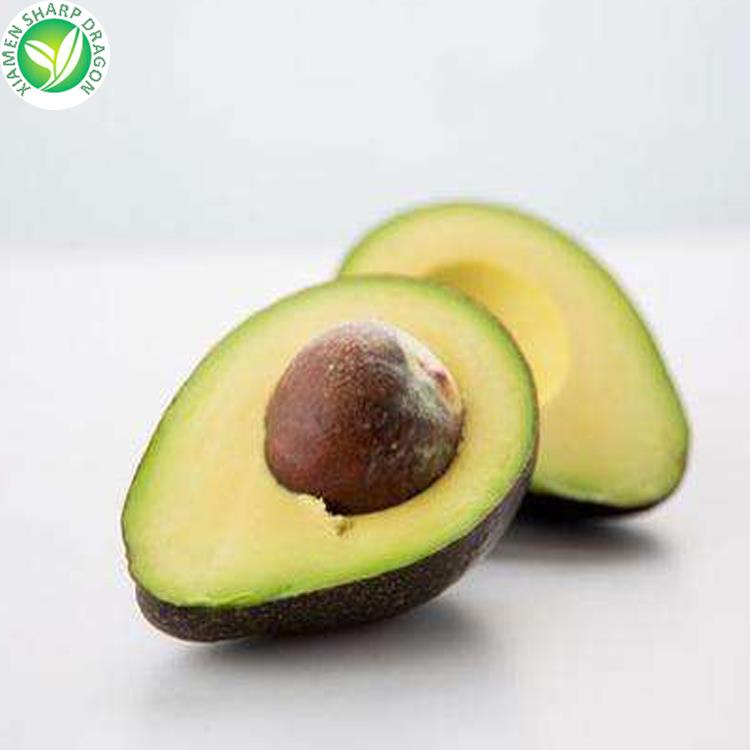
The Fat Is a Reason to Measure Avocado, Not Avoid It
Calling all fat unhealthy is too crude to guide a meal. The American Heart Association's 2026 dietary guidance recommends sources of unsaturated fats in place of sources of saturated fat. Its companion guidance explains that monounsaturated and polyunsaturated fats can help reduce LDL cholesterol when they replace saturated fats. The operative word is "replace." A food may offer a favorable fat pattern while still increasing total calories if it is added without adjusting the rest of the meal.
Treat avocado flesh and avocado oil as separate portions. Whole flesh brings water, fiber and a particular texture along with fat. Oil is almost entirely fat and is dosed differently. Guacamole may include vegetables, acid and salt; a commercial spread may include oil, starch, dairy ingredients or preservatives. A health judgment made for plain avocado cannot be pasted onto every product that uses "avocado" in its name.
Worked substitution example: Imagine that a sandwich recipe uses a spread whose verified label lists 90 calories and 1.5 grams of saturated fat at the recipe dose. A reformulated trial removes that dose and adds 50 grams of avocado, estimated from the FDA poster at about 83 calories. The change is approximately 7 fewer calories before any other recipe adjustment, while the saturated-fat comparison must come from the avocado evidence and the original spread label. If you keep the original spread and add avocado, the meal rises by about 83 calories instead. Whether you replace or add changes the conclusion more than the word "healthy."
Use this logic without treating avocado as the only acceptable fat source. The large observational study summarized by NHLBI found no added heart association when avocado replaced nuts, olive oil or other plant oils. The benefit signal was tied more clearly to replacing foods such as butter, margarine, processed meat and some dairy products. That supports dietary variety and substitution, not a ranking in which avocado automatically beats every other whole-food fat.
What Heart and Weight Research Can-and Cannot-Establish
Two types of evidence appear frequently in avocado health claims. Observational cohorts compare what people report eating with outcomes that occur later. Randomized trials assign an avocado-containing diet or meal and compare selected measurements with a control. Both are informative, but they answer different questions. An association in a cohort does not prove that avocado caused the outcome, while a short trial of cholesterol markers does not establish lifelong disease prevention.
The NHLBI summary describes a study of more than 100,000 adults. Eating at least two avocado servings per week was associated with 16% fewer cardiovascular-disease events and 21% fewer coronary-heart-disease events than lower intake, with no difference observed for stroke. Substitution analyses were stronger when avocado replaced certain animal or processed fat-containing foods. The study adjusted for many diet and lifestyle variables, but it remained observational. People who choose avocado can differ from non-eaters in ways a model cannot remove completely.
A 2024 systematic review and meta-analysis offers a more restrained clinical picture. It included nine randomized trials with 503 participants and one prospective cohort with 55,407 participants. Across the pooled evidence, avocado consumption produced a small reduction in total cholesterol, with no significant overall difference in LDL cholesterol, HDL cholesterol or triglycerides. A subgroup with high cholesterol showed larger changes, but the authors rated certainty low to very low and called for larger, better-conducted studies.
The same review found that avocado consumption did not negatively affect body weight or body composition in the included evidence. That does not mean avocado burns fat or that adding it guarantees weight loss. Body weight reflects total energy intake, expenditure and dietary adherence over time. An avocado portion may make a meal satisfying for some people, yet a rich avocado dish can still add substantial energy. Use the food as a chosen part of the meal, not as a correction for the rest of the day.
Evidence-reading example: A 16% relative association is not a statement that 16 of every 100 people are protected. In a hypothetical population with 10 events per 100 people, a 16% relative difference corresponds to 8.4 rather than 10 events, or 1.6 fewer per 100. In a group with 2 events per 100, the same relative difference corresponds to 1.68 events, or 0.32 fewer. The study did not supply those hypothetical baselines; the calculation shows why relative percentages need context and why association is not personal prediction.

Portion, Frequency and Tolerance Are Separate Decisions
There is no official avocado-only requirement that every adult must reach each day. The FDA's 30-gram raw-fruit display is a labeling and education reference, not a prescription. One person may use 30 or 50 grams as a topping, while another may build a meal around a larger portion. The Dietary Guidelines advise choosing the amount according to energy needs and paying extra attention to portions of calorie-dense foods. Weighing the edible portion once or twice gives you a better reference than guessing from fruit size.
Frequency asks another question. A food can be healthy without needing to appear daily, and avocado should not crowd out fruit, vegetable, legume, nut, seed or protein variety. If you enjoy it often, track what role it fills. A repeated 50-gram spread used instead of another fat is not equivalent to eating a whole avocado in addition to every usual meal. The relevant pattern includes total portions and substitutions across the week.
Digestive tolerance also varies. Fiber can support normal bowel function, but a sudden increase may cause gas or discomfort in some people. Our evidence-focused guide to avocado and gut tolerance separates ordinary fiber effects, IBS/FODMAP considerations and product handling from the broad health verdict. If symptoms repeat, record the edible weight, full meal and timing rather than assuming every avocado form will behave identically.
Potassium deserves proportionate caution. The FDA poster lists 140 milligrams in its 30-gram avocado portion, while NIH explains that people with impaired potassium excretion from kidney disease or certain medications may need individualized limits. That is a reason to count the avocado within the prescribed plan, not to declare it dangerous to everyone. A person following a renal or medication-related potassium restriction should use the amount given by their clinician or dietitian.
Health and allergy note: Seek individualized advice when kidney function, medicines, a diagnosed digestive condition or a known allergy changes food choices. Hives, swelling of the lips or tongue, throat tightness, trouble breathing, dizziness or fainting after food can signal a serious allergic reaction; MedlinePlus advises emergency help for anaphylaxis.
Whole, Frozen and Formulated Avocado Are Different Foods
Judge each product form on its own. Plain whole flesh provides the clearest comparison with the FDA raw-fruit reference. Plain frozen pieces can preserve the main fat, fiber and mineral contribution, but variety, maturity, water content, trim and thawed yield still vary. Acid-treated frozen avocado adds declared ingredients that may protect color and affect taste or labeling. Guacamole, spreads, smoothies, desserts and sauces have to be judged as complete formulations.
| Product form | What the health judgment can use | What can change the answer |
|---|---|---|
| Raw edible flesh | Measured edible weight and a matching public composition reference | Fruit size, cultivar, maturity, edible yield and the rest of the meal |
| Plain or treated frozen pieces | Actual ingredient declaration, label, frozen or thawed basis and product specification | Added acid or salt, drip, broken pieces, oxidation, serving state and storage history |
| Guacamole, spread, drink, sauce or dessert | Full recipe, serving size and finished Nutrition Facts panel | Avocado percentage, oil, dairy, starch, salt, added sugar and actual serving count |
Freezing should not be described as making avocado either healthier or unhealthy by itself. Physical structure, softness, drip, color and flavor may change during freezing and thawing. Nutrient retention depends on the nutrient, raw material, treatment, storage and measurement basis. Our frozen avocado nutrition guide shows how to compare a commercial label with a public reference on an equal 100-gram basis without claiming one universal retention percentage.
Ingredient order and serving basis often resolve apparent contradictions. A plain 100-gram frozen product and a 100-gram dip containing 35% avocado are not competing nutrition analyses; they are different foods. Likewise, a label per 30 grams and another per 100 grams must be normalized before comparison. Check whether values are as sold, as prepared, frozen, thawed or drained. If the product contributes only part of a recipe, multiply by its inclusion rate before assigning its nutrients to the finished portion.

For Frozen Avocado, Turn the Health Claim into a Specification
A frozen-avocado purchase should connect the nutrition statement to a defined item. Start with the product form-halves, chunks, slices or pulp-and the full ingredient declaration. Identify whether the nutritional basis is a database calculation, a current supplier document or representative analysis. State the serving state and unit. If a claim will appear on a finished retail product, apply the destination market's rules and include every ingredient in the recipe rather than assigning raw-avocado values to the package.
Usable yield is the bridge between a healthy portion idea and real service. Frost, released liquid, broken pieces and trim can change how much visually acceptable avocado reaches a bowl. In our frozen-food work, we would test the actual thaw route and application before converting a menu portion into purchase weight. The linked guide to using frozen avocado in food production explains why product status, frozen or partial-thaw handling, drip and hold conditions belong in that trial.
Worked foodservice example: A breakfast program plans 200 bowls with 45 grams of thawed usable avocado in each. Required edible output is 200 × 45 g = 9,000 g, or 9.0 kilograms. An illustrative trial measures 95% usable yield, so frozen input is 9.0 ÷ 0.95 = 9.47 kilograms. If operating records justify a 2% allowance, planned input becomes 9.47 × 1.02 = 9.66 kilograms before rounding to a purchasable pack. The 95% yield and 2% allowance are hypothetical method values, not XMSD product promises.
Use the calculated input to protect both portion and claim integrity. If a menu describes a 45-gram avocado serving but the scoop contains only 35 grams after drip and breakage, the nutrition and cost model are both overstated. Conversely, buying from gross carton weight without measuring usable output can make an acceptable product appear expensive. Define edible output, run more than one representative bag, report average and spread, and connect the acceptance rule to the intended use.

Build Acceptance Around the Finished Use
A nutritionally suitable ingredient can still fail the application. A visible bowl needs recognizable pieces, controlled browning and tolerable liquid release. A dip may accept softer fruit but requires consistent solids, flavor and ingredient declaration. A smoothie can use frozen pieces directly only when the exact product instructions, food-safety status and equipment support that route. We recommend approving the form in the finished food instead of treating the category name as proof of performance.
Set sample conditions before comparing lots. Record frozen sample weight, thaw method, drain time, usable weight, color evaluation time, defect categories and recipe inclusion. Serve coded samples at the same temperature and dose. A sample that looks green immediately after opening may brown or release liquid during the real service hold. Include the planned serving point in the ingredient test instead of judging appearance only at package opening.
Risk signals need a defined response. Unexpected sourness may come from declared acid treatment or may indicate a mismatch with the approved reference; the ingredient list and retained sample help separate those explanations. Excess surface frost can interfere with dosing but does not, by itself, prove a safety failure. Damaged packaging, temperature exposure or an unknown ready-to-eat status raises a different control question. Hold the lot, compare the approved documents and trace the handling record instead of using color as a safety test.
Pack size should follow consumption per shift. If you use 4 kilograms per breakfast service, opening a much larger liner may extend handling and create leftover product. Smaller inner packs may cost more per kilogram but reduce repeated exposure and waste. Compare pack price on usable kilograms after the validated thaw and hold, not solely on stated net weight. Then define the carton, coding, storage statement and route evidence needed for the destination.

XMSD sourcing note: Review the XMSD frozen avocado range, then send the intended form, ingredient declaration, served weight, application, pack format, destination and trial method. We will review which product and order details need sample-based confirmation.
The Practical Verdict
Avocado can be healthy because it offers whole-food unsaturated fat, fiber and potassium in a versatile form. Its fat content is not a reason to avoid it, but its energy density is a reason to measure the portion and decide what it replaces. Evidence supports a place in heart-healthy eating patterns; it does not support calling avocado a cure, a guaranteed weight-loss food or a requirement for every day.
Use grams of edible flesh when the number matters. Separate plain avocado from oil, dips, sweetened drinks and mixed dishes. If you buy frozen avocado, connect the claim to the actual ingredient list, label basis, thawed usable yield and finished-food trial. You can then state the health answer on the right food basis and repeat the commercial portion at service.
References
- Dietary Guidelines for Americans, 2025–2030
- U.S. Food and Drug Administration: Raw Fruits Nutrition Facts Poster
- American Heart Association: 2026 Dietary Guidance to Improve Cardiovascular Health
- American Heart Association: Fats in Foods
- Avocado Consumption and Cardiometabolic Health: Systematic Review and Meta-Analysis
- NIH NHLBI: Avocados Can Support a Heart-Healthy Diet
- NIH Office of Dietary Supplements: Potassium Fact Sheet for Consumers
- NIDDK: Eating, Diet, and Nutrition for Constipation
- MedlinePlus: Food Allergy
- XMSD operational experience in frozen-fruit sourcing, IQF processing, quality control, packaging, and B2B export coordination.