


Does an Apple a Day Keep the Doctor Away? What the Research Shows
Aug 31, 2020

An apple can be a useful food choice, but eating one every day has not been shown to remove the need for medical care. The familiar proverb makes a much larger promise than the research supports. It is reasonable to enjoy apples for their flavor, texture and contribution to a varied diet. It is unreasonable to use the saying as a reason to postpone an appointment or replace prescribed treatment.
The distinction becomes clearer when you ask what a study actually measured. A survey of doctor visits, a trial measuring cholesterol and an experiment measuring lunch intake are three different investigations. Each can tell us something about apples without proving that the fruit prevents every illness. The food form matters too: a whole apple, a drink and a sweetened filling are different things to eat.
For an everyday decision, choose the apple product you actually want to use, understand the portion and preparation, and judge it within the complete meal. There is no need to earn a daily apple streak. There is value in learning how to read the claims attached to a familiar food.

The doctor-visit study tested a narrow version of the saying
Davis and colleagues examined US survey data in a paper published in JAMA Internal Medicine in 2015. Their final analysis included 8,399 adults. The apple-eating category used at least 149 g of raw apple, approximately a small apple, reported in a dietary recall considered typical by the participant. It was a classification for the analysis, not a recommended daily dose.
The main outcome was reporting no more than one physician visit in the preceding year. After adjustment for several personal and health-related characteristics, the association between apple eating and that outcome was not statistically significant. The researchers also examined other healthcare use. This was an observational comparison rather than an experiment assigning people to eat apples, so it could not establish cause and effect.
The University of Michigan's explanation highlights why adjustment mattered: apple eaters differed in other habits and characteristics. A simple comparison between groups can therefore give a different impression from the analysis that accounts for those differences. The useful question is not merely whether one group looks healthier. It is whether the difference can reasonably be attributed to the fruit.
A doctor visit is also an imperfect shorthand for health. An appointment may involve prevention, monitoring, treatment or reassurance. Counting visits gives information about service use; it does not provide a complete account of how well a person is. Keep attending the care appropriate to your circumstances, regardless of whether apples happen to be part of your breakfast.
Other apple trials answer other questions
A controlled trial by Koutsos and colleagues, published in 2020, studied 40 adults with mildly elevated cholesterol. Participants consumed two specific whole apples daily, 340 g without the core, or a matched control drink for eight weeks each, separated by a four-week washout. Reported LDL cholesterol was 3.72 mmol/L after the apple period and 3.86 mmol/L after the control period. The trial found no effect on blood pressure.
That result concerns a defined food, comparator, group and period. It is not evidence that one apple of any size replaces cholesterol treatment, or that a frozen dessert delivers the same result. The trial measured risk markers rather than demonstrating fewer heart attacks or fewer doctor visits. Those distinctions preserve what is interesting about the finding without enlarging its promise.
A separate experiment by Flood-Obbagy and Rolls compared apple, applesauce and apple juice before a meal in 58 adults. The portions were matched for weight and energy. Whole apple produced greater satiety and lower meal intake than the other tested forms. This was a short-term eating experiment; the result should not be turned into a guaranteed long-term weight-loss figure.
These studies can coexist without contradicting one another. A food may influence a measurement under trial conditions while a population survey finds no clear relationship with a different outcome. The right response is to keep each conclusion attached to its question. Combining all favorable findings into one sweeping benefit list makes the evidence harder, rather than easier, to understand.

Read a food headline with four details beside it
Start with the people. Adults with a particular starting condition are not automatically representative of every age group or medical situation. Next, identify the actual food and the comparison. A trial of whole fruit against a drink answers a different question from a comparison against another whole fruit. Neither tells you what happens when apple is added to an unrelated recipe.
Then look at the time period and outcome together. A meal experiment can examine immediate appetite. A longer intervention can examine a measured marker. A survey can examine reported habits and healthcare use. The timescale and measurement tell you what kind of decision the finding can support. They also reveal when a headline has skipped an essential qualification.
You do not need to become a statistician before choosing lunch. A short description is enough: who ate what, compared with what, for how long, and what changed? If you cannot fill in those details, treat the headline as a starting point for reading. It is not yet a practical instruction for your shopping basket.
| Question | Information to find | Useful distinction |
|---|---|---|
| Who took part? | Age group and relevant starting condition | A defined study group is not everyone |
| What was eaten? | Form, amount and comparison food | Whole fruit and a formulated food differ |
| How long was it studied? | Meal, weeks or longer follow-up | Immediate response and lasting outcome differ |
| What was measured? | The specified outcome | Food composition, biomarkers and illness are different measurements |
One additional distinction helps: a measurement of what is in an apple is not a measurement of what the apple will do to a person. A composition table can support a calculation of carbohydrate or fiber in a specified serving. It cannot, on its own, demonstrate treatment of a disease. Use composition information for meal arithmetic and clinical research for claims about outcomes.
The same discipline applies to a dramatic percentage. Ask what the percentage describes, what comparison produced it and whether it is an observed association or an intervention result. A number can be accurate within its study and still be misleading when moved into a different sentence. Keeping the original denominator and outcome in view is often more useful than remembering the headline number.
Keep the studied food attached to the conclusion
A whole apple has edible flesh, skin if retained, and a recognizable structure. Juice, puree, dried pieces and a formulated filling differ in preparation and eating experience. Harvard's Nutrition Source discusses these distinctions, including the loss of much of the fiber during clear juice production. The word apple on a product name does not make all of those forms nutritionally identical.
The apple skin and preparation guide deals specifically with peel decisions. Here, the broader point is to describe the food accurately before borrowing a conclusion about it. If a study used skin-on whole fruit, say that. If the product in your hand is a blend, read what else is included.
We would ask for the actual ingredient description before discussing a nutrition-led application. Plain frozen apple pieces, sweetened apple filling and a finished pastry require different information. A supplier's statement about the fruit component may be perfectly accurate while leaving the rest of the recipe unaddressed. That gap becomes important as soon as someone tries to describe the finished serving.
A worked example of fruit content, not clinical equivalence
Hypothetical label-review example: a recipe produces a 140 g dessert serving containing 35% apple by weight. The apple contribution is 140 g multiplied by 0.35, or 49 g. The remaining 91 g comes from the other recipe components. The product developer records 49 g as the recipe's apple contribution and evaluates the finished dessert using its complete formulation.
The decision is to describe what the recipe contains, rather than call the dessert equivalent to a whole-apple intervention. That calculation supplies no clinical effect and no automatic nutrition value. For a real product, use the actual recipe and appropriate finished-product information; if processing changes the stated basis, resolve that basis before presenting the number.
This example also shows why a serving photograph is insufficient. Two bowls can look equally full while containing different proportions of fruit, sauce and other ingredients. The information needed to describe a recipe comes from the recipe itself. A photograph can show piece size or appearance, but it cannot settle an ingredient-percentage question hidden beneath the surface.

Put a daily apple within a varied diet
The NHS uses one medium apple as an example of a fruit portion within its UK 5 A Day guidance. It recommends variety across fruit and vegetables; it does not make apples the whole plan. Its guidance also distinguishes whole fruit from juice and smoothies, whose combined daily amount is limited to 150 ml and counts as no more than one portion.
Those are practical dietary conventions, not thresholds derived from the doctor-visit study. The research classification of 149 g and the familiar phrase one apple serve different purposes. An apple's size also varies. If you need a measured serving for a particular plan, use its edible weight and the food information appropriate to that form rather than assuming every apple supplies the same amount.
For people managing diabetes, CDC guidance includes whole fruit within suitable carbohydrate choices and emphasizes portion size. Follow the plan developed with your care team. A naturally sweet food still contributes carbohydrate, and a fruit headline provides no basis for changing medication. The useful information is the actual serving and how it fits the complete eating occasion.
For someone without a special dietary requirement, enjoyment and practicality can remain central. Choose a texture and flavor you like. Keep other fruits and vegetables available. If you prefer a pear on a particular day, that choice does not require an explanation about failing the proverb. A flexible eating pattern has room for familiar favorites and alternatives.
Choose the apple form for the meal you intend to make
A fresh apple may suit an eating occasion where crunch and portability matter. Prepared slices may suit a dish where visible pieces matter. Small dice can distribute apple across a spooned mixture. A smooth preparation serves another purpose. These are culinary choices you can assess directly, without asking a medical study to choose a recipe for you.
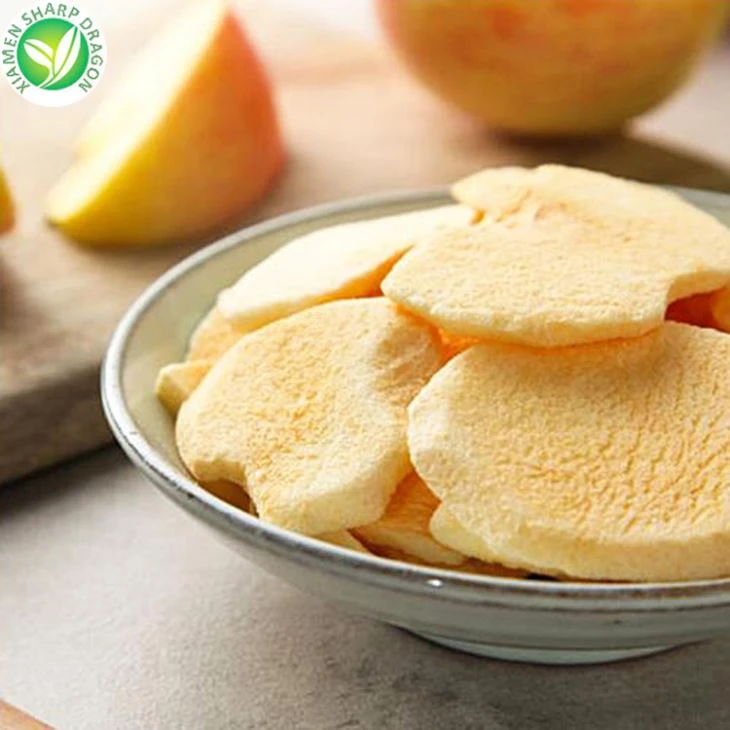
The frozen apple range provides a starting point for comparing available forms. For a selected product, read its preparation directions and review the result in the intended dish. A photograph of frozen pieces does not predict precisely how firm or soft they will be after your cooking method. A modest kitchen trial answers that practical question more directly.
We would distinguish a visible topping from an evenly distributed fruit inclusion before choosing the cut. Large pieces can be useful when presentation depends on seeing apple. Smaller pieces may be easier to distribute through a mixture. The trade-off is not that one cut is healthier; it is whether the prepared food gives the appearance and eating texture the recipe needs.

A foodservice example with two different acceptance questions
Hypothetical kitchen example: twelve warm dessert portions are planned with 100 g of apple ingredient per portion, giving 1,200 g in total. The cook obtains two suitable samples, 600 g of slices and 600 g of dice, and prepares each with the same recipe procedure and the required product instructions. Each trial represents six portions on the stated ingredient basis.
The sliced version is judged for recognizable pieces and neat serving. The diced version is judged for even distribution and whether the spooned portion has the intended texture. The cook records the finished batch weights separately, because 600 g of apple input is not necessarily 600 g of finished recipe. The chosen form is the one that meets the actual presentation requirement.
The example's result is a documented culinary choice, not a supplier yield promise or a health finding. It also prevents an avoidable misunderstanding at ordering: the kitchen can explain whether it wants visible apple pieces or a distributed inclusion. That description is useful in a foodservice conversation, where a generic request for healthy apples would leave the application unclear.

A fruit snack and a fruit ingredient need different label questions
A bag of fried apple slices is a distinct snack format. It should be assessed through its own ingredients, serving size and nutrition information. The presence of apple does not make a crisp snack interchangeable with fresh fruit by weight, nor does a pleasant crunch demonstrate any of the outcomes measured in a whole-apple study.
The same approach works for a sauce or filling. First identify the food being sold. Then examine the amount you plan to eat and the complete ingredients. If you are comparing two products, keep the comparison basis consistent. A small serving from one pack and a much larger serving from another can obscure the practical difference you meant to examine.
Pack size and serving size answer different questions. The first tells you how much food is supplied; the second tells you the amount used for the displayed information or intended eating occasion. A pack containing several servings is not one serving simply because it can be opened at once. Check both before using a label figure in meal planning.
For a repeated kitchen use, keep the original product identity connected to any container used during preparation. Clear packing arrangements help preserve the information needed to identify the ingredient and follow its directions. This is especially useful when several similar-looking fruit components are used in different recipes. The label should remain available when the person preparing the food needs it.
Preparation and individual needs still come first
FDA guidance advises washing fresh produce under running water before preparation or eating, including when the peel will be removed. Start with clean hands and equipment, cut away damaged areas and discard rotten produce. Keep ready-to-eat produce away from raw meat and the equipment used with it. A nutritious food still requires ordinary care in the kitchen.
For frozen apple, follow the selected product's cooking or preparation instructions. FDA explains that freezing does not reliably kill bacteria in ready-to-cook foods. A product that requires cooking should therefore be cooked as directed. Do not turn an image of clean-looking frozen fruit into an assumption that it is ready to eat straight from the bag.
An apple habit should also respect an individual's allergy or dietary plan. The NHS recommends medical assessment when food allergy is suspected. If eating a food causes a reaction, seek appropriate advice instead of trying to meet a daily target. Sudden throat or mouth swelling, difficulty breathing or collapse requires emergency help; follow any prescribed allergy action plan.
A practical way to finish a food decision is to name the form, portion and purpose in one sentence. For example, you may want fresh apple for crunch, or a prepared apple ingredient for a cooked dish. Once those details are clear, choose suitable food, handle it correctly and enjoy the meal. The proverb can remain a saying; your food choice can rest on something more specific.

For a frozen apple ingredient, send us the cut and intended dish. We can review relevant product information and preparation requirements with you, so the selection is based on the food you plan to serve.
References
- Davis and colleagues (2015): Apple consumption and physician visits
- University of Michigan: Explanation of the physician-visit study
- Koutsos and colleagues (2020): Whole apple crossover trial
- Flood-Obbagy and Rolls (2009): Fruit form, satiety and meal intake
- Harvard Nutrition Source: Apple forms
- NHS: 5 A Day portion sizes
- CDC: Choosing healthy carbohydrates
- FDA: Selecting and serving produce safely
- FDA: Ready-to-cook foods
- NHS: Food allergy