


Zucchini Nutrition, Bitter Taste and Frozen Buyer Guide
Apr 09, 2019

Zucchini is a tender summer squash with a high water content. It can contribute vitamin C, potassium, carotenoids and fiber to a varied diet, especially when the skin is retained, but it is not a detox treatment and it does not remove heavy metals or cure stomach ulcers. Those older claims confuse ordinary food composition with medical treatment. A responsible product description should explain what zucchini is and where it fits in a meal without promising a therapeutic result.
There is also one unusual but important eating caution. A zucchini that tastes distinctly and abnormally bitter may contain excessive cucurbitacins. Food-safety authorities advise consumers not to eat unusually bitter squash. Cooking should not be used as a rescue step for a sample with a strong bitter taste. This issue is different from the mild vegetal flavor of a normal green or golden zucchini.
For an importer, distributor, prepared-food producer or foodservice buyer, the larger task is specification control. You need to approve the species and color, cut style, dimensions, maturity, seed development, skin condition, blanching status, piece separation, defects, texture after cooking, drained yield, microbiology, residue documents, pack and cold chain. This guide turns those topics into decisions that can be written into a purchase specification.
The short answer: Normal zucchini is a nutritious vegetable, not a medicine. Do not eat a zucchini that has an intense, unexpected bitter taste. For frozen procurement, do not approve a lot from a photograph or the word "IQF" alone. Confirm identity, cut tolerance, maturity and seed limits, blanching, defects, sensory quality, cooking yield, microbiological limits, packaging, traceability and temperature condition against a representative sample and the final application.

First Define Zucchini, Courgette and Summer Squash
Zucchini and courgette are common names for the same type of young summer squash. Green zucchini is widely recognized, while golden or yellow zucchini has yellow skin and a different visual effect. Do not assume that "yellow zucchini" means yellow crookneck squash, and do not let the broader term "summer squash" replace the precise commercial identity when color and shape matter to your product.
The raw material is normally harvested while the rind and internal tissue are still tender. The University of California, Davis, describes desirable summer-squash quality in terms of uniform shape, firmness, a glossy tender rind, tender internal tissue and an intact trimmed stem. As the fruit becomes overmature, the rind can become tougher, the seeds more developed and the center softer or more fibrous. Freezing cannot reverse that maturity.
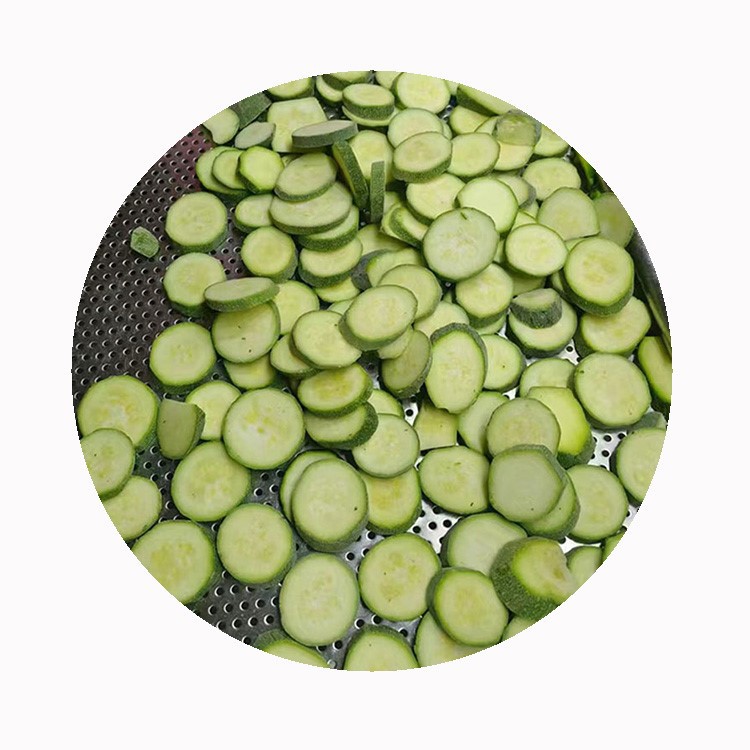
Write the identity into the specification: green zucchini, golden zucchini or an agreed mix; skin-on or peeled; stem and blossom ends removed; and slice, half-moon, dice, strip or another named cut. The XMSD frozen zucchini range can help you compare formats, while the approved order sheet must still name the exact grade.
Application should drive the choice. Round slices retain an obvious zucchini identity in tray meals and grilled-vegetable mixes. Dices distribute more evenly through soup, sauce, filling and ready-meal formulations. Strips work in stir-fries and mixed vegetable dishes. A cut that looks attractive in a frozen sample may be too large for dosing equipment or too delicate for a long cook.

What Zucchini Nutrition Can and Cannot Support
USDA FoodData Central identifies raw green zucchini, including the skin, as a specific food record. The practical nutritional picture is straightforward: zucchini is mostly water, low in energy and a source of several micronutrients and dietary fiber. Its exact values vary with cultivar, maturity, sample preparation and analytical source. Cooking method and portion size determine what reaches the plate.
That evidence does not support saying that pectin in zucchini "adsorbs and removes bacterial toxins and heavy metals" from the human body. It also does not establish zucchini as a treatment that protects the gastric mucosa or heals ulcers. Pectin is a soluble-fiber component found in plant foods, but the presence of a component is not proof of a clinical detoxification or ulcer-healing effect.
The same discipline applies to fatty-acid claims. Finding a small amount of linoleic, stearic or palmitic acid in a food-composition table does not make zucchini an "oil food," and calling individual fatty acids "benign oils" is not a meaningful nutrition conclusion. Evaluate the whole serving and the full diet. For a commercial product, verify the nutrition declaration using the destination-market rules and an appropriate data or testing basis.
Frozen zucchini can remain a useful ingredient because freezing offers year-round availability, controlled cuts and convenient dosing. It is not nutritionally identical to every fresh sample, and it should not be promoted as superior merely because it is frozen. Blanching, storage duration, cooking water and heating intensity can affect some nutrients. The honest buyer advantage is predictable sourcing and preparation, not a miracle-health promise.
Treat Intense Bitter Taste as a Rejection Signal
Cucurbitacins are naturally occurring bitter compounds in the gourd family. Commercial zucchini is selected and grown so that the edible fruit normally contains very low levels, but unusual plants or growing circumstances can produce a strongly bitter fruit. ANSES warns that inedible gourds can contain highly irritating and bitter cucurbitacins and can cause serious food poisoning.
The relevant sensory signal is not a faint vegetal or slightly bitter note. It is an intense, disagreeable bitterness that is clearly abnormal for zucchini. If a household sample tastes that way, stop tasting and discard it. Do not keep eating to decide whether the taste will improve. German consumer authorities likewise advise that bitter pumpkins and zucchini should not be eaten.
Do not assume boiling, frying, baking, freezing or adding sauce makes an intensely bitter zucchini safe. A cooking step designed for texture and flavor is not a validated cucurbitacin-removal control. In procurement, include flavor and abnormal-bitterness rejection in raw-material assessment, in-process sensory checks where safe and appropriate, and finished-product release. Escalate a confirmed abnormal finding through the supplier's traceability and incident procedure.
This uncommon hazard should be handled proportionately. It does not mean ordinary commercial zucchini is unsafe. It means that a distinctive warning sign has a specific response. Supplier approval, seed control, agricultural traceability, representative sampling and a clear complaint-investigation path are more useful than alarming consumers about every mild flavor difference.

Why Frozen Zucchini Becomes Soft or Watery
Zucchini's high water content explains much of its frozen behavior. Ice crystals form during freezing and can damage cell structure. When the pieces thaw or cook, water is released and the tissue is softer than raw zucchini. A result that would be unacceptable for a raw salad may still work well in soup, sauce, casserole, bakery filling or a cooked ready meal.
Raw-material maturity changes the result. Young, firm zucchini with tender skin and limited seed development generally provides a more uniform starting point than large, overmature fruit with a soft center and coarse seeds. Long delays before processing, physical damage, excessive blanching, slow freezing, temperature fluctuation and rough handling can add further texture loss.
Penn State Extension notes that thawed frozen zucchini is well suited to baked products and explains blanching as a step used to slow enzyme activity before home freezing. Commercial process conditions are not copied from a household instruction. Time, temperature, cut size, equipment load, cooling and freezing rate must be controlled for the intended product. Ask the supplier whether your grade is unblanched or blanched and which conditions are monitored.
For many hot applications, adding the product from frozen can reduce unnecessary standing time and water release before cooking. That is not universal. A batter, bakery filling or portion-controlled blend may require a defined thaw-and-drain step. Test the actual recipe, batch size, pan, oven, kettle or line. "Cook from frozen" and "thaw before use" are process instructions, not quality grades.
Instead of requiring "fresh-like crunch," define a realistic application result: pieces remain visibly identifiable after a five-minute sauté; dice survive a specified kettle cycle without turning to puree; or a drained thawed sample stays within an agreed loss range. The IQF zucchini product example is a starting format for that application trial.

Build a Cut Specification That Can Be Inspected
Nominal size is not enough. A "10 mm slice" specification should state the permitted thickness range, how diameter is treated, whether tapered end pieces are accepted, how fused clusters are counted and what percentage may fall outside tolerance. For dice, define the target dimensions and whether one, two or all three dimensions are measured. For strips, define length, width and thickness priorities.
List defects in language both parties can identify. Relevant groups may include stem or blossom-end material, hard rind, developed seeds, soft or translucent tissue, serious discoloration, decay, foreign vegetable matter, foreign material, broken pieces, excessive frost, freezer burn and fused blocks. Separate safety-related foreign material from appearance defects; they should not share one vague total allowance.
The USDA Agricultural Marketing Service maintains grade standards and inspection instructions for frozen summer squash. Those references show the value of defined sample units, defect categories and scoring methods. They do not automatically become your purchase contract, especially outside the United States. Use them as a framework, then state the grade, edition, deviations and destination requirements your order actually follows.
Sampling must represent the lot. Pull units across production time and pallet positions rather than taking the most attractive bag from the top layer. Record the lot code, carton and bag, sample temperature, preparation method and assessor. If dimensions change after cooking, keep frozen-cut inspection and cooked-application evaluation as separate results.
Worked example: A buyer measures 200 frozen pieces from a representative composite sample. Fourteen pieces are outside the agreed thickness range, and six different pieces are seriously broken. If the categories are mutually exclusive, the observed combined defect rate is (14 + 6) divided by 200, or 10%. If three broken pieces were already among the fourteen out-of-size pieces, counting both findings as separate defective pieces would exaggerate the lot result. Record both defect observations and the unique-piece total, then compare them with the agreed limits.
A single 200-piece result is not a universal acceptance plan. The worked figure demonstrates counting discipline. Your sampling plan must define lot size, sample size, number of samples, acceptance number, reinspection rule and action after failure. Photographs with a scale can support the record, but they do not replace calibrated measurement.
Approve Texture with a Repeatable Cooking Test
Texture words such as tender, firm and not mushy need a preparation method. Specify sample mass, frozen or thawed starting state, equipment, water or oil amount, product-to-pan ratio, temperature, time, stirring and drain interval. A small laboratory pan can produce a different result from a full industrial kettle because heat recovery and evaporation differ.
For a sautéed side dish, score piece identity, skin separation, center softness, surface browning and free water. For soup, score whether the cut remains visible after the actual hold time. For bakery use, measure drained thawed weight and evaluate whether released water weakens the dough or filling. One generic texture approval cannot represent all three applications.
Treat thawed drip and cooking loss as useful process indicators, not isolated quality claims. State whether the number is based on initial frozen mass, thawed drained mass or cooked drained mass. Define the sieve or colander, drain time and surface-water handling. Otherwise, two laboratories can report different "yield" results from the same product.
Worked example: A factory starts with 1,000 kg of frozen zucchini. Inspection and sorting remove 3%, leaving 970 kg. The validated cooking-and-draining trial then gives a 12% loss on that remaining mass, so usable cooked output is 970 × 0.88 = 853.6 kg. If the delivered ingredient cost is USD 1,200 for the original 1,000 kg, the ingredient cost is about USD 1.41 per usable cooked kilogram before labor, energy and other losses. This method is more decision-useful than comparing delivered price alone.
Run the comparison with enough replicate samples to see normal lot variation. A difference of one percentage point may be measurement noise, while a repeated difference across production lots can affect formula cost and line throughput. Lock the preparation method before using the result in a supplier scorecard.

Food Safety Depends on Controls Before Freezing
Freezing preserves food by stopping microbial growth while the product remains frozen, but USDA FSIS guidance makes clear that freezing does not reliably destroy all microorganisms. Frozen zucchini therefore depends on approved farms, hygienic water, controlled harvesting, clean transport, effective washing, sanitation, personnel practices, foreign-material control, time-temperature control and a verified food-safety plan before and during freezing.
For household handling of fresh zucchini, FDA advice is to rinse produce under running water before cutting and not to use soap, detergent or a commercial produce wash. For commercial manufacturing, follow the facility's validated wash and sanitation program. A consumer washing instruction is not a substitute for validation, chemical concentration control, water-quality monitoring or cross-contamination prevention on a production line.
Set microbiological criteria from the intended use, process and destination law. A frozen vegetable that receives a validated full cook can have a different risk assessment from an ingredient added after the kill step. Name the organisms or indicators, method, sample plan, units and release rule. "Tested" without those details does not show whether the result protects your product.
Review pesticide-residue compliance for the destination market, along with heavy-metal and contaminant requirements where applicable. Ask for current reports tied to the correct product, lot or crop under the agreed program. Certificate logos in a sales image are not enough; verify the certificate holder, site, standard, scope, issue and expiry dates. XMSD's frozen produce safety guide gives a broader framework for that review.
Foreign-material controls should match the process. Magnets, screens, optical sorting, manual inspection, metal detection and X-ray each detect different hazards or defects. Confirm which controls apply to the actual zucchini line and pack format, their validation and verification, rejection handling and record retention. Do not describe one machine as proof that every foreign-material risk is controlled.
Check Packing, Cold Chain and Arrival Condition
Common commercial formats include a food-grade inner bag in a corrugated carton, larger foodservice bags and retail packs. Confirm net weight, bag material and thickness, seal integrity, carton strength, label language, lot code, production date, shelf-life basis, pallet pattern and any destination-specific marks. If private-label packing is required, approve artwork and barcode before the packaging is printed.
Cold-chain terms should be measurable. State the storage and transport temperature, the point and method of measurement, recorder placement, permissible exceptions and action after a deviation. A single air reading taken at the open container door does not describe product-core condition throughout the load. Review the logger trace with the receiving inspection.
At arrival, check container seal and condition before unloading; then examine pallet stability, carton dryness, crushing, bag seals, lot coding, frozen condition and evidence of thaw-refreeze. Large fused blocks, excessive loose ice or distorted packaging may justify investigation. They are not automatically proof of one cause, so record product temperature and distribution evidence before assigning responsibility.
Use a retained sample and clear claims procedure. Specify how soon the buyer must report a problem, which photographs, lot codes, temperatures and quantities are needed, how samples will be preserved, and who authorizes disposition. A documented process protects both parties and makes corrective action more useful than a general complaint that the zucchini was "too watery."
For buyers comparing a broad vegetable program, the XMSD frozen vegetable selection guide provides a wider category view. Keep the zucchini approval separate enough to protect its high-water texture and maturity-sensitive quality.

Use a Three-Stage Approval Plan
Stage 1: document review. Send the intended application, exact product identity, cut, pack, annual or shipment volume, destination, required certificates, test criteria and labeling needs. Review the proposed specification, process flow, food-safety documentation, allergen statement, certificate scope, residue plan, microbiological methods and example certificate of analysis before requesting a final sample.
Stage 2: representative sample and application trial. Check frozen appearance, separation, dimensions, color, maturity, seeds, skin, defects, odor and abnormal bitterness under a controlled procedure. Cook it in the real recipe. Measure drained or cooked yield when the economics matter. Record the method, lot and results so that the approved benchmark can be used later.
Stage 3: pre-shipment and receiving controls. Confirm current-lot documents, packaging, quantity, loading plan and inspection requirement. At receipt, verify seal, logger, temperature, cartons, codes and samples. Do not allow a successful development sample to become permanent evidence for every future crop and production lot.
Green and golden zucchini can also require separate approved references. Color differences may be intentional, but unexpected mixing affects a visible recipe. If golden zucchini is the required format, compare the XMSD golden zucchini example and specify whether green pieces, skin color variation or mixed cuts are permitted.
XMSD sourcing note: Tell us your application, green or golden preference, cut dimensions, blanching requirement, pack, destination, expected cooking method, annual or shipment volume and document list. We will review a suitable frozen zucchini option and a sample plan for the current project.
Frequently Asked Questions
Is a very bitter zucchini safe after cooking?
Do not use cooking as a rescue step. An intense, unusual bitter taste can indicate cucurbitacins, and food-safety authorities advise not eating bitter zucchini or other bitter squash. Stop tasting, discard the product and investigate a commercial lot through traceability and supplier controls.
Can zucchini detox heavy metals or heal stomach ulcers?
Those are not supported food claims. Zucchini is a high-water vegetable that contributes nutrients and fiber to a balanced diet. It should not replace medical diagnosis or treatment, and its pectin content does not prove that eating it removes heavy metals or bacterial toxins from the body.
Should frozen zucchini be thawed before cooking?
It depends on the application. Direct cooking from frozen can reduce standing-water loss in sautéed dishes and soups. A bakery filling or portion-controlled blend may require a defined thaw-and-drain step. Test the actual process and follow the approved product instruction.
Why does frozen zucchini release so much water?
Zucchini naturally contains substantial water. Freezing damages some cell structure, so thawing and cooking release liquid. Maturity, cut size, blanching, freezing rate, temperature fluctuation and cooking method all affect the result. Compare products with one repeatable application test and a defined drained-yield method.
Are zucchini skin and seeds edible?
The tender skin and undeveloped seeds of normal young zucchini are generally eaten. In overmature fruit, tougher rind and developed seeds can reduce quality. Set maturity, seed and skin-defect limits according to the cut and final application instead of requiring automatic peeling.
References
- USDA FoodData Central. "Squash, summer, green, zucchini, includes skin, raw." Food composition database.
- University of California, Davis Postharvest Research and Extension Center. "Summer Squash: Recommendations for Maintaining Postharvest Quality."
- U.S. Department of Agriculture, Agricultural Marketing Service. "Frozen Squash (Summer) Grades and Standards" and inspection instructions.
- ANSES. "Beware of inedible gourds." Guidance on cucurbitacin poisoning and abnormal bitter taste.
- Federal Centre for Nutrition, Germany. "Do not eat bitter pumpkins and zucchini." Consumer safety guidance.
- U.S. Food and Drug Administration. "7 Tips for Cleaning Fruits, Vegetables."
- USDA Food Safety and Inspection Service. "Freezing and Food Safety."
- Penn State Extension. "Zucchini." Guidance on preparation, blanching and freezing behavior.
This article provides general food and procurement information. It does not replace medical advice, destination-market law, a validated food-safety plan, laboratory testing or the signed purchase specification.