


Frozen Asparagus Diameter, Tip Integrity and Texture Guide
Apr 11, 2019

The previous version of this page said asparagus could kill tumors, prevent cancer-cell spread and cure a hangover. Those claims overstate limited research and cannot support frozen-vegetable lot approval. This replacement answers the commercial questions that affect retail, foodservice and industrial performance: spear or cut style, diameter distribution, length, tip integrity, head-material ratio, basal toughness, trim, loose pieces, blanching, cooked texture, flavor, packing and frozen-chain evidence.
A thick asparagus spear is not automatically tough, and a thin spear is not automatically tender. UC Davis states that diameter is not a good indicator of proper maturity or tenderness. Harvest timing, cultivar, butt-end tissue, raw storage, wound damage, blanching and the customer cook all influence bite. Diameter still matters for portion appearance and cooking uniformity, but it must be controlled alongside tenderness.
Approve the exact form. Whole spears support premium presentation but expose tip-breakage and length risk. Tips emphasize head integrity and premium appearance. Center cuts improve distribution but need a defined head-material percentage. Mixed cuts can suit soup or ready meals, provided the tip-to-stem ratio and cooked texture match the formula. Sample across cartons, cook under one repeatable method and compare usable output rather than the lowest delivered price.
The short answer: Specify Asparagus officinalis, green or white type, spear, tip or cut style, diameter and length distributions, head-material ratio, compact tips, butt trim, loose pieces, discoloration and defects. Then validate blanching, free flow, cooked tenderness by spear zone, flavor, usable yield, intended use, packing and cold-chain records.

Lock Species, Color Type and Product Style
Write Asparagus officinalis when botanical identity matters, plus cultivar or agreed type, green or white color, origin and crop window. Green and white asparagus are not interchangeable visual styles. Growing method, peeling, color, flavor, diameter and texture expectations differ. A signed specification should identify the actual product rather than offer "green/white" as an unresolved option.
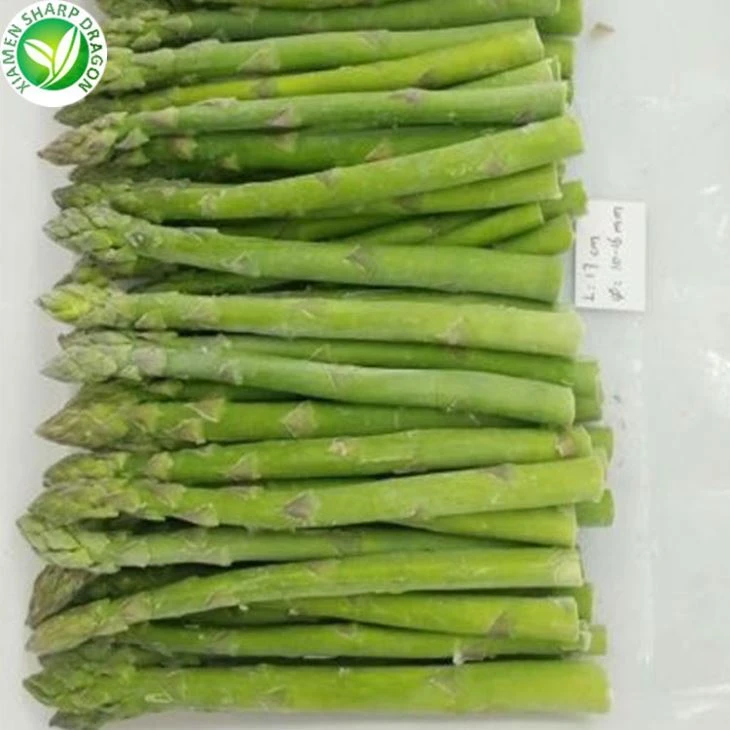
Define whole spears, tips, cut spears, cuts and tips, center cuts or mixed pieces. USDA frozen-asparagus standards use style definitions that can support clear trade language. Whole spears include the head and most of the stalk. Tips and cut spears retain head material. Center cuts exclude heads. The exact commercial cut and length still require a signed drawing or photo scale.
The XMSD frozen asparagus range provides a starting point for spear, tip and cut discussions. Use it to select the intended family, then request the current technical sheet, representative sample, process flow and partner-facility scope for the quoted item.
Choose the form from the application backward. Retail side-dish packs need aligned whole spears, attractive color and compact heads. Foodservice garnish values intact tips and predictable portion count. Soup and quiche can use shorter cuts if head-to-stem ratio and texture remain balanced. A puree or sauce route can use sound offcuts but should not absorb fibrous bases, decay or foreign material as "processing grade."
State the processing state: raw frozen, blanched, steam-treated, cooked, seasoned or mixed with other ingredients. A pale green surface does not prove blanching adequacy. Ask for the actual flow, ingredients, time-temperature control, cooling, drainage, freezing and verification evidence.
Raw Maturity and Trim Control Tenderness
UC Davis describes high-quality fresh green asparagus as dark green, firm, glossy, straight and tender, with tightly closed compact tips. It notes that spears are commonly cut at about 23 centimeters as they emerge, but diameter alone does not predict tenderness. Build incoming controls around tip condition, straightness, butt-end quality and a cooked fiber test.
Asparagus respires quickly after harvest. Delay and warm handling can accelerate quality loss. UC Davis also reports that ethylene exposure can accelerate lignification and that rough handling, bruising and tip breakage can promote toughening through wound response. Request harvest-to-cooling time, raw storage temperature, receiving condition and trim records for the proposed route.
Inspect the tip, middle and base separately. The basal section is normally firmer and can become stringy or woody. Define the permitted pale or white base, cut-end dryness, hollowness, splitting and ragged trim. A clean square cut supports appearance, but the real decision is whether the retained base reaches the approved tenderness after the customer cook.
Use a standardized bend, bite, shear or fiber method. A sensory panel can score tip tenderness, mid-stalk bite, base stringiness and overall chew with retained anchors. An instrument method needs sample temperature, probe, speed, orientation and measurement position. Report the distribution across spears instead of one average force.
White asparagus often receives peeling and has a different color and texture route. If supplied, define peel removal, residual peel, tip color, diameter, butt trim and cooked bitterness separately. Do not borrow green-asparagus visual limits while leaving the peeling specification open.
The XMSD frozen green asparagus reference can frame the whole-spear discussion. Lock the actual diameter, length, tip, trim, color and cooked-fiber method before approving a sample.

Measure Diameter and Length as Distributions
Diameter affects appearance, portion count and cooking uniformity even though it does not prove tenderness. State where the spear is measured and in what condition. USDA inspection instructions call for size determination after units are thawed enough to separate, before they lose rigidity, using a defined asparagus sizer. Use a calibrated gauge or caliper when the method is repeatable.
Define single-size or blended-size programs. Record undersize, in-band and oversize by count or mass, plus the maximum spread within a pack. A declared 8-to-12-millimeter range still needs an in-band percentage and sampling plan. Without them, one supplier may deliver a tight 9-to-11-millimeter distribution while another fills the bag with both extremes.
Length needs the same discipline. For whole spears, measure from tip to butt along the main axis. Define curved spears, short units and broken bases. For cuts, state nominal length, in-band distribution, fines and oversize. A 20-to-40-millimeter cut can behave differently from a nominal 30-millimeter cut if most pieces cluster near one end.
Worked example: A retail buyer samples 500 thawed-separable spears from ten bags. The specification requires 8 to 12 millimeters at the agreed measurement point, at least 90% in band, no more than 5% below 8 millimeters and no more than 5% above 12 millimeters by count. Inspectors find 461 in band, 18 undersize and 21 oversize. The results are 92.2%, 3.6% and 4.2%, so diameter passes. Twelve spears are shorter than the separate 150-to-170-millimeter length rule, however, and that result must be evaluated independently. A size pass cannot cancel a length failure.
Photograph the composite before sorting and show the gauge position. Keep lot, carton, bag and inspector identification. A ruler image of the best-looking spear is useful only as supporting evidence; it cannot replace the full distribution.

Tip Integrity and Head-Material Ratio Need Separate Rules
An asparagus head can be compact, open, broken or shattered. Define the difference with photographs. Compact tips support premium appearance; feathered or open tips can signal maturity or handling differences. Broken heads reduce visual value and create loose buds and fragments that distribute unevenly through a pack.
USDA's current public grade page says Grade A frozen asparagus may contain no more than 5% loose material by weight, while Grade B allows no more than 10%, alongside color, flavor, odor, appearance and eating-quality requirements. Use those numbers only when the contract adopts the same definitions and method. A customer can set tighter or different limits.
For cuts and tips, control the percentage of head material. Too little head material can make a premium "cuts and tips" bag look like stem cuts; too much can change cost and cooking. State the unit or mass basis, minimum tip length and classification of partial heads. Keep the result separate from shattered-tip and loose-material defects.
USDA announced a proposal on April 10, 2026 to revise the head definition and percent-head requirements for the "cut spears or cuts and tips" style. No final replacement appeared in the current source check. Confirm the version in force when the contract is signed and quote the exact edition or definitions instead of writing only "USDA Grade A."
Inspect tip damage frozen and after the customer cook. A head may appear intact under frost but shed buds during mixing. Record whole compact heads, open tips, partial heads, shattered heads, loose buds and fragments. For soups and quiche, a controlled head-material ratio can matter more than whole-spear appearance; for retail spears, the reverse may apply.

Blanching Must Balance Color, Enzymes and Bite
A typical frozen-asparagus route may include receiving, cooling, washing, sorting, trimming or peeling, size grading, cutting, blanching, cooling, draining, IQF freezing, inspection and packing. The actual sequence varies. Request the process flow and evidence for the proposed product rather than assuming every green spear has the same thermal history.
Codex CXS 320-2015 provides general quick-frozen vegetable principles: suitable raw material and preparation, enzyme inactivation where needed, rapid passage through the maximum ice-crystallization range and maintenance of the frozen product. For asparagus, whole diameter and cut length influence heat transfer. The thickest base and thin tip cannot be treated as identical pieces.
Under-blanching can leave unwanted enzyme activity and quality drift. Excess blanching can soften tips, dull flavor and leave too little texture for the customer cook. Record style, diameter class, load, medium, time, temperature, cooling, drainage and verification. Review the worst-case large spear and fragile tip.
Published asparagus research shows that blanching, freezing and frozen storage can change texture, with the basal segment presenting a specific lignification and shear challenge. Do not convert one laboratory treatment into a universal factory recipe. Use the evidence to justify zone-based texture testing and shelf-life validation on the actual cultivar and process.
Fix the customer's cook. For steaming, control load, steam condition, time and endpoint. For sauté, control frozen input, pan size, oil, heat and agitation. For soup, control liquid, salt, acid and hold. For a ready meal, test the complete freeze-reheat cycle. Score tip integrity, mid-stalk bite, base stringiness, color, flavor and free water.
The XMSD frozen vegetable range can help coordinate asparagus with other IQF vegetables. If the final formula is a blend, align component size, blanching state and cook time instead of approving every ingredient only in isolation.

Use Non-Overlapping Defect Categories
| Finding | Measurement | Decision focus |
|---|---|---|
| Open or broken tip | Photo anchor, unit count and severity | Maturity, handling and presentation |
| Loose material | Defined sieve or sort and mass percentage | Tip breakage, cutter and transfer damage |
| Pale or white base | Length, affected area and cooked fiber test | Trim and usable tenderness |
| Ragged or angled cut | Photo scale, angle and unit percentage | Blade condition and presentation |
| Stringy or tough base | Fixed cook plus sensory or shear zones | Maturity, raw storage and trim |
| Discoloration or decay | Named category, area, count and escalation | Quality concession versus hold |
| Loose ice or clumps | Ice mass, cluster mass and separation force | Drainage, IQF, seal and cold chain |
USDA frozen standards consider color, uniformity, defects, character and flavor under defined style and grade logic. Use their terms as a common language, then write the customer's exact method and acceptance. Do not combine grit, decay, tip breakage, tough bases and loose material into one general "defect" total.
Inspect frozen, conditioned and cooked states. Frost can hide discoloration and cut quality. Thawing exposes damage but reduces rigidity. Cooking reveals stringiness and flavor. Keep sample time and temperature fixed so different lots receive the same test.
Create a photo atlas with acceptable, marginal and reject examples. Train supplier and buyer inspectors on the same retained sample. Record a classification priority for overlapping findings. Safety-relevant decay, foreign material and illegal residues remain outside a commercial cosmetic allowance.

Calculate Usable Spears and Cuts
Delivered price can hide undersize and oversize, short spears, broken tips, loose material, tough bases, discoloration, loose ice and excess cooking loss. Define non-overlapping deductions and calculate usable output for the intended application. Keep food-safety failures outside the commercial calculation.
Practical example: A 1,000-kilogram frozen asparagus lot costs USD 2,050 delivered. The signed frozen and cooked inspection finds 15 kilograms of loose ice, 42 kilograms of off-size or short spears, 31 kilograms of broken heads and loose material, 38 kilograms of pale or damaged bases, 54 kilograms of stringy units outside the cooked limit and 40 kilograms of excess cook loss. No mass is deducted twice. Usable output is 780 kilograms, so cost is USD 2,050 divided by 780, or about USD 2.63 per usable kilogram. A USD 2,120 offer yielding 830 kilograms costs about USD 2.55 per usable kilogram and may be better if safety, document and delivery gates pass.
Calculate by route. A soup producer can use sound stem cuts but needs a controlled head-material ratio and tender base. A retail spear pack values length, alignment and intact compact tips. A puree line can use sound fragments but rejects grit, decay and excessive fiber. Document each approved exception instead of silently shifting Grade A material into a lower-value application.
The XMSD asparagus packing and private-label reference helps connect spear style with bag size, presentation, label and carton decisions. Confirm the product, plant, pack material, artwork and evidence scope for each project.
Food Safety, Packing and Cold Chain Complete Approval
Freezing does not sterilize asparagus. Define whether the product is ready to cook, intended for a validated further heat process or ready to eat. FDA guidance notes that bacteria can survive freezing and that ready-to-cook frozen foods need appropriate cooking instructions. A blanching step for enzyme control does not automatically establish ready-to-eat status.
Set microbiological requirements by organism, analytical method, sample unit, sampling plan and lot action. Review raw source, water, wash, trim and cut, blanch, cooling, environmental hygiene, freezing, inspection, foreign-material prevention and packing. Confirm pesticide-residue requirements against the destination and crop program.
Traceability should connect field or receiving lot, cultivar, harvest and cooling, wash and trim run, size grader, cutter, blanching record, freezer batch, inspection, metal detection or agreed foreign-material control, packing code, cold-store position and shipment. Verify certificate holder, facility address, activity, product scope and validity.
Whole spears need protection from tip breakage and compression. Cuts need stable component distribution and seals that contain small pieces. Choose bag dimensions, fill weight, carton strength and pallet pattern for the actual style. Measure head breakage and loose material at production release and arrival with the same method.
Define free-flow expectations, cluster mass and separation force. Review multiple bags and pallet positions. Codex quick-frozen principles use product temperatures of minus 18 degrees C or colder through the frozen chain, subject to permitted tolerances. Write the set point, logger location, deviation owner and receiving action.
For retail, foodservice, ready-meal, soup and industrial programs, the XMSD food-processing buyer route helps organize style, size, head material, blanching, cook, pack and evidence inputs. We review a suitable product and partner-facility route order by order.
Use a Stage-Gated Frozen Asparagus Approval
Run the gates in sequence. Diameter cannot compensate for a stringy base; a compact tip cannot excuse weak microbiological evidence; a Grade A name cannot replace the contract's edition, style and method. Reopen the relevant gate when crop, cultivar, plant, cut, blanch, pack or application changes.
- Lock identity: Asparagus officinalis, green or white type, cultivar or agreed type, origin and crop.
- Lock application: retail spear, foodservice tip, soup cut, ready meal, blend or puree with a standard cook.
- Set geometry: style, diameter, length, head-material ratio, compact tips, butt trim, loose material and breakage.
- Set quality: color, straightness, pale base, ragged cut, fiber, grit, discoloration, decay, ice and clumps.
- Validate processing: cooling, trimming, blanching, drainage, IQF, tip-to-base cooked texture, flavor and usable yield.
- Verify safety: intended use, microbiology, residues, foreign material, traceability, facility scope and directions.
- Validate delivery: bag, carton, pallet, frozen-chain record, arrival inspection and shelf-life application trial.
Send the green or white type, spear, tip or cut style, diameter and length distributions, head-material and defect rules, blanching state, cooking method, pack, destination, volume and evidence list. We can review a suitable frozen asparagus product and partner-facility scope before quotations are treated as comparable.
XMSD sourcing note: Tell us the asparagus style, diameter, length, head-material ratio, tip and trim limits, blanching state, cook, pack and destination. We will review a suitable IQF asparagus route and the required evidence.
Discuss Your Frozen Asparagus RequirementFrequently Asked Questions
Are thicker asparagus spears always tougher?
No. Diameter affects portion and cook uniformity, but UC Davis notes that it is not a reliable tenderness indicator. Test tip, middle and base after the customer's cook.
Should frozen asparagus diameter be measured frozen or thawed?
Use the written method. USDA inspection instructions size units after they are thawed enough to separate but before rigidity is lost. Keep condition, gauge position and timing identical across lots.
What is head material in frozen asparagus cuts?
It is the portion of cuts containing the asparagus head or tip under the adopted definition. State the exact standard edition, minimum length, measurement basis and required percentage.
Why can the base of a frozen spear feel stringy?
Basal tissue is naturally firmer, and maturity, raw storage, wound response, trimming, blanching and frozen storage can affect fiber and shear. Approve base trim through a zone-specific cooked test.
Does blanching make frozen asparagus ready to eat?
Not automatically. Blanching may be designed for enzyme and quality control rather than a validated kill step. Ready-to-eat status needs process validation, post-process hygiene, microbiological evidence and compliant labeling.
References
- USDA Agricultural Marketing Service, Frozen Asparagus Grades and Standards. Current public grade summary, loose-material limits, flavor, odor, appearance and eating-quality framework.
- USDA, United States Standards for Grades of Frozen Asparagus. Styles, diameter classes, color, uniformity, defects, character, flavor and sampling tables.
- USDA, Frozen Asparagus Inspection Instructions. Thawed-separable sizing, measurement timing, head-material and inspection procedures.
- USDA AMS, 2026 proposal to revise frozen asparagus grade standards. Proposed changes to head definition and percent-head requirements for cut spears or cuts and tips.
- UC Davis Postharvest Research and Extension Center, Asparagus (Green). Maturity, compact tips, diameter and tenderness, respiration, ethylene, lignification, tip breakage and decay.
- Codex Alimentarius, Standard for Quick Frozen Vegetables, CXS 320-2015. Preparation, enzyme control, quick-freezing and frozen-chain principles.
- Sanchez-Pineda-Infantas, Cano-Munoz and Hermida-Bun, Blanching, Freezing and Frozen Storage Influence Texture of White Asparagus. Basal-segment lignification, shear, fiber and frozen-storage texture context.
- U.S. Food and Drug Administration, Ready-to-Cook Food Safety. Bacterial survival during freezing and the importance of validated cooking directions.
Disclaimer: This article provides general frozen-food procurement and product-development information, not medical, legal or process-validation advice. Confirm identity, specifications, processing, intended use, food-safety controls, labeling and compliance on the actual product, partner facility, destination market and application.