


What Is Sugarcane For? Uses, Outputs and Buyer Fit
Aug 05, 2019

Sugarcane is used mainly to make sugar, but the stalk can enter several very different commercial routes. It can be sold in an edible form for chewing, pressed for fresh juice, processed into sugar and liquid food ingredients, fermented into ethanol, or used within an integrated mill that also produces steam, electricity and fiber-based materials. Animal feed, soil inputs and other products may be made from side streams, but those are outputs of a particular processing system rather than automatic uses for every load of cane.
The practical answer changes with what you plan to buy. A retailer may need peeled, cut and packed sticks. A beverage factory may need a defined juice or syrup base. A sugar mill receives harvest-stage stalks close to its crushing operation. An ethanol plant needs a fermentable stream that fits its process and local regulation. A board, paper or energy operator normally evaluates bagasse or another mill-generated stream-not cartons of food-grade peeled cane. Calling all of these simply "sugarcane" hides the most important commercial distinction.
Start with the intended output, then identify the correct intermediate, specification owner and receiving system. That route-first method prevents a common error: evaluating a good product against the wrong job. Fresh-stick appearance matters to retail; fermentable solids matter to ethanol; fiber condition matters to a materials route. No single sugarcane specification can represent all three.
The short answer: Sugarcane supplies food, beverages, sugar ingredients, ethanol, process energy and fiber-based materials. The use determines the product form: edible sticks, extracted juice or syrup, a fermentable feedstock, or a residue stream generated at a mill. Before you discuss quality or price, specify the required output and delivered form.

Start With the Output, Not the Stalk
Sugarcane is a crop, a fresh food and an industrial feedstock, but it is rarely all three in the same transaction. CIRAD describes established outlets that include sugar, rum, fuel ethanol, energy and chemical or material uses; it also notes that mills must be supplied through organized, time-sensitive systems.[1] That combination explains why a useful "uses" map must show the handoff between the field, food packer, mill and downstream user.
The table below is a routing guide, not a claim that one supplier, variety or region supports every destination. Each route has its own processing assets, legal category, test methods and economics. The "delivered form" column is therefore more important than a long list of possible finished products.
| Destination | Commercial output | Typical delivered form to define |
|---|---|---|
| Direct food | Chewing sticks, portions or foodservice pieces | Whole or peeled cane, named cut, pack and handling condition |
| Juice and beverage | Fresh juice, treated juice, beverage base or syrup | Cane selected for local extraction or a defined liquid intermediate |
| Sugar and food ingredients | Raw or refined sugar and application-specific sweetener streams | Harvested cane to a nearby mill, or a separately specified sugar or syrup product |
| Fermentation and ethanol | Fuel, industrial or potable ethanol according to plant and law | Juice, syrup, molasses or cellulosic feedstock accepted by that facility |
| Heat and electricity | Process steam, on-site power or export electricity | Usually bagasse and sometimes other biomass available within the mill system |
| Fiber and biorefinery | Pulp, paper, board, composites, chemicals or other bio-based outputs | A characterized fiber or molecular stream, not an undefined "cane waste" |

Food Route One: Fresh Sticks and Pressed Juice
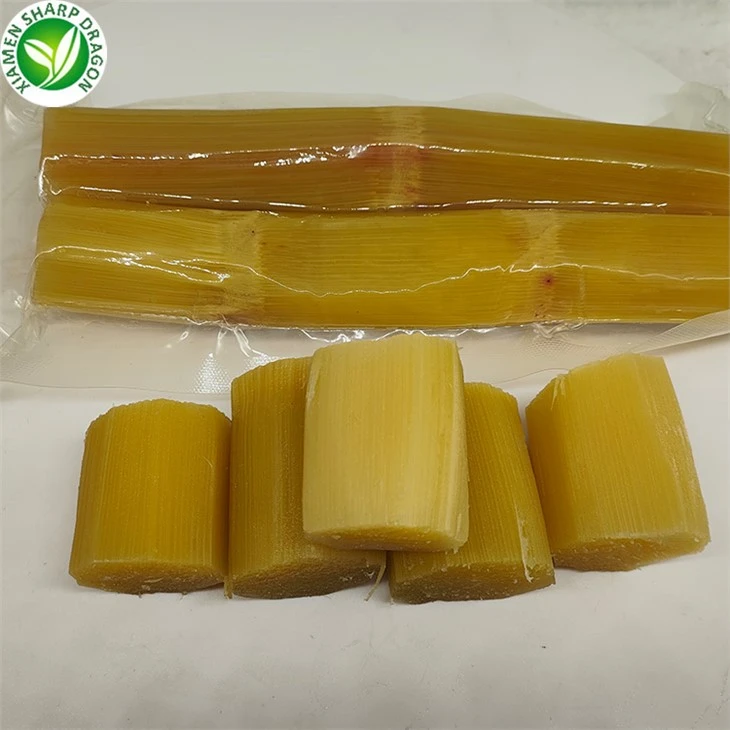
Direct eating is the shortest route. Consumers chew prepared cane to release the juice and discard the fibrous residue. The commercial product may be a whole trimmed stalk, a peeled section, a longitudinal cut or a short portion. For this route, visible cleanliness, peel removal, cut consistency, chewability, color, flavor, packing integrity and the agreed storage system directly affect acceptance. An industrial sugar variety can have useful recoverable sugar yet still be awkward as a retail stick because the rind, fiber, diameter or presentation does not fit the consumer format.
The current XMSD peeled fresh sugarcane presentation shows one food-use form: peeled pieces in individual packs. Use it as a visual starting point, not as a universal contract. For an actual order, confirm piece dimensions, net weight, number of pieces, allowed color variation, surface condition, packing material, storage statement, destination requirements and verification records.
Pressed juice is a different product even when it starts with edible cane. Local vendors may extract and serve it quickly, while an industrial beverage operation may clarify, filter, heat-treat, chill, freeze, concentrate or formulate the juice under a validated process. The safety and quality responsibility follows that process. "For juice" is incomplete unless the buyer states whether the purchase is raw cane for immediate local pressing or a processed liquid ingredient. A stalk specification cannot silently substitute for a microbiological, compositional and packaging specification for a ready-to-use juice base.
Practical example: one cane, two food decisions. A retailer wants 180 mm peeled sticks that fit a narrow tray and look uniform through clear film. A beverage operator wants material that performs consistently in a defined extraction trial, then plans to filter and pasteurize the liquid. The retailer may reject a thick, visually irregular lot that the beverage trial accepts. The beverage operator may reject a beautiful snack lot if the recovered liquid behaves poorly in its process. Neither decision proves that the cane is generally "good" or "bad"; each answers a different use.

Food Route Two: Sugar and Ingredient Streams
Industrial sugar production remains a primary use of sugarcane. The stalk stores crystallizable sucrose, and mills separate a sugar-bearing juice from the fibrous part before producing raw sugar and other streams.[1] Sucrose is the central target, but it is not the only substance in the stalk or juice. The separate guide to which sugar is present in sugarcane owns the chemistry and sugar-identity question.
For a food manufacturer, the useful procurement object is usually not the stalk. It may be granulated sugar, raw sugar for refining, a defined syrup, molasses for an approved application, or a standardized cane-juice base. Each has a separate identity, legal name, composition, color, flavor, moisture or solids basis, contaminant controls and packaging system. The word "natural," the crop origin or a photograph of cane cannot replace the specification for that delivered ingredient.
The extraction sequence also belongs to a different decision. A high-level map only needs the handoff: harvested cane reaches a mill, juice is separated, and the sugar-bearing stream is processed into the intended product while other streams leave the main route. If you need the unit operations, use the dedicated explanation of how sugar is extracted from sugarcane. Keeping that boundary prevents a uses guide from becoming an incomplete factory flow chart.
Food application further changes the acceptance logic. A bakery, confectionery line, beverage plant and fermentation operation do not necessarily buy the same grade or care about the same secondary attributes. Iowa State University's Agricultural Marketing Resource Center notes that refined sugar deliveries serve several major food-manufacturing sectors and describes sucrose uses across baked goods, confectionery, beverages, alcohol and other foods.[4] Name your finished application instead of stopping at "food use."

Fuel Route: Ethanol Needs a Defined Fermentable Feedstock
Sugarcane can supply ethanol because microorganisms can ferment accessible sugars. Depending on the plant configuration and policy environment, the feedstock may be cane juice, syrup, molasses or a cellulosic stream. The U.S. Department of Energy's Alternative Fuels Data Center distinguishes sugar- and starch-based feedstocks, whose sugars are relatively easy to extract and ferment, from cellulosic feedstocks containing cellulose, hemicellulose and lignin, which require more difficult conversion.[2] "Cane ethanol" therefore does not identify one universal inlet material.
The ethanol destination must also be named. Fuel ethanol, industrial ethanol and potable alcohol can sit under different specifications, denaturing rules, excise regimes, food or chemical controls and customer qualifications. The molecule is ethanol, but the commercial product and permitted route are not interchangeable. We show fermentation as a destination without implying that a fresh produce supplier can qualify ethanol or that a beverage-grade process automatically meets fuel regulation.
Plant location and integration matter. Freshly harvested cane is bulky and time-sensitive, so sugar and ethanol plants are normally connected to regional cane supply rather than importing retail packs as an industrial feedstock. CIRAD states that cut stems need rapid transfer to the mill, while the Agricultural Marketing Resource Center likewise explains why cane is processed near growing areas.[1][4] For an industrial buyer, the first feasibility question is often "Which local intermediate reaches our process reliably?" rather than "Can sugarcane make ethanol?"

Energy and Materials Usually Begin With Mill-Generated Fiber
After juice extraction, the remaining fibrous material is called bagasse. Mills commonly use it as boiler fuel to make steam and electricity. In an integrated plant, that energy can support the mill's own operations; where equipment, connection and local power rules allow, surplus electricity may also reach a grid. UNICA reports this operating pattern in Brazil and identifies bagasse and straw as primary sugarcane biomass sources for bioelectricity.[3] The example proves an established route, not a guaranteed electricity yield for every mill.
Energy performance depends on far more than the crop name. Moisture, ash, contamination, particle form, boiler and turbine configuration, steam demand, maintenance, seasonal availability and grid access can all affect the useful result. If you compare fuels, request the relevant material analysis and operating basis. If you evaluate an integrated mill, distinguish gross generation, internal consumption and exported electricity. Claims such as "bagasse powers the factory" are not a substitute for a plant-specific energy balance.
Fiber can also enter material routes. CIRAD lists paper, cardboard, insulation, films and textiles among possible uses, while the Agricultural Marketing Resource Center notes paper, board, plastics, mulch and bedding.[1][4] Peer-reviewed reviews extend the research map to composites, chemicals, biofuels and other value-added outputs.[5] These routes do not mean all bagasse is interchangeable. Pulping, board, composite and biochemical operations can require different fiber length, moisture, ash, storage, pretreatment and contaminant limits.
Other side streams may support feed, agricultural or fermentation uses, but their identities and constraints belong in a dedicated co-product review. FAO's technical discussion shows both established residue uses and the market, treatment and nutritional limits that can prevent an apparently possible route from being practical.[6] The guide to sugarcane by-products covers that inventory. A useful boundary remains: a possible laboratory conversion is not automatically a commercial market, and a mill residue is not automatically a safe feed, fertilizer or food ingredient. Treatment, law, local demand and plant economics decide whether a route is usable.
Translate the Use Into the Right Specification
A route map becomes commercially useful only when it changes the request for quotation and the sample review. Begin with the delivered product, not a wish list copied across unrelated forms. Then identify the few attributes that drive performance in the named application. Use the table as a starting framework, then set numeric limits and methods from your receiving facility, applicable law and validated trials.
| Buyer and use | Specify first | Do not substitute |
|---|---|---|
| Retail or foodservice sticks | Whole/peeled/cut form, dimensions, color and defect basis, texture, net weight, pack, handling and destination compliance | A mill's sugar-recovery grade |
| Beverage or food ingredient | Liquid or stalk form, treatment state, flavor/color basis, defined solids or dilution basis, microbiological plan, pack and process trial | A photograph and a generic "sweet" claim |
| Sugar or ethanol plant | Accepted feedstock, receiving window, plant method, composition/recoverability basis, foreign matter and delivery schedule | Retail appearance limits |
| Energy operator | Material identity, moisture and ash method, contamination, particle form, volume profile and combustion-system fit | Cane price per tonne without an energy basis |
| Pulp, board or composite plant | Fiber source, preparation, moisture, ash/dirt, size distribution, storage history and process trial | "Bagasse" as a complete grade name |
For harvest-stage cane entering a mill, the commercial value question is broader than the destination map. It may require accepted sampling, recoverable sugar or fermentable basis, usable yield, deterioration controls and cost per usable output. Use the separate sugarcane raw-material value guide when those variables become the decision. For route selection, choosing the destination and specification owner is enough.
Buyer responsibility also changes by handoff. A fresh-produce importer controls destination labeling, storage and distribution requirements with the supplier. A beverage factory owns its formula, process validation and finished-product release. A mill owns its receiving and conversion method. An energy or materials plant owns the acceptance test that connects the residue to its equipment. Writing these responsibilities beside the specification prevents an untested assumption from moving downstream.
Worked Example: Convert a Beverage Plan Into the Correct Input
Assume a beverage developer plans a pilot run of 80,000 bottles, each containing 250 mL. The total finished beverage is:
80,000 × 250 mL = 20,000,000 mL = 20,000 L
The trial formula uses 12% standardized sugarcane juice base by volume. The formulation requirement is therefore:
20,000 L × 0.12 = 2,400 L of juice base
Do not convert that result into a guessed tonnage of stalks. The calculation identifies the correct commercial question: can a supplier provide 2,400 L of a juice base that meets the agreed treatment state, composition method, sensory profile, microbiological plan and pack basis? If the plant intends to press cane itself, run a documented extraction trial to convert 2,400 L into a raw-cane requirement, then add a separately justified process and handling allowance. A generic internet yield would create false precision.
Suppose the same buyer instead asks for 9,600 retail packs of four 250 mm peeled sticks. That is a count-and-dimension program, not a 2,400 L juice-base program. The two orders may come from the same crop, yet their units, samples, defect rules, packing tests and commercial risks are different. This is why the use must be translated before a quote is compared.

Three Commercial Checks Prevent Wrong-Route Buying
First, name the output and market. "Food" could mean a ready-to-chew stick, freshly pressed juice, bottled beverage ingredient, crystal sugar or fermentation substrate. "Energy" could mean internal process steam, on-site electricity or grid export. The destination country and legal category determine which claims, documents and tests matter.
Second, name the physical handoff. State whether the buyer receives whole stalks, peeled portions, extracted liquid, syrup, sugar, molasses, bagasse or another characterized stream. Include who performs peeling, extraction, treatment, concentration, drying or size reduction. If the handoff is unclear, both parties may price a different product while using the same word.
Third, test in the receiving system. Review real packed units for direct food, test the agreed base in the beverage formula, apply the mill's receiving and analytical method to harvest-stage cane, and evaluate representative fiber in the actual or qualified pilot process. A supplier certificate can support identity or control; it cannot prove performance in equipment it has never entered.
Practical example: do not ship food packs to solve a residue problem. A packaging-material developer wants bagasse fiber for a molded tray trial. An offer of vacuum-packed peeled cane looks clean and has a clear food format, but it is the wrong intermediate: buying and transporting an edible product only to extract juice and recover fiber would add steps and cost. Locate a mill-generated fiber stream, define moisture, ash, contaminants and preparation, and run the molding trial. Do not claim direct-food supply as capability for that route without a qualified source and specification.
Send the intended market, whole/peeled/cut format, target dimensions, pack, quantity, storage plan and destination requirements. We can review whether a current fresh sugarcane presentation is relevant. Industrial ethanol, electricity, bagasse and chemical routes require separately qualified producers and are not implied by this food-product discussion.
The Practical Use Decision
Sugarcane is for much more than one bag of table sugar, but the long list of possibilities is not itself a buying guide. Fresh food, juice, sugar, ethanol, steam, electricity and fiber materials begin at different commercial handoffs. Some use the edible stalk; some use extracted sugar-bearing liquid; some depend on residues that only exist after milling.
The sound decision sequence is simple: define the finished output, select the correct delivered intermediate, assign the specification to the receiving process, and verify a representative sample in that process. This preserves the real versatility of sugarcane without pretending that every stalk, supplier or facility can serve every route.
References
- CIRAD. Sugarcane-Plant and uses. Crop identity, mill logistics, sugar, rum, ethanol, energy and material routes. Accessed 27 August 2026.
- U.S. Department of Energy, Alternative Fuels Data Center. Ethanol Feedstocks. Sugar/starch and cellulosic feedstock distinctions. Accessed 27 August 2026.
- Brazilian Sugarcane and Bioenergy Industry Association (UNICA). Bioelectricity. Bagasse and straw in mill energy and grid supply. Accessed 27 August 2026.
- Agricultural Marketing Resource Center, Iowa State University. Sugarcane Profile. Proximity to mills and established food, bagasse, ethanol and electricity uses. Accessed 27 August 2026.
- Shabbirahmed AM, et al. Sugarcane bagasse into value-added products: a review. Environmental Science and Pollution Research. 2022;29(42):62785–62806. doi:10.1007/s11356-022-21889-1.
- Food and Agriculture Organization of the United Nations. Sugarcane as feed: by-products and end-use context. Commercial and technical limits of residue utilization. Accessed 27 August 2026.