


What Happens When Pumpkin Freezes? Texture and Ice Damage
Oct 15, 2024

When pumpkin freezes, some of the water in its flesh becomes ice. Ice formation can damage the tissue that holds that water in place, so the flesh often feels softer and releases liquid when it thaws. A whole pumpkin accidentally frozen outdoors may lose the firmness needed for storage or display. Prepared pumpkin pieces frozen for food use can still be useful ingredients, with a texture suited to their intended cooking or processing method.
The distinction is the starting material and the process. An intact fruit exposed to a cold night has not been selected, prepared and packed as a frozen ingredient. Commercial pieces may be washed, cut and heat treated before controlled freezing. Cooked puree has already lost the structure of raw flesh before it enters the freezer. These forms should not be judged against one shared idea of fresh firmness.
Softness alone tells you about texture, not whether pumpkin is safe. Handling history, temperature control, contamination and the condition of the food require a separate decision. For quality, the useful question is how much shape and water retention remain after a defined preparation, and whether those results suit the dish.
Why frozen flesh becomes softer after thawing
Fresh pumpkin feels firm because its cells and the material between them form a connected structure. Water contributes to that structure. During freezing, ice changes the way water is distributed, and damaged tissue may no longer retain it as effectively once the ice melts. University extension guidance describes the familiar result in produce: softer flesh and more free liquid after thawing. This is a physical change, rather than proof that the food has spoiled.
Ice can hide the change. A frozen cube may feel hard even when its thawed flesh will be weak. Pressing it with a fork straight from the bag tells very little about how it will hold together in a casserole. Compare pieces at the same stage of preparation.
Thawing is not a repair step. Returning damaged flesh to its original temperature does not rebuild the structure it had before freezing. Cooking may make a softer ingredient perfectly suitable for soup, mash or filling, but it creates another product state. A cooked comparison should use the same cooking treatment for every sample, otherwise heat exposure can hide or exaggerate the difference attributed to freezing.
For us, a meaningful texture description names the action the piece must withstand. Does it stay recognisable after gentle stirring? Can it be portioned without breaking into fragments? Does it become smooth when blended? These questions translate a vague complaint about mushiness into a practical acceptance test. The preferred result changes with the application; a smooth puree and a distinct vegetable inclusion have different jobs.

A frosted whole pumpkin is a different problem
A weather report below freezing does not establish that every part of a pumpkin froze. Air temperature, exposure time and the temperature within the fruit are different measurements. UC Davis identifies freezing injury in pumpkins and winter squash at temperatures below approximately -0.8°C (30.5°F). Treat that as a warning about fresh-fruit susceptibility, not a countdown or a guarantee that every fruit becomes damaged at the same moment.
Also distinguish freezing injury from chilling injury. Chilling is damage to sensitive produce at low temperatures above its freezing point. The UC Davis guidance describes pumpkins and winter squash as chilling sensitive; surface pitting and increased decay can follow unsuitable cold storage. A fresh pumpkin can therefore suffer from a storage environment that never produces visible ice. Conversely, a prepared frozen ingredient belongs in frozen storage, not in the storage regime for a whole fresh fruit.
After an accidental freezing event, examine the whole fruit as a fresh produce problem. Note the exposed side, any split rind, leaking tissue, collapsed areas or advancing decay. Record what happened and separate affected fruit from sound stock. An undamaged-looking section of rind does not show the condition of all the flesh beneath it, and a single photograph does not establish the duration of exposure.
A carving or display pumpkin also has a different use history from an ingredient. Cutting openings, handling it repeatedly or leaving it outdoors introduces questions that a factory-prepared food does not share. Do not reclassify a deteriorating display pumpkin as a soup ingredient simply because blending would hide its loss of shape. The condition and handling history must support food use before any recipe decision is made.

Prepared pieces and puree respond differently
Purposeful freezing begins with a chosen food form. Uniform pieces can be evaluated for cut size, peel status and heat treatment before freezing. Puree is evaluated for consistency and water separation because it no longer contains intact cubes. Freezing a whole unprepared pumpkin and freezing a prepared bag are not equivalent operations, even though both eventually become cold and hard.
For home preservation, the National Center for Home Food Preservation recommends selecting mature pumpkin, washing and cutting it, removing seeds, cooking until soft, separating the pulp from the rind and mashing it before cooling and packing. Its winter-squash guidance follows a similar cooked-pulp approach. These tested home methods should not be converted into a made-up industrial blanching time for diced pumpkin.
Ask whether the pieces are raw, blanched or more fully cooked. Blanching uses a short heat treatment to control enzymes, but it also changes texture; it is not the same as full cooking. General vegetable-processing guidance explains the purpose, while the actual pumpkin cut and validated production process determine the treatment. Record that process state with the sample so the kitchen can interpret its behaviour.
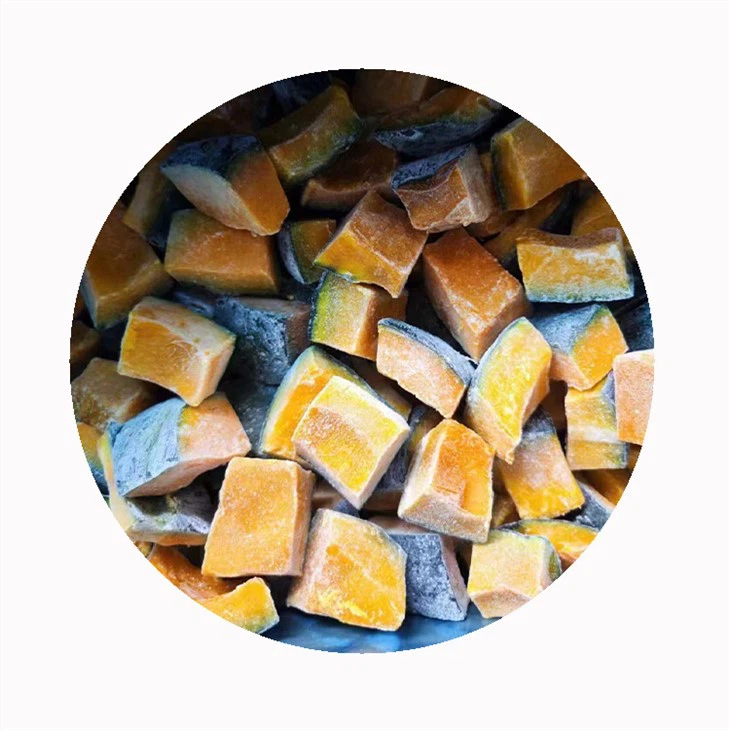
Peel status changes the comparison too. A skin-on piece may retain an outer edge while the flesh softens; a peeled cube offers no rind to support it. The frozen pumpkin product forms illustrate why a name such as diced pumpkin needs a supporting photograph and cut description. Use those details to select a comparable sample, then judge its actual performance instead of assuming that all orange pieces behave alike.
Use the photographs to identify skin, shape and visible surface frost. To assess internal tissue damage, prepare a sample and examine its behaviour. This connects a frozen presentation with the cooked result that matters in the kitchen.

Freezing speed matters, but the whole history matters too
Faster freezing generally favours smaller ice crystals and less disruption than a slow freeze under otherwise comparable conditions. University of Minnesota guidance recommends freezing produce quickly and avoiding an overloaded freezer because slow freezing gives poorer texture. This principle helps explain why a thick, tightly packed mass is a different quality challenge from separated, prepared pieces.
IQF means individually quick frozen. Cultivar, maturity, cut geometry, previous heat treatment and subsequent storage also influence the result, so products carrying the same description can suit different applications. Compare the approved product definition and a representative sample together.
A large piece also has more distance between its centre and its exposed surfaces than a small piece. That matters when comparing samples because their temperature histories may differ even in the same equipment. Do not explain every soft result as a freezing-speed failure before checking whether one sample was thicker, riper or more heavily cooked. Change one major factor at a time when investigating a complaint.
Later temperature fluctuation can reduce quality further. Partial warming and refreezing encourage changes in the ice structure and can make pieces stick together. Stable frozen storage protects the quality already achieved. It does not improve poor raw material or reverse earlier damage. For household frozen storage, the university guidance uses 0°F, approximately -18°C, or below; commercial handling must also follow the applicable product specification and control plan.
When we investigate a texture difference, we would keep the original sample identity attached to the preparation notes. A retained sample kept under controlled conditions, an arrival sample and a kitchen sample may answer different questions. If only the kitchen sample has been repeatedly opened and warmed, compare it with an unopened bag before drawing a conclusion about the delivery.

Separate drip, loose ice and loss of shape
Liquid in a thawed container has several possible contributors. Some came from moisture naturally present in the flesh; some may have been ice on the outside of the pieces. Washing, draining and packing conditions can also affect what is observed. Calling every gram of collected liquid cell damage overstates what a simple kitchen test measures. State the method and call the result what it is: liquid release under those test conditions.
Before a comparison, define the starting mass, the preparation temperature, the endpoint and the drain arrangement. Use the same sieve or tray and the same drainage interval. Decide whether loose ice is included in the starting mass. Do not squeeze one sample and leave another untouched. Such differences can produce an impressive-looking percentage that describes handling technique rather than a product difference.
Shape retention needs its own record. Photograph equal amounts on the same background after the same preparation. Record intact pieces, broken fragments and puree-like material according to a definition agreed before testing. If small fragments pass through the sieve, account for them separately from clear liquid where practical. Otherwise an apparent drip-loss result can include lost solids.
A comparison involving thawed material should use a controlled method such as the approach described in handling and defrosting frozen pumpkin. This quality assessment is not a reason to leave food on a counter until it feels soft. Maintain the required handling controls while preparing the sample, then record the result at a consistent endpoint.
Record colour separately. Varieties and maturity levels can begin with different shades of flesh, while lighting, surface moisture and frost alter their appearance. Photograph comparable samples under consistent light. Then interpret the colour alongside the texture result and handling history.
Use the result to choose an application
Loss of raw firmness is a serious issue when the intended product needs visible, separate pieces. It may be a smaller issue when the next operation is deliberate blending. That does not make every soft batch suitable for puree: flavour, colour, foreign material, handling and safety still have to be acceptable. The application decision comes after those basic conditions have been established.
Practical example: Suppose a catering kitchen is selecting pumpkin for a vegetable side dish that is portioned with a spoon and held briefly before service. It compares peeled cubes of the same nominal size using one approved cooking procedure. One sample keeps recognisable pieces after the planned stirring and holding; another breaks down. The kitchen selects the first for that dish and considers the second only for a separately assessed blended application. The result is a product choice tied to service conditions, not a claim that every softer piece is defective.
The same logic applies to foodservice and catering preparation: a sample must survive the actual sequence used in the kitchen. A cube that looks attractive immediately after cooking can behave differently after mixing with a sauce. A very gentle demonstration may fail to reveal the handling that occurs during normal portioning. Include those actions in the trial so the buying decision reflects the serving result.
For a blended soup or bakery filling, consistency and water release become more useful measures than sharp corners. Evaluate the prepared pumpkin on the same basis each time, then adjust the formulation through a documented trial. The method chosen for cooking pumpkin from frozen also affects the final result, so do not compare one boiled sample with another roasted sample and attribute all the difference to freezing.
A buyer may prefer a firmer cut for visible inclusions and a different form for a smooth filling. Keep those approvals separate. One generic approved pumpkin sample can create confusion when several applications require different behaviour. A short specification describing the use, the preparation method and the desired result is more useful than an unexplained adjective such as premium.
A small comparison can make the difference measurable
A controlled liquid-release test can reveal a difference worth investigating, even without specialist texture equipment. It works best as a comparison within a defined method, not as a universal pumpkin grade. Repeat the test on more than one portion and keep the results, including any unexpected variation. A single selected cube or the easiest-looking bag is a weak basis for accepting a whole lot.
Worked example: Suppose a quality technician starts with two 500 g portions of comparable frozen pumpkin pieces, both without loose external ice. Under the same controlled thawing and drainage procedure, portion A releases 40 g of liquid and portion B releases 75 g. The illustrative liquid-release ratios are 40 ÷ 500 × 100 = 8% and 75 ÷ 500 × 100 = 15%. The difference is 7 percentage points, or 35 g per test portion. These are assumed figures for explaining the calculation, not measured XMSD results or acceptance limits.
The technician then checks the retained solids and records whether the higher-release sample also breaks apart. If it does, both observations support a texture investigation. If it remains intact but carries more surface ice than first recorded, the starting preparation needs review. The next action comes from the combined evidence, rather than rejecting material because one percentage looks larger.
For a soup formulation, that extra liquid may remain in the kettle and require a change in added stock. For a drained inclusion, it may reduce usable retained weight. Those are different commercial consequences even with the same test result. Do not subtract released liquid from the ingredient cost calculation without first deciding whether the recipe uses it or discards it.
A practical acceptance range should come from suitable approved samples and repeated trials in the intended application. Record the method alongside the range. If the method changes, compare old and new results before assuming the same numerical limit still means the same quality. This keeps the test useful when responsibility passes from product development to receiving inspection or another production shift.
Protect the sample and keep safety decisions separate
Packaging should help maintain the agreed condition during storage and handling. Check the inner bag as well as the carton: tears, an open seal or excessive exposure during repeated portioning may change the sample before it reaches the trial. The frozen-food packaging options provide a starting point for discussing bag and carton format, while the actual selection should reflect use rate, handling and the approved product.

Connect packing observations with transport evidence. Record the lot code, the location of the sampled cartons and the available temperature records. Photograph unusual clumping before trying to separate the pieces. These records help establish whether the concern is isolated to damaged packaging or appears more widely; the carton photograph here simply illustrates packing presentation.
Freezing does not reliably destroy the microorganisms already present in food. After thawing, growth can resume under suitable conditions. Therefore a satisfactory texture test cannot release a lot whose safety history is unresolved. Likewise, softness caused by ice damage is not, by itself, proof of contamination. Keep the quality decision and the food-safety decision in separate records, with the right evidence for each.
Use the applicable food-safety procedure for an unplanned thawing or temperature event. Preserve the temperature and time information available, segregate the affected material and obtain the responsible assessment before use. Smell, colour and a taste test are not substitutes for that assessment. Ordinary cooking should not be proposed as a way to rescue visibly spoiled food or erase an unknown handling history.
The final quality judgment should name the form and the intended use: whole fresh fruit with suspected frost injury, prepared frozen pieces with acceptable cooked structure, or puree with manageable water separation. That description tells the next person what was actually assessed. It is far more actionable than saying only that the pumpkin has been frozen and is therefore either ruined or unchanged.

For a pumpkin sample review, send the intended dish, peel status, cut, heat-treatment requirement and the texture problem you want to solve. We can use those inputs to discuss a relevant product and comparison method.
References
- UC Davis - Pumpkin & Winter Squash
- University of Maryland Extension - The Basics of Freezing Foods at Home
- University of Minnesota Extension - Preserving Food at Home: Freezing
- National Center for Home Food Preservation - Freezing Pumpkin
- National Center for Home Food Preservation - Freezing Winter Squash
- XMSD operational perspective on product-form comparison, sample handling, packing and application assessment. Worked figures are illustrative.