


What Are the Benefits of Okra? Nutrition, Frozen Formats and Buyer Decisions
Jun 17, 2019

Okra's clearest benefits come from what the edible pod contains and how it works in food. Plain okra supplies dietary fiber, vitamin C, vitamin K, folate, magnesium and other nutrients while remaining low in energy and fat. Its natural mucilage also gives soups, stews and sauces body without requiring a separate thickener. Those are useful, defensible advantages. They do not mean that okra cures diabetes, prevents heart disease or guarantees weight loss.
Product form changes the answer. Raw okra, plain IQF frozen okra, boiled okra, breaded fried okra and vacuum-fried okra chips have different moisture, oil, sodium, serving sizes and nutrient values. If you buy frozen okra for a ready meal, foodservice menu or retail pack, judge the cut, maturity, texture, seed development, ice condition, pack integrity and finished-product nutrition basis together. A green appearance or a generic raw-okra data sheet cannot prove the composition of the item you will sell.
The short answer: Okra is a nutrient-containing, fiber-providing vegetable ingredient with valuable culinary texture. Plain frozen okra can keep those advantages convenient and portionable, but the final benefit depends on the exact product, preparation, serving and evidence behind any label claim.

What the Nutrition Data Actually Support
Start with a defined food form and weight basis. The USDA FoodData Central legacy entry for raw okra reports about 33 kilocalories, 1.9 grams of protein, 0.2 grams of fat, 7.5 grams of carbohydrate and 3.2 grams of dietary fiber per 100 grams. The same entry reports vitamin C, vitamin K, folate, magnesium and potassium. These values describe raw edible okra in that database; they are not a guaranteed specification for every cultivar, harvest, frozen lot or cooked recipe.
The USDA legacy entry for frozen, unprepared okra reports approximately 30 kilocalories, 1.69 grams of protein, 0.25 grams of fat, 6.63 grams of carbohydrate and 2.2 grams of dietary fiber per 100 grams. The difference from the raw entry is a useful reminder that databases contain separate samples and processing states. It is not evidence that freezing always removes exactly one gram of fiber or changes every lot in the same way.
| Benefit area | What the evidence supports | What to check in a product |
|---|---|---|
| Dietary fiber | Okra contributes fiber as part of a varied diet. | Serving weight, product form and finished analysis. |
| Vitamin contribution | Raw okra contains vitamins C and K plus folate. | Blanching, storage, cooking and claim basis. |
| Culinary function | Mucilage can add viscosity to wet dishes. | Cut size, maturity, cook time and target texture. |
This composition makes plain okra useful when you want vegetable volume, fiber and micronutrient contribution without much energy or fat from the ingredient itself. The word plain matters. Oil, coating, cheese sauce, coconut milk, salt and sugar belong to the finished dish, and they can matter more to its nutritional profile than the okra. Read or build the whole recipe before describing the outcome.

How Okra's Nutrients Function-and Where the Claims Stop
Fiber supports the diet; it is not a treatment claim
Dietary fiber adds bulk and supports normal digestive function. Okra also contains soluble, gel-forming material associated with its characteristic mucilage. That helps explain both its culinary thickening behavior and its contribution to fiber intake. A serving of okra can therefore help you build a fiber-containing meal, especially when it replaces a lower-fiber ingredient rather than being added to an already large dish.
The evidence boundary is important. Fiber in ordinary food supports an overall dietary pattern, but one okra serving does not prove that a person will avoid constipation, lower cholesterol by a set amount or control blood glucose. Individual response, total diet, portion and medical status all change the outcome. Product copy should describe measured fiber and a lawful nutrient claim where applicable, not promise a disease result.
Vitamin C, vitamin K and folate have established body roles
NIH explains that vitamin C is involved in collagen synthesis, antioxidant activity, immune function and the absorption of nonheme iron. Vitamin K is required for proteins involved in normal blood clotting and bone metabolism. Folate participates in one-carbon transfer reactions needed for DNA synthesis and cell division. These are established physiological roles of nutrients, not proof that okra alone produces a clinical effect.
A database value tells you that a food can contribute a nutrient. It does not establish absorption for every meal or authorize wording such as strengthens bones, prevents illness or protects the heart. Cooking, serving size and the rest of the diet affect the contribution. In markets with regulated nutrition and health claims, the finished product and the destination rules decide what can appear on pack.
Clinical okra research is promising but not a license for sweeping claims
A 2024 systematic review and meta-analysis included eight randomized trials with 521 adults and reported changes in some glucose and lipid outcomes. The authors also noted inconsistent clinical findings, substantial heterogeneity for fasting glucose, a limited number of trials and the need for larger studies. Several interventions used powders or supplementation patterns rather than an ordinary serving of plain frozen okra.
The responsible conclusion is narrow: okra is a nutritious food ingredient, and clinical research continues to examine concentrated or repeated consumption in selected populations. You should not turn those trials into a promise that a retail bag of frozen okra treats diabetes, reduces medication needs or guarantees a cholesterol change. Keep food composition, dietary guidance and clinical treatment in separate lanes.

Plain, Frozen and Prepared Okra Are Different Products
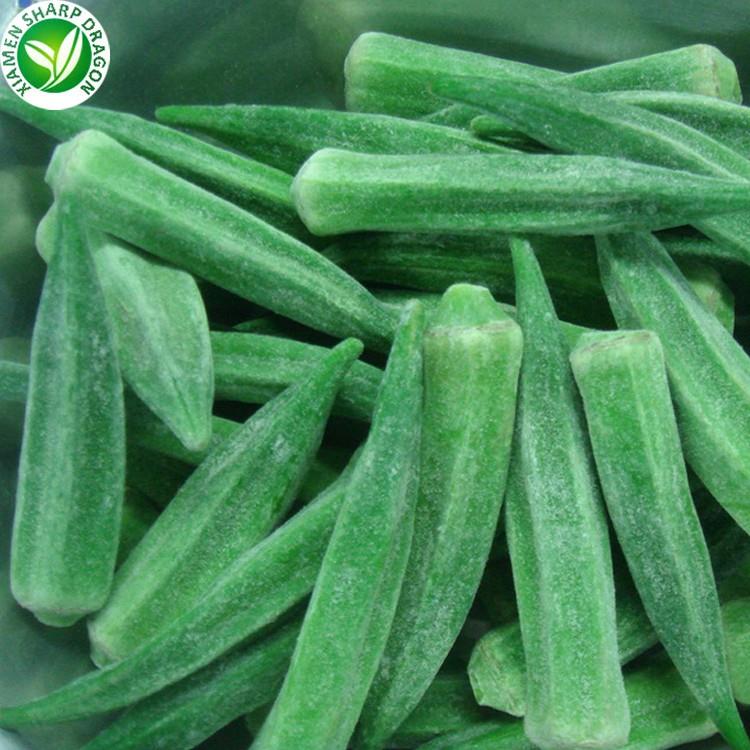
Plain IQF okra is usually the most direct frozen counterpart to a vegetable ingredient. Whole pods preserve visible shape; cut or sliced pieces shorten preparation and distribute more evenly through soups, stews and ready meals. The current XMSD frozen okra range shows these different commercial forms. Choose among them by application, not by assuming that one form is nutritionally superior.
Freezing is not a nutrient lock that makes the food chemically unchanged forever. Vegetables may be washed, sorted, trimmed, cut and blanched before freezing. Blanching controls enzymes and supports frozen quality, but heat and water can affect sensitive nutrients. Frozen storage time, temperature variation and final cooking add more variables. A comparative study of eight fruits and vegetables found frozen vitamin levels broadly comparable with refrigerated samples in many cases, but it did not test okra and did not show identical retention for every vitamin or commodity.
For a fuller explanation of those variables, review the evidence on how frozen vegetables compare nutritionally. If your question is about freezing method, blanching and whole-versus-cut use, the separate okra freezing guide owns that handling intent. Here, the procurement lesson is simpler: identify the process state before interpreting nutrition.
Prepared products create a larger distinction. Breaded fried okra contains coating and oil. Okra chips may have much less water per 100 grams, so solids and calories appear concentrated; frying can add substantial fat, and seasoning can add sodium or sugar. A sauced ready meal includes every ingredient in the formula. The nutrition panel must describe the commercial food as sold or prepared under the applicable rule, not a visually similar raw pod.
Practical example: Suppose your ready meal uses 80 grams of plain cut IQF okra, while a competing side dish uses 80 grams of breaded fried okra. The same okra weight does not create the same finished nutrition. For your product, calculate the full formula including sauce; for the fried item, include coating and absorbed oil. Compare both on the same prepared-serving basis, then approve only claims supported by the finished specification or analysis.

Use Mucilage, Cut and Texture on Purpose
Okra's mucilage is not merely a texture defect. In gumbo, soups, curries and sauces, it can be part of the thickening system. Cutting exposes more interior surface, so small cross-cut pieces can release their characteristic viscosity readily into a wet recipe. Whole pods release differently and keep a stronger visual identity. The right choice follows the finished dish.
If you want distinct pieces in a ready meal, define slice thickness, percentage of broken pieces, seed maturity and the maximum acceptable softening after the actual heat process. If you want body in a sauce, test how the cut behaves through mixing, heating, holding and reheating. A sample that looks attractive while frozen may still disintegrate after retort-like heating, extended simmering or a second foodservice heat cycle.
Maturity often explains disagreements that a color check misses. Younger pods are generally more tender, while advanced seed development and fibrous walls can create a tougher bite. Frost can obscure the surface, so thawed or cooked evaluation is necessary. We recommend assessing both the frozen condition and the prepared condition because they answer different questions: separation and package handling before cooking, then tenderness, viscosity, flavor and structural integrity after cooking.
Example: A hypothetical soup line needs okra pieces to remain visible after 18 minutes of simmering and 20 minutes of hot holding. Test two candidate cuts at the same inclusion rate and cooking sequence. If a smaller cut thickens the broth but loses its piece identity, while a larger cut stays visible but leaves the broth too thin, choose the cut based on the product brief-or blend two controlled cuts only after verifying that the mix remains consistent from batch to batch.

Turn Nutrition Benefits into a Purchase Specification
A nutrition-led product brief still needs physical acceptance criteria. Start with the item identity: plain IQF whole, cut or sliced okra; unbreaded; unseasoned; and intended to be cooked. Then define cut geometry, maturity expectation, color range, seed development, broken-piece control, free-flowing condition and foreign-material requirements in language that can be measured or agreed against an approved sample.
For a ready-meal factory, the decisive evidence is application performance. Run the candidate through the real mixing, thermal process, freezing, storage and reheating sequence. Record piece integrity, viscosity, drained weight where relevant and sensory result. The food-processing application pathway is useful when cut, bulk pack and production fit matter more than a consumer-facing pod appearance.
For a retail or private-label program, the decisive evidence includes the approved formula, serving rationale, nutrition-data source, destination-market rules and artwork control. Raw database data can support an early feasibility check. It should not be copied onto a commercial pack without deciding whether calculation is permitted, whether representative laboratory testing is needed, and whether the result describes the final lot and preparation statement.
For foodservice, convenience and usable yield may be the most valuable practical benefits. Measure the proportion that can move directly from freezer to recipe, the amount discarded during sorting, portion consistency and labor saved against fresh prep. Keep the nutrition story honest: reduced trim loss and controlled portions are operational advantages, but they do not make an oily or salty finished dish nutritionally equivalent to plain okra.
Acceptance logic: Approve the product only when the frozen sample meets the agreed visual and pack criteria, the cooked sample fits the application, and the nutrition or label file matches the exact commercial form. One of these checks cannot substitute for the other two.

Two Worked Calculations for Better Decisions
Worked example: estimate a serving before label approval
Assume a development recipe uses 150 grams of plain frozen, unprepared okra per serving. Using the USDA legacy reference of 30 kilocalories and 2.2 grams of dietary fiber per 100 grams, the provisional calculation is: 150 ÷ 100 × 30 = 45 kilocalories, and 150 ÷ 100 × 2.2 = 3.3 grams of fiber. Against the FDA adult Daily Value of 28 grams, 3.3 ÷ 28 × 100 = 11.8% of the Daily Value before regulatory rounding.
This is a development estimate, not an approved pack declaration. The final serving may weigh differently after cooking, the database entry may not represent your cultivar and process, and the destination may use another labeling system. Add every recipe ingredient, use the market's required basis and rounding rules, and support the value with an accepted database method or representative finished-product analysis.
Worked example: compare cost per usable kilogram
Consider two hypothetical 1,000-kilogram IQF okra lots offered at the same purchase price of US$1.20 per kilogram. Lot A leaves 3% unusable pieces after your agreed sorting rule, so usable weight is 1,000 × 0.97 = 970 kilograms. Its ingredient cost is US$1,200 ÷ 970 = about US$1.237 per usable kilogram. Lot B leaves 8% unusable pieces, giving 920 usable kilograms and US$1,200 ÷ 920 = about US$1.304 per usable kilogram.
The nominal price is identical, but Lot B costs roughly 6.7 cents more per usable kilogram before you count extra sorting labor or recipe disruption. The action is to define the sorting rule first, test representative samples under the same method and compare usable cost-not to accept a generic statement that both lots are Grade A. This calculation is illustrative and does not represent an XMSD price, defect rate or shipment result.
Arrival Checks That Protect Product Value
Inspect the product before the condition changes. Record reefer or shipment information available to you, outer-carton condition, inner-pack seals, lot codes, frost, free-flowing separation and any evidence of thaw-and-refreeze history. Clumping alone does not prove a food-safety failure, but severe blocks, wet cartons, distorted packs or extensive internal ice justify a closer temperature-history and quality review.
Draw samples according to the agreed plan, not from one easy carton. Evaluate whole or cut identity, size distribution, broken pieces, color, visible defects and foreign material. Then cook a retained portion with the approved method. A frozen sample can pass visual review yet fail on toughness, excessive seed maturity, rapid breakdown or unexpected viscosity. Record both states so a later complaint can be traced to the same acceptance basis.
Packaging protects more than appearance. Seal failure and moisture ingress can increase ice formation, dehydration and handling damage. Match inner-bag size to the quantity opened per production cycle, and match carton strength to stacking and route conditions. The XMSD overview of frozen-food packaging options provides a useful starting point, but your approved pack must be reviewed with the actual okra weight, pallet pattern, distribution route and handling practice.
Keep the specification, approved sample record, product label, nutrition basis, packing instruction, inspection result and corrective action connected by product and lot code. If a nutrition value or application claim matters commercially, make it traceable to the same version of the product that passed physical acceptance. That connection is what turns a general benefit statement into defensible product information.
XMSD sourcing note: Send your intended dish, whole or cut preference, serving or batch quantity, packing format, destination and label needs. We can review the product form and evidence package required for your program.
Frequently Asked Questions
What is the main benefit of okra?
There is no single benefit that fits every use. Nutritionally, plain okra contributes fiber and several vitamins and minerals for relatively little energy. In food, its mucilage can add body to wet dishes. In frozen supply, whole and cut IQF forms add portioning convenience and reduce fresh preparation. Keep each claim tied to its evidence.
Does frozen okra have exactly the same nutrients as raw okra?
No exact equality should be assumed. Cultivar, maturity, blanching, cutting, frozen storage and cooking can affect measured values. USDA raw and frozen entries are separate reference points, not a universal retention equation. Use the entry that matches the food form for early work, then support commercial labeling with the method accepted in the destination market.
Can okra nutrition data support a disease claim?
Nutrient composition alone cannot support a claim that okra treats or prevents disease. Some clinical trials and meta-analyses have examined okra powders, supplements or repeated consumption, but the evidence has limitations and does not turn ordinary frozen okra into medical treatment. Use lawful nutrient wording based on the finished product.
Should whole or cut IQF okra be selected for a nutrition-led product?
Choose by application first. Whole pods suit dishes where shape and bite remain visible. Cuts distribute readily and may provide more predictable portioning or thickening. Nutrition differences cannot be inferred from shape alone; compare the exact specification, serving and processing history, then test it in the final recipe.
A Practical Conclusion
Okra earns its place as a useful vegetable ingredient because it combines fiber, micronutrients, low energy density and a distinctive thickening function. Plain IQF frozen okra adds convenience and repeatable product form, but it does not make every nutrient identical to raw okra or every prepared dish equally nutritious. The sound decision is to name the exact food, use evidence that matches it, test the intended application, calculate usable yield and approve claims only for the finished commercial product.
For your next comparison, put three items on the same review sheet: the defined IQF specification, the cooked result from your real process and the nutrition basis intended for the destination market. If all three agree, okra's benefits become useful product evidence rather than a broad marketing promise. If one fails, correct the cut, process, serving calculation or claim before artwork and volume commitment.
References
- USDA FoodData Central: Okra, raw, FDC ID 169260
- USDA National Nutrient Database SR28: Okra, frozen, unprepared, NDB 11280
- NIH Office of Dietary Supplements: Vitamin C Fact Sheet for Health Professionals
- NIH Office of Dietary Supplements: Vitamin K Fact Sheet for Health Professionals
- NIH Office of Dietary Supplements: Folate Fact Sheet for Health Professionals
- U.S. FDA: Daily Value on the Nutrition and Supplement Facts Labels
- Zhang et al. (2024): Effects of Okra Consumption on Glycemic Parameters and Lipid Profile in Adults
- Bouzari et al. (2015): Vitamin Retention in Eight Fruits and Vegetables
- Nursal and Yücecan (2000): Vitamin C Losses in Frozen Vegetables During Cooking