


Frozen Stem and Leaf Vegetables: XMSD Buyer Guide
Aug 15, 2026

"Stem and leaf vegetables" is a useful buying family, but it is not one technical specification. Spinach leaves, cabbage shreds, celery dice, and spring-onion rings differ in structure, moisture, aroma, pigment, trimming loss, cutting behavior, heat response, and finished use. A buyer who asks only for "IQF leafy vegetables" leaves the factory to decide too many variables.
This guide replaces an old consumer nutrition article that included unsupported medical claims. The commercial question is clearer: how should you specify frozen leaf and stem vegetables so that the delivered ingredient works in your soup, sauce, filling, meal, seasoning blend, foodservice pack, or retail product? The answer begins with exact identity and preparation, then moves through cut distribution, leaf-to-stem balance, blanching, color, separation, cooked yield, safety evidence, packing, and cold-chain control.
The short answer: Name the vegetable and supplied style, define usable leaf and stem material, measure the cut as a distribution, state the heat-treatment status, approve frozen and cooked color, and compare accepted cooked yield. Add limits for coarse stems, root ends, yellow leaves, foreign material, fines, free ice, and clumps. Test a representative sample in the buyer's real process before locking the order.
Define the Supplied Material Before Discussing Price
Start with the common name, botanical identity when substitution is possible, variety or type when it changes performance, origin, crop or production period, maturity, and intended frozen format. "Spinach" can mean whole leaf, cut leaf, chopped material, portions, pellets, or a compressed block. "Cabbage" can mean green cabbage, Chinese cabbage, a strip, a square cut, or a coarse chop. "Green onion," "spring onion," and "scallion" are used differently across markets, so use photographs and a written identity rather than relying on one trade name.
Then define preparation. State whether roots, crowns, outer leaves, seed stems, coarse petioles, damaged tips, discolored material, soil, weeds, and other field material are excluded. For celery, state whether leaves are allowed and whether strings or coarse basal sections are limited. For spring onion, write the target green-to-white ratio or the accepted visual range. For cabbage, state whether heavy core pieces are acceptable. These choices affect usable yield, appearance, flavor, and cost.
The USDA processing-spinach standard evaluates defects such as roots, weeds, foreign material, discoloration, seed stems, coarse stalks, decay, and dirt. A commercial contract does not have to copy a U.S. grade, but the defect logic is valuable: name the defect, define how it is separated or measured, set the sample condition, and agree on the acceptance limit. "Good quality" cannot be audited; a weighed fraction of coarse stems can.
| Material | Common buying styles | Decision-changing controls |
|---|---|---|
| Spinach | Leaf, cut leaf, chopped, portions, block | Coarse stems, chop distribution, compression, color, free water |
| Cabbage | Shred, square cut, strip, coarse chop | Variety, core material, width and length, breakage, cooked bite |
| Celery | Dice, slice, segment, leaf-and-stem blend | Stem diameter, strings, leaf allowance, aroma, fibrous pieces |
| Spring onion | Ring, chop, short segment | Green-to-white ratio, root ends, ring length, aroma, clumping |
Use the table to build questions, not to assume that every production site supplies every style. We match the requested material, process, facility, pack, destination, and evidence order by order. The buyer should approve a dated product specification and a representative sample or photo standard. If natural variation is expected, define the acceptable range rather than demanding an impossible visual clone.
Spinach: Control Leaf, Stem, Chop, and Compression
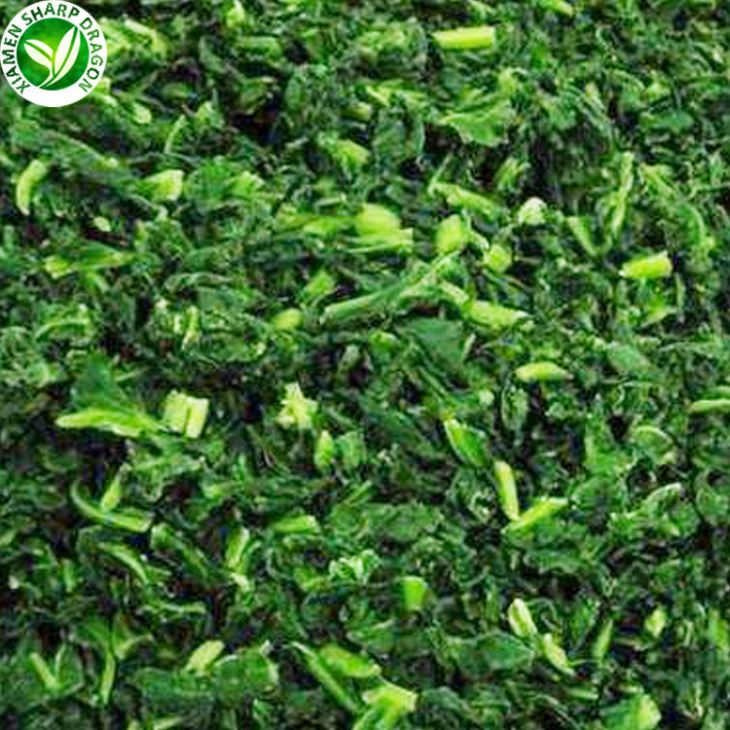
The format determines how spinach enters a recipe. A visible leaf style may suit layered dishes or fillings, while a controlled chop may disperse more evenly in soup, sauce, bakery filling, or prepared meals. Blocks and portions solve handling or dosing needs but are not the same as free-flowing IQF particles. Write whether the requirement is individually quick frozen, portioned, or compressed, and describe the expected separation at the stated storage condition.
A nominal chop such as 10–20 mm is only a target. Real material includes folded leaf, stems, irregular fragments, and fines. Define the test portion, frozen or thawed condition, measuring method, target range, and limits for oversize, undersize, fines, coarse stems, and compact masses. Decide whether results are reported by weight or count. Weight is usually more meaningful for irregular leafy pieces, but the method must match the buyer's line.
Leaf-to-stem balance changes color, bite, flavor, and cost. "Stemless" is usually a poor commercial phrase because leaf spinach naturally includes acceptable petiole material. Define unwanted coarse or fibrous stem separately from normal edible stem. Approve photographs of acceptable and rejected fractions, then check several samples across the lot. Our frozen spinach range can begin the format discussion, but final acceptance belongs in the order specification.

Compression and drainage also matter. A tightly compressed sample may appear economical in a block but require more thawing and mechanical separation. Excess process water may appear as free ice or drain loss, while aggressive pressing may remove desirable moisture and change texture. Define net-weight checks, free-ice handling, drain method if used, and the application's acceptable moisture result. Do not compare two samples only by frozen visual volume.
Practical example: A sauce producer tests two chopped-spinach samples at equal invoice weight. Sample A is darker and more compact; Sample B is more free flowing. After the same cook, Sample A leaves more fibrous stem pieces and requires longer mixing to disperse. Sample B gives a more consistent fill weight and appearance. The buyer records maximum coarse-stem and clump fractions and selects by accepted sauce yield, not frozen color alone.
Cabbage: Specify Variety, Core Material, and Two Dimensions
Cabbage performance starts with type. Green cabbage and Chinese cabbage differ in leaf structure, rib thickness, moisture, flavor, and cooking behavior. A picture of the final dish helps, but it does not replace the product identity. State the variety or type, desired leaf and rib character, permitted core material, maturity, cut style, and intended cook. If the pack is a blend, give the cabbage percentage and tolerance by weight.
For strips and shreds, width alone is incomplete. Long ribbons can wrap around augers, bridge in hoppers, and produce uneven portioning. Define both width and length distribution, plus limits for fines, large leaf sheets, thick rib pieces, and compacted clusters. A square cut needs two dimensions and a policy for folded pieces. Inspect the product in its frozen state and after the buyer's normal handling because brittle pieces can break during transport or feeding.
The IQF chopped cabbage page shows one commercial format. Your order still needs an agreed distribution and cooked endpoint. A meal tray requiring visible cabbage pieces may need a broader but stronger cut. A dumpling filling may accept smaller particles but needs controlled free water. A soup line may prioritize pumpability and repeatable portioning.

Cooked bite is the final arbiter. Cabbage can move from firm to soft quickly, and ribs may remain firmer than leaves. Use the buyer's actual time, temperature, load, sauce, salt, pH, equipment, and holding period. Record the result at the intended serving point, not immediately after blanching. The incoming specification should support the required endpoint, while the buyer's process must avoid creating the defect it later attributes to the ingredient.

Practical example: A dumpling producer requests 20 mm chopped cabbage but finds long strips blocking portioning equipment. The supplier's average width is correct, yet length was never limited. A second trial records width, length, fines, and heavy-rib fractions from a 1 kg test portion. The buyer approves a two-dimensional distribution and adds a dewatering result after the filling process. The specification now controls the real cause of line variation.
Celery and Spring Onion: Aroma and Component Ratio Are Part of the Grade
Celery is purchased for both structure and aroma. Define stem diameter or source grade when it changes fiber, the cut size, leaf allowance, color range, strings or coarse-fiber limit, basal or root-end defects, discoloration, and aromatic intensity after the buyer's cook. A diced product may contain natural curved pieces; decide how irregular shapes are measured and whether the application values a clean cube or only a consistent dose.
Our frozen celery range provides starting formats for discussion. For a soup or sauce, measure the percentage of large fibrous pieces that remain after the actual cook. For a visible meal component, check edge damage and color. If leaves are allowed, control them as a range because leaf-heavy material can change flavor, appearance, and bulk density.

Spring onion requires a component-ratio decision. Green tops bring color and a different aromatic profile; white stem sections change appearance, bite, and cost. State a target green-to-white ratio with tolerance, or approve a visual reference supported by weighed checks. Define ring or chop length, root-end exclusion, yellow or dry material, thick basal sections, soil, foreign material, and clumps. A pack that looks greener on the surface may not represent its overall ratio.
The frozen spring onion range can support format selection. Aroma should be assessed after a defined preparation, because direct tasting of frozen material is neither a reliable sensory method nor a substitute for the intended cook. Record sample weight, recipe concentration, heat treatment, tasting time, and the reference against which strength is judged.

Blanching, Cooling, and Freezing Must Match the Product
Codex's quick-frozen-vegetable framework recognizes washing, preparation, cutting, and blanching or enzyme inactivation as commodity-dependent operations. It does not create one universal blanching time for every leaf and stem vegetable. The suitable process depends on material, maturity, cut, line load, equipment, cooling, freezing rate, expected shelf life, and final use. Ask for the supplied status and measurable finished result rather than assuming a hidden process setting.
Heat treatment affects enzyme activity, color, texture, aroma, microbial load, and later cooking response. Too little treatment can leave unstable quality; too much can soften leaves, dull aroma, increase broken pieces, or release solids. Rapid and controlled cooling matters because retained heat continues to change delicate tissue. Drainage before freezing influences surface ice, clumping, net-weight checks, and yield after preparation.
Color should be approved under defined conditions. Compare the frozen sample under consistent lighting, then assess it after the buyer's cook and hold. Record unacceptable yellow, brown, black, translucent, or bleached areas by a stated method. Natural crop variation makes a broad phrase such as "bright green" difficult to enforce. A retained reference, color range, defect fraction, and photographed test are stronger.
Freezing preserves the product under controlled conditions but is not a universal pathogen kill step. Blanching should not be treated as proof that an ingredient is fully cooked or ready to eat. State whether the supplied product is intended for further processing, align labeling and preparation instructions, and validate the buyer's thermal process where required. Product safety status must come from the actual hazard analysis, process, tests, and intended use.
Practical example: A retail soup developer likes the frozen color of a spring-onion sample but loses most of its green appearance after reheating and ten minutes of hot holding. Another sample begins slightly darker but holds color and aroma better through the full service simulation. The buyer approves the second sample and writes the cook-and-hold assessment into the specification instead of selecting from a frozen photograph.
Compare Accepted Cooked Yield, Not Invoice Weight Alone
Leafy products can lose value through free ice, drain loss, fines, coarse stems, yellow pieces, unusable clumps, or texture failure. Build a repeatable yield test around the intended application. Weigh the frozen sample, separate free ice only by the agreed method, cook under fixed conditions, drain or hold as the recipe requires, remove defined rejects, and weigh the accepted result. Record every loss category so a corrective action can target the cause.
Worked example: Treat these figures as a buyer calculation, not a universal yield promise. A meal producer receives 1,000 kg of frozen chopped spinach. The agreed test finds 18 kg of separable free ice, 22 kg of coarse stems and yellow material, and 64 kg of process loss after the buyer's cook and drain.
Accepted cooked quantity: 1,000 − 18 − 22 − 64 = 896 kg.
Accepted cooked yield: 896 ÷ 1,000 × 100 = 89.6%.
If delivered ingredient value is $1,420: invoice cost is $1.42/kg.
Cost per accepted cooked kilogram: $1,420 ÷ 896 = about $1.58/kg before freight, storage, labor, energy, sauce, and packing.
A second sample priced at $1.38/kg may not have a lower usable cost if accepted yield falls to 84%. Use several representative lots before building a purchasing assumption. The important comparison is not one best laboratory result; it is stable performance within the agreed commercial range. Keep photos and weights for each rejected fraction, as well as cooked texture and portioning notes.
Safety, Foreign Material, and Order-Specific Evidence
Leaf and stem vegetables grow close to soil and can carry dirt, stones, weeds, insects, hard plant parts, and other field material. Effective controls can include field management, receiving inspection, washing, flotation or separation, trimming, visual sorting, sanitation, screens, magnets, metal detection, and other line-specific measures. Ask where each control operates, what it can detect, what it cannot detect, and how findings are recorded and investigated.
The microbiological plan must match the vegetable, process, destination, customer, and intended use. Define criteria, sampling, test method, laboratory, release timing, action on failure, and any destination-specific requirements. Do not write "international standard" without naming the standard. Do not infer ready-to-eat status from a frozen appearance or a blanching statement. The buyer's use and label must align with the supplied status.
Build an order evidence matrix. Typical items can include the signed specification, ingredient and processing-aid declaration, allergen and cross-contact statement, GMO statement where relevant, certificate holder and scope, facility address, traceability codes, production and expiry data, COA or release record, microbiological results where required, pesticide-residue or contaminant evidence based on risk, origin documents, packing list, and destination certificates. Confirm applicability and validity rather than collecting logos.
Practical example: A private-label buyer approves chopped cabbage visually but the first document review shows that the certificate presented belongs to another legal entity. The buyer checks the certificate holder, manufacturing address, product scope, validity, and relationship to the quoted lot before printing packaging. The product may still be suitable, but evidence must follow the actual production and export chain.
Packing, Clumping, and Cold-Chain Acceptance
Delicate leaves and small cuts are sensitive to compaction, dehydration, breakage, and temperature fluctuation. Specify the food-contact liner, bag weight, seal, net weight, carton strength, code format, pallet pattern, wrap, loading plan, shelf life, and storage condition. State whether the product must remain free flowing and how clumps are defined. A soft cluster that separates with light hand pressure is different from a solid mass that interrupts dosing.
Temperature fluctuation can promote recrystallization, surface ice, discoloration, dehydration, and clumping. It may also increase breakage as the pack is handled. Our frozen packaging information can support the pack discussion, but order documents must confirm the selected bag, carton, coding, pallet, and loading arrangement. Generic packaging photos do not create a contract.

At arrival, record container and seal condition, carton damage, code, product temperature, visible ice, dehydration, clumping, color, odor, and breakage before routine handling changes the evidence. Follow the agreed sampling plan and compare the same test method used for approval. If a logger shows an excursion, evaluate its duration, position, product condition, and acceptance rules; one isolated number should not replace the agreed assessment.
Approve the Sample in the Real Application
A useful sample protocol records the product and lot, frozen temperature, pack condition, sample weight, cut distribution, leaf and stem fractions, defects, free ice, clumps, color, odor, and photographs with a scale reference. Then run the ingredient through the buyer's normal thaw-free or thawed preparation, cook, mix, fill, hold, freeze-thaw, or reheat route. Record accepted yield and the result at the point the customer experiences it.
Test more than one bag and, for a trial run, sample the beginning, middle, and end. Fine and coarse pieces can segregate during conveying and filling. A correct batch average does not guarantee that every retail bag has the same leaf-to-stem or green-to-white ratio. If unit-level consistency matters, write a unit-level sampling and tolerance rule and confirm that the filling process can meet it.
For an RFQ, send the exact vegetable identity, supplied style, cut distribution, leaf/stem or green/white ratio, blanching and cooking status, defect limits, color and sensory reference, clump and free-ice method, microbiological and residue requirements, intended use, destination, required documents, pack, quantity, Incoterm, port, target shipment period, and sample protocol. Separate mandatory limits from preferences so quotations remain comparable.
Frequently Asked Questions
1. Are frozen spinach, cabbage, celery, and spring onion interchangeable in one specification?
No. They need separate identity, preparation, cut, defect, heat-treatment, sensory, and yield controls. A shared document can organize the family, but each material should have its own measurable requirements and application trial.
2. Does blanching mean a frozen leafy vegetable is fully cooked?
Not necessarily. Blanching is a product- and process-dependent treatment that can control enzymes and affect quality. Confirm the supplied status, intended use, label, microbiological plan, and required buyer cooking process rather than assuming ready-to-eat status.
3. How should a buyer specify spinach stem content?
Distinguish normal edible petiole from coarse or fibrous stem. Define the sample size and condition, separate the agreed reject fraction, report it by weight, and retain photographs of acceptable and rejected material. Check cooked texture as well as frozen appearance.
4. What is the best way to compare two frozen cabbage offers?
Compare identity, width and length distribution, core or rib fraction, fines, free ice, defects, cooked bite, accepted yield, evidence, packing, and delivered cost. Test both samples under the same production and hold conditions. Unit price alone is incomplete.
5. What should be included in a frozen stem-and-leaf vegetable sample request?
Include product identity, style, cut, component ratio, heat-treatment status, defects, color, sensory target, clump and free-ice rule, intended recipe, destination requirements, pack, volume, documents, and the test method. Ask whether the sample represents the proposed production route.
Send us the application, cut, component ratio, pack, destination, and trial method.
We will review the available product and partner-factory route, clarify open specification points, and prepare an order-specific response. Use the XMSD inquiry form to share your RFQ.
References
- USDA Agricultural Marketing Service. Frozen Leafy Greens Grades and Standards.
- USDA Agricultural Marketing Service. Spinach for Processing Grades and Standards.
- Codex Alimentarius. Standard for Quick Frozen Vegetables, CXS 320-2015.