


Frozen Carrot Production Process: A Buyer Control Guide
Sep 11, 2023

A controlled frozen carrot production process begins with sound roots and ends with a coded lot that performs as specified after cooking. Between those points, the processor sorts, washes, peels, trims, cuts, may blanch according to the selected product standard and validated process, cools, drains, quick-freezes, inspects, packs and stores the product under frozen conditions. Every transfer can change color, cut uniformity, surface ice, texture, defect level or usable yield.
The process should therefore be approved as a sequence of measurable releases, not as a generic arrow diagram. Start with the intended application and product style. Then define how size is measured, which defects are counted, whether the product is blanched, how the finished lot is sampled, what cooked texture is acceptable, and which records connect the packed carton to the raw-material and processing run.
Direct answer: Approve frozen carrots by checking five linked results: correct identity and cut, controlled raw-material defects, a documented heat-and-cooling route where blanching is used, rapid freezing with free-flowing pieces, and acceptable color and texture after the agreed cooking test. A bright unopened bag does not prove the cut distribution, tenderness or usable yield.

Read the Flow as Evidence, Not as a Recipe
The normal commercial route is receiving, lot identification, sorting, washing, peeling and trimming, cutting or size grading, blanching when the agreed process calls for it, cooling, dewatering, quick freezing, post-freeze sorting, foreign-material control, packing and frozen storage. The general frozen-vegetable process guide explains the common sequence. Carrots still need their own release rules because a dice, a smooth slice, a crinkle slice and a shaped cut do not share the same cutting loss, heating response or application performance.
Two respected standards illustrate why a process description must identify its basis. The USDA frozen-carrot grade standard defines the product as washed, sorted, peeled, trimmed and blanched before freezing. The Codex carrot annex defines quick-frozen carrots from prepared roots that may or may not be blanched. That is not a contradiction to hide. It means the order, destination rule, label, intended use and facility process must state which route applies.
For each stage, record the incoming lot, the measured variable, the applicable limit, the sampling frequency, the person or system making the release, and the action for a deviation. A line record that says only "wash OK" or "freezer OK" cannot show water condition, product temperature, throughput, detector challenge or the quantity placed on hold. The evidence should identify the exact production interval represented.
We recommend tracing one representative carton backward during qualification. Its code should lead to the packing run, inspection result, freezing interval, blanching or non-blanch route, cutting batch and receiving lots. Trace another raw-material lot forward and reconcile where its mass went. This two-direction check exposes gaps that a certificate or polished factory photograph cannot show.
Release Raw Carrots for Processing Yield and Finished Quality
Freezing preserves the condition entering the line; it does not repair tough, cracked, decayed, green-shouldered or poorly colored roots. UC Davis lists firmness, straight shape, uniform taper, bright orange color, low residual root hair and freedom from green shoulder or green core among useful fresh-carrot quality indicators. For frozen production, translate those indicators into the yield and defect risks that matter after peeling and cutting.
Maturity is not simply "young" or "old." Roots must have enough diameter and internal development for the chosen cut while remaining tender enough for the target cooked texture. A narrow root may be inefficient for a large dice or wide slice. An over-mature root can give a woody or fibrous core. A mixed diameter distribution can create more trim, off-size pieces and uneven blanching even when the average looks acceptable.
Sample beyond the top layer of a receiving bin. Record lot identity, gross weight, variety when relevant, root diameter distribution, color, firmness, decay, cracking, splits, green shoulder, insect or disease damage, soil and foreign vegetation. Separate removable trim from conditions that justify a hold or rejection. A peelable surface mark affects cost; decay or an unidentified load changes the release decision.
Practical example: Two hypothetical raw lots have the same delivered price. Lot A gives 88 kg of acceptable prepared roots from 100 kg received, while Lot B gives 94 kg because it has less cracking, green shoulder and severe taper. Before cutting, Lot A already costs 6.8% more per usable kilogram of prepared root. Keep this intake yield separate from later cut and finished-product yield so the source of the loss remains visible.

Lock the Cut Style Before Discussing Quality
"Frozen carrot" is not a complete item name. USDA recognizes whole, halves, quarters, slices, diced, double-diced, strips, chips and other cut styles. Codex also provides carrot presentations such as whole, finger, halves, quarters, lengthwise slices, julienne or shoestring, rings or roundels, pieces and dice. The wording and dimensional rules differ, so name the governing standard or place your own clear drawing and measurement method in the specification.
Cut choice changes the whole process. Dice must move predictably through fillers and blends. Smooth rounds need controlled thickness for even cooking. Crinkle slices increase surface contour and create a different visual identity. Flower shapes need an agreed profile because a decorative cut can lose definition through breakage. Julienne or shredded forms expose more surface and can clump or soften faster. Our IQF frozen carrot range shows several commercial formats, but the purchase specification should control the exact order.
Do not approve only an average dimension. Define the target band and separately control the tails: below-size fragments, above-size pieces, malformed pieces and shapes outside the named style. State whether assessment uses mass, piece count or measured dimensions. A piece-count result can overstate small fragments, while a mass result can hide many small pieces; choose the method that predicts the application.
Example: In a hypothetical 10 kg dice sample, 9.2 kg falls inside the agreed size band, 0.5 kg is undersize and 0.3 kg is oversize. The lot has 92% in-range product, so it passes a 90% overall in-range rule. However, it fails if the contract also caps oversize at 2% because the measured oversize is 3%. Keep the separate tail limit when oversized dice can block a filler or cook too slowly.
Cutters must be checked under representative throughput, not only during an empty-line setup. Root diameter, feed orientation, blade condition and line speed change the distribution. Record startup, product or size changeovers, blade adjustments and checks during the run. Compare the cut frozen and after cooking, because a nominally correct piece that fractures or loses shape may still fail its real job. The dedicated guide to shredded carrot performance explains why fine cuts require a different application decision from dice or slices.

Control Washing, Peeling and Trimming as Defect-Removal Steps
Washing should remove soil and loose material without turning process water into a cross-contamination route. Review the water source, relevant potable-water or regulatory criteria, tanks, flumes, sprays, filters, make-up water, overflow and drainage. If an antimicrobial is used, the facility should control the variables that determine its effect for that chemistry, such as active concentration, pH, organic load, contact time and instrument calibration.
Peeling removes the outer surface but also creates yield loss and a fresh exposed surface. Set the peel result by visible acceptance, not by machine name. Under-peeling leaves skin, crown tissue or dark rings. Excessive peeling wastes sound tissue and can reduce the dimensions needed for the target style. Track peeled yield and verify the result across large and small roots.
Trim green tops, secondary roots, damaged ends and objectionable tissue before cutting. Codex specifically addresses green tops, extraneous vegetable material and unpeeled areas in its carrot defect provisions. Your contract should define how these are identified and counted. Do not combine foreign material, peel residue, discoloration and harmless shape variation into one vague "defect percentage." Their risk and corrective action are different.
Inspect the result at more than one point. A clean root can pick up fragments from cutting or handling. A rejected surface defect can become several smaller defective pieces after dicing. Link receiving, peeled-root and finished-cut data so a rising defect does not disappear between departments. Trend by lot and shift; one acceptable composite sample cannot explain a local surge.
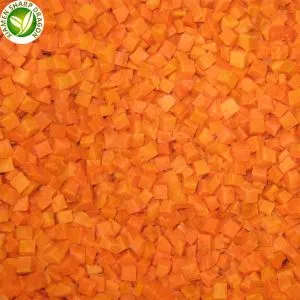
Validate Blanching Without Sacrificing Texture
Blanching is commonly used to reduce enzyme activity and stabilize frozen-vegetable color and flavor during storage. It also changes tissue. Too little treatment can leave the chosen quality endpoint uncontrolled; too much can soften carrot pieces, leach soluble material and reduce the clean shape needed after cooking. The correct operating window depends on cut, dimensions, raw condition, loading, equipment, heat-transfer method and the validated endpoint.
A published carrot experiment studied hot-water treatments from 70 to 90°C and suggested 80°C for 6 minutes as a compromise under its particular test conditions. That number is useful evidence that enzyme inactivation, color, phenolics and texture move together; it is not a universal production setting. Do not copy it into a contract without validation on the actual style, line, throughput and required storage life.
Measure product exposure, not only the machine display. Review loading, residence-time distribution, water or steam condition, product temperature at a representative point, startup and shutdown, product changeovers, throughput changes and the quality or enzyme verification used by the facility. Define what quantity is held when a limit is missed and how rework, reprocessing or disposal is decided.
Cooling must stop continued heating promptly under sanitary control. Drainage then removes surface water before freezing. Poor cooling can extend softening; long warm residence creates another handling exposure; poor dewatering contributes to surface ice, clumps and misleading pack weight. Treat blanching, cooling and drainage as one connected balance rather than three isolated check marks.
Blanching is not automatically a validated pathogen-kill step. FDA explains that freezing does not kill most bacteria, and a partially cooked frozen food still requires the intended safety controls and cooking instructions. Align the process description, hazard analysis, microbiological plan, label and intended downstream use. If your application is ready-to-eat, the evidence burden is different from a product sold with a validated downstream cook.
Practical example: A hypothetical sample remains bright after a short cook but leaves four mushy pieces in a 20-piece texture check. A second process sample is slightly firmer and has one fibrous piece. If the application requires visible dice that survive a ready-meal reheat and the contract permits no more than two mushy or two fibrous pieces in that test, the second sample is the defensible choice. Record the preparation method so later lots are judged on the same basis.

Freeze the Product Rapidly and Prove Separation
Quick freezing aims to move the product through its principal ice-crystal formation range rapidly enough to limit damaging crystal growth. Under Codex CXS 320, the process is complete when the thermal center reaches -18°C after thermal stabilization, and the product is then maintained at -18°C or colder through the cold chain. The applicable contract or destination rule may add other requirements.
Tunnel air temperature does not prove the product endpoint. Inlet temperature, piece thickness, belt depth, feed distribution, frost on coils, airflow and throughput all change freezing performance. A bed containing 10 mm dice behaves differently from thick crinkle slices. Define where product temperature is measured, how the measuring device is calibrated, how frequently checks occur, and what production interval a missed release places on hold.
IQF is a process description; free-flowing condition is a finished result. Inspect separation, clumps, loose surface ice, dehydration, breakage and pieces stuck together by frozen process water. Small clumps that separate with light handling may be treated differently from a solid mass indicating poor drainage or temperature abuse, but the specification must define the test and tolerance.
Frozen storage does not stop quality change forever. A peer-reviewed frozen-carrot storage study found that the tested temperature regimes significantly affected color, drip loss, texture and vitamin C under its conditions. Do not turn its modeled shelf-life result into a universal commercial promise. Use it as evidence that storage history belongs in product design, shelf-life validation and shipment review.

Inspect Defects, Foreign Material and Cooked Texture Separately
USDA Grade A uses good color, practical uniformity of size and shape, practical freedom from defects and tender texture, with a score of at least 90 points. Grade B uses reasonably good versions of those factors and at least 80 points. These are voluntary U.S. grade terms, not automatic contract limits for every export order. If you reference them, state the edition, grade and inspection method rather than borrowing the words "Grade A" as a sales adjective.
Judge each attribute in the condition required by the method. USDA evaluates color on thawed product and texture after cooking; its texture concept covers tenderness, freedom from mushiness and freedom from coarse or fibrous units. A frozen photograph cannot demonstrate those results. Use controlled thawing or cooking, a defined sample and the same time, water ratio or application method for approvals and repeat lots.
Create separate defect categories for peel residue, green or white discoloration, brown or dark areas, cracks, malformed pieces, mechanical damage, tough or woody tissue, fragments, extraneous vegetable material and other foreign material. Set critical, major and minor rules according to risk and use. Do not let many attractive orange pieces mathematically cancel one prohibited foreign object.
The broader frozen-vegetable inspection guide can help organize arrival checks. For carrots, add style-specific measurements and a cooked texture test. Keep the approved reference sample, photographs taken under controlled lighting, written defect definitions and the application test aligned. Photos assist communication, but measured limits decide the lot.

Verify Post-Process Hygiene and Detection Evidence
After any heat treatment, carrots move through cooling, dewatering, conveying, freezing, inspection and packing. Protect this zone through suitable hygienic separation, traffic control, condensation management, drainage, cleaning, maintenance and food-contact surface control. The relevant monitoring program depends on intended use, facility risk assessment and destination requirements.
Foreign-material control needs layers. Field and receiving controls address stones, vegetation and agricultural contamination. Washing, trimming and visual or optical sorting address other visible defects. Product-suitable screens, magnets, metal detection or X-ray may address defined hazards at their proven sensitivity. One detector does not remove every piece of hard plastic, stone, glass or nonferrous metal.
Review detector challenge material, size, orientation, product effect, frequency, reject confirmation, alarm handling and the disposition of product since the last acceptable check. The displayed sensitivity during an empty test may not equal performance through a dense frozen pack. A failed challenge should trigger a time-defined hold and documented investigation, not an undocumented second try.
Pack and Code for the Route You Will Actually Use
Packing must protect separation, moisture, identity and handling strength. Confirm inner material, seal construction, net weight, case strength, coding, label language, cooking statement, pallet pattern and carton marks. A 10 kg industrial liner, a foodservice bag and a retail pouch face different opening frequency, compression and moisture-barrier needs.
Use the frozen packaging overview to frame options, then test the chosen construction at the real fill weight, carton stack, route and storage period. Check seals, code legibility and net weight during the run. Reconcile packed output with input, rejects, rework and work in progress so traceability and yield use the same mass boundary.
Move sealed cartons to frozen storage promptly and record the agreed temperature basis. Review case condition, pallet stability, airflow clearance, loading exposure and reefer evidence. A cold-room display describes its sensor location, while an arrival sample describes only the cases opened. Use both process records and representative arrival inspection to reconstruct the lot condition.
Calculate Saleable and Cooked Yield Before Price Approval
Delivered price is meaningful only after the product passes the size, defect and application rules. Inspect representative cases while frozen, weigh exclusions by defined category, and then run the agreed cooking or production test. Keep ordinary cooking loss separate from pieces rejected for wrong size, damage, peel, discoloration, clumping or texture.
Worked example: A hypothetical 100 kg delivered sample costs USD 1.10 per kilogram. Inspection removes 3.0 kg of off-size pieces, 1.5 kg of peel or discoloration, 0.8 kg of damaged pieces and 1.2 kg of excessive clumps or loose ice. Saleable frozen weight is 93.5 kg, so frozen saleable yield is 93.5%. The delivered cost becomes USD 1.10 divided by 0.935, or USD 1.176 per saleable frozen kilogram.
The same plant cooks 20.0 kg of saleable product under its standard method and obtains 17.8 kg at the target tenderness. Cooked yield is 17.8 divided by 20.0, or 89.0%. Combined frozen-saleable and cooked yield is 0.935 multiplied by 0.89, or 83.22%. The raw delivered product therefore costs about USD 1.322 per usable cooked kilogram before labor, energy, sauce and other ingredients.
These figures are teaching values, not an XMSD lot result or price offer. Replace them with representative measurements. If one sample has lower delivered price but more fragments, ice and cooked softening, compare both at the same usable endpoint. This reveals whether the saving survives the line rather than disappearing into waste and recipe correction.
XMSD sourcing note: Send the required carrot style, dimensions, defect rules, blanching or cooking status, application test, pack, destination, annual quantity and document needs. We can review the request against available frozen carrot products and a suitable partner-factory route.
Frequently Asked Questions
Are frozen carrots always blanched before freezing?
Commercial frozen carrots are commonly blanched, and the USDA frozen-carrot standard includes blanching in its product definition. The Codex carrot annex permits product that may or may not be blanched. State the agreed route and verify its quality, safety and labeling basis rather than assuming from the word "frozen."
Which frozen carrot cut is best for ready meals?
Use dice when dosing and piece identity matter, slices or crinkle slices when a visible side-dish shape matters, and finer cuts when rapid integration is more important than firmness. Run the exact cut through filling, freezing, reheating and holding before approval.
Does IQF guarantee loose carrot pieces?
No. Drainage, feed depth, cut dimensions, freezing performance, packaging and temperature history all affect separation. Define a clump test and tolerance in the finished specification and inspect representative shipped cases.
How should frozen carrot color and texture be checked?
Use the condition specified by the chosen method. USDA assesses color on thawed product and texture after cooking. Keep lighting, sample size, cooking time and acceptance definitions consistent so the reference sample and repeat lots are comparable.
Which records support a frozen carrot lot release?
Review receiving and traceability records, peeling and cutting yield, size and defect results, water controls, blanching and cooling records when applicable, product-temperature release, post-freeze inspection, detector checks, testing required by the plan, packing and coding checks, frozen-storage data and corrective actions.
Final Thoughts from XMSD
The strongest frozen carrot process is not the one with the longest flow chart. It is the one that connects root condition, cut distribution, heat history, drainage, product temperature, defects, cooked texture, packaging and traceability to explicit release decisions. When you compare delivered cost at the usable cooked endpoint, the specification becomes a practical operating tool rather than a list of attractive claims.
References
- Codex Alimentarius. CXS 320-2015, Standard for Quick-Frozen Vegetables, including the carrot annex.
- USDA Agricultural Marketing Service. United States Standards for Grades of Frozen Carrots.
- UC Davis Postharvest Research and Extension Center. Carrot: Maturity, Quality and Postharvest Handling.
- U.S. Food and Drug Administration. Are You Storing Food Safely?.
- Gonçalves EM, et al. Carrot peroxidase inactivation and physical changes due to blanching. Journal of Food Engineering.
- Paciulli M, et al. Effect of different cooking methods on industrially frozen carrots. Journal of Food Science and Technology.