


Nutrient Content of Frozen Asparagus
May 08, 2023

Plain frozen asparagus remains a useful source of folate, vitamin K, vitamin C, fibre, and several minerals. In the USDA reference for frozen asparagus that has been cooked, boiled, drained, and prepared without salt, one 180 g cup provides 32 kcal, 5.3 g protein, 3.5 g carbohydrate, 2.9 g fibre, 243 mcg dietary folate equivalents, 144 mcg vitamin K, 43.9 mg vitamin C, and 309.6 mg potassium. Those numbers describe one precisely defined food form; they do not apply automatically to an unprepared bag, a smaller serving, a salted product, or asparagus served with butter, cheese, sauce, or another ingredient.
The practical conclusion is more useful than a long list of supposed benefits. Freezing does not make asparagus nutritionally empty, but blanching, frozen storage, cooking, draining, cultivar, maturity, and water content can change individual values. Frozen asparagus can contribute to a balanced diet; its nutrient content alone does not prove that it prevents cancer, heart disease, infection, inflammation, or digestive disorders. For a commercial label or product specification, start with the exact food form and measurement basis, then use product-specific data under the rules of the destination market.
The short answer: Frozen asparagus keeps meaningful nutritional value. A cooked, drained, unsalted 180 g cup is especially notable for folate, vitamin K, and vitamin C, but the product form and preparation method must be stated before any number or health interpretation is used.

What One Cup of Cooked Frozen Asparagus Provides
The most defensible starting point is a food-composition entry that defines the product and serving. The table below uses USDA FoodData Central legacy data for "asparagus, frozen, cooked, boiled, drained, without salt." The serving is one cup weighing 180 g. The percentage figures use the FDA Daily Values for adults and children aged four years and older. They are reference percentages for interpreting a serving, not a prescription for an individual diet.
| Nutrient | Amount per 180 g cup | Approximate FDA Daily Value |
|---|---|---|
| Energy | 32 kcal | Not classified as high or low by %DV |
| Protein | 5.3 g | About 11% |
| Total carbohydrate | 3.5 g | About 1% |
| Dietary fibre | 2.9 g | About 10% |
| Folate | 243 mcg DFE | About 61% |
| Vitamin K | 144 mcg | 120% |
| Vitamin C | 43.9 mg | About 49% |
| Potassium | 309.6 mg | About 7% |
| Iron | 1.0 mg | About 6% |
| Sodium | 5.4 mg | Less than 1% |
This table immediately corrects a common source of confusion. "One cup" is not a universal mass. A cup of raw pieces, a cup of cooked and drained spears, and a cup of a prepared asparagus dish can weigh differently. Water gained or lost during cooking changes the nutrient concentration per 100 g or per cup even when no nutrient has been added. Salt, oil, cheese, and sauce then change the final nutrition profile independently of the asparagus.
Worked example: The FDA Daily Value for vitamin C is 90 mg. Dividing 43.9 mg by 90 mg and multiplying by 100 gives 48.8%, which rounds to about 49% of the Daily Value in the defined 180 g serving. The same method gives 60.8% for folate: 243 mcg DFE divided by the 400 mcg DFE Daily Value. If your serving is 100 g rather than 180 g, a direct scaling of this database entry gives about 24.4 mg vitamin C and 135 mcg DFE folate. Use that calculation only as a transparent estimate; use the actual product declaration when the number will appear on a commercial label.
What the Main Nutrients Do-and What the Numbers Cannot Prove
Folate supports cell division, but it is not a heart-disease claim
Folate is a water-soluble B vitamin involved in one-carbon transfers used to make DNA and RNA and to metabolise amino acids. The NIH Office of Dietary Supplements also identifies asparagus as one of the foods with comparatively high folate levels. That physiological role explains why folate is nutritionally important. It does not justify saying that a serving of frozen asparagus prevents heart disease or treats an elevated homocysteine result.
The measurement basis matters here. Natural food folate is expressed as dietary folate equivalents on many labels, while folic acid is the form used in fortified foods and many supplements. Plain asparagus contains food folate; it is not the same product as a fortified food or a folic-acid supplement. If you are preparing a nutrition panel, keep the nutrient name, unit, food form, and jurisdictional calculation method aligned.
Vitamin K has a clear biological role and a relevant medication caution
Vitamin K is required for proteins involved in normal blood clotting and bone metabolism. The 144 mcg in the defined cup is above the current 120 mcg FDA Daily Value, so this is one of the most prominent nutrients in the reference entry. More is not automatically better for every situation, however. The number describes food composition, not a treatment dose and not a promise of a bone or cardiovascular outcome.
Medication note: NIH guidance says people taking warfarin or similar anticoagulants should keep vitamin K intake consistent because sudden changes can alter the medicine's effect. That does not mean asparagus must always be avoided. If this applies to you, discuss a stable eating pattern with your clinician rather than making a large change based on one article.
Vitamin C and fibre contribute to normal functions without preventing disease
Vitamin C is required for collagen synthesis, participates in normal immune function, acts as a physiological antioxidant, and improves absorption of non-haem iron from plant foods. Those established functions are different from a claim that asparagus prevents infection, inflammation, cancer, or cardiovascular disease. Even high-dose vitamin C supplement trials have not produced a general cancer-prevention conclusion, so it would be especially inappropriate to transfer that promise to an ordinary vegetable serving.
The 2.9 g fibre in the reference cup contributes about one tenth of the FDA Daily Value. Fibre from vegetables can be part of an eating pattern that supports regular bowel habits, and NIDDK guidance recommends adequate fibre and fluids for constipation management. One serving of asparagus is not a constipation treatment, however. If your diet has been low in fibre, increase fibre gradually and drink appropriate fluids; persistent digestive symptoms need individual assessment rather than a larger portion of one food.
Protein and potassium are contributions, not complete solutions
A 180 g cup supplies 5.3 g protein. That is useful for a vegetable, but it does not make asparagus a complete protein strategy for a vegetarian or vegan meal. Pair it with beans, lentils, soy foods, nuts, seeds, eggs, dairy, fish, meat, or another protein source that suits your diet. The same cup supplies 309.6 mg potassium. Potassium is involved in nerve transmission, muscle contraction, and kidney function, yet this amount is about 7% of the FDA Daily Value and should not be described as an electrolyte replacement for an athlete.
Potassium-rich eating patterns may contribute to blood-pressure control, but the evidence concerns the overall diet and often the balance with sodium. A plain unsalted asparagus entry is very low in sodium. A prepared side dish may not be: stock, seasoning blends, cheese, cured meat, sauce, or salted butter can move sodium far more than freezing itself. Judge the finished dish or packaged product, not the ingredient in isolation.

How Blanching, Freezing, Storage, and Cooking Change the Result
Commercial frozen asparagus is normally understood as a processed vegetable rather than raw spears placed directly into a freezer. A short blanching treatment is commonly used before freezing to inactivate enzymes that would otherwise continue to affect flavour, colour, and quality. Blanching is a heat-and-water exposure, so water-soluble compounds such as vitamin C and folate can respond differently from minerals or fibre. The freezing step then slows deterioration, but it does not place every nutrient in permanent suspension.
A controlled study of industrially frozen asparagus, green beans, and zucchini followed raw material through blanching, two months of frozen storage at -18°C, and final boiling. Its results did not support a simple claim that all nutrients fall after freezing. Retention varied by vegetable and compound, and the authors reported that well-performed industrial freezing could produce cooked vegetables with overall nutritional value comparable to cooked fresh material. That study is useful because it examines an actual process chain, but it still represents selected cultivars, conditions, compounds, and two months of storage. It cannot guarantee the vitamin content of every commercial lot.
A related study on structure, texture, and antioxidant capacity shows why "nutrient retention" and "eating quality" should not be treated as the same question. Freezing and subsequent boiling changed cell structure and could soften tissue even when measured nutrient or antioxidant results remained acceptable. You may therefore find a product nutritionally suitable but texturally wrong for a crisp plated side. In soups, purées, sauces, omelettes, casseroles, and filled products, the softer result may be much less important.
Final cooking can change the number again. Prolonged heating and a large volume of discarded water can reduce the amount of water-soluble nutrients that remain in the eaten portion. Cooking liquid used as part of a soup or sauce is different from liquid poured away after boiling. Oil, butter, salt, and sauce alter energy, fat, and sodium but do not come from the freezing process. When you compare two nutrient tables, first ask whether the entries describe unprepared frozen asparagus, cooked and drained asparagus, or a finished recipe.

Fresh and Frozen Asparagus Are Best Compared at the Point of Use
Raw fresh asparagus and cooked frozen asparagus are not matched test conditions. Raw fresh spears have not been blanched or boiled; cooked frozen spears have experienced both processing and final preparation. A fair comparison controls the edible mass, cultivar where possible, cooking method, draining, storage history, and any added ingredients. Without those controls, a higher value may reflect concentration or water content rather than a clear nutritional advantage.
Fresh asparagus has a practical texture advantage when the menu depends on a crisp spear, a grilled surface, or a very precise tender-crisp result. Frozen asparagus offers portioning, reduced trimming, and availability beyond the fresh harvest window. Those are operational differences, not proof that one form is always healthier. The better choice is the form that produces the required dish and is actually served and eaten without unnecessary waste or unsuitable preparation.
Practical example: Imagine a foodservice kitchen choosing asparagus for two dishes. A plated side requires intact 15 cm spears with a firm bite after high-heat finishing; fresh spears may give the kitchen tighter texture control. A 200-litre blended asparagus soup uses cut pieces, includes the cooking liquid, and does not display whole spears; frozen cuts can reduce trimming and portioning work without creating a meaningful visual disadvantage. Test each form in the actual recipe, record cooked yield and texture, then choose on the result rather than on a generic fresh-versus-frozen slogan.
Prepared products require an additional separation. Plain frozen asparagus is not nutritionally equivalent to asparagus in cheese sauce, a buttered steam pouch, a cream soup, a fried coating, or a seasoned ready meal. Read the ingredient statement and nutrition panel for the finished product. If you are developing a recipe, calculate or analyse the complete formula after processing; copying values from plain asparagus understates whatever the other ingredients contribute.

How to Use Frozen Asparagus in a Balanced Meal
For everyday use, treat frozen asparagus as a vegetable component rather than a supplement. Your meal still needs enough energy and a suitable balance of protein, carbohydrate, fat, and other vegetables or fruit. The 180 g database cup is a generous vegetable portion, not a required serving. Your package instructions, appetite, recipe, and overall meal pattern give better guidance than trying to chase the highest percentage in the table.
Cook only as much as needed for the desired texture. Starting from frozen can limit handling and drip loss for many hot applications, while thawing may be useful when a recipe needs accurate moisture control. Avoid leaving thawed asparagus at room temperature while other preparation continues. The correct method depends on the cut, spear diameter, blanching level, appliance, batch size, and target texture, so one universal cooking time would be misleading without those conditions.
Pairing choices can make the meal more complete. In a plant-based bowl, combine asparagus with beans, tofu, tempeh, quinoa, or another substantial protein and include a source of energy appropriate to the meal. In a mixed diet, asparagus can accompany eggs, fish, poultry, or meat. A small amount of fat may improve flavour and help a meal feel satisfying, but a heavy sauce changes the energy and sodium profile. The useful question is not whether asparagus is "good" in isolation; it is whether the finished meal matches your nutritional and practical needs.
If digestive tolerance is your concern, begin with a moderate portion rather than treating fibre as a dose to maximise. You may find a softer cooked texture easier to tolerate, or you may notice gas or discomfort after particular vegetables or large portions. Your individual response does not prove that asparagus is generally harmful. Persistent pain, marked changes in bowel habits, allergy symptoms, or a medically restricted diet need professional guidance.

For Product Specifications and Labels, Define the Measurement Basis
Public nutrition databases answer a general food question. A product specification answers a commercial question. If you are importing, distributing, packing under a private label, or using asparagus in a manufactured food, write down exactly what the declared values describe: green or white asparagus; spears, tips, or cuts; unprepared or prepared state; 100 g or serving basis; drained or undrained; and whether salt or another ingredient is present. We begin there because an undefined basis creates false differences before anyone reviews a laboratory result.
1. Match the product identity, ingredient statement, and data source
For plain IQF asparagus, the ingredient statement should describe the actual ingredient and any permitted additions. Do not use the cooked, unsalted database entry to support a salted steam pouch or a sauce product. Ask whether the nutrition values are calculated from a recognised database, taken from a supplier declaration, or supported by analysis. Each route has different uncertainty and must follow the destination market's current labelling rules.
A useful product page also separates commercial form from nutrition evidence. Our current frozen asparagus range shows that spears, tips, and cuts are distinct purchasing formats. Those forms can perform differently in cooking and portioning, but the page itself is not a medical authority and does not replace product-specific nutrition support.
2. Test the format in the real application
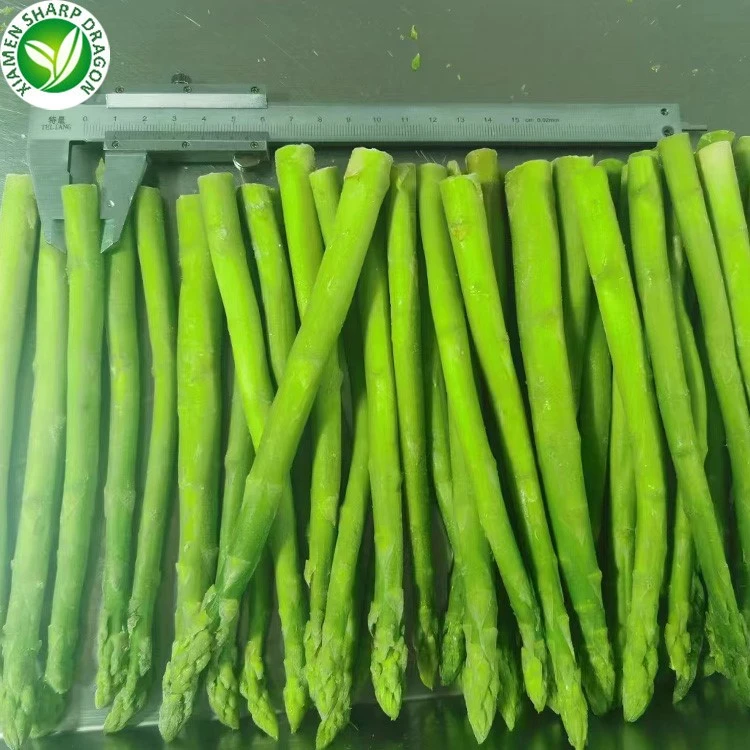
Spear diameter and cut length change heat penetration, texture, piece count, fill distribution, and visual grade. They do not automatically change the nutrient amount per gram, but they can change cooking loss and the drained yield used in a recipe calculation. For an automated filling line, test the selected cut in the actual sauce or meal rather than approving it from a photograph. Record frozen input mass, cooked or drained output mass, broken pieces, texture, colour, and portion variation.
Worked example: A hypothetical ready-meal formula adds 12 kg of frozen asparagus cuts to a batch and obtains 10.8 kg after its defined cooking and draining step. The cooked yield is 10.8 ÷ 12 × 100 = 90%. If the finished meal contains 90 g of those cooked cuts per tray, 10.8 kg supplies 120 trays. A nutrition calculation based on 100 g of unprepared product would not describe the same state. Use the 90 g cooked contribution and the approved data for that cooked basis, then recalculate whenever process yield changes materially.
3. Control the pack, storage statement, and evidence set
Packaging protects the food form used in the calculation. Tears, weak seals, heavy frost, clumping, and evidence of thawing can signal moisture movement or temperature exposure that also affects usable yield and texture. Choose an inner pack that fits the quantity opened per production shift or service period, then verify carton strength, coding, and pallet handling for the route. Our frozen-food packaging overview shows available pack functions; the agreed order specification must identify the actual material, size, print, and carton configuration.
Keep commercial and technical evidence aligned. The product specification, ingredient statement, nutrition declaration, test or calculation basis, storage wording, pack artwork, and sample approval should describe the same product. A general certificate page can support supplier screening, while the accepted order still needs the documents relevant to its destination and batch. You can review our current certification and quality-system information as one part of that check, then record which current documents your market and contract require.

Frequently Asked Questions
Why does my frozen asparagus label not match the USDA table?
First compare the food form and serving weight. The USDA figures used here are for a 180 g cup that is cooked, boiled, drained, and unsalted. Your label may describe 85 g or 100 g of unprepared product, another cultivar, a salted item, or a different analytical or rounding basis. Scale only when the underlying food state is comparable; otherwise use the product-specific declaration.
Does frozen asparagus prevent cancer or heart disease?
No such conclusion can be made from its nutrient content. Folate, vitamin C, vitamin K, fibre, potassium, and plant compounds have established biological roles or areas of research, but a composition table is not a clinical trial. Frozen asparagus can be part of a balanced vegetable-rich diet; it should not be marketed or used as a treatment or a guaranteed prevention strategy.
Is frozen asparagus a good protein source for a vegetarian meal?
The defined 180 g serving supplies 5.3 g protein, which is a useful contribution but usually not enough to anchor a meal by itself. Combine it with a substantial protein source such as beans, lentils, tofu, tempeh, eggs, dairy, nuts, seeds, fish, or meat according to your eating pattern.
XMSD sourcing note: If you are evaluating frozen asparagus for retail, foodservice, or manufacturing, we can discuss product form, cut size, packing, sample review, and the documentation basis needed for your application and market.
Final Thoughts from XMSD
Frozen asparagus retains a meaningful nutrient profile, with the defined cooked 180 g cup contributing substantial folate, vitamin K, and vitamin C alongside fibre, protein, and minerals. The responsible way to use those numbers is to keep the food form visible: unprepared is not cooked, drained is not undrained, plain is not sauced, and a public database is not a batch guarantee. For everyday eating, use asparagus as one part of a varied meal. For commercial work, align the product identity, process yield, nutrition basis, pack, documents, and destination-market rules before approving a claim or label.
References
- USDA FoodData Central API - Asparagus, frozen, cooked, boiled, drained, without salt
- U.S. FDA - Daily Value on the Nutrition and Supplement Facts Labels
- NIH Office of Dietary Supplements - Folate Fact Sheet for Health Professionals
- NIH Office of Dietary Supplements - Vitamin K Fact Sheet for Health Professionals
- NIH Office of Dietary Supplements - Vitamin C Fact Sheet for Health Professionals
- NIH Office of Dietary Supplements - Potassium Fact Sheet for Health Professionals
- NIDDK - Treatment for Constipation
- Impact of the Industrial Freezing Process on Selected Vegetables - Part I: Structure, Texture and Antioxidant Capacity
- Impact of the Industrial Freezing Process on Selected Vegetables - Part II: Colour and Bioactive Compounds