


XMSD Onion Anatomy: Is an Onion a Root?
May 22, 2019

No. The onion you buy is a true bulb, not a root. The small, hard basal plate at the bottom is a compressed stem. Most of the thick concentric layers are modified leaf bases that store water and carbohydrates. The thin fibrous roots grow from the underside of that plate, while green leaves and the central growing point emerge above it.
Calling an onion a "root vegetable" in everyday cooking is understandable because the bulb develops at or below the soil surface and is harvested from the ground. In botany and product specification, however, root, stem, leaf base, skin, neck, sprout, and basal plate describe different tissues. That distinction helps you define trimming, usable yield, cut shape, core material, defects, and the frozen-onion format your recipe actually needs.
Quick answer: An onion bulb contains several plant organs. Its basal plate is a short stem, its edible layers are mainly swollen leaf bases, and its fibrous roots attach below the plate. Commercially, "onion" remains the correct food name; the botanical explanation becomes useful when writing trim, core, cut-size, and defect requirements.

What a True Onion Bulb Contains
A longitudinal cut through a mature bulb gives the clearest answer. At the base is a short, flattened disc called the basal plate. University of Florida horticultural guidance identifies that plate as anatomically stem tissue. Roots arise from its lower side. Leaf bases and bulb scales attach above it, and buds form from its growing regions.
The fleshy layers surrounding the center are not rings of root tissue. They are modified leaf bases, often called scales. Their stored water and carbohydrate make up most of the onion portion used in food. Toward the outside, thinner dry scales form the papery tunic that reduces moisture loss and protects the bulb. The upper end narrows into the neck, where the leaf bases continue into foliage during growth.
The visible root tuft may remain on a fresh harvested bulb, but it is normally trimmed from a prepared food ingredient. The root crown and basal plate are related but not identical purchasing terms. A specification should state what is removed, how closely it is trimmed, and how remaining tough or fibrous material is judged. "Remove the root" is too vague if one team removes only the dry root fibers and another cuts deeply into edible scales.
| Onion part | Botanical identity | Commercial relevance |
|---|---|---|
| Fibrous strands below the bulb | Adventitious roots | Normally removed; residual root material needs a defined tolerance |
| Hard disc at the base | Compressed stem or basal plate | Can remain tough; trimming depth affects yield and ring continuity |
| Thick concentric layers | Fleshy leaf bases or scales | Main usable tissue; layer thickness influences dice, slice, and ring behavior |
| Dry outer covering | Tunic or dry scale leaves | Protects fresh bulbs but is usually peel waste in processed onion |
| Center and growing point | Bud, inner scales, and possible sprout or seed-stem tissue | May create tough, discolored, hollow, or detached core material |

Why Onion Is Not a Root, Tuber, Corm, or Rhizome
Several underground storage organs are grouped together in kitchens even though plants build them differently. A true storage root is enlarged root tissue. A stem tuber is swollen stem tissue with buds. A corm is mainly a solid, enlarged stem. A rhizome is a horizontal underground stem. A true bulb combines a compressed basal stem with fleshy storage leaves. Onion is the familiar true-bulb example.
| Storage structure | Main storage tissue | Visible clue | Example |
|---|---|---|---|
| True bulb | Fleshy leaf bases around a basal stem | Concentric scales above a plate | Onion |
| Storage root | Enlarged root tissue | No layered bulb scales or basal plate | Sweet potato |
| Stem tuber | Swollen underground stem | Buds or "eyes" across the surface | Potato |
| Corm | Mostly solid stem tissue | Solid interior rather than fleshy layers | Gladiolus |
| Rhizome | Horizontal stem | Nodes and shoots along a sideways axis | Ginger |
This classification does not decide nutritional value or menu placement. "Vegetable" is a practical food category, while bulb, root, and stem are botanical descriptions. An onion can be sold and eaten as a vegetable even though the harvested organ is not a botanical root. Avoid turning a useful anatomy distinction into a claim that one underground vegetable is automatically healthier than another.
The distinction also does not mean every food name needs botanical language. A retail pack should still use the legally appropriate common or usual name for onion in its destination market. "Modified leaf bases with compressed stem" belongs in an explanation, training document, or technical review; it is not a clearer ingredient declaration than "onion."

Why the Anatomy Matters in Fresh and Frozen Onion Specifications
A whole fresh bulb preserves all of its structural relationships. You can see bulb diameter, roundness, neck closure, outer skin, root-end trimming, firmness, sprouting, decay, and mechanical damage. The current XMSD fresh onion range provides this whole-bulb context, while the fresh red onion reference illustrates one color and size route. Put the required variety, crop, size, pack, and condition into the signed order so an attractive page image cannot substitute for the approved lot criteria.
After peeling and cutting, some whole-bulb evidence disappears. A frozen dice lot no longer shows original diameter or neck closure, but it reveals cut distribution, layer separation, small fragments, remaining skin, root crown, tough core, sprouts, discoloration, clumps, and free ice. A slice lot reveals ring continuity and layer thickness. A ring program may need a narrow bulb-diameter band because natural ring size comes from the bulb itself.
USDA's frozen-onion grade standard gives useful defect vocabulary. It treats core material as onion flesh that may include sprouts, seed stems, root crown, and root material, and states that it should not be discolored, excessively tough, fibrous, soft, or mushy. The standard uses different measurement rules for whole style and for strips, diced, and other styles. That is a strong reminder that one generic "no roots" limit cannot describe every cut format.
Use the standard as a vocabulary and grading reference, not as an automatic order specification. Your application may need tighter or differently measured limits. A smooth sauce can tolerate smaller pieces that would look defective in a visible vegetable mix. Natural rings need continuity that a dice program does not. A frozen soup ingredient may accept a different cooked texture than a raw-looking salad garnish.
The Root End Changes Cut Yield and Appearance
Trimming the root end is a controlled compromise. A shallow cut preserves edible bulb tissue but can leave tough basal plate or dry roots. A deep cut removes that material but sacrifices good scales and may release the layers. On a whole peeled onion, too much removal creates a flat cavity. In a ring, it can break continuity. In dice, it may increase tiny fragments and uneven pieces.
The neck end creates a similar decision. Dry top and tough neck tissue should not enter the finished ingredient, but over-trimming reduces yield. Seed-stem or sprout material can extend through the bulb center and may remain firm after the surrounding scales soften. External inspection alone can miss that condition, so cut representative bulbs during raw-material approval.
Practical example: A processor compares two root-end trimming settings on the same onion lot. Setting A removes an average 7 g from a 210 g bulb and leaves visible tough basal material on 9 of 100 inspected bulbs. Setting B removes 13 g and leaves the defect on 1 of 100 bulbs. The extra trimming loss is 6 g per bulb, or about 2.86% of incoming bulb weight.
Do not choose Setting B from the defect count alone. Cook both samples in the intended product, measure how the residual material affects eating quality, calculate the yield cost of the deeper cut, and set an agreed defect tolerance. A shallow setting can be unacceptable for a visible premium dice, while a deeper setting may waste usable tissue without changing a puréed sauce.
Choose a Cut That Works with Onion Layers
Dice, slices, strips, rings, chopped pieces, and whole peeled onions come from the same layered bulb, but they do not behave as interchangeable formats. A dice dimension describes the cutting grid; it does not guarantee that every curved layer will become a perfect cube. Natural curvature creates arcs, rectangles, and smaller fragments. Specify the target band, measuring method, undersize and oversize limits, and how separated layers are counted.
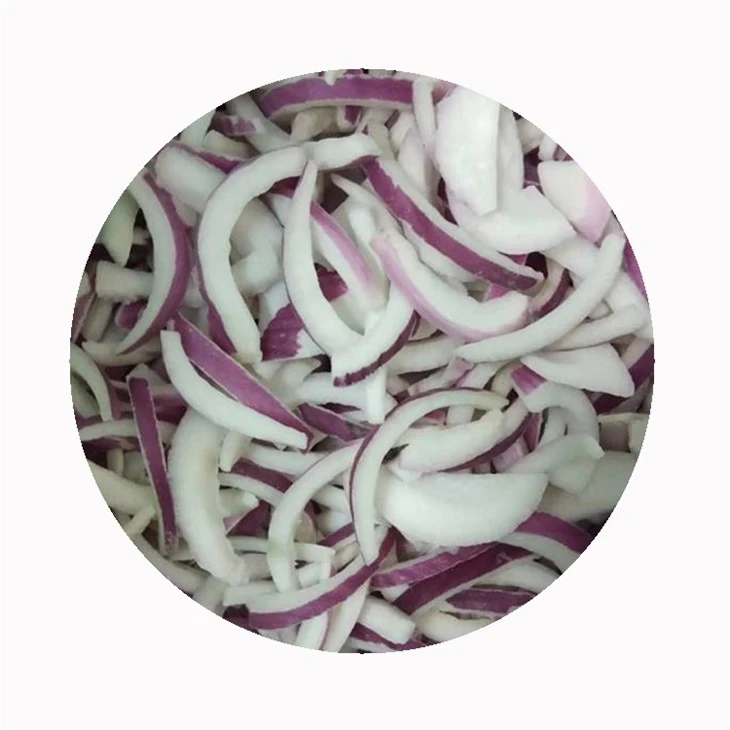
Slices cut across the bulb axis reveal concentric rings. Slices cut in another orientation can produce longer arcs or strips. State the orientation when shape matters. The XMSD frozen onion slices page gives a product-form reference, but your approval should use a signed sample or photo scale tied to measured thickness, diameter, breakage, and application performance.
Diced onion is often easier to dose into sauces, fillings, soups, and ready meals. The frozen onion cubes reference shows a 10 × 10 mm route. Treat that as one option, not a universal recommendation. Small dice disperse rapidly and may soften faster; large dice remain more visible but can cause portion variation or require a longer cook.
Frozen condition matters too. Individually quick-frozen pieces should remain sufficiently separate for representative dosing. Large clumps can hide root-crown pieces, distort a portion, and heat differently from loose dice. Measure clumps, free ice, cut distribution, and defects while the sample remains at the specified inspection state; do not thaw an entire sample and then claim that it was free-flowing when frozen.

Calculate Usable Yield from the Whole Bulb
Botanical anatomy becomes commercial when purchased bulb weight turns into accepted product weight. Whole onions may lose dry skins, roots, necks, basal tissue, damaged scales, decay, sprouts, off-size bulbs, wash water, and cutting fragments. Frozen finished product may also lose weight during sorting or carry surface ice that does not belong in the approved edible yield.
Measure each stream without double counting. If a decayed bulb is rejected whole, do not also estimate its skin and root loss inside separate categories. Record incoming net onion weight, each removal, rework, work in process, approved output, and reconciliation difference. Then divide approved output by incoming net raw material to calculate usable yield.
Worked example: A trial starts with 1,000 kg of net whole onions. It records 36 kg of roots and necks, 74 kg of dry skins and outer scales, 42 kg of decayed or damaged bulbs, 48 kg of trimming and cutting fragments, and 12 kg of final sorting rejection. Approved frozen dice before packing is 788 kg, with no removal counted twice. Reconciliation is 1,000 − 36 − 74 − 42 − 48 − 12 = 788 kg, so usable yield is 788 ÷ 1,000 × 100 = 78.8%.
Assume the raw onion costs 0.82 local currency units (LCU) per kilogram and measured processing, freezing, inspection, and packing add 310 LCU to the batch. Cost before distribution is therefore (1,000 × 0.82 + 310) ÷ 788 = about 1.43 LCU per approved kilogram. If a deeper basal trim lowers approved output to 760 kg without changing other cost, the result rises to about 1.49 LCU/kg.
These are scenario figures, not an XMSD price or guaranteed yield. Replace them with your crop lot, cut, process, rejection rules, energy, labor, pack, and accepted output. The calculation shows why an anatomy term such as basal plate can influence a real specification and cost decision.

Build the Approval Around the Intended Product
Begin with identity: common onion species or type, white, yellow, or red color route, whole or cut form, and any variety or crop requirement. Then define the anatomical conditions that matter: root removal, neck trimming, skin, basal material, sprouts, seed stems, loose scales, tough core, discoloration, decay, and foreign material. Use separate safety and cosmetic categories instead of hiding every issue inside one total-defect allowance.
For cut frozen onion, add dimension and distribution, orientation, breakage, small fragments, clumps, free ice, color, aroma, texture, process state, cooking instructions, microbiological criteria, foreign-material controls, pack, net weight, storage temperature, shelf life, label, traceability, and release documents. The XMSD frozen onion range helps identify possible forms. Select one form, name its final limits, and tie them to the facility and order; otherwise different cuts can be quoted as though they were equivalent.
Inspect raw and cooked samples. Raw frozen inspection reveals separation, ice, color, visible defects, and cut distribution. The cooked test reveals tough basal tissue, fibrous centers, bitterness or off-flavor, excessive softness, water release, and whether the chosen size fits the recipe. A piece that looks acceptable while frozen may be the first hard material a customer notices after the surrounding onion softens.
- Lock identity and form. Name bulb onion, color, fresh or frozen state, and whole, dice, slice, strip, ring, or chopped style.
- Define trim boundaries. State acceptable root, crown, basal plate, neck, skin, sprout, seed-stem, and tough core condition.
- Set the measurement method. Fix sample size, frozen or thawed state, cut caliper method, defect units, severity, and acceptance number.
- Test the real application. Use the intended sauce, soup, filling, topping, or ready-meal process and score the result at service.
- Calculate approved yield. Reconcile all material and compare price per accepted kilogram or serving, not only raw-bulb price.
- Tie evidence to the order. Confirm the facility, product specification, signed sample, pack, certificate scope, lot records, and deviation action.
This sequence keeps the anatomy lesson practical. If root-crown material is visible but does not affect the application, you can set a measured cosmetic limit. If it remains tough after cooking, it becomes an eating-quality issue and may justify deeper trimming or tighter sorting. If the required ring diameter cannot be produced from the proposed bulb size, change the raw-material band before negotiating a finished-ring tolerance.
Keep photographs with the measurement record. A close-up of the root end, a longitudinal bulb cut, the agreed dice or slice distribution, and the cooked defect make words such as "well trimmed" and "tough core" easier to apply consistently across production, inspection, and repeat orders. Name the sample date, lot, preparation, scale, and lighting so the image remains evidence rather than decoration.

XMSD sourcing note: Tell us the onion color, whole or cut form, size distribution, root and core tolerance, cooking application, pack, annual volume, destination market, and required documents. We can review a suitable fresh or frozen onion specification, sample, and partner-factory route order by order.
FAQ About Onion Bulbs and Roots
Which part of an onion is the actual root?
The actual roots are the thin fibrous strands that emerge from the underside of the basal plate. They absorb water and minerals while the plant grows. They are separate from the fleshy bulb layers eaten as onion.
Is an onion a stem or a leaf?
A true onion bulb contains both. Its basal plate is a compressed stem, while most of its fleshy storage layers are modified leaf bases. Saying only "stem" or only "leaf" misses the combined structure.
Why are onions often called root vegetables?
The culinary grouping is convenient because onion bulbs develop at or below ground and are harvested from the soil. It is not a precise botanical classification. For food naming, onion remains a vegetable; for anatomy, the harvested organ is a bulb.
Final Thoughts from XMSD
An onion is not a botanical root. It is a true bulb built from a compressed basal stem, fleshy leaf bases, protective outer scales, and a growing center, with actual fibrous roots attached below. That answer is simple; its commercial consequences are more detailed.
When you buy fresh or frozen onion, translate the anatomy into measurable trimming, core-material, cut-shape, defect, yield, and cooked-performance requirements. The correct specification does not argue about kitchen vocabulary. It makes clear which tissues belong in the approved product, how they are measured, and what happens when the lot falls outside the limit.
References
- University of Minnesota Open Textbook: Plant Parts We Eat-Bulb and Onion
- University of Florida: Bulbs and the Basal Plate
- University of Florida Gardening Solutions: Bulbs, Corms, Tubers, and Rhizomes
- University of California Agriculture and Natural Resources: Underground Plant Parts
- Purdue University: Onion and Its Relatives
- USDA Agricultural Marketing Service: United States Standards for Grades of Frozen Onions
- XMSD operational experience in onion form selection, cut-size review, application testing, packaging, frozen handling, and B2B export coordination.