


Frozen Okra Cooking Trials: Texture, Yield and Holding
May 08, 2019

A foodservice cook time is not one number printed beside the word okra. The usable setting depends on whether the product is whole or cut, how much surface ice enters the equipment, whether it was blanched before freezing, the batch load, the cooking method, the recipe, the required texture and what happens after the pan leaves the heat.
For a central kitchen, restaurant group or ready-meal line, the better question is: what validated time-and-process window delivers the specified portion after cooking and holding? This guide explains how to answer that question without duplicating a basic boiling guide or treating a household instruction as a production standard.
Practical answer: Start frozen okra trials with the supplier's product status and cooking instructions. Test representative whole and cut formats at the intended batch load. Record equipment recovery, time, product temperature, firmness, color, mucilage, drained yield and performance after the real holding period. Approve a range only after the same method works across representative lots and the applicable food-safety limits are met.

Separate the cooking question from the existing boiling answer
An existing XMSD article already explains approximate household-style boiling times for fresh and frozen okra. Repeating those minutes here would add little value and could leave you with the wrong control point. Boiling is only one possible method, and the clock alone does not describe kettle recovery, drain loss, hot holding or the portion that reaches service.
This article therefore treats cooking as an application-approval exercise. The unit of approval is not "three minutes." It is a named product, lot condition, recipe, equipment, load, endpoint and post-cook route. A result obtained with 500 grams in an open saucepan cannot be transferred unchanged to 20 kilograms in a steam-jacketed kettle.
Choose the right starting point.
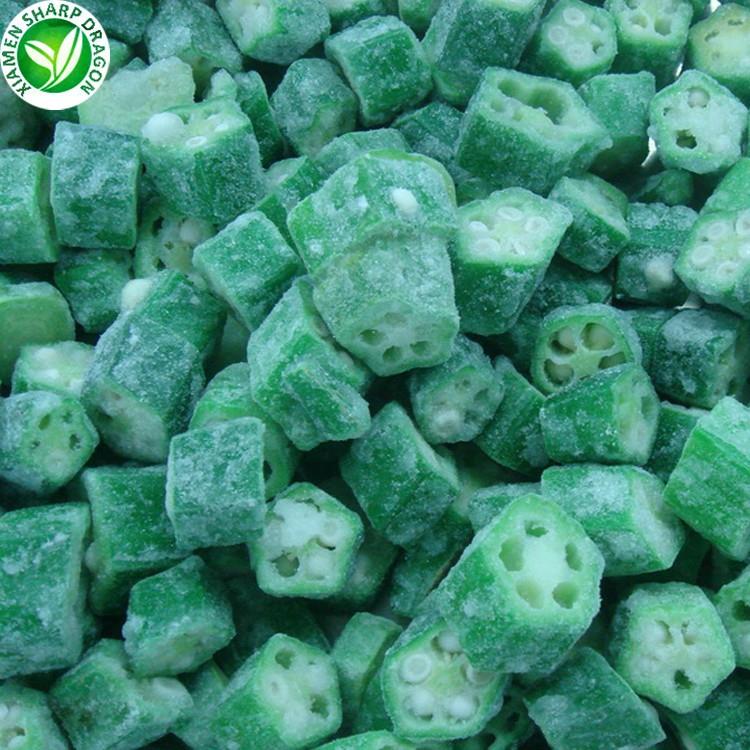
Use the fresh-and-frozen boiling guide when the decision is a simple boiling method. For a commercial trial, first compare the available frozen okra range and decide whether a defined whole frozen okra format or a cut format matches the dish and equipment.
Confirm what the supplier has actually supplied
Frozen okra is commonly blanched before freezing, but "frozen" does not by itself tell you the degree of blanching or whether the product is intended to be fully cooked before service. The 2022 Codex Standard for Quick-Frozen Vegetables describes operations such as washing, cutting and blanching or enzyme deactivation as product-dependent steps. It also defines quick freezing and cold-chain conditions; it does not give one service cook time for every okra style.
Request the product specification, ingredient statement, preparation status and manufacturer cooking instruction. Confirm whole, trimmed whole, sliced or other cut; nominal length or slice thickness; size distribution; broken pieces; loose frost; ice clumps; and whether the samples represent the shipment. If instructions say to cook from frozen, test from frozen. Do not thaw merely to make a trial convenient unless the intended operation will also thaw.
Also identify what can change between approval and supply. A sample may be the right style yet come from a narrow size grade, a different crop window or a different blanch setting from later shipments. Ask which specification fields are controlled lot by lot and which are only descriptive. If cooking performance depends on a narrow variable, convert it into an agreed limit or a change-notification trigger. This prevents your kitchen from compensating for an upstream change with longer cook time after the order arrives.
| Incoming fact | Why it changes cooking | Trial record |
|---|---|---|
| Whole or cut | Heat path and exposed mucilage differ | Style, dimensions and distribution |
| Blanched status | Starting texture and enzyme activity differ | Supplier statement and lot code |
| Loose frost or clumps | Added ice changes recovery and dilution | Observed condition and sampled mass |
| Cooking instruction | Defines the supplier's intended route | Version, date and required endpoint |

Define the service endpoint before choosing minutes
"Cooked" is too vague for approval. Write the intended use first: intact pods in a plated side, cut okra in a vegetable blend, a thickening contribution in gumbo, a component in curry, or a pre-cooked inclusion that will receive another heat step. The same mucilage that is undesirable in a dry side dish may be useful in a stew.
Convert the application into observable endpoints. A side dish may require bright green color, tender skin, no woody bite, limited split pods and low free liquid. A sauce application may permit softer tissue and deliberately use viscosity. A ready meal must still perform after filling, chilling or freezing, distribution and consumer reheating. Evaluate the last relevant state, not only the moment the chef turns off the heat.
Write the scoring anchors with a reference sample or photograph before the trial. "Firm" can mean undercooked to one evaluator and pleasantly intact to another. Use the same trained assessors, serving temperature, sample mass and waiting time. If two applications need different endpoints, approve two named methods instead of hiding both inside a wide tolerance that nobody can reproduce.
| Method | Useful trial question | Likely failure to watch |
|---|---|---|
| Boil or simmer | When does the target tenderness appear after liquid recovery? | Dilution, split pods, soft tissue, high mucilage |
| Steam | Is heating uniform across tray depth? | Cold centers or overdone upper layers |
| Sauté or roast | Can released water leave before the surface steams? | Crowding, wet pan and uneven browning |
| Stew or sauce | What addition point delivers the intended body and piece integrity? | Excess viscosity or disintegrated pieces |
Build a trial matrix that changes one decision at a time
Use at least three representative treatments around a plausible starting condition. Keep product lot, recipe, equipment, batch load and sampling method constant while changing one variable such as time. If you change time, load and pan depth together, you will know which sample you prefer but not why.
Record the frozen product mass, surface-ice condition, water or sauce mass, equipment setting, time of addition, lowest medium temperature after loading, recovery point, sampling times and endpoint temperatures. For a steam tray, record tray depth and rack position. For a sauté pan or oven, record oil addition, surface area, mixing frequency and venting. For a kettle, record fill level and agitation.
Practical example: You test 2.0-kilogram cut-okra loads at 4, 6 and 8 minutes after the sauce returns to its defined simmer. Each treatment is drained or sampled by the same method, then scored immediately and after 30 minutes of intended holding. The six-minute sample cannot be approved merely because it looks best at time zero; it must also meet the holding endpoint.

Measure five outputs instead of relying on the clock
Product temperature: Follow the manufacturer's cooking instruction and the food-safety rules that apply at your operation. Use a suitable calibrated probe and a defined sampling plan. Temperature is a safety and process record; it does not by itself prove acceptable texture.
Texture: Use a simple anchored scale. For example, 1 may mean hard or fibrous, 3 may mean tender with intact shape, and 5 may mean mushy or disintegrating. Define the target before the panel sees the samples. Score whole and cut pieces separately if both are present.
Color and piece integrity: Photograph samples under the same light and background. Record darkened pieces, split pods, loose seeds and fragments. The USDA frozen-okra grade material is useful for understanding styles and defects in the incoming product, but you should also create post-cook acceptance limits for your operation.
Mucilage or free liquid: Decide whether viscosity is useful, acceptable or a defect in the named dish. Measure it consistently, such as drained liquid mass, line-spread distance or a trained visual scale at a fixed temperature. Do not call all visible mucilage "poor quality."
Yield: Weigh the saleable cooked product after the defined drain and hold. Include pieces removed for woody texture, severe breakage or color defects. Portion cost depends on this usable mass, not on frozen invoice mass alone.
Treat mucilage as a formulation variable
Okra mucilage contains water-soluble polysaccharide material that can change viscosity, water binding, texture and appearance. Peer-reviewed reviews describe its use as a thickener, stabilizer or texture modifier. Its release depends on product maturity, exposed cut surface, water contact, heat, agitation and recipe conditions.
If a dry side dish is the target, compare whole versus cut pieces, avoid unnecessary wet handling, prevent pan crowding and remove released moisture through the intended high-surface-area process. If viscosity is wanted in soup or stew, compare addition point and cooking exposure instead of trying to remove the function. Acids, salts and other ingredients can change the system, but their effects are formulation-specific; verify them in the actual recipe rather than repeating a generic "anti-slime" tip.

Control batch load and equipment recovery
A larger frozen load removes more heat from water, sauce, steam equipment, oil or a hot metal surface. If the process timer starts at addition, two otherwise similar runs with different recovery times can report the same nominal cook time and produce different texture. Define whether timing starts at product addition, liquid recovery, steam recovery or another measurable event.
Do not scale a pilot by multiplying minutes by kilograms. Scale load-to-water ratio, kettle fill, tray depth, surface loading, agitation and energy input. At production scale, map several locations and sample the coldest or slowest-heating area. If the equipment never recovers to the pilot condition, reduce load or redesign the process instead of extending time until the average sample looks done.
Make cut size part of the approved specification
Whole pods and cut pieces should not share one cooking limit. A thin slice has a shorter heat path and more exposed mucilage than a large segment. A lot containing many short pieces, caps and fragments can appear overcooked while larger pieces remain firm. Measure dimensions on the incoming sample and connect them to the trial result.
Ask the supplier for nominal dimensions and tolerances, then verify a practical sample count. The original image's caliper is useful because it turns "small pods" into a measurable statement. Record oversize, undersize and broken fractions separately. A receiving limit is much more useful than asking a chef to compensate for a shifting size distribution.

Validate holding, cooling and reheating as separate steps
Texture continues to change after the active cook. A pan that passes immediately may become dull, soft or watery after 30 or 60 minutes on the service line. Run the real hold with the intended lid, pan depth, humidity and mixing. Measure temperature at defined points and repeat the sensory and yield checks at the end.
Food-safety requirements must come from your operation's jurisdiction and approved plan. As one reference model, the FDA 2022 Food Code treats heat-treated plant foods as time/temperature control for safety foods and provides controls for hot holding, cooling and reheating. Its commonly used limits include hot holding at 57°C (135°F) or above; cooling from 57°C to 21°C (135°F to 70°F) within two hours and to 5°C (41°F) within six hours total; and reheating cooked, cooled food for hot holding to 74°C (165°F) for 15 seconds. Confirm local adoption, exceptions and the exact product route before turning these figures into an SOP.
Quality approval and safety release are not interchangeable. A crisp green sample can fail a temperature control, and a safely held sample can be too soft to serve. Keep both decisions in the record.
Use a worked yield example to set the purchase load
Worked example: illustrative trial data, not a universal okra yield
Suppose you start with 10.00 kg of frozen cut okra. After cooking and the defined drain, 8.55 kg remains. Cooking yield = 8.55 ÷ 10.00 = 85.5%.
After the real 45-minute hot hold and removal of unacceptable pieces, 7.95 kg is serviceable. Final usable yield = 7.95 ÷ 10.00 = 79.5%.
The service plan needs 180 portions at 40 g each: 180 × 0.040 = 7.20 kg of usable cooked okra.
Required frozen load before your operation's separate contingency allowance = 7.20 ÷ 0.795 = 9.06 kg. Replacing 79.5% with an unverified catalog assumption would change ordering, pan load and portion cost.
USDA's Food Buying Guide provides reference serving yields for frozen whole and cut okra in institutional meal planning. Those values are useful checks, not substitutes for a kitchen's own recipe, equipment, draining and hold trial. Compare your result with the reference, investigate a large difference and approve the number supported by your actual operation.
Scale up with a release sheet, not kitchen memory
Write the approved conditions as a bounded operating window: product code and style, frozen mass, allowable clumping, equipment, water or sauce ratio, load, recovery definition, time range, endpoint temperature, sensory score, drain method, immediate yield, hold condition, final yield and corrective action. Add the probe ID or calibration status where required.
Then challenge the window. Repeat with at least another representative lot and the intended upper production load. Include the worst plausible tray position or kettle location. If a new supplier, cut tolerance, blanch condition or pack format changes a critical input, reopen the trial instead of silently keeping the old time.

Diagnose common trial failures
Treat a failed sample as evidence about a variable, not as permission to change several controls at once. First separate incoming-product variation from equipment or method variation. Compare retained frozen samples, lot records and photographs before altering the SOP. Then choose the smallest controlled comparison that can disprove the leading cause.
| Observed result | Check first | Next controlled comparison |
|---|---|---|
| Outer pieces soft, centers firm | Size distribution and load mixing | Tighter size grade or revised agitation |
| Pan steams instead of browning | Surface load, frost and released water | Lower load at constant heat and area |
| Excess viscosity | Cut surface, agitation and wet exposure | Whole versus cut at the same recipe condition |
| Good immediately, poor after service hold | Hold time, temperature, pan depth and lid | Earlier cook endpoint with the same validated hold |
| Yield varies by lot | Ice, clumps, size, defects and drain method | Repeat standardized mass balance on retained samples |
Example: Three lots pass immediate texture, but one lot loses 12 percentage points more usable yield during a 45-minute hold. Do not respond by shortening every cook. Compare that lot's size distribution, frost, blanch status, recovery curve and end-of-hold defects against the approved lots. If smaller pieces explain the loss, tighten the receiving distribution or qualify a separate method. If all incoming measures match, challenge pan depth, hold temperature and mixing before opening a supplier complaint.
Close the investigation with a decision and an owner: accept within the current window, change a measurable product limit, revise the method, or reject the lot. Record what evidence would trigger the same action next time. A diagnosis that ends with "monitor" but has no threshold merely delays the next disagreement.
Turn the trial result into a supplier requirement
Send the supplier a concise application brief: whole or cut format, dimensions, allowed broken fraction, intended cook-from-frozen route, recipe type, equipment, load, target firmness, mucilage role, immediate and held yield, pack size and destination. Ask which lots and specifications support that use, then confirm with representative samples.
For investigation, retain the lot code, frozen-condition photographs, cooking log, weights and scored samples where practical. A complaint that says only "too slimy" gives the supplier little to trace. A record that identifies cut size, 20-kilogram kettle load, recovery time, viscosity score and held yield creates an actionable comparison.
When you compare suppliers, use the same cooking matrix and report both quality and usable economics. A low frozen cost can disappear if the lot needs a lower equipment load, longer recovery, more sorting or produces less serviceable mass after holding. Tie your approval to the specified product and evidence set, not to a demonstration sample without a traceable production basis.
Prepare a foodservice trial request
Review the current bulk frozen okra formats, then state your cut, pack, load and application target. If supplier qualification is part of the decision, compare the available processing and quality evidence.
Use the XMSD inquiry form to send the destination, annual or trial volume, whole or cut style, intended cooking method, pack format and required documents. We will review the inputs and coordinate the appropriate product and sample route.
References
- Codex Alimentarius, Standard for Quick-Frozen Vegetables, CXS 320-2015, amended 2022
- USDA Agricultural Marketing Service, Frozen Okra Grades and Standards
- USDA Agricultural Marketing Service, Frozen Okra Grading Manual
- USDA Food and Nutrition Service, Food Buying Guide, Section 2 Vegetables Yield Table
- U.S. FDA, Food Code 2022
- Dantas et al., Okra as a Potential Functional Food Source of Mucilage and Bioactive Compounds
- Evaluation of Cookery Methods in Reduction of Pesticide Residues and Quality Attributes of Okra Fruit
- Aworh, Quality Attributes of Frozen Okra as Influenced by Processing and Storage
The okra is cooked for 3-5 minutes. The okra does not need to be cooked for too long, which will destroy the nutrients in it, resulting in lower food value.
